Our Location
Free Trade Tower, Xiyong street.
Chongqing, China

Free Trade Tower, Xiyong street.
Chongqing, China
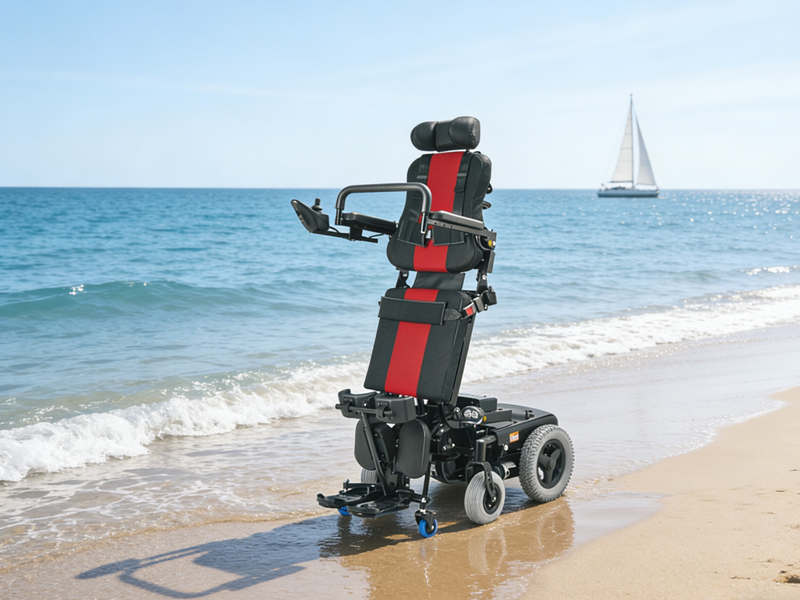
users would spend most of their day sitting. While sitting offers stability and mobility, it creates another set of challenges—circulation problems, muscle stiffness, pressure sores, limited interaction height, and reduced independence. The modern world is finally catching up to a simple truth: human bodies are not meant to stay in one position all day.
That realization has shaped one of the most meaningful innovations in mobility today: the lie down standing wheelchair—a multi-functional power wheelchair designed not only to move but to care for the body. Instead of limiting users to sitting, it supports lying flat, reclining, standing upright, elevating the legs, and transitioning between positions using smooth electrical power.
This new category of wheelchairs marks a cultural shift. Mobility is no longer defined as “rolling forward”; it is now about posture, health, flexibility, and independence. And for many users, the difference is life-changing.
People who do not rely on wheelchairs rarely think about the hidden consequences of long-term sitting. But users know these challenges intimately:
Legs grow stiff and circulation slows.
The lower back absorbs constant pressure.
Muscles that aren’t used gradually weaken.
Skin becomes vulnerable to breakdown and ulcers.
Daily tasks become harder because the world is built for standing height.
Traditional wheelchairs do little to address these physiological stresses. The lie down standing wheelchair was created precisely to solve this: it respects the body’s need for varied posture. It enables the user to redistribute pressure, stretch the spine, relax horizontally, and interact with their environment at eye level—all without leaving the chair.
This matters not just physically, but psychologically. Being able to change posture at will gives a sense of autonomy, something every person deserves.
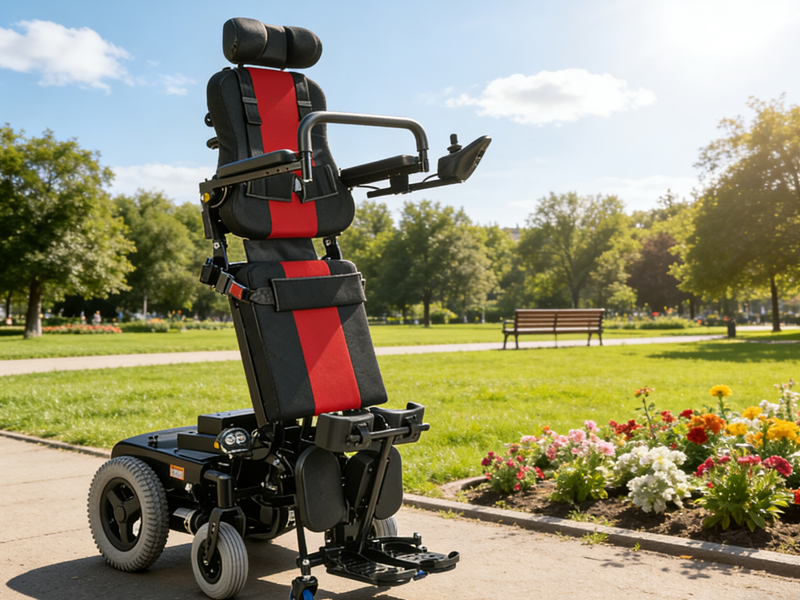
The defining quality of a lie down standing wheelchair is versatility. At the press of a button, it transitions smoothly between different postures:
1. Sit Mode
The standard seated position for daily movement indoors or outdoors. The chair behaves like a regular power wheelchair—stable, responsive, and controlled by a joystick.
2. Recline Mode
Allows the backrest to descend gradually, perfect for pressure relief, relaxing, reducing muscle tension, or improving breathing comfort.
3. Lie-Down Mode
A fully horizontal surface that works like a mobile resting bed. Users who experience fatigue, orthostatic intolerance, or chronic pain can rest without transferring to a bed.
4. Elevating Leg Mode
The legs lift higher than the heart to aid circulation, reduce swelling, and ease discomfort.
5. Standing Mode (The signature feature)
With secure straps, cushioning, and mechanical support, the chair gently lifts the user into a standing position—safely and comfortably. This allows:
Weight-bearing for bone health
Natural stretching of muscles and joints
Eye-level conversations
Access to shelves, cabinets, and counters
A feeling of normalcy and empowerment
Standing is more than a physical act—it’s emotional liberation. The lie down standing wheelchair gives that experience back to people who may not have stood in years.
Electromagnetic Braking
Most high-end lie down standing wheelchairs feature electromagnetic braking systems. This is crucial because:
Standing requires absolute stability
Lying down shifts weight distribution
Reclining and leg elevation change the chair’s center of gravity
Electromagnetic brakes engage instantly and lock the chair securely, even on mild slopes. Users can transition positions confidently without worrying about movement or tipping. It is a subtle feature, but it makes multi-posture mobility safe enough for everyday use.
Although many people can benefit, certain groups experience exceptional advantages:
1. People with spinal cord injuries
Standing assists with digestion, circulation, bladder management, and bone density. It also stretches the hips and knees, helping prevent contractures.
2. Long-term wheelchair users
Anyone who spends most of the day seated will benefit from posture variation and the ability to lie down or stand when needed.
3. Individuals with muscular or neuromuscular disorders
Gentle transitions and multiple positions relieve fatigue and reduce risk of muscle strain.
4. Users with pressure sore history
Changing posture prevents pressure buildup and promotes skin integrity.
5. People seeking greater independence
Standing makes daily living tasks—reaching cabinets, cooking, grooming—far easier. Lying down allows rest without assistance.
In short: a lie down standing wheelchair is not only a mobility device; it is a health and lifestyle tool.
Mobility is not only about moving from one location to another. It is about living fully. Here is how a lie down standing wheelchair improves daily life in meaningful ways:
Eye-Level Interaction
Standing puts users at the same height as friends, colleagues, and family members. Social engagement feels more natural, and communication becomes more comfortable.
Reduced Caregiver Dependence
Users can adjust posture on their own—no need for repeated transfers from bed to chair or chair to standing frame.
Better Comfort Throughout the Day
Being able to switch positions based on fatigue, pain, or activity keeps the body relaxed and energized.
Improved Mental Well-Being
Regaining the ability to stand—even with help from a wheelchair—brings a sense of dignity, confidence, and emotional renewal.
Better Productivity and Engagement
Reaching shelves, working at a counter, or performing hobbies becomes easier. The wheelchair adapts to the user, not the other way around.
What to Consider Before Choosing a Lie Down Standing Wheelchair
Every user has unique needs. Before selecting a chair, consider:
Your body’s tolerance for standing
Some conditions require a doctor’s approval before beginning weight-bearing.
Your environment
Measure doorways, turning spaces, and transportation needs. Multi-posture wheelchairs are bulkier than standard ones.
Battery and maintenance expectations
Powerful motors and posture systems require reliable charging and occasional servicing.
Your daily habits
If you remain in your wheelchair for most of the day, a lie down standing wheelchair may significantly improve your lifestyle.
People who switch to a lie down standing wheelchair often describe the experience as transformative:
They stand again after years.
Pain decreases because posture changes throughout the day.
Tasks become easier and more independent.
They engage socially at a natural height.
They feel healthier, stronger, and more confident.
The wheelchair becomes not just a tool—but a partner in daily life.
Mobility is no longer just about movement—it’s about flexibility, comfort, and freedom. The lie down standing wheelchair is a powerful example of what happens when engineering meets empathy.
It gives users the ability to lie down when tired, recline for relaxation, stand tall for interaction, and move confidently throughout the day. It protects health, reduces pressure, encourages circulation, and restores dignity.
For many, it is far more than equipment.
It is a new beginning.