Our Location
Free Trade Tower, Xiyong street.
Chongqing, China

Free Trade Tower, Xiyong street.
Chongqing, China
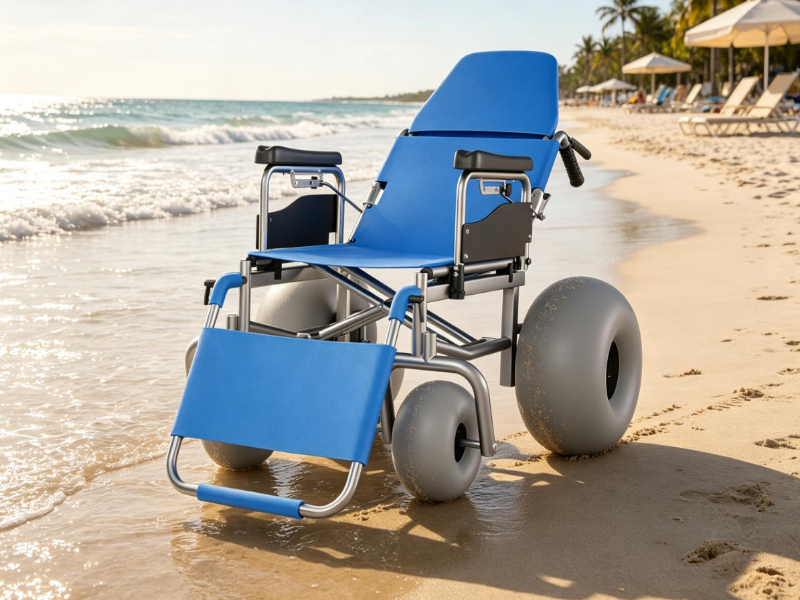
A beach should be a place where everyone can get close to the water, feel the sea breeze, spend time with family, and enjoy the freedom of being outdoors. Yet for many wheelchair users, the most attractive part of the beach is also the biggest mobility challenge: sand. A conventional wheelchair that works perfectly on pavement, indoor floors, or smooth walkways can quickly become difficult to push once its narrow wheels reach soft sand. The wheels sink, resistance increases, and even a short journey toward the shoreline can become exhausting.
Table of Contents
ToggleThis is exactly where a purpose-built Beach Wheelchair for Sand can make a meaningful difference. Instead of simply adapting a standard wheelchair for occasional outdoor use, an All-Terrain Wheelchair for the Beach is designed around the characteristics of soft, uneven, and sometimes wet surfaces. Wider air-filled wheels, a stable frame, comfortable seating, adjustable positioning, and easy transportation can turn an inaccessible beach trip into a much more practical outdoor experience.
For families, resorts, hotels, rehabilitation centers, municipalities, rental companies, and individual users, choosing the right Beach Wheelchair for Sand is therefore not simply a matter of appearance. It involves understanding how the wheelchair handles soft ground, how easily it can be transported, how comfortable it remains during long outings, and whether its construction is suitable for repeated exposure to outdoor conditions.
The problem with ordinary wheelchairs on beaches is not necessarily the wheelchair itself. It is the interaction between conventional wheel design and unstable ground.
Most everyday wheelchair wheels are optimized for relatively firm surfaces. On asphalt, tile, concrete, or compact flooring, the wheel maintains a predictable contact area with the ground. Sand behaves very differently. As pressure is applied through a narrow wheel, the sand shifts away from the contact point, allowing the wheel to sink. Once this happens, rolling resistance rises dramatically.
For the user, this can mean slower movement and greater physical effort. For a caregiver pushing the chair, the difference can be even more noticeable. A route that would normally take only a few minutes may require considerable strength when crossing dry, loose sand.
A dedicated Beach Wheelchair for Sand addresses this issue through its wheel configuration. Instead of relying on narrow wheels designed primarily for hard surfaces, beach models generally use wider, larger pneumatic or airbag-style wheels that distribute the load over a broader area. This reduces the tendency to sink and helps the wheelchair move more smoothly across soft ground.
The principle is simple: spreading the load over a larger contact area can make soft terrain easier to cross. That does not mean every beach becomes effortless, because sand conditions vary considerably. Dry powdery sand, compact wet sand, gravel, grass, and shallow water each behave differently. However, a properly engineered All-Terrain Wheelchair for the Beach gives the user a much better starting point than a conventional wheelchair.
Buying a beach wheelchair requires looking beyond the word “beach” in the product name. The actual design determines whether the chair will be practical in real outdoor conditions.
The first consideration should be the wheel system. For soft sand, wide wheels are particularly important because they help distribute pressure and reduce sinking. Air-filled or airbag-style wheels can also provide a degree of cushioning when traveling across uneven surfaces. This is valuable not only for traction but also for ride comfort.
The second consideration is stability. A beach wheelchair needs to remain balanced while moving across changing terrain. Sand is rarely perfectly level, and users may encounter small slopes, compacted sections, grass, gravel, or transitions between different surfaces. A stable frame and appropriate wheel geometry can help make movement more predictable.
The third consideration is comfort. A beach outing can last several hours, and users may spend much of that time seated. An adjustable backrest and leg rest can make a substantial difference. Instead of forcing the user to remain in one fixed position, an adjustable design allows the seating angle to be changed according to the user’s comfort and activity.
Material selection is also important. Beach equipment may be exposed to moisture, sand, humidity, and salt-laden air. Easy-to-clean, water-resistant seating materials can make regular maintenance much simpler. The frame should also be appropriate for outdoor use, with materials selected to provide durability under the expected conditions.
Finally, portability matters. A beach wheelchair that performs well but is extremely difficult to transport may not be practical for families or rental operators. Folding frames and quick-release wheels can significantly reduce storage requirements and make transportation by car easier.
These are not merely technical details. Together, they determine whether a wheelchair becomes something that users actually want to take to the beach or something that remains stored because moving it is too inconvenient.
For buyers looking for an All-Terrain Wheelchair for the Beach, IYASOCARE’s YSB01 and YSB02 provide two useful approaches to outdoor accessibility. Rather than treating them as identical products, it is better to understand what each model is designed to emphasize.
The YSB01 Beach Wheelchair is designed for users who want a combination of outdoor capability, portability, and adjustable comfort. Its foldable structure and quick-release front and rear wheels make transportation and storage easier, which is particularly useful for families traveling to the coast by car.
One of the most noticeable features is its large airbag-style wheel configuration. The product information describes front and rear wheels designed to handle beaches, grass, wetlands, and wading environments, while the wide wheel design helps distribute pressure on softer surfaces.
The YSB01 also places considerable emphasis on seating comfort. Its backrest can be adjusted, with the product information specifying a maximum tilt of up to 150 degrees, while the footrest can be adjusted to support different seating and resting positions. The seat uses Oxford cloth, with breathable and waterproof options described for different outdoor requirements.
For users spending extended periods at the beach, this adjustability can be valuable. A beach wheelchair should not only help someone reach the shoreline; it should also allow them to remain comfortable after arriving. Being able to change the backrest and leg position can provide a more relaxed experience during longer outings.
The frame is constructed from steel, and the product page lists a 500 mm seat width, 450 mm seat depth, 700 mm backrest height, and large front and rear wheel dimensions. The listed product information contains different load figures in separate sections, so buyers should confirm the applicable configuration and rated capacity with the manufacturer before placing an order.
This makes the YSB01 particularly attractive for personal beach travel, family outings, coastal leisure, rehabilitation activities, resorts, and accessibility programs where portability and comfort are important.
It is also worth emphasizing that a beach wheelchair should not be judged only by how it performs on dry sand. The ability to transition between sand, grass, gravel, and other outdoor surfaces can make a wheelchair considerably more useful. The YSB01’s wide-wheel configuration and outdoor-oriented construction are intended to support this type of multi-surface use.
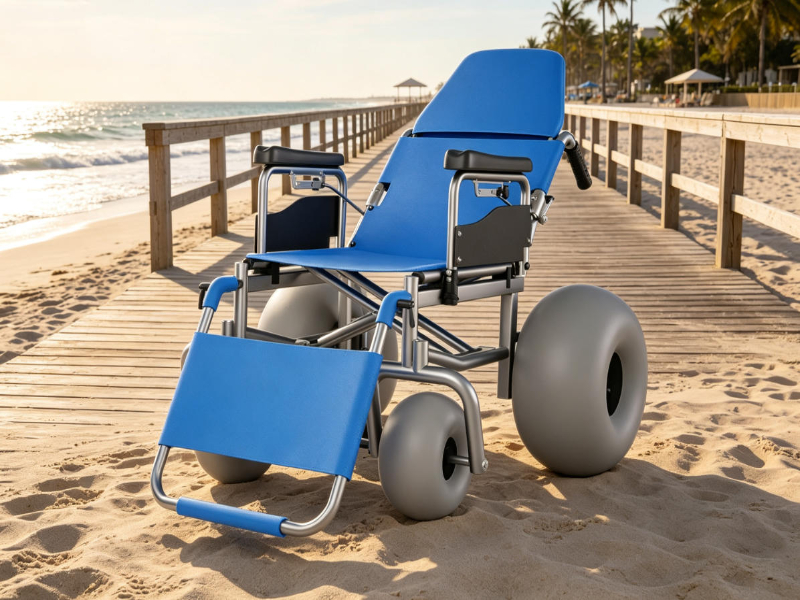
The YSB02 Beach Wheelchair takes the outdoor concept further by combining a folding stainless-steel frame with an optional flotation system. This makes it particularly interesting for users and organizations that want more than simple sand mobility.
The YSB02 uses a stainless-steel frame, front and rear quick-release airbag wheels, adjustable backrest and leg rest, and waterproof Oxford cloth seating. The product page specifies a maximum backrest tilt of 170 degrees and describes the wheelchair as suitable for sand, gravel, and shallow-water environments.
One of its most distinctive features is the optional inflatable flotation kit. When equipped appropriately, the wheelchair is designed to float on water, expanding its potential use for beach and water-based activities. This is a specialized function, however, and should not be interpreted as permission to enter water without suitable supervision, environmental assessment, and adherence to the manufacturer’s operating instructions.
Portability is another strength. The YSB02 has a folding structure and quick-release wheels, while the manufacturer lists a folding size of approximately 990 × 630 × 750 mm. Its listed net weight is 24 kg, which can make transportation more manageable than many heavy-duty outdoor mobility systems.
The product page lists a 500 mm seat width, 480 mm seat depth, 10-inch front wheels, 12-inch rear wheels, a stainless-steel frame, and a 100 kg load capacity.
For hotels, beach resorts, public accessibility programs, outdoor recreation providers, and users who regularly participate in waterfront activities, these features make the YSB02 a particularly distinctive All-Terrain Wheelchair for the Beach.
The key difference between the YSB01 and YSB02 is therefore not simply which model is “better.” The more useful question is which one fits the intended environment. The YSB01 emphasizes versatile beach mobility, folding convenience, and adjustable comfort, while the YSB02 adds stainless-steel construction and optional flotation capability for more specialized water-related use.
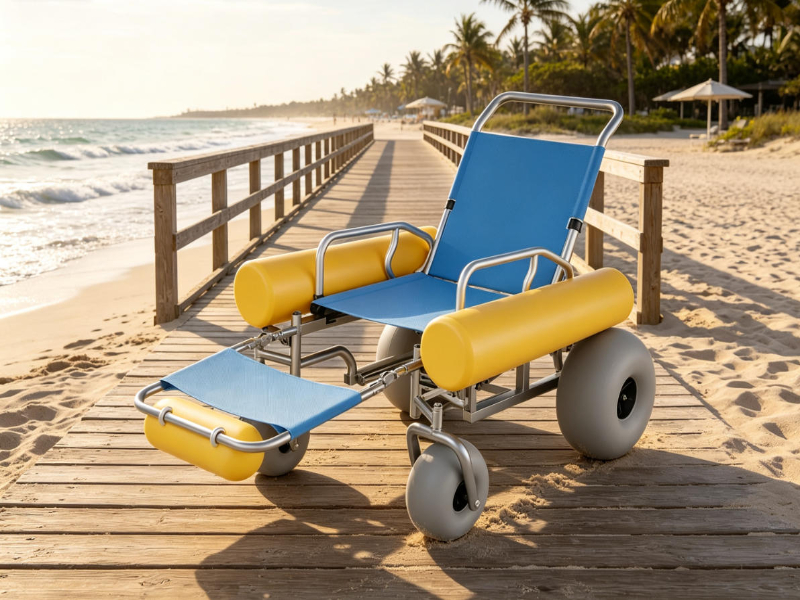
It is easy to focus on wheels when discussing a beach wheelchair because sand is the most obvious obstacle. Yet mobility is only part of the experience.
Imagine spending three hours at the beach. The wheelchair has successfully crossed the sand, but the seat is uncomfortable, the backrest cannot be adjusted, and the user’s legs remain in one fixed position. In this situation, good terrain performance alone does not create a good mobility experience.
This is why modern All-Terrain Wheelchair for the Beach designs increasingly combine mobility and positioning features. Adjustable backrests allow users to move between upright and more relaxed positions. Adjustable leg rests can help accommodate different seating preferences. Waterproof or breathable fabrics can also be useful when the environment includes moisture, splashes, or long periods outdoors.
The YSB01 and YSB02 both incorporate adjustable backrest and leg-rest functions, allowing the user to change position according to the situation.
For caregivers, these features can also make outdoor activities easier because they reduce the need to constantly reposition the user manually. The goal is not to replace appropriate caregiver assistance, but to make everyday positioning more flexible.
Although the name Beach Wheelchair for Sand suggests a single application, the underlying design principles have broader value.
Soft grass can create similar problems to sand. Gravel can produce vibration and instability. Uneven park paths can challenge small conventional wheels. Waterfront areas may combine pavement, grass, gravel, and wet ground within a single journey.
A wheelchair equipped with larger, wider wheels can therefore be useful in more places than simply the beach. IYASOCARE’s own beach wheelchair materials describe applications across grass, gravel, shallow water, streets, and other outdoor environments.
This makes these products relevant for coastal resorts, accessible tourism, rehabilitation centers, public beaches, outdoor events, parks, and family recreation.
For commercial users, this versatility can also improve equipment utilization. A wheelchair used only for one specific location may have limited value outside peak beach season. A model that can support multiple outdoor environments can potentially serve more users and more situations.
Before purchasing a Beach Wheelchair for Sand, buyers should evaluate the product against the actual environment in which it will be used.
Start with the terrain. Determine whether the chair will primarily travel over dry sand, compact wet sand, grass, gravel, boardwalks, or shallow water. No wheelchair should be assumed to perform equally well on every surface.
Check the wheel dimensions and design. Wider wheels are generally better suited to soft terrain because they distribute pressure over a larger area. The wheel material, inflation requirements, and maintenance should also be understood before purchase.
Look at user comfort. Seat width, seat depth, backrest height, footrest adjustment, and reclining range all influence the experience of longer outings.
Consider the user’s weight and body dimensions. Do not rely solely on general marketing descriptions. Always confirm the rated load capacity of the exact configuration being purchased.
Think about transportation. Measure the folded wheelchair and compare it with the available vehicle storage space. Quick-release wheels and a folding frame can make a significant difference.
Consider exposure to water and salt air. If the wheelchair will frequently be used near the sea, materials and maintenance requirements become especially important.
Finally, consider who will operate the wheelchair. A manual beach wheelchair may work well when a caregiver or companion is available to push it, while users seeking independent powered mobility may require a different type of all-terrain electric wheelchair.
A good purchase decision is therefore based on the complete usage scenario rather than one specification.
A simple comparison can help clarify the decision:
| Consideration | YSB01 | YSB02 |
|---|---|---|
| Primary focus | Beach and outdoor mobility | Beach, outdoor and water activities |
| Frame | Steel | Stainless steel |
| Folding design | Yes | Yes |
| Quick-release wheels | Yes | Yes |
| Wide airbag-style wheels | Yes | Yes |
| Adjustable backrest | Yes | Yes |
| Adjustable leg/footrest | Yes | Yes |
| Maximum listed recline | Up to 150° | Up to 170° |
| Waterproof seating | Available | Yes |
| Flotation option | Not highlighted | Optional flotation kit |
| Listed load capacity | Confirm configuration | 100 kg |
| Listed net weight | Approx. 22 kg | 24 kg |
The specifications should always be confirmed with the manufacturer before purchasing because configurations, materials, and rated capacities can vary. The table is intended as a practical buying guide based on the current product information.
For a family looking for a practical Beach Wheelchair for Sand that can be folded and transported for vacations, the YSB01 is a strong option to investigate. Its combination of wide outdoor wheels, adjustable seating, folding construction, and weather-friendly materials makes it suitable for a wide range of recreational scenarios.
For organizations or users who need additional water-oriented functionality, the YSB02 deserves closer attention. Its stainless-steel frame, large airbag wheels, adjustable seating, and optional flotation kit make it a more specialized solution for beach and water activities.
Accessible tourism is becoming increasingly important as families, hotels, resorts, municipalities, and recreational organizations recognize that accessibility should extend beyond building entrances and paved walkways. A beach is not truly accessible if the path ends where the sand begins.
A purpose-built Beach Wheelchair for Sand helps close that gap. It does not eliminate every challenge associated with natural terrain, but it provides a mobility platform specifically designed to cope with conditions that ordinary wheelchairs were never intended to handle.
The YSB01 and YSB02 demonstrate two different approaches to this idea. The YSB01 focuses on practical outdoor versatility, folding convenience, adjustable positioning, and large wheels suitable for soft surfaces. The YSB02 adds stainless-steel construction and an optional flotation kit, making it particularly interesting for more demanding beach and water applications.
For a manufacturer, resort, distributor, or accessibility program, this type of product can also become part of a broader inclusive mobility strategy. Instead of asking wheelchair users to adapt to the beach, the equipment is designed to adapt more effectively to the environment.
That is the real value of an All-Terrain Wheelchair for the Beach: not simply moving across sand, but making outdoor participation more realistic.
The best Beach Wheelchair for Sand is not necessarily the wheelchair with the largest wheels, the heaviest frame, or the greatest number of features. It is the model that matches the user’s physical requirements, the terrain, the frequency of use, transportation needs, and the type of outdoor activities planned.
For general beach outings, family vacations, coastal leisure, and outdoor mobility, the YSB01 offers a compelling combination of folding portability, large airbag-style wheels, adjustable seating, and outdoor-oriented construction.
For users or organizations looking for a more specialized beach and water mobility solution, the YSB02 provides stainless-steel construction, wide airbag wheels, adjustable positioning, folding transportation, and an optional flotation kit.
Both models reflect an important change in wheelchair design: mobility should not stop at the edge of a paved road. With appropriate equipment, careful planning, and suitable supervision, beaches and other outdoor environments can become considerably more accessible.
For buyers interested in exploring beach mobility equipment, IYASOCARE’s official website provides access to its broader range of wheelchairs and rehabilitation mobility solutions.
1. Can a Beach Wheelchair for Sand be used on ordinary outdoor surfaces?
Yes. Purpose-built beach wheelchairs can also be useful on surfaces such as grass, gravel, compact outdoor paths, and some waterfront environments. However, performance depends on the specific terrain and the wheelchair’s design. The YSB01 and YSB02 are both described for use across multiple outdoor surfaces beyond sand.
2. Which is better for beach use, the YSB01 or YSB02?
It depends on the intended application. The YSB01 is particularly suitable for users who prioritize folding portability, outdoor versatility, and adjustable comfort. The YSB02 is more specialized, with a stainless-steel frame and optional flotation kit for beach and water activities. Buyers should compare user requirements, load capacity, transport needs, and operating environment before choosing.
3. Can an All-Terrain Wheelchair for the Beach enter water?
Some specialized models are designed with water-related features, but users should never assume that every beach wheelchair is safe for water use. The YSB02 offers an optional inflatable flotation kit and is specifically described for beach and water activities, but water use should follow the manufacturer’s instructions and appropriate safety procedures.
WhatsApp us