Our Location
Free Trade Tower, Xiyong street.
Chongqing, China

Free Trade Tower, Xiyong street.
Chongqing, China

Qatar’s healthcare sector has continued to develop, creating new opportunities for businesses supplying medical equipment and mobility solutions. Among the products attracting increasing attention are electric wheelchairs. With growing demand from hospitals, rehabilitation centers, elderly care providers, and individual users, powered mobility equipment has become an important category for medical supply distributors.
For wholesale medical supply businesses, importing electric wheelchairs into Qatar can be a promising business opportunity. However, success requires more than finding a manufacturer with competitive prices. Importers must understand local customs procedures, applicable medical device requirements, shipping arrangements, battery transportation regulations, and the expectations of local customers.
A reliable supply chain, appropriate product selection, and effective after-sales service are essential for building a sustainable wholesale business.
Electric wheelchairs provide an important mobility solution for people who have difficulty operating traditional manual wheelchairs. They allow users to move independently through powered motors and joystick controls, reducing the physical effort required for everyday activities.
In Qatar, potential customers include hospitals, rehabilitation centers, private medical equipment retailers, home healthcare providers, and elderly care facilities. Each customer group may have different purchasing requirements.
Hospitals and rehabilitation centers generally prioritize product reliability, safety, durability, and ease of maintenance. Private medical equipment retailers may focus more on affordability, appearance, portability, and customer preferences. Home healthcare providers often look for comfortable wheelchairs that are easy to operate and suitable for everyday use.
Understanding these differences helps wholesalers select appropriate products instead of purchasing large quantities of models without knowing their actual market demand.
Three categories are particularly worth considering.
Lightweight folding electric wheelchairs are suitable for users who frequently travel between home, hospitals, shopping centers, and other locations. Their compact structures make storage and transportation easier. Buyers should pay attention to folding dimensions, total weight, battery removal, and frame durability.
Standard electric wheelchairs are designed for regular everyday use. They typically feature joystick controls, comfortable seating, adjustable armrests, footrests, and electromagnetic braking systems. These products can form the foundation of a wholesale inventory because they serve a relatively broad customer base.
Heavy-duty electric wheelchairs are intended for users who require higher weight capacities, stronger frames, and more powerful motors. Some models are also designed for outdoor environments and uneven surfaces. Importers should carefully evaluate motor performance, wheel design, battery capacity, and structural strength before purchasing these products.
Rather than importing every available model, wholesalers should begin with a focused product range that covers the most common customer requirements.
Before importing electric wheelchairs into Qatar, businesses should understand the country’s commercial import procedures and determine whether additional medical equipment approvals apply.
The General Authority of Customs is responsible for customs clearance, while the Ministry of Public Health (MoPH) is relevant to applicable medical equipment licensing and regulatory requirements.
The first step is to ensure that the importing business has an appropriate commercial registration and licensed business activities covering medical equipment trading. Commercial importers must also meet the relevant customs registration and declaration requirements.
For overseas manufacturers, cooperating with an established Qatari importer or distributor can simplify the process of managing local documentation, customs clearance, and regulatory enquiries.
Medical equipment requirements should be checked separately. Qatar’s Ministry of Public Health provides medical device licensing and technical evaluation services for equipment used in healthcare facilities. Supporting documentation may include CE or FDA-related certification, a certificate of origin, technical catalogues, and other product information, depending on the applicable approval route.
Importers should not assume that every electric wheelchair follows an identical registration process. Requirements can depend on product classification, intended use, and the type of healthcare facility or distribution channel involved.
Before placing a wholesale order, it is advisable to confirm the applicable requirements directly with MoPH or a qualified local regulatory representative.
Product documentation should also be reviewed carefully. Manufacturers should provide relevant certificates, technical specifications, operating instructions, battery information, warranty conditions, and product identification details.
A certificate covering a different model or manufacturing facility should not automatically be accepted as evidence of compliance for the product being purchased.
Preparing accurate shipping documents is one of the most important parts of the import process.
Incomplete or inconsistent paperwork can delay customs clearance and increase transportation and storage expenses.
For commercial shipments, the main documents generally include:
The commercial invoice should clearly identify the wheelchair models, quantities, unit prices, transaction currency, and country of origin.
Avoid using general descriptions such as “medical products” or “mobility equipment.” Specific product descriptions make it easier for customs authorities and clearance agents to identify the imported goods.
Another important consideration is HS code classification.
Electric wheelchairs, replacement batteries, motors, chargers, and electronic controllers may require different classifications depending on how they are imported. Qatar Customs publishes an integrated customs tariff and information about tariff exemptions, including wheelchair-related categories.
Some qualifying wheelchair products may benefit from customs duty exemptions. However, wholesalers should confirm the correct classification and eligibility of their specific products before shipment rather than assuming that every powered mobility product and accessory receives identical treatment.
A qualified customs broker can review the product specifications and confirm the appropriate tariff classification.
Country-of-origin information must also remain consistent across the commercial invoice, certificate of origin, product packaging, and other relevant shipping documents.
For example, a wheelchair manufactured in China but shipped through another country should not be incorrectly declared as originating from the transit country.
Shipping costs can significantly influence the profitability of an electric wheelchair wholesale business.
Because electric wheelchairs contain frames, motors, batteries, and other components, their transportation requirements are different from those of smaller medical accessories.
Sea freight is generally worth considering for larger wholesale orders. It allows businesses to transport multiple units together and can reduce the average transportation cost per wheelchair.
However, importers should calculate shipping expenses using actual carton dimensions, gross weight, total shipment volume, and packaging arrangements.
Foldable models may offer better transportation efficiency because they can occupy less space. Nevertheless, the manufacturer’s export carton dimensions should always be checked before confirming an order.
Air freight is more suitable for urgent deliveries, product samples, replacement components, and smaller shipments. Although it is generally more expensive, it can help distributors respond quickly to customer demand.
One particularly important issue is lithium battery transportation.
Many modern electric wheelchairs use lithium-ion batteries, which are subject to international dangerous goods transportation requirements. The applicable rules depend on battery specifications and whether batteries are installed in equipment, packed with equipment, or transported separately.
Before shipment, wholesalers should request the battery chemistry, voltage, capacity in ampere-hours, watt-hour rating, and applicable UN 38.3 test summary.
Battery energy can be calculated using:
Watt-hours (Wh) = Voltage (V) × Capacity (Ah)
For example, a 24V battery with a capacity of 20Ah has a nominal energy rating of 480Wh.
This information helps freight forwarders determine the correct transportation procedures, packaging, labels, and documentation.
Importers should never assume that an electric wheelchair can be shipped as ordinary cargo simply because its battery is installed inside the product.
It is best to have the manufacturer and freight forwarder review the battery specifications before booking transportation.
Selecting a dependable manufacturer is one of the most important decisions for a wholesale medical supply business.
A low purchase price may initially appear attractive, but inconsistent quality, limited spare parts availability, and poor technical support can create much higher costs over time.
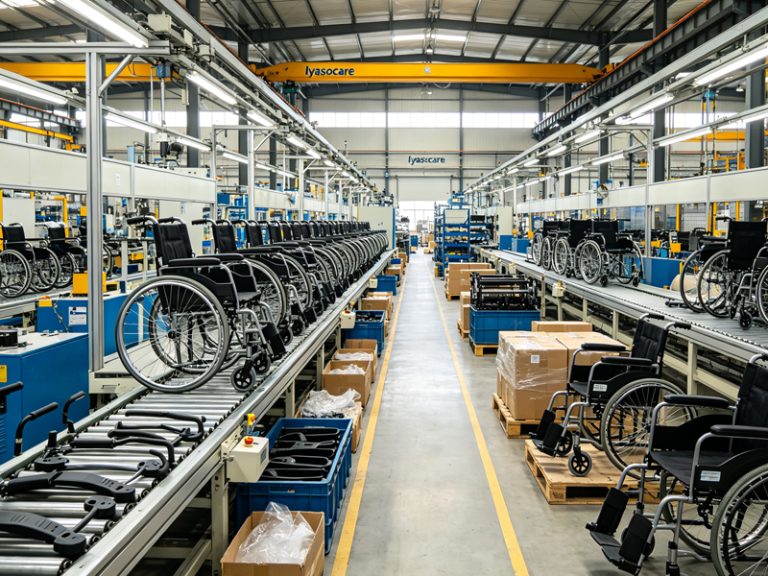
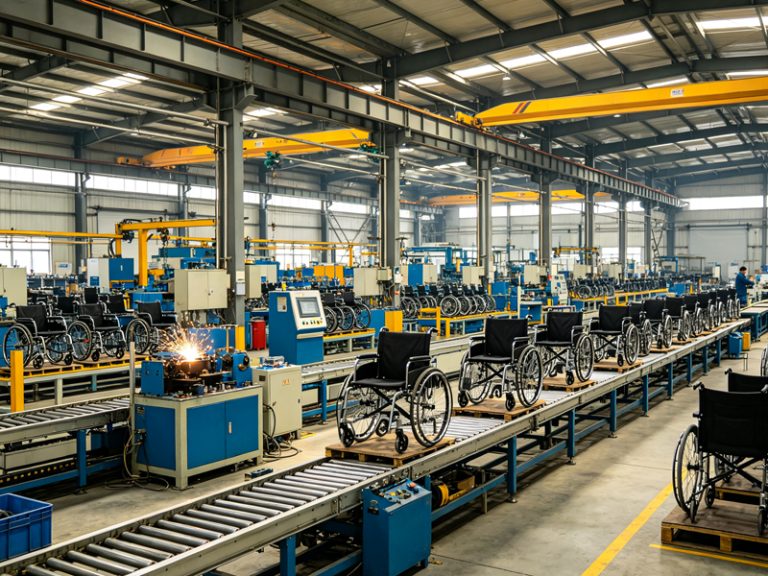
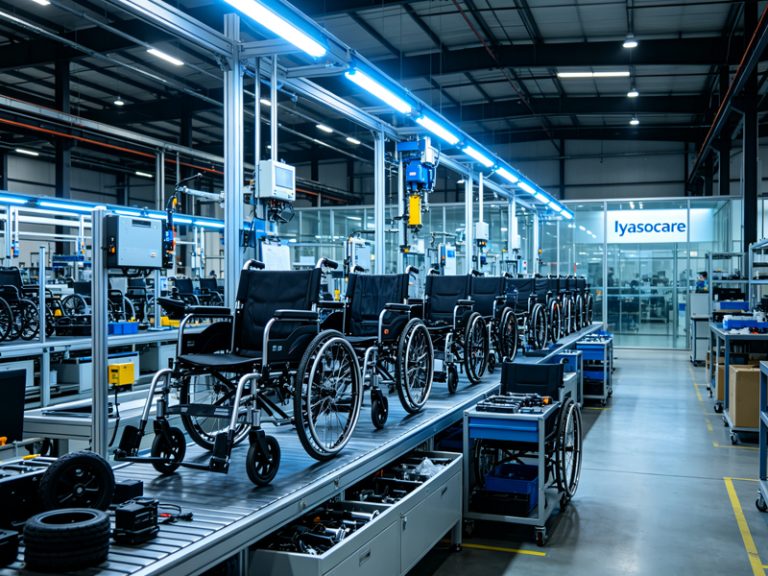
Importers should begin by examining the manufacturer’s production experience and specialization.
A company that focuses on electric wheelchairs and powered mobility equipment is generally a more suitable sourcing partner than a general trading company offering unrelated products.
Ask whether the manufacturer operates its own production facilities, employs qualified technical personnel, and maintains established quality inspection procedures.
Important manufacturing details include frame welding, motor assembly, battery quality, controller performance, braking systems, electrical connections, and final product testing.
It is also worth asking whether the manufacturer has experience supplying overseas medical equipment distributors and can provide the documentation needed for international trade.
Spare parts availability is equally important.
Electric wheelchairs contain components that may eventually require replacement, including batteries, chargers, motors, joystick controllers, electronic control boards, tires, armrests, and footrests.
A manufacturer that can supply replacement components independently gives the local distributor greater control over maintenance and warranty services.
Before signing a wholesale agreement, request a spare parts catalogue and clarify the availability of replacement components for existing models.
Product customization can also create business opportunities. Some distributors may prefer customized branding, bilingual user manuals, specific seat dimensions, removable batteries, or particular product configurations.
However, any customization involving the frame, battery, electrical system, or safety-related components should be properly assessed and documented.
Before placing a large order, importing samples is highly recommended.
A physical sample allows buyers to evaluate frame stability, motor performance, battery charging, joystick responsiveness, braking reliability, seat comfort, and folding mechanisms.
If the sample meets expectations, its specifications should become the reference for future wholesale production.
Product suitability is not determined by technical specifications alone. Qatar’s environmental conditions should also influence purchasing decisions.
High temperatures, strong sunlight, dust, and occasional sand exposure can affect the performance and maintenance requirements of powered mobility equipment.
Lithium batteries, for example, can experience reduced performance and accelerated aging when exposed to unsuitable operating or storage temperatures.
Manufacturers should provide clear temperature limits and explain the battery protection systems incorporated into their products.
Dust protection is another important consideration. Electric wheelchairs contain motors, electrical connectors, controllers, and other sensitive components that should be appropriately protected against environmental exposure.
Importers should ask manufacturers for available ingress protection ratings and the conditions under which the products have been tested.
Comfort should not be overlooked either.
Breathable upholstery, removable cushions, adjustable footrests, and suitable seat dimensions can make everyday use more comfortable, especially for people who spend extended periods in their wheelchairs.
For wholesale distributors, understanding these practical requirements makes it easier to recommend appropriate models to hospitals, retailers, and individual customers.
A profitable wholesale business needs an accurate understanding of its total landed cost.
The manufacturer’s quotation is only one part of the purchasing expense. Importers should also consider export packaging, international freight, cargo insurance, customs charges where applicable, clearance fees, local transportation, warehousing, and after-sales service.
The basic calculation is:
Landed Cost Per Unit = Total Import and Acquisition Costs ÷ Number of Saleable Units
For example, suppose a distributor imports 30 electric wheelchairs and the combined purchase and import expenses amount to QAR 90,000.
The average landed cost is:
QAR 90,000 ÷ 30 = QAR 3,000 per wheelchair.
If the distributor sells each unit for QAR 4,200, the gross profit before additional selling and operating expenses is QAR 1,200 per unit.
The gross margin is calculated as follows:
Gross Margin = (Selling Price − Landed Cost) ÷ Selling Price × 100%
In this example, the gross margin is approximately 28.6%.
These figures are illustrative rather than actual Qatar market quotations.
Businesses should also account for marketing expenses, sales commissions, warranty claims, replacement parts, and inventory management when estimating their final profitability.
The cheapest manufacturer is not necessarily the most profitable supplier. A slightly higher purchase price may be justified when the manufacturer offers more reliable products, consistent production quality, better battery performance, and dependable technical support.
For medical supply distributors, long-term product reliability can be more valuable than a small initial discount.
Once products have been imported successfully, the next challenge is developing a stable customer base.
Wholesale distributors should avoid depending entirely on individual retail sales. Building relationships with several types of healthcare customers can create more consistent business opportunities.
Hospitals and rehabilitation centers are potential institutional customers. These organizations may require detailed product specifications, technical documentation, formal quotations, and warranty commitments.
Medical equipment retailers represent another important channel. They often need several wheelchair models at different price points to serve customers with different mobility requirements.
Home healthcare companies and rehabilitation providers may also require electric wheelchairs for patients receiving assistance outside traditional hospital environments.
For these customers, product demonstrations can be particularly useful. Caregivers and healthcare professionals may want to examine the wheelchair, test its controls, and evaluate its comfort before recommending it.
A professional wholesale catalogue should include product photographs, model numbers, technical specifications, battery information, user weight capacity, warranty terms, and available accessories.
Providing clear information helps purchasing managers and retailers compare different products more efficiently.
Distributors should also consider offering flexible wholesale quantities and dependable replenishment arrangements.
Rather than importing a large inventory immediately, a new business can begin with a carefully selected range, evaluate customer enquiries, and expand based on actual sales performance.
Electric wheelchairs are essential mobility products. Customers depend on them for everyday activities, and equipment failure can create considerable inconvenience.
For this reason, after-sales service should be considered an essential part of the wholesale business model.
Distributors should establish clear warranty policies, local technical support arrangements, and procedures for obtaining replacement components.
Technicians should receive appropriate training to handle common issues involving batteries, chargers, motors, electrical connections, and joystick controllers.
It is also advisable to maintain a reasonable inventory of frequently required spare parts.
Providing user manuals and maintenance instructions in English and Arabic, where appropriate, can further improve the customer experience.
A distributor that provides reliable support after the sale can develop stronger relationships with retailers, healthcare providers, and end users.
Over time, this service capability can become an important competitive advantage.
New importers should pay particular attention to several common mistakes.
First, do not assume that overseas product certification automatically satisfies every Qatari regulatory requirement. Confirm the applicable requirements before shipment.
Second, avoid using incorrect HS codes. Complete electric wheelchairs and separately imported replacement components may have different classifications.
Third, never overlook lithium battery transportation documentation. Missing or inaccurate battery information can cause shipment delays.
Fourth, do not focus entirely on the manufacturer’s purchase price. Product quality, warranty conditions, and spare parts availability influence the total cost of operating the business.
Finally, avoid importing too many models before understanding customer demand. A smaller, well-selected inventory is often a more sensible starting point for a new distributor.
Importing electric wheelchairs into Qatar offers opportunities for wholesale medical supply businesses that understand the local market and are prepared to invest in reliable products and professional distribution.
However, sustainable success depends on more than purchasing products at competitive prices. Importers must understand customs procedures, confirm applicable medical equipment requirements, prepare accurate documentation, manage battery transportation, and develop dependable relationships with manufacturers and local customers.
Choosing the right product range is equally important. Lightweight folding models, standard electric wheelchairs, and heavy-duty powered wheelchairs can serve different customer segments and help distributors develop a balanced inventory.
Most importantly, businesses should treat after-sales service as an essential part of their offering. Reliable technical support, replacement parts, and clear warranty policies can strengthen customer confidence and encourage repeat wholesale orders.
For businesses entering Qatar’s medical supply market, the best long-term strategy is to combine regulatory awareness, product quality, competitive pricing, and customer-focused service. This approach provides a stronger foundation for building a sustainable electric wheelchair distribution business.
1. What documents are required to import electric wheelchairs into Qatar?
Commercial importers generally need a commercial invoice, certificate of origin, packing list, bill of lading or air waybill, and customs declaration. Depending on the product and intended use, additional medical equipment approvals, conformity documents, technical specifications, and lithium battery transportation documents may also be required.
2. Are electric wheelchairs exempt from customs duties in Qatar?
Qatar Customs publishes tariff exemptions covering certain wheelchair categories. However, the applicable treatment depends on the correct HS code and current customs regulations. Importers should confirm the classification and eligibility of their specific products before shipping.
3. How can wholesale buyers find a reliable electric wheelchair manufacturer?
Wholesale buyers should evaluate manufacturing experience, product quality, battery reliability, relevant certifications, spare parts availability, and warranty support. Requesting product samples and conducting pre-shipment inspections are also effective ways to reduce purchasing risks.