Our Location
Free Trade Tower, Xiyong street.
Chongqing, China

Free Trade Tower, Xiyong street.
Chongqing, China
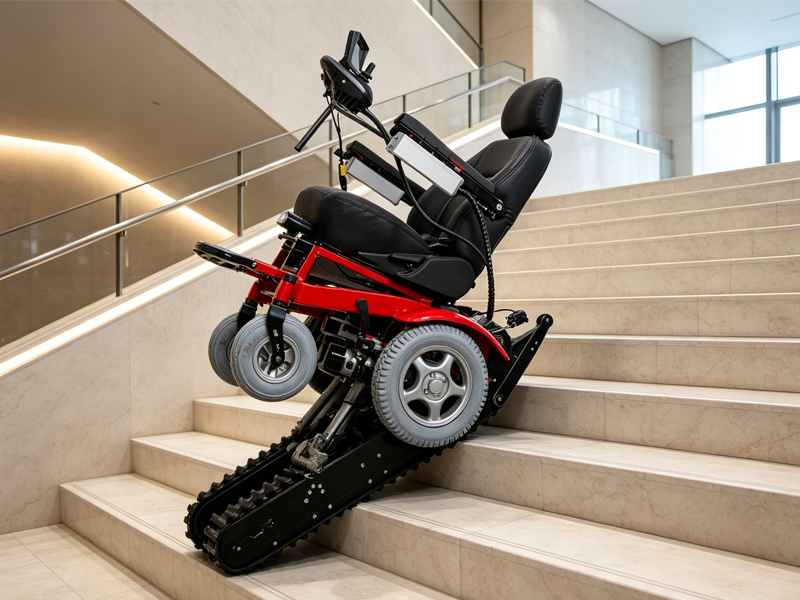
When stairs become difficult or impossible to use, choosing the right accessibility solution can make a major difference in everyday life. Two of the most commonly considered options are a wheelchair lift for stairs and a stair lift. Although both systems are designed to help people move between different levels of a building, they work in very different ways and are intended for different needs.
A stair lift carries a person while they sit on a motorized chair that travels along a rail installed beside the staircase. A wheelchair lift, on the other hand, is designed to carry a person while they remain in their wheelchair. Depending on the building and staircase configuration, a wheelchair-accessible lift may use a vertical platform, inclined platform, or another type of platform lift system.
The difference may sound simple, but it becomes important when you consider wheelchair size, available space, staircase width, installation requirements, safety, accessibility, cost, and long-term use.
So, which is better: a wheelchair lift for stairs or a stair lift? There is no universal answer. The right choice depends primarily on how the person needs to travel and whether they can safely transfer out of a wheelchair.
The easiest way to understand these two systems is to look at what each one actually carries.
A stair lift carries a person.
A wheelchair lift carries a person and their wheelchair.
That distinction affects almost everything else.
With a traditional stair lift, the user typically approaches the lift, sits on the seat, fastens the safety belt, and operates the controls to travel up or down the staircase. At the destination, the user gets off the lift and leaves the stairway.
For someone who can walk a short distance, stand briefly, and transfer from a wheelchair to a stair-lift seat, this can be a practical solution.
A wheelchair user who cannot safely transfer, however, may need a platform-based accessibility lift. The person can roll their wheelchair onto the platform, secure it using the appropriate safety equipment, and travel between levels without leaving the wheelchair.
This is why the phrase “wheelchair lift for stairs” can sometimes cause confusion. A wheelchair lift is not simply a larger version of a stair lift. It is a different type of accessibility equipment with a different operating concept.
| Feature | Wheelchair Lift for Stairs | Stair Lift |
|---|---|---|
| Main purpose | Transports a wheelchair user with their wheelchair | Transports a seated passenger |
| User transfers from wheelchair? | Usually no | Usually yes |
| Platform or seat | Platform | Chair |
| Wheelchair travels with user | Yes | Usually no |
| Space required | Generally more | Generally less |
| Staircase width | Important consideration | Often easier to accommodate |
| Typical installation | Straight or curved configurations depending on system | Straight or curved rail |
| Best suited for | Full-time wheelchair users and people who cannot transfer | People who can transfer to a seat |
| Accessibility | Provides wheelchair-level access | Primarily provides seated mobility |
| Installation complexity | Often higher | Often simpler |
The table gives the quick answer, but the real decision requires a closer look at how each system works.
A stair lift is one of the most familiar residential mobility solutions.
It consists of a motorized chair mounted to a rail or track that follows the staircase. The rail is usually attached to the stair treads or another suitable structural surface. When activated, the motor moves the chair along the rail.
The user normally sits in the chair while traveling between floors.
Modern stair lifts commonly include a seat belt, armrests, footrest, swivel seat, obstruction sensors, emergency controls, battery backup, and controls on the armrest or remote controls. Features vary by manufacturer and model.
For a person who has difficulty climbing stairs because of age, injury, reduced mobility, or another physical limitation, a stair lift can make an otherwise inaccessible staircase usable again.
One of the biggest advantages is that stair lifts generally require less space than platform lifts.
A stair lift also tends to be easier to install in a typical residential environment, especially when the staircase is straight and there is adequate structural support for the rail.
However, there is one important limitation that should not be overlooked:
The user must be able to get into and out of the stair lift safely.
For example, imagine someone who uses a wheelchair throughout the house but can stand with support for a short period. A stair lift might still be practical because they can transfer from the wheelchair to the stair-lift seat.
But if that person cannot transfer safely, a stair lift may not meet their actual accessibility needs.
This is where a wheelchair lift becomes more relevant.
A wheelchair lift is designed around a different principle: the wheelchair remains with the user during the journey.
There are several types of wheelchair-accessible lift systems, and the exact design depends on the staircase, floor levels, available space, building structure, and accessibility requirements.
A vertical platform lift, for example, moves a platform vertically between two levels. It can be used where there is a suitable vertical path and enough space for the lift structure.
An inclined platform lift travels along the angle of a staircase. Instead of carrying only a seated passenger, it uses a platform large enough for a wheelchair.
For staircases, an inclined platform lift can be particularly relevant when there is no practical way for a wheelchair user to transfer to a conventional stair lift.
The user approaches the platform in their wheelchair, enters the designated area, engages the safety system, and operates the lift. The wheelchair and occupant then travel together.
This provides a fundamentally different type of independence.
Instead of asking, “Can the person transfer from the wheelchair?” the question becomes, “Can the wheelchair safely access and fit the platform?”
That distinction can be extremely important for people who rely on wheelchairs for most or all of their mobility.
When comparing a wheelchair lift for stairs vs stair lift, this is often the first practical question to ask.
If the person can comfortably and safely transfer from a wheelchair to a stair-lift seat, a stair lift may be sufficient.
If transferring is difficult, painful, unsafe, or impossible, a wheelchair-accessible platform lift may be more appropriate.
Consider two examples.
Example 1: A senior homeowner
A homeowner has arthritis and reduced leg strength. Walking upstairs has become difficult, but they can stand and sit independently. They do not use a wheelchair full-time.
A stair lift could potentially be a suitable solution because the person can sit directly on the lift and travel upstairs.
Example 2: A full-time wheelchair user
Another homeowner uses a power wheelchair throughout the day and cannot safely transfer to another seat.
For this person, a standard stair lift may not solve the actual accessibility problem. A platform-based wheelchair lift may be more appropriate because the wheelchair can travel with the user.
These examples demonstrate why choosing accessibility equipment based only on price can lead to the wrong result.
The cheapest system is not necessarily the most suitable system.
The goal should be to choose equipment that works safely and consistently with the user’s actual mobility needs.
One of the biggest practical challenges with wheelchair lifts is space.
A stair lift is relatively compact because the user sits in a chair. When folded, many stair-lift seats leave much of the staircase available for other users.
A wheelchair platform requires considerably more room.
The platform must accommodate the wheelchair itself, and there must be sufficient clearance for the user to enter and exit safely. Depending on the system, additional space may be necessary at the top and bottom of the staircase.
This means a wheelchair lift may not be suitable for every narrow staircase.
Before selecting a system, professionals typically need to consider:
This is particularly important for power wheelchairs and larger mobility devices.
A manual wheelchair may fit comfortably on one platform while a larger power wheelchair or mobility scooter may require a significantly larger platform.
Therefore, do not assume that a lift advertised as a “wheelchair lift” will automatically accommodate every wheelchair.
The wheelchair dimensions and total occupied load should be checked before purchasing.
The shape of the staircase also affects the choice.
A straight stair lift is generally designed for a staircase that travels in one continuous direction without intermediate curves or landings.
Curved staircases require a rail designed specifically for the staircase configuration. The rail may need to follow turns, bends, intermediate landings, or changes in direction.
Wheelchair platform lifts can also be configured for different environments, but their design and installation can be more involved.
This is one reason an on-site assessment is valuable.
A photograph may show the general staircase layout, but it cannot always reveal the clearance, landing dimensions, structural conditions, or other details that affect lift installation.
For homeowners, taking accurate measurements before requesting a quote can help, but a professional site assessment is usually the safest way to determine compatibility.
In most typical residential installations, a stair lift takes less space than a wheelchair platform lift.
This is mainly because the stair lift carries a seated person rather than a wheelchair.
For a narrow staircase, this can be a decisive factor.
A stair lift can often be folded when not in use. This allows other family members to continue using the stairs.
A platform lift, by contrast, has a larger footprint and may reduce the usable width of the staircase when installed.
However, “less space” does not automatically mean “better.”
If a wheelchair user cannot transfer to the stair lift, saving space does not solve the accessibility problem.
The correct question is not simply:
“Which lift takes less room?”
It is:
“Which lift provides the required level of access while fitting safely into the available space?”
That is a much more useful way to approach the decision.
Installation requirements can vary significantly by model and building.
A stair lift usually requires a rail to be securely installed along the staircase, plus a suitable power supply. Many residential stair lifts use rechargeable batteries, allowing the lift to continue operating for a period during a power interruption.
A wheelchair platform lift typically involves more substantial equipment and may require additional structural work, electrical work, safety features, and landing modifications.
For commercial or public buildings, accessibility requirements can also be more complex.
Installation may involve considerations related to:
Because requirements vary by jurisdiction and building type, installation should be evaluated according to the applicable local requirements rather than relying on a generic online specification.
Price is naturally one of the first questions people ask.
But comparing the price of a stair lift with the price of a wheelchair platform lift is not always an apples-to-apples comparison.
A stair lift is typically a simpler system. A wheelchair lift needs a larger platform, additional safety equipment, and potentially more extensive installation.
The final price can depend on:
1. Straight or curved staircase
Straight installations are generally simpler than customized curved installations.
2. Lift capacity
A lift designed for a wheelchair and occupant may require greater load capacity than a standard passenger stair lift.
3. Platform size
Larger platforms can affect both equipment and installation costs.
4. Number of floors
Travel distance and the number of access points can influence the system design.
5. Structural modifications
If the building needs modifications, these can significantly affect the project cost.
6. Electrical work
Additional wiring or electrical upgrades may be required depending on the installation.
7. Customization
Curved rails and unusual architectural configurations can require custom engineering.
For this reason, online “average prices” should be treated as general reference points rather than guaranteed project costs.
The most meaningful comparison is to obtain quotes for the same staircase and the same accessibility requirements.
Safety is central to any mobility lift.
A stair lift typically includes features such as:
A wheelchair platform lift has a different safety design because the wheelchair itself is traveling on the platform.
Depending on the system, safety features may include:
The specific equipment varies, so consumers should examine the manufacturer’s technical documentation rather than assuming every model has identical features.
One particularly important point is wheelchair restraint.
A wheelchair should not simply be placed on a platform and left unsecured. The appropriate restraint system should be used according to the lift manufacturer’s instructions.
The same applies to the user.
Accessibility equipment is intended to make movement safer and easier, but correct installation and operation remain essential.
This is another area where buyers sometimes encounter confusion.
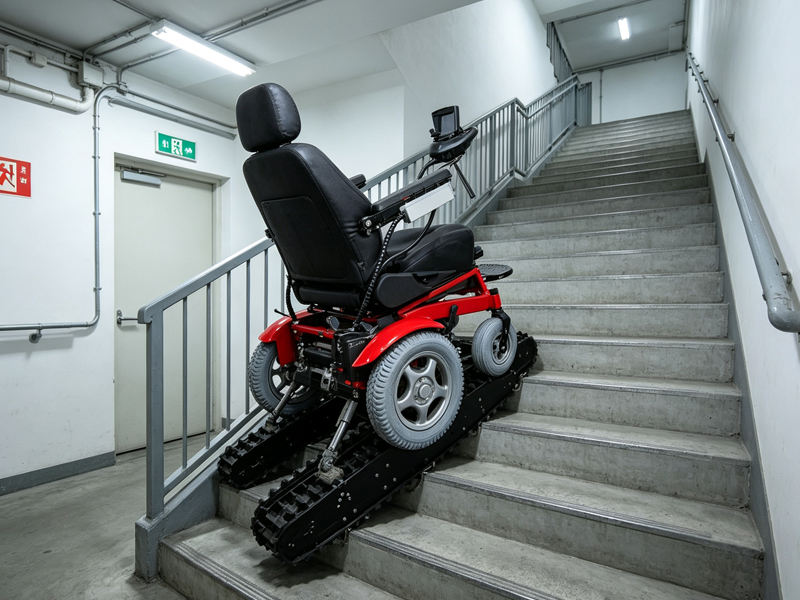
A mobility scooter is generally larger and shaped differently from a standard wheelchair. Turning radius, length, handlebars, and steering controls can all affect whether it can be safely accommodated.
A stair lift normally does not transport the scooter.
The user would need to transfer to the stair-lift seat, while the scooter remains on the other level or is moved separately.
A sufficiently large platform lift may be able to accommodate certain mobility scooters, but compatibility must be confirmed from the actual dimensions and weight.
If you use a scooter, measure:
Then compare those measurements with the manufacturer’s platform specifications.
There is no single solution for every home.
A stair lift may make sense when:
A wheelchair platform lift may make more sense when:
The decision should start with the user’s daily routine rather than the equipment itself.
Ask what actually happens every time the person needs to go upstairs.
Do they get out of the wheelchair?
Can they stand?
Can they safely sit down?
Does someone need to assist them?
Does the wheelchair need to be available on the other floor?
These practical questions often make the choice much clearer.
One mistake I see repeatedly in accessibility planning is starting with the product rather than the user.
Someone searches for “stair lift,” finds several models, compares prices, and chooses the one that appears affordable.
Only later do they discover that the user cannot transfer safely from the wheelchair.
The opposite can also happen.
A family purchases a large wheelchair platform system even though the user can comfortably use a compact stair lift, and the larger system takes up valuable space unnecessarily.
A better process is:
User → Staircase → Space → Equipment → Installation → Cost
Not:
Price → Product → Hope it works
This small change in the decision-making process can prevent a lot of frustration.