Our Location
Free Trade Tower, Xiyong street.
Chongqing, China

Free Trade Tower, Xiyong street.
Chongqing, China
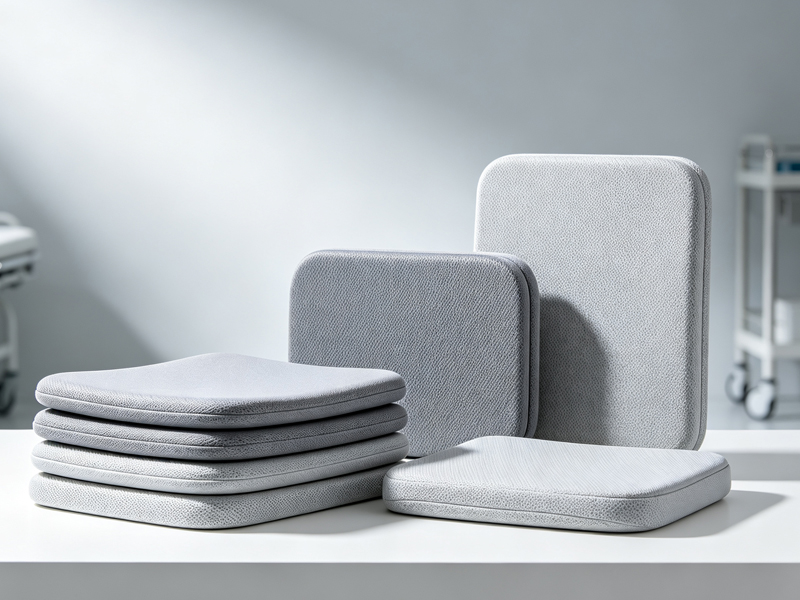
Choosing a wheelchair cushion for wholesale distribution involves much more than comparing prices or selecting an attractive product design. For distributors, medical equipment suppliers, rehabilitation product retailers, and institutional buyers, the right cushion must meet several expectations at once: comfort, durability, material quality, ease of maintenance, consistent manufacturing standards, and reliable supply.
Among the different materials available, nylon has become an important option in wheelchair cushion construction. Known for its strength, relatively low weight, abrasion resistance, and practical maintenance characteristics, nylon can offer an appealing balance between everyday usability and commercial value. However, not all nylon wheelchair cushions are made to the same standard. Differences in fabric quality, internal support, stitching, construction, and overall design can have a significant impact on product performance.
For wholesale buyers, understanding these differences is essential. A cushion that looks suitable in a product photograph may perform very differently after months of regular use. Likewise, a low purchasing price does not necessarily translate into better profitability if the product generates frequent complaints, returns, or replacement requests.
Nylon is a synthetic material widely used in products that require a combination of strength, flexibility, and resistance to everyday wear. In wheelchair cushions, nylon is commonly used as an outer fabric or cover material, protecting the internal cushioning structure while providing a practical surface for daily use.
One of its most valuable characteristics is abrasion resistance. Wheelchair cushions are exposed to repeated friction as users sit down, reposition themselves, transfer between surfaces, and move throughout the day. The cover may also experience contact with clothing, wheelchair components, and other equipment.
A well-selected nylon fabric can withstand this repeated contact better than many lightweight fabrics that are not designed for demanding applications.
Another advantage is its relatively lightweight construction. For wheelchair users, caregivers, and healthcare facilities, products that are easier to handle can make everyday routines more convenient. A lightweight cushion can also be easier for distributors to package, transport, and store.
Nylon is also available in different fabric constructions, thicknesses, coatings, and finishes. This gives manufacturers flexibility when developing products for different customer groups and price segments.
For example, a basic nylon wheelchair cushion designed for general daily use may prioritize affordability and easy maintenance. A higher-specification model may use a more substantial fabric construction, reinforced seams, and additional protective features.
However, wholesale buyers should remember one important point: nylon alone does not guarantee a high-quality cushion.
The actual performance depends on the grade of nylon, fabric density, yarn quality, manufacturing process, and the way the material is integrated into the complete cushion design.
The outer cover is often the first part of a wheelchair cushion that customers notice. It also plays an important role in protecting the internal material from dust, friction, and everyday handling.
When evaluating a nylon wheelchair cushion supplier, fabric quality deserves close attention.
A good nylon cover should feel sufficiently strong without becoming unnecessarily stiff or uncomfortable. If the fabric is too thin, it may wear out quickly under repeated friction. If it is excessively rigid, it may affect flexibility and the overall user experience.
Wholesale buyers should ask manufacturers about the following specifications:
These details are particularly important when sourcing products for hospitals, rehabilitation centers, nursing facilities, and other environments where cushions may be used frequently.
Fabric appearance should also be evaluated carefully. A consistent surface, clean finishing, and uniform color contribute to the perceived quality of the finished product.
For private-label buyers, appearance can influence brand positioning. A cushion with neat stitching, a professional finish, and a well-designed cover is easier to present as a reliable medical or mobility accessory.
It is also worth asking whether the nylon cover is removable and replaceable. A removable cover can simplify routine maintenance and may extend the practical service life of the complete cushion when the internal cushioning material remains in good condition.
Nevertheless, buyers should not assume that every nylon cover is machine washable or waterproof. These characteristics depend on the fabric treatment, coating, zipper construction, and manufacturer’s care instructions.
A common purchasing mistake is focusing too heavily on the nylon cover while overlooking the internal cushioning material.
In reality, the filling has a direct influence on comfort, support, pressure distribution, and long-term performance.
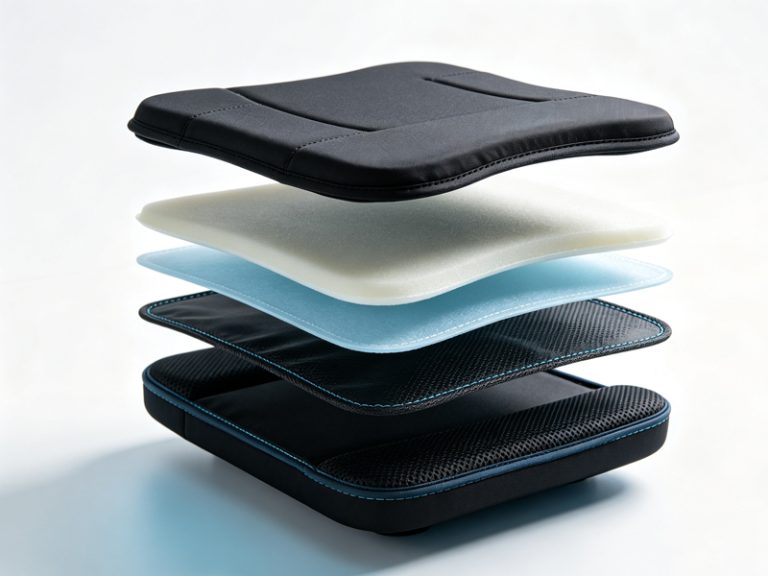
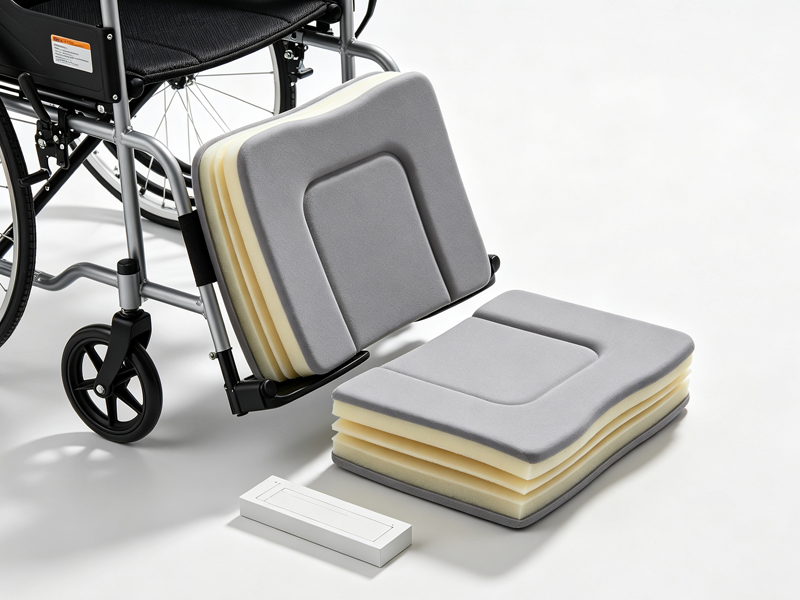
Different wheelchair cushions use different internal materials, including polyurethane foam, high-resilience foam, gel components, air cells, and layered combinations. Each option offers different characteristics and serves different market needs.
For general-purpose wheelchair cushions, polyurethane foam is widely used because it offers a practical combination of cushioning, shape retention, and manufacturing flexibility.
Higher-resilience foam may be suitable for products that require better recovery after repeated compression. Some premium models combine multiple foam densities to provide different levels of support across the seating surface.
Gel-based designs may appeal to customers looking for additional cushioning and pressure-management features. Air-cell systems, meanwhile, are commonly used in specialized seating products where adjustability and pressure redistribution are important considerations.
For wholesale buyers, the key is to match the filling material with the intended application rather than automatically choosing the most expensive option.
A basic nylon wheelchair cushion for general retail distribution has different requirements from a specialized pressure-management cushion intended for users with elevated skin-injury risks.
Buyers should evaluate:
It is also important to distinguish between comfort claims and clinical performance claims.
A standard foam cushion should not automatically be marketed as a pressure-relief or pressure-injury prevention product. Such claims require appropriate product design, supporting evidence, and compliance with applicable regulatory requirements.
For users with limited mobility or a high risk of pressure injuries, seating selection should be based on an appropriate clinical assessment.
A reliable manufacturer should be able to explain the construction of its cushion clearly instead of relying on vague descriptions such as “extra comfortable” or “premium support.”
Even when a cushion uses good nylon fabric and suitable filling, poor workmanship can reduce its overall service life.
For wholesale buyers, stitching quality is one of the easiest aspects to overlook during initial product selection. Yet it can become a major source of customer complaints after distribution.
Wheelchair cushions experience repeated movement and loading. Seams around the edges, corners, zipper areas, and attachment points may be exposed to considerable stress.
If stitching is inconsistent or insufficiently reinforced, seams can loosen or split over time.
A well-manufactured nylon wheelchair cushion should have:
The quality of the zipper also deserves attention. If the cover is removable, a poorly selected zipper may become difficult to operate or fail after repeated use.
For large orders, wholesale buyers should request production samples and inspect several units rather than relying on a single sample.
This is especially useful when evaluating manufacturers that produce different cushion sizes or product variations. A supplier may produce one excellent sample but deliver inconsistent quality across a larger production run.
Manufacturing consistency is therefore just as important as the quality of the original sample.
A wheelchair cushion is used for extended periods, often every day. As a result, comfort cannot be judged by softness alone.
The relationship between the cover fabric, internal filling, cushion dimensions, and seating environment all contribute to the user experience.
Nylon can be engineered into different fabric structures, some of which allow better airflow than others. However, nylon is not automatically breathable simply because it is lightweight.
The fabric construction and any additional waterproof coating can influence ventilation and moisture management.
For wholesale buyers serving warm climates or customers who spend extended periods in wheelchairs, these characteristics are worth evaluating.
A cushion cover should also be practical to clean. In healthcare and institutional environments, routine hygiene is an important purchasing consideration.
Some nylon covers are designed to be wiped clean, while others may be removable for washing according to the manufacturer’s instructions.
Buyers should clarify:
Water resistance and waterproof performance should also be treated as separate specifications. A fabric that resists occasional splashes is not necessarily suitable for continuous moisture exposure.
For institutional buyers, requesting documented cleaning instructions is a sensible step before approving a large purchase.
The easier a product is to maintain, the more practical it may be for facilities managing multiple wheelchairs.
A high-quality cushion is not necessarily a suitable cushion for every wheelchair.
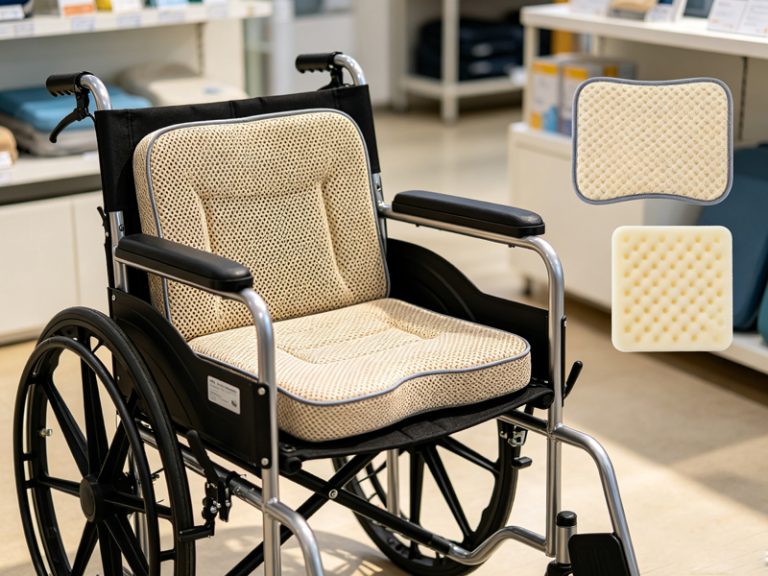
Correct dimensions are essential for proper fit, stability, and everyday usability. A cushion that is too wide, too narrow, too thick, or poorly shaped may not sit securely on the wheelchair seat.
Wholesale buyers should therefore pay close attention to available sizes and dimensional tolerances.
Common purchasing specifications include:
Standard sizes can help distributors simplify inventory management, but customized dimensions may be necessary for certain markets or wheelchair models.
Thickness is another important consideration.
A thicker cushion is not automatically more comfortable or supportive. Excessive height can change the user’s seated position and affect wheelchair fit, footrest alignment, transfer height, and overall posture.
Similarly, a very thin cushion may not provide sufficient support for the intended user.
Wholesale buyers should consider the target application before selecting dimensions. Products intended for occasional transport use may have different specifications from cushions designed for daily seating.
If the manufacturer offers customization, buyers should request a size chart and confirm the acceptable manufacturing tolerances before placing bulk orders.
When purchasing wheelchair cushions in wholesale quantities, product quality must be consistent across the entire order.
A reliable supplier should have a clear quality-control process covering raw materials, production, assembly, and finished products.
Rather than accepting general promises about quality, buyers should ask for specific information about inspection procedures and testing methods.
Depending on the product design and intended market, useful quality checks may include:
| Quality area | What wholesale buyers should check |
|---|---|
| Fabric durability | Abrasion resistance and material consistency |
| Stitching | Seam strength and finishing quality |
| Filling | Density, firmness, and recovery |
| Dimensions | Width, depth, and thickness tolerances |
| Zipper | Smooth operation and durability |
| Cleaning | Resistance to approved cleaning methods |
| Appearance | Color consistency and surface defects |
| Packaging | Protection during storage and transportation |
For products intended for specialized healthcare use, additional testing and documentation may be necessary.
Buyers should also clarify which testing standards are relevant to their destination market and product classification. Not every general-purpose wheelchair cushion is subject to the same regulatory requirements.
For example, requirements may differ depending on whether a product is marketed as a basic mobility accessory or as a medical device with specific therapeutic claims.
Requesting test reports, material specifications, and relevant compliance documents before ordering can reduce unnecessary sourcing risks.
A good supplier should be willing to explain what has been tested, which standards were followed, and what the results actually demonstrate.
Price is always an important factor in wholesale purchasing. However, choosing the cheapest nylon wheelchair cushion is not necessarily the most profitable decision.
A product with a low initial purchase price may create additional expenses through quality complaints, returns, damaged packaging, or premature replacement.
For distributors, total purchasing cost should be evaluated alongside product performance and supplier reliability.
Consider a simple example.
Supplier A offers a lower unit price but uses thinner fabric and has less consistent stitching. Supplier B charges slightly more but provides better material specifications, stable production quality, and more reliable delivery.
Although Supplier A appears more attractive at the quotation stage, Supplier B may offer better long-term commercial value.
Wholesale buyers should compare the following cost factors:
Unit price: The quoted price for each cushion, including any agreed customization.
Minimum order quantity (MOQ): The minimum quantity required for standard and customized orders.
Sample cost: Whether samples are free, refundable, or charged separately.
Packaging cost: Whether individual packaging, cartons, labels, and private-label requirements are included.
Shipping cost: Freight, insurance, customs duties, and other relevant import expenses.
Quality-related costs: Potential replacement, rework, and after-sales expenses.
It is also important to request clear quotations with consistent product specifications. Comparing prices between cushions with different dimensions, fillings, and fabric grades can lead to misleading purchasing decisions.
A proper comparison should always be based on equivalent product configurations.
Finding a suitable manufacturer is one of the most important steps in wholesale sourcing.
A supplier may offer attractive pricing and a broad product catalog, but that does not automatically mean it can support long-term distribution requirements.
Wholesale buyers should look for manufacturers with practical experience in wheelchair cushions and related mobility products.
One important factor is production capability. Can the supplier manufacture the required quantities consistently? Does it have stable access to raw materials? Can it handle different cushion sizes, fabric specifications, and packaging requirements?
Communication is equally important.
A professional manufacturer should be able to answer technical questions, explain product differences, provide samples, and communicate realistic production lead times.
Before committing to a large order, buyers should evaluate the supplier in several areas:
Product development: Can the manufacturer adjust dimensions, fabric choices, thickness, and cushion construction?
Quality management: Are there documented inspection procedures and traceable production standards?
Customization: Can the supplier provide OEM or ODM services, private labeling, and customized packaging?
Production capacity: Can it support repeat orders and seasonal demand?
Delivery reliability: Are production schedules and shipping arrangements clearly communicated?
After-sales support: Does the supplier have a defined process for handling defects or product-related complaints?
For international wholesale buyers, export experience can also make a difference. A manufacturer familiar with international shipping documentation, packaging requirements, and destination-market regulations may help simplify the purchasing process.
It is worth building a relationship with a supplier that understands your business model rather than choosing a different manufacturer every time a slightly lower quotation appears.
Long-term cooperation can support more consistent specifications, easier repeat ordering, and better inventory planning.
For distributors and established mobility equipment brands, customization can be an effective way to differentiate products in a competitive market.
Nylon wheelchair cushions offer several possible customization options, depending on the manufacturer’s capabilities.
These may include:
OEM and ODM services can be particularly useful for wholesalers who want to build their own product lines without establishing a manufacturing facility.
However, customization should be approached carefully.
Every additional specification may affect the unit cost, MOQ, production time, and quality-control requirements.
Before confirming a customized order, buyers should approve a production sample and ensure that all agreed specifications are documented.
This is especially important for repeat orders. A clear product specification sheet helps prevent changes in fabric, color, dimensions, or filling materials without approval.
For brands selling through online marketplaces, medical supply stores, or regional distributors, consistent product presentation can also strengthen customer recognition.
The goal should not simply be to make a cushion look different. Customization should create a clear commercial advantage while maintaining reliable product performance.
Even experienced buyers can encounter problems when sourcing wheelchair cushions, particularly when placing large orders with unfamiliar manufacturers.
Several purchasing mistakes are worth avoiding.
Choosing based on photographs alone.
Product images cannot reliably demonstrate fabric strength, foam density, stitching quality, or long-term performance. Always request a physical sample when practical.
Assuming all nylon fabrics are the same.
Different nylon grades, fabric constructions, and coatings can produce very different results. Ask for detailed material specifications.
Ignoring the internal cushion structure.
The outer cover is only one component. Filling quality, firmness, thickness, and shape retention are equally important.
Focusing only on the lowest quotation.
A low price may come with compromises in material quality, manufacturing consistency, or after-sales service.
Overlooking product claims and regulations.
Claims relating to pressure redistribution, pressure injury prevention, infection control, or medical performance should be supported by appropriate evidence and compliance documentation.
Skipping pre-production confirmation.
For customized or large-volume orders, written specifications and approved samples help reduce misunderstandings.
Failing to plan inventory requirements.
MOQ, production lead time, shipping time, and seasonal demand should all be considered before confirming an order.
Avoiding these mistakes can make the sourcing process more predictable and help protect the buyer’s reputation in the marketplace.
Before choosing a nylon wheelchair cushion manufacturer, it is useful to review the complete product and supplier rather than making a decision based on one or two specifications.
The following checklist can help purchasing teams organize their evaluation:
| Purchasing consideration | Key question |
|---|---|
| Nylon fabric | Is the fabric durable and suitable for the intended application? |
| Cushion filling | Does the filling provide the required support and comfort characteristics? |
| Construction | Are seams, edges, and zippers properly finished? |
| Dimensions | Are the available sizes compatible with target wheelchairs? |
| Maintenance | Are cleaning instructions clear and practical? |
| Testing | Can the supplier provide relevant test reports? |
| Customization | Are OEM, ODM, and private-label options available? |
| Pricing | Is the quotation based on clearly defined specifications? |
| MOQ | Does the minimum order quantity match purchasing capacity? |
| Lead time | Can the manufacturer meet the required delivery schedule? |
| Packaging | Is the packaging suitable for storage and international shipping? |
| After-sales service | Is there a clear process for handling quality issues? |
A manufacturer that can answer these questions clearly is generally easier to evaluate and work with than one that provides only a product photograph and a price list.
Ultimately, a good nylon wheelchair cushion is the result of balanced product engineering, appropriate material selection, careful manufacturing, and consistent quality control.
1. What should wholesale buyers look for when purchasing nylon wheelchair cushions?
Wholesale buyers should evaluate the nylon fabric quality, internal cushioning material, stitching strength, cushion dimensions, ease of cleaning, and overall manufacturing consistency. They should also consider MOQ, customization options, quality-control procedures, and supplier reliability. Requesting product samples and technical specifications before placing a bulk order is strongly recommended.
2. Are nylon wheelchair cushions suitable for everyday use?
Yes. A properly manufactured nylon wheelchair cushion can be suitable for everyday use, particularly when the fabric, internal filling, and overall construction are selected for the intended application. Nylon offers useful characteristics such as abrasion resistance, relatively low weight, and practical maintenance. However, the cushion’s suitability depends on its complete design, not just the outer material. Users with specific postural or pressure-management needs may require a professionally assessed seating solution.
3. Can manufacturers provide customized nylon wheelchair cushions for wholesale orders?
Many wheelchair cushion manufacturers offer OEM and ODM customization services. Depending on production capabilities, options may include custom dimensions, nylon fabric colors, cushion thickness, foam density, removable covers, logos, labels, and packaging. Buyers should confirm the MOQ, additional costs, production lead time, and approved product specifications before proceeding with a customized wholesale order.