Our Location
Free Trade Tower, Xiyong street.
Chongqing, China

Free Trade Tower, Xiyong street.
Chongqing, China
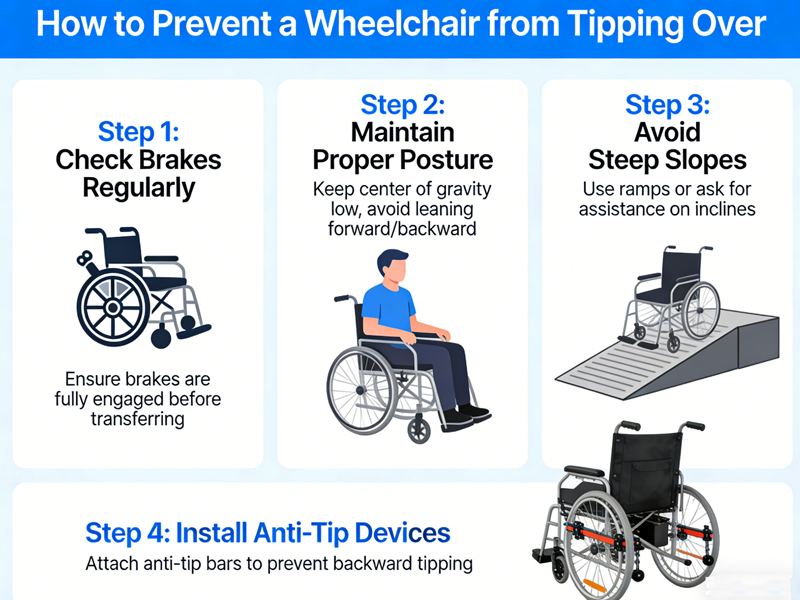
A wheelchair should represent freedom, not fear. Yet for many users and caregivers, the possibility of tipping—whether forward, backward, or sideways—remains a constant concern. The truth is, most tipping incidents are preventable. They rarely happen because of a single mistake; instead, they’re often the result of small oversights in technique, setup, or environment.
At its core, wheelchair stability is about balance—specifically, the relationship between the user’s center of gravity and the chair’s base of support.
When the combined center of gravity shifts outside the footprint of the wheelchair (the area between the wheels), tipping becomes likely. This shift can happen surprisingly easily:
What makes this tricky is that many of these actions are part of daily life. The goal isn’t to avoid movement—it’s to manage it intelligently.
A properly fitted and adjusted wheelchair is your first line of defense against tipping.
Many users underestimate how much configuration matters. Seat position, wheel alignment, and backrest angle all influence stability.
For example, when rear wheels are positioned further forward (a common setup for active users), the chair becomes easier to maneuver—but also more prone to tipping backward. Conversely, moving the wheels back increases stability but reduces agility.
There is no universal “safe” setup. The ideal configuration depends on:
Working with a professional to fine-tune these adjustments is one of the most effective long-term safety strategies.
Tipping rarely occurs during obvious “dangerous” moments. It often happens during routine tasks.
Reaching forward or sideways is one of the most common causes of tipping.
When you lean, your body weight shifts beyond the wheelchair’s base. Even a small reach can create a tipping point if done too quickly or without counterbalance.
Better approach:
Abrupt shifts—like dropping into the chair quickly or leaning back forcefully—can destabilize the wheelchair.
Momentum matters. A fast movement creates more force than a slow one, even if the motion itself is small.
Better approach:
Placing heavy bags on the back of the wheelchair might seem convenient, but it shifts weight behind the rear axle—making backward tipping much more likely.
Better approach:
Even with perfect technique, the environment can introduce risk.
Going uphill naturally shifts your weight backward; going downhill pushes it forward.
Key strategies:
Cracks, curbs, gravel, and grass can destabilize wheels and cause sudden shifts.
Key strategies:
Descending even a small curb incorrectly can lead to forward tipping.
Safer method:
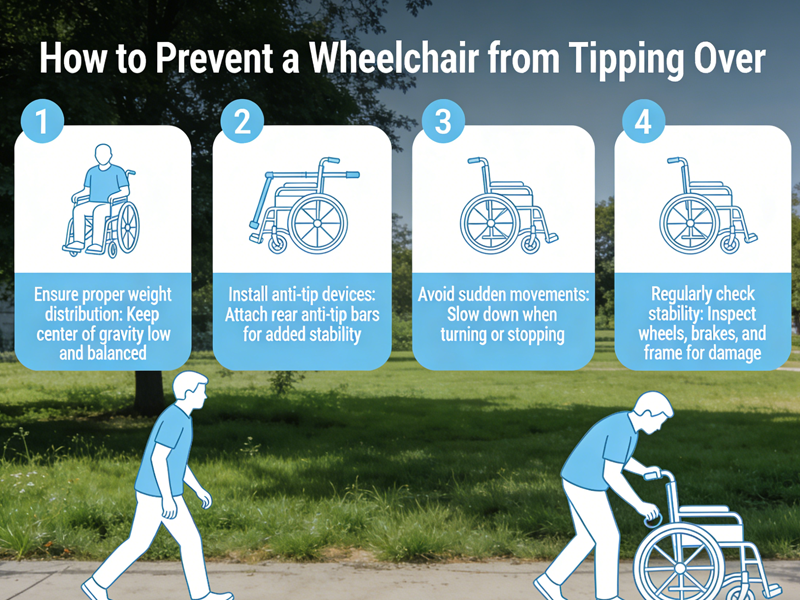
Anti-tip bars are often seen as optional—but for many users, they’re essential.
These small extensions at the back of the wheelchair prevent it from tipping too far backward. While they may slightly limit maneuverability (especially for advanced users performing wheelies), they provide a critical safety buffer.
They’re particularly valuable for:
Choosing whether to use anti-tip devices should be a deliberate decision—not an afterthought.
Wheelchair safety isn’t just about equipment—it’s also about the user’s physical awareness.
Core strength plays a significant role in maintaining stability. The stronger your torso control, the better you can manage shifts in weight without overcorrecting.
But even more important is awareness.
Experienced wheelchair users develop an intuitive sense of where their center of gravity is at all times. This awareness allows them to move confidently without tipping—even in dynamic environments.
Ways to improve this include:
Getting in and out of a wheelchair is one of the most common times for tipping incidents.
During a transfer, your weight shifts dramatically, and the wheelchair may move if not properly secured.
Best practices:
Taking a few extra seconds to set up properly can prevent serious accidents.
For caregivers, understanding wheelchair tipping is just as important.
A well-meaning helper can unintentionally cause instability—for example, by pushing too quickly, stopping abruptly, or leaning on the chair.
Caregivers should:
The goal is to support—not override—the user’s balance.
A poorly maintained wheelchair is inherently less stable.
Loose components, worn tires, or misaligned wheels can all increase the risk of tipping.
Regular checks should include:
Small mechanical issues can lead to big safety problems if ignored.
Fear of tipping can limit independence. But overconfidence can be just as dangerous.
The safest approach lies in the middle—developing confidence through experience, while maintaining awareness of limits.
New users should:
Experienced users, on the other hand, should periodically reassess their habits. Familiarity can sometimes lead to shortcuts that increase risk.
Preventing wheelchair tipping isn’t about avoiding risk entirely—it’s about managing it intelligently.
Every movement, surface, and setup plays a role. The more you understand these interactions, the more natural safety becomes.
Over time, what once required conscious effort turns into instinct.
And that’s the goal: not restriction, but freedom with control.
1. What is the most common cause of wheelchair tipping?
The most common cause is leaning too far outside the wheelchair’s base of support—especially when reaching forward or sideways. This shifts the center of gravity beyond the wheels, making tipping likely. Simple adjustments like moving closer to objects instead of reaching can significantly reduce this risk.
2. Are anti-tip wheels necessary for all users?
Not for everyone, but they are highly recommended for beginners, users with limited balance, or those frequently navigating slopes. More experienced users may choose to remove them for greater mobility, but this should only be done with proper training and awareness of the risks.
3. How can I safely navigate ramps and slopes?
When going uphill, lean slightly forward to counterbalance backward tipping. When going downhill, lean slightly backward and control your speed. Avoid sudden stops or turns on slopes, as these can quickly destabilize the wheelchair.