Our Location
Free Trade Tower, Xiyong street.
Chongqing, China

Free Trade Tower, Xiyong street.
Chongqing, China

When choosing an electric wheelchair, most buyers naturally pay attention to battery capacity, driving range, seat comfort and maximum speed. The motor is often reduced to a single number in the specification sheet: 200 W, 400 W, 800 W or more. Yet the way that motor is designed and connected to the wheel can have just as much influence on how an electric wheelchair actually feels on the road.
This is where the wheelchair hub motor becomes important.
A hub motor places the motor directly inside, or closely integrated with, the wheel hub rather than positioning a separate motor away from the wheel and transferring power through a conventional drivetrain. This architecture can create a compact and relatively direct power system, which is particularly attractive for electric mobility equipment where space, weight, efficiency and control all matter.
Understanding How Wheelchair Hub Motors Work and What to Know therefore requires looking beyond motor wattage. A good wheelchair hub motor needs to work with the controller, battery, drive wheel, braking system, frame and user’s operating environment. The motor that performs well on a lightweight indoor wheelchair may not be the right choice for a heavier outdoor model. Similarly, a high-power motor does not automatically mean better mobility if the gearing, battery and control system are poorly matched.
For wheelchair users, caregivers, mobility retailers and international distributors, understanding this relationship makes it much easier to compare electric wheelchair specifications and identify a product that is genuinely suited to its intended application.
The simplest way to understand a wheelchair hub motor is to imagine that the wheel and motor have been brought together into one compact assembly.
In a conventional powered wheelchair drivetrain, the basic arrangement may look something like:
Motor → gearbox → output shaft → wheel
The motor is physically separate from the wheel, and a transmission system transfers the motor’s rotational force to the drive wheel. Gear reduction is often used because electric motors can operate efficiently at higher rotational speeds while the wheelchair requires lower wheel speed and higher torque.
A hub motor changes that architecture. Instead of locating the motor elsewhere on the chassis, the motor is integrated into the wheel hub.
The simplified structure becomes:
Electrical power → motor inside hub → wheel rotation → wheelchair movement
The exact internal design can vary. Some hub motors are direct-drive motors, while others use internal reduction mechanisms. The important distinction is that the motor is integrated with the wheel assembly rather than relying on a long mechanical power-transfer path.
This compact arrangement is one reason hub motors are attractive for mobility applications. Fewer external drivetrain components can create a cleaner mechanical layout and make it easier for designers to package the drive system into the wheelchair.
The concept is already used in wheelchair-related mobility systems. Yamaha, for example, describes a wheelchair power unit in which the motor is built into the wheel hub assembly, with independent control of the two drive wheels allowing forward, reverse and turning movements.
The result is not simply a different-looking motor. It changes how power is delivered to the wheel and how the wheelchair can be engineered around that power source.
The working process begins with the battery.
An electric wheelchair battery stores electrical energy, which is supplied to the motor system through the controller. The controller acts as the electronic link between the user’s commands and the motors.
When the user moves the joystick forward, the joystick sends a signal to the controller. The controller interprets the requested direction and speed, then regulates the electrical output delivered to the drive motor.
Inside the hub motor, electrical energy is converted into rotational movement. The interaction between the motor’s stationary and rotating components produces torque, causing the wheel assembly to rotate. Because the motor is integrated directly into the wheel hub, the rotational force can be transferred to the wheel with a relatively compact mechanical arrangement.
The process happens continuously rather than as a single command.
Joystick movement → controller interpretation → motor power → wheel rotation → wheelchair movement → continuous control adjustment
When the joystick is pushed further, the controller can request greater motor output, depending on the wheelchair’s programmed speed and control characteristics. When the joystick returns toward its neutral position, the controller reduces the drive command.
For a two-wheel-drive wheelchair, the controller also has to coordinate the left and right motors. If both wheels rotate at similar speeds, the chair moves approximately straight ahead. If one wheel rotates faster than the other, the wheelchair turns. This differential control is a fundamental part of powered wheelchair manoeuvrability. Yamaha’s wheelchair power-unit technology similarly uses independent speed control of the two drive wheels for forward, reverse and turning operation.
This is why the wheelchair hub motor cannot be evaluated independently from the controller. A powerful motor with poor control programming may feel less predictable than a lower-powered motor with a well-matched control system.
One of the most useful comparisons when learning How Wheelchair Hub Motors Work and What to Know is the difference between a hub motor system and a conventional geared motor.
A geared wheelchair motor normally separates the motor from the wheel. The motor rotates at a relatively high speed, while a gearbox reduces the output speed and increases usable torque at the wheel. The basic architecture provides designers with considerable flexibility in matching motor characteristics to the wheelchair’s load and terrain.
A hub motor, by contrast, places the motor at the wheel itself. Depending on the design, it may be gearless or incorporate reduction components inside the hub.
The difference can affect packaging, maintenance, efficiency, noise, weight distribution and driving characteristics.
A conventional geared system can be particularly useful when high wheel torque is required from a relatively compact motor. Gear reduction allows the motor to operate at a higher rotational speed while producing slower, stronger wheel rotation.
A hub motor can offer a more integrated solution. Because the motor is already located at the wheel, the system can reduce the need for external mechanical transmission components. This can simplify the physical layout and create opportunities for compact wheelchair designs.
Neither architecture is automatically superior in every application.
For an indoor folding wheelchair, compact packaging and straightforward integration may be particularly valuable. For a heavy-duty outdoor wheelchair that regularly climbs slopes or travels across rough terrain, torque, gearing, wheel diameter, motor thermal performance and battery output may matter more than whether the motor is technically a hub motor.
This is why serious buyers should compare the complete drive system, not just the motor architecture.
“800 W” looks impressive on a product specification sheet, but wattage alone cannot tell you how an electric wheelchair will perform.
Power is important, but wheelchair performance also depends on torque, wheel diameter, gearing, total vehicle weight, user weight, terrain, battery voltage, controller programming and traction.
Torque is particularly important when the wheelchair starts from rest or climbs a slope. A wheelchair may have sufficient peak power but still feel weak if the drive system does not deliver useful torque at the wheel under the required conditions.
This is why the question should not simply be:
“How many watts does the wheelchair motor have?”
A better question is:
“How is the available motor power converted into useful wheel torque under the expected operating conditions?”
IYASOCARE’s own guidance on electric wheelchair drive motors makes the same distinction, noting that torque can be more meaningful than maximum wattage for applications involving ramps, grass, heavier loads and outdoor terrain.
For example, IYASOCARE’s YSH1008 electric handcycle wheelchair attachment uses a 48V 800W hub motor, a 12 Ah lithium battery and a 16-inch wheel. The manufacturer lists a travel range of approximately 40–50 km and multiple speed levels.
That specification is useful because it demonstrates the relationship between the hub motor, battery, wheel and controller rather than presenting motor power as an isolated number.
A wheelchair hub motor cannot produce useful performance without an appropriate electrical supply.
The battery provides the energy, while the controller manages how that energy reaches the motor. If the battery cannot supply the required current under load, the motor may not be able to maintain expected performance even if its nominal power rating looks impressive.
Battery voltage is also important. A 24 V wheelchair system and a 48 V system operate under different electrical conditions, and the motor, controller and battery must be designed as a compatible system.
This is one reason manufacturers should not simply combine a high-power motor with an existing battery and assume that performance will improve.
Thermal management also matters. Motors generate heat during operation, particularly when working under heavy load or climbing. A wheelchair regularly used on slopes with a heavier occupant may place considerably more demand on the drive system than one used primarily on flat indoor flooring.
For buyers, therefore, the useful specification is not just motor wattage. Look at:
| Drive-system factor | Why it matters |
|---|---|
| Motor power | Indicates electrical output capability |
| Torque | Important for starting and climbing |
| Battery voltage | Must match the motor/controller system |
| Battery capacity | Influences usable energy and range |
| Controller | Determines how motor power is delivered |
| Wheel diameter | Influences speed and torque at the ground |
| Total weight | Affects energy and climbing requirements |
| Terrain | Determines the real workload |
This system-level approach provides a much more realistic picture of performance than comparing two motors by wattage alone.
A modern wheelchair hub motor depends heavily on the controller.
The joystick does not normally send raw battery power directly to the motor. Instead, it provides an input signal representing the user’s requested movement. The controller interprets that signal and determines how much power should be delivered to each drive motor.
This is especially important during turning.
Imagine the user pushes the joystick forward and slightly to the right. The controller has to translate that input into different commands for the left and right drive wheels. The outside wheel may rotate faster while the inside wheel slows down, allowing the wheelchair to curve rather than simply moving straight.
The controller also manages acceleration and deceleration. A wheelchair that immediately jumps toward maximum speed can be difficult to operate safely in a crowded room. A well-calibrated system can provide smoother low-speed movement and more predictable responses.
IYASOCARE’s recent technical explanation of electric wheelchair joystick controllers describes this process in detail: joystick sensors detect movement, the controller interprets the signal and then coordinates the drive motors, with different motor outputs enabling turning.
This makes the controller an essential part of the hub motor system. When evaluating an electric wheelchair, asking about the motor without asking about the controller leaves out one of the most important pieces of the system.
The first advantage is packaging.
Because the motor is integrated into the wheel assembly, designers can create a compact drive system without necessarily needing the same external drivetrain arrangement as a conventional geared motor.
The second advantage is mechanical integration. The shorter mechanical path between motor and wheel can reduce the number of external components required to transfer rotational force. Depending on the design, this can simplify the overall architecture.
The third advantage can be weight distribution and design flexibility. Placing the drive motor at the wheel provides engineers with another way to distribute components around the chassis.
The fourth advantage is potentially lower mechanical complexity outside the hub. With fewer exposed drivetrain components, there may be fewer external transmission parts to package around the frame.
However, these advantages should not be overstated. Hub motors are not automatically maintenance-free, more efficient or more powerful than geared motors. The final result depends heavily on engineering quality and the specific design.
For mobility equipment, reliability matters more than a fashionable motor architecture. A well-designed geared motor can outperform a poorly designed hub motor in the wrong application.
The biggest limitation is that placing the motor inside the wheel can make the wheel assembly more complex.
If the motor itself develops a problem, replacing or repairing the affected assembly may require more specialised parts than replacing a conventional external motor. This is particularly important for distributors who need to provide long-term after-sales service.
Heat can also become an engineering consideration. The motor is positioned within the wheel area, so designers need to manage heat generated during sustained operation. Heavy loads, repeated acceleration and climbing can increase thermal demand.
Another consideration is unsprung or wheel-mounted mass. Depending on the design, placing additional motor weight at the wheel can influence how the wheelchair responds to uneven surfaces.
These factors do not mean hub motors are unsuitable for wheelchairs. They simply demonstrate why the complete engineering design matters.
For B2B buyers, one practical question is particularly useful:
“If the motor or wheel assembly requires replacement, how quickly can the supplier provide the correct spare part?”
A technically impressive wheelchair can become a difficult commercial product if replacement components are unavailable.
The best application depends on the complete wheelchair design.
A hub motor wheelchair can be attractive when compact packaging, integrated wheel drive and clean mechanical architecture are priorities. It can also work well in electric mobility products where the manufacturer wants to integrate the motor directly into the drive wheel.
For urban mobility, indoor use and certain lightweight electric mobility products, these characteristics can be valuable. A compact system can help designers preserve space for seating, batteries and folding mechanisms.
For outdoor applications, the decision becomes more complicated. Rough terrain, steep gradients, heavier users and long operating periods increase the demand placed on the drive system.
In these cases, buyers should pay particular attention to torque, wheel diameter, controller programming, battery output, suspension and traction.
IYASOCARE’s current product portfolio illustrates why the drive system needs to be matched to the application. The company offers lightweight electric wheelchairs as well as all-terrain and off-road models, meaning that a single motor configuration would not be appropriate for every product. Its current catalogue includes more than 40 electric wheelchair models alongside manual, off-road, standing, stair-climbing and other mobility categories.
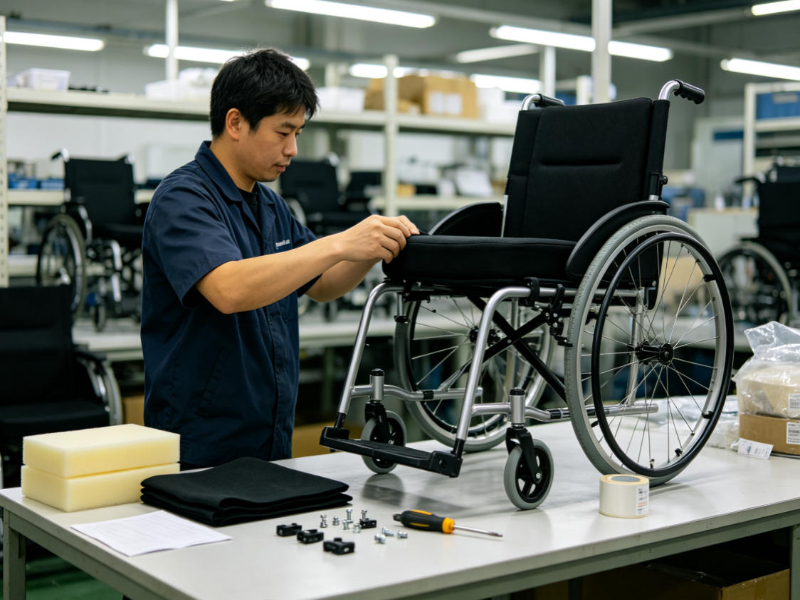
For buyers looking beyond a single product and evaluating an electric wheelchair manufacturer, the broader manufacturing capability matters.
IYASOCARE positions itself as a manufacturer of electric and manual wheelchairs rather than simply a component reseller. Its current product range covers electric wheelchairs, manual wheelchairs, standing wheelchairs, stair-climbing wheelchairs, off-road wheelchairs, sports wheelchairs, transfer wheelchairs and mobility products.
This matters because an electric wheelchair is a system made from many interconnected components. Motor selection affects controller requirements. Controller selection affects battery integration. Battery configuration affects range and packaging. Wheel size influences torque and speed. Frame design affects total weight. Braking and suspension influence handling.
A manufacturer that understands the complete wheelchair therefore has an advantage over a supplier that simply sells individual motors.
For international distributors, IYASOCARE also promotes OEM and ODM cooperation, including brand customisation, structural engineering support, packaging and labelling. Its current REHACARE 2026 information specifically positions the company as an OEM/ODM medical mobility manufacturer for distributors, hospitals and rehabilitation brands.
For buyers developing their own wheelchair brand, this broader capability can be more valuable than simply finding the cheapest motor.
For a distributor or importer, product selection should begin with the target market rather than the factory catalogue.
First, identify the intended user. Is the wheelchair designed for elderly users, rehabilitation patients, active users, outdoor users or general daily mobility?
Second, identify the operating environment. Indoor flooring, urban pavement, grass, ramps and rough outdoor surfaces place very different demands on a drive system.
Third, confirm the complete motor specification. Ask about motor type, nominal power, peak power where relevant, torque, voltage, controller compatibility and expected operating conditions.
Fourth, examine the battery system. Confirm battery chemistry, voltage, capacity, charging time, expected range and replacement options.
Fifth, ask about serviceability. If a hub motor fails, can the supplier provide a replacement wheel-motor assembly? Are controllers, batteries, chargers and other electrical components available separately?
Finally, request the technical documentation for the exact configuration being purchased. For regulated medical mobility products, certification and compliance documentation should correspond to the actual product configuration and target market.
These questions can save considerably more time and money than simply negotiating the motor price.
Before selecting a wheelchair hub motor, consider the following:
Motor architecture — Understand whether it is direct-drive or uses internal reduction.
Power and torque — Do not judge performance from wattage alone.
Battery compatibility — Confirm that battery voltage and current capability match the motor and controller.
Controller quality — Look for smooth acceleration, predictable low-speed control and appropriate differential-drive behaviour.
Wheel size — Larger wheels can affect obstacle handling, speed and torque requirements.
User load — Total user and equipment weight changes the workload.
Terrain — Flat indoor flooring is very different from ramps, grass or rough outdoor surfaces.
Braking — Confirm how the wheelchair stops and holds position when the joystick returns to neutral.
Heat management — Ask how the motor is designed for sustained loads.
Replacement parts — Confirm the availability of the correct motor/wheel assembly and controller.
Warranty and technical support — Especially important for B2B distributors selling into overseas markets.
A good supplier should be able to answer these questions clearly rather than simply quoting a motor wattage.
The most interesting development in electric mobility is not necessarily that motors are becoming more powerful. It is that motors, controllers, batteries, sensors and mechanical structures are increasingly being designed as one integrated system.
That trend is particularly relevant to wheelchair technology. Users expect smooth joystick control, compact dimensions, reliable braking, long battery life and increasingly sophisticated mobility functions. These expectations cannot be solved by upgrading one component in isolation.
A wheelchair hub motor can be an important part of that system because it brings the drive motor closer to the wheel and allows manufacturers to rethink the mechanical architecture of the wheelchair.
But the motor should never be considered the entire solution.
The best-performing electric wheelchair is the result of matching the motor to the battery, controller, wheel, frame, braking system and intended environment. This is why two wheelchairs with apparently similar motor ratings can feel completely different in real-world use.
For distributors, this is also an important lesson when building a product portfolio. Instead of asking only which wheelchair has the highest motor power, look at which manufacturer can provide the right combination of engineering, product range, documentation, spare parts and long-term support.
Understanding How Wheelchair Hub Motors Work and What to Know starts with one simple idea: the motor is closely integrated with the wheel, allowing electrical energy to be converted into wheel rotation through a compact drive architecture. The controller interprets the user’s joystick commands, the battery supplies energy, and the motor produces the torque required to move the wheelchair.
From there, the real engineering becomes more complicated.
Motor wattage matters, but torque matters too. Battery capacity matters, but controller programming matters as well. Wheel diameter, user weight, terrain, braking, suspension and thermal performance all influence how the wheelchair performs in everyday conditions.
For buyers evaluating electric mobility products, the key is therefore not to ask whether a hub motor is universally better than a geared motor. The better question is whether the specific wheelchair hub motor system is correctly engineered for the user and application.
IYASOCARE provides a useful example of this system-based approach, with a broad electric wheelchair portfolio and specialised mobility products rather than relying on one universal drive configuration. Its YSH1008 electric handcycle, for example, uses a 48V 800W hub motor, while its broader electric wheelchair range uses different drive configurations according to product requirements.
For an individual buyer, that means looking beyond the catalogue headline. For a distributor, it means evaluating the factory behind the product.
Ultimately, a good wheelchair hub motor should not simply make a wheelchair move. It should deliver predictable torque, responsive control, appropriate efficiency and reliable performance within the environment for which the wheelchair was designed. That is what turns motor technology into useful mobility.
1. How does a wheelchair hub motor work?
A wheelchair hub motor integrates the electric motor into the wheel hub. Electrical energy from the battery is managed by the controller and converted by the motor into rotational force at the wheel. The controller adjusts motor output according to joystick commands, allowing the wheelchair to move forward, reverse and turn. In two-wheel-drive systems, the left and right motors can be controlled independently to create differential steering.
2. Is a hub motor better than a geared motor for an electric wheelchair?
Not automatically. A hub motor can provide a compact and integrated drive system, while a geared motor can offer useful torque through mechanical reduction and may be well suited to heavier or more demanding applications. The better choice depends on the wheelchair’s total weight, user load, terrain, wheel size, battery, controller and intended operating conditions. Motor architecture should therefore be evaluated as part of the complete drive system rather than in isolation.
3. What should I check when buying a wheelchair with a hub motor?
Look beyond motor wattage. Check the motor’s power and torque, battery voltage and capacity, controller compatibility, wheel size, user load, climbing ability, braking system, terrain suitability and availability of replacement parts. For B2B buyers, it is also important to confirm technical documentation, warranty support, spare-part supply and whether the manufacturer can provide consistent configurations for future orders. A supplier with complete wheelchair engineering and OEM/ODM capabilities can be particularly valuable when building a long-term product range.