Our Location
Free Trade Tower, Xiyong street.
Chongqing, China

Free Trade Tower, Xiyong street.
Chongqing, China
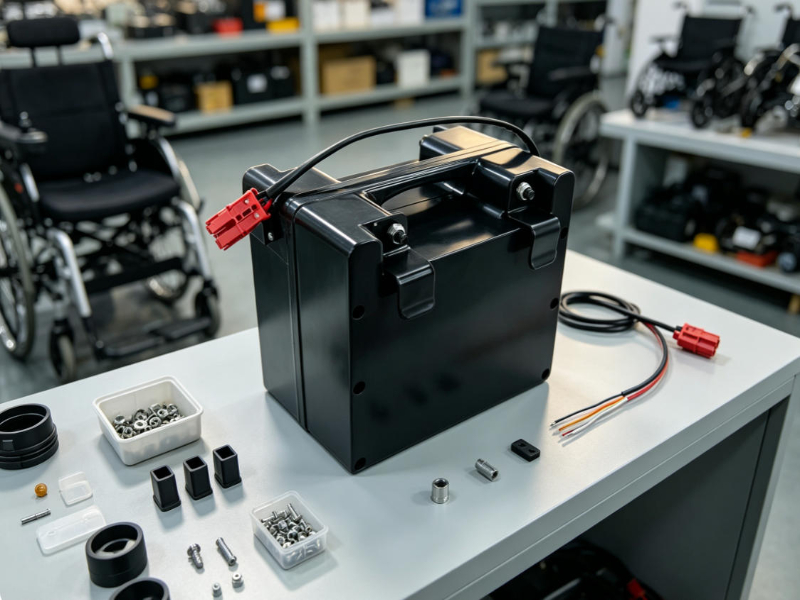
When people start shopping for a mobility scooter, the battery is rarely the first thing they think about. Most buyers begin with questions about speed, seat comfort, folding design, weight capacity or driving range. Yet once the scooter is used regularly, the battery often becomes one of the most important parts of the entire ownership experience. It determines how far the scooter can travel, how often it needs to be charged, how heavy the equipment is to transport and, over time, how much maintenance and replacement may be required.
That is why knowing how to choose the right battery for a mobility scooter is more important than simply choosing the largest battery available. A battery that is too small may leave the user worrying about range, while an unnecessarily large battery can add weight, cost and charging requirements without providing a meaningful benefit. The right choice depends on the scooter, motor, user weight, typical travel distance, terrain, storage conditions and daily routine.
Modern mobility scooters generally use either sealed lead-acid batteries or lithium-based battery systems. Both can provide dependable power when correctly matched to the scooter, but they offer very different advantages. Lead-acid batteries remain attractive because of their established technology and lower initial cost, while lithium batteries are increasingly popular because of their lower weight, energy density and convenience for active users. IYASOCARE’s current mobility scooter range reflects both approaches, with models using lead-acid and lithium battery configurations for different applications.
The key is not to ask which battery is universally “best.” The better question is: Which battery is right for the way the mobility scooter will actually be used?
The most useful starting point when deciding how to choose the right battery for a mobility scooter is your normal travel distance.
Think about a typical day rather than the maximum journey you might make once or twice a year. A person who uses a scooter to travel around a residential community, visit a nearby shop or move around a care facility may only need a modest range. Someone who regularly travels around a large town, visits shopping centres, attends appointments or spends several hours outdoors may need substantially more usable energy.
This distinction matters because battery capacity and advertised driving range are closely connected, but the number printed in a catalogue is not a guarantee of real-world distance. Actual range can change with user weight, terrain, temperature, tyre pressure, driving speed, stopping and starting, battery age and road conditions.
For example, IYASOCARE’s lightweight mobility scooter models include configurations offering approximately 10–30 km or 12–18 km of stated range, depending on the battery configuration and operating conditions. Other models are designed around longer everyday travel, with the YSS3003 listed with a range of up to 35 km.
This means a buyer should not begin with “How many amp-hours should I buy?” Begin with “How far do I normally need to travel?”
Once that answer is clear, battery capacity becomes much easier to evaluate.
Mobility scooter batteries are commonly described using voltage (V) and amp-hours (Ah). These figures tell you important information, but they should not be read separately.
Voltage describes the electrical potential of the battery system. Amp-hours indicate how much electrical charge the battery can theoretically deliver over time. A useful way to compare total stored energy is watt-hours:
Watt-hours (Wh) = Voltage (V) × Capacity (Ah)
For example, a 24 V 20 Ah battery has a nominal energy value of approximately 480 Wh, while a 24 V 10 Ah battery has approximately 240 Wh.
This does not mean a 480 Wh battery will always deliver exactly twice the real-world driving range of a 240 Wh battery. Motor efficiency, controller behaviour, terrain, load and other conditions influence actual performance. Nevertheless, watt-hours provide a more useful comparison when evaluating batteries with different voltage and capacity combinations.
This is particularly important when comparing lithium battery options. A 48 V 12 Ah system, for example, has approximately 576 Wh of nominal energy, which is different from simply comparing “12 Ah” with another battery without considering voltage.
For consumers, the practical lesson is simple: do not compare amp-hours alone when the voltage is different.
For distributors and mobility-equipment buyers, this becomes even more important because two scooters may advertise similar Ah figures while having substantially different electrical systems.
For many buyers, the biggest decision is between sealed lead-acid and lithium.
Lead-acid batteries have been used in mobility equipment for decades. Sealed AGM and gel batteries are familiar to dealers and technicians, relatively easy to source in many markets and usually less expensive at the point of purchase. They can therefore remain a sensible choice for users who prioritise initial affordability and use their scooter for moderate distances.
The main disadvantage is weight. Lead-acid batteries are relatively heavy, which increases the overall weight of the mobility scooter. This becomes particularly noticeable when a scooter needs to be transported or lifted into a vehicle.
Lithium batteries take a different approach. Their higher energy density allows manufacturers to provide useful energy with less battery weight. IYASOCARE’s own comparison of lithium and lead-acid systems highlights lower weight, improved energy density, longer potential service life and greater portability as important reasons lithium has become increasingly attractive in modern mobility equipment.
Lithium systems are therefore particularly interesting for users who frequently travel, transport their scooter, or want to minimise the physical burden of handling mobility equipment.
However, lithium is usually more expensive initially, and not every scooter can accept a lithium battery simply because the physical battery appears to fit. Voltage, charger specifications, battery-management electronics, connectors and the scooter’s electrical system must all be compatible.
The right battery is therefore determined by the complete scooter—not by the battery technology alone.
Battery weight can have a direct impact on mobility scooter ownership.
A scooter may be marketed as “portable,” but if its battery is heavy, the practical experience of transporting the scooter may still be difficult. This is particularly relevant to folding mobility scooters that are regularly placed in a car.
Lithium batteries can offer a significant advantage in this situation because they can provide substantial energy without the same weight associated with many lead-acid configurations.
Consider IYASOCARE’s lightweight folding scooter range. The YSS3028, for example, is listed at approximately 23 kg net and uses a 24 V 10 Ah or 15.6 Ah lithium battery configuration, while the YSS3027 weighs approximately 22 kg and also uses lithium battery options.
That kind of design demonstrates an important relationship between battery technology and product portability. The battery is not simply an energy source. It becomes part of the physical design strategy of the scooter.
For someone who keeps a scooter permanently at home, battery weight may be less important. For someone who places it into a car several times a week, battery weight can become one of the most important specifications.
When deciding how to choose the right battery for a mobility scooter, always ask:
Will I need to lift, remove, carry or transport the battery regularly?
If the answer is yes, battery weight deserves much more attention.
Driving range is one of the most frequently misunderstood mobility scooter specifications.
Manufacturers normally test or estimate range under defined conditions, but real-world use is rarely identical to a controlled test. A user travelling over flat pavement at moderate speed may achieve very different results from someone travelling uphill, carrying a heavier load or repeatedly accelerating and braking.
Temperature can also affect battery performance. Battery age matters as well. A battery that delivered excellent range when new may provide less usable energy after prolonged use and repeated charge cycles.
This is why buyers should avoid choosing a battery solely because a product page advertises a particular maximum range.
A better strategy is to create a range margin.
If your normal round trip is approximately 10 km, choosing a scooter with a stated maximum range of exactly 10 km would leave little room for changing conditions. A model advertised with substantially more range may provide a more comfortable margin for unexpected detours, hills or battery ageing.
The exact margin required depends on the manufacturer, model and use case. There is no universal percentage that applies to every mobility scooter.
What matters is avoiding a situation in which the user regularly operates the battery close to its practical limit.
A larger battery does not automatically make a mobility scooter more powerful.
The motor determines how the scooter converts electrical energy into movement, while the battery supplies the energy required by the electrical system. The controller regulates how that power is delivered.
This means battery selection has to be compatible with the scooter’s motor and controller.
For example, IYASOCARE’s current mobility scooter range includes products using different motor configurations, from compact 180 W or 250 W systems to higher-powered 350 W designs. The battery configurations vary accordingly, including 24 V lithium, 24 V lead-acid and 48 V lithium systems.
A buyer should therefore never replace a mobility scooter battery simply because another battery has a higher Ah rating. The replacement must meet the scooter’s required voltage, charging system, physical dimensions, connector configuration and electrical specifications.
This is especially important for replacement batteries.
If the original scooter was designed around a specific battery-management system or charger, installing an incompatible battery can create charging problems, performance issues or safety risks.
When in doubt, use the original battery specification as the starting point and confirm compatibility with the manufacturer or qualified technician.
Battery selection and charger selection should never be separated.
A battery needs a charger designed for its chemistry and electrical characteristics. A lithium battery and a sealed lead-acid battery are not interchangeable simply because they share the same nominal voltage.
Charging requirements can differ according to battery chemistry, battery-management system, capacity and manufacturer specifications.
This is one reason buyers should use the charger recommended for the exact scooter and battery configuration.
A correct charging system also affects convenience. A user who travels frequently may value a battery that can be recharged within their daily routine, while an occasional user may be perfectly comfortable with overnight charging.
IYASOCARE’s published mobility scooter information, for example, lists charging periods of around 5–8 hours for several lithium-powered folding models.
Rather than asking only “How long does the battery last?”, ask two questions:
How far can I realistically travel?
and
How easily can I recharge it when I return?
Together, these questions give a much better picture of everyday usability.
Lithium batteries usually cost more than lead-acid batteries at the beginning, but the initial purchase price does not tell the whole story.
For frequent users, the lower weight can make transportation easier. Higher energy density can help manufacturers create more compact battery systems. Lithium technology can also provide longer service life under appropriate operating conditions.
IYASOCARE’s recent battery guidance describes lithium systems as increasingly attractive for mobility applications because of their lower weight, energy efficiency, charging convenience and potential long-term value. It also points out that lithium batteries still require correct charging and should not be treated as maintenance-free.
This makes lithium particularly attractive for:
However, lithium should not automatically replace lead-acid in every application. If the scooter is primarily used for short local journeys and affordability is the highest priority, a properly specified lead-acid system can still make practical sense.
The best battery is the one that provides the required performance without creating unnecessary cost or weight.
It is easy to assume that newer technology automatically makes older technology obsolete. In mobility equipment, that is not necessarily true.
Lead-acid batteries remain useful because they are familiar, widely supported and relatively affordable. For users who travel short distances, do not frequently transport their scooter and want to minimise the initial purchase price, they can be a perfectly reasonable choice.
IYASOCARE’s mobility scooter range includes lead-acid configurations such as the YSS3003, which is listed with a 24 V 20 Ah lead-acid battery, while other models use lithium configurations.
The important issue is matching the technology to the application.
For example, a mobility scooter used mainly inside a large building or around a residential community may not need the lightweight characteristics of a premium lithium battery. A user who transports a folding scooter in a vehicle several times a week may have exactly the opposite priority.
Battery selection should therefore be based on use frequency, travel distance, transport requirements and budget, rather than technology trends alone.
Battery requirements are also affected by the total load placed on the mobility scooter.
A heavier user requires more energy to move than a lighter user under otherwise similar conditions. The difference becomes even more noticeable on slopes, uneven surfaces or during frequent starts and stops.
Terrain matters because the motor has to work harder when climbing. Grass, rough pavement, ramps and inclines can increase energy consumption compared with smooth, flat flooring.
This is why a user who regularly travels on hills should not select a battery based solely on the distance they travel.
Imagine two users who both travel 15 km per day. One travels almost entirely on flat pavement. The other travels 15 km through a hilly area with several ramps. Their battery requirements may be quite different.
This is also why IYASOCARE positions different mobility scooter models around different applications. Its product information distinguishes lightweight portable scooters from models intended for longer-range everyday mobility, rather than treating one battery configuration as suitable for every user.
The more demanding the terrain, the more carefully the buyer should consider the complete motor-battery system.
A battery can be technically suitable for a mobility scooter and still perform poorly if it is stored incorrectly.
Extreme temperatures can affect battery performance and charging. Long periods of storage can also create problems if the battery is left in an inappropriate state of charge.
Lead-acid batteries are particularly sensitive to being stored for long periods without adequate charging, while lithium batteries also require proper storage conditions and should not be exposed to excessive heat.
For occasional users, this is an important consideration. A scooter that sits unused for weeks or months requires a different battery-care routine from a scooter used every day.
Before storing the scooter for a long period, follow the battery manufacturer’s instructions regarding charge level, temperature and charging frequency.
Do not assume that “not using the scooter” means the battery requires no attention.
Good battery care can be just as important as choosing the right battery in the first place.
Instead of comparing batteries using one specification, use this simple five-part framework:
Distance — How far do you normally travel during a typical day?
Energy — What voltage and Ah capacity does the scooter require?
Weight — Will the scooter or battery need to be lifted and transported?
Environment — Will you use it mainly indoors, outdoors, on flat roads or on hills?
Ownership — Is your priority low upfront cost or lower weight and longer-term convenience?
This framework prevents a common mistake: choosing the battery first and the scooter second.
The scooter should come first. Once you know the motor, controller and electrical architecture, you can determine which battery options are compatible and then select the configuration that best matches the user’s lifestyle.
For distributors and mobility-equipment buyers, IYASOCARE provides an interesting example of why battery selection should be linked to product positioning.
The IYASOCARE mobility scooter range includes lightweight folding scooters, compact electric mobility scooters and longer-range configurations. Different models use different battery systems, allowing products to target different customer requirements rather than forcing every user into one battery solution.
The YSS3027 is positioned around lightweight portability. It weighs approximately 22 kg and uses a 24 V 10 Ah or 15.6 Ah lithium battery, with a stated charging time of around 5–8 hours and a maximum load of 120 kg. This type of configuration is particularly relevant when easy transport and everyday urban mobility are priorities.
The YSS3028 goes a step further for users who want reduced physical effort during storage. It weighs approximately 23 kg and features one-touch electric folding, while using 24 V 10 Ah or 15.6 Ah lithium battery options. Its design demonstrates that battery choice is only one part of portability; the folding mechanism and total scooter weight matter as well.
For customers who prioritise longer local journeys, the YSS3003 provides a different proposition. Its published specification includes a 24 V 20 Ah lead-acid battery, dual 250 W motors and a stated range of up to 35 km. Rather than competing directly with ultra-light folding scooters, it targets users who place greater value on range and everyday performance.
Another interesting option is the YSS3004, a one-hand-operated portable mobility scooter using a 48 V 12 Ah lithium battery, 350 W motor and a stated 15–30 km range. Its 25–30 kg net/gross weight range and 150 kg load rating make it a different proposition again, particularly for users who value one-hand control, portability and higher load capacity.
These examples illustrate an important principle for distributors: battery configuration can help define the market position of a mobility scooter. Lightweight lithium models can target portability and travel, while larger lead-acid configurations may remain attractive in value-focused or longer-range applications.
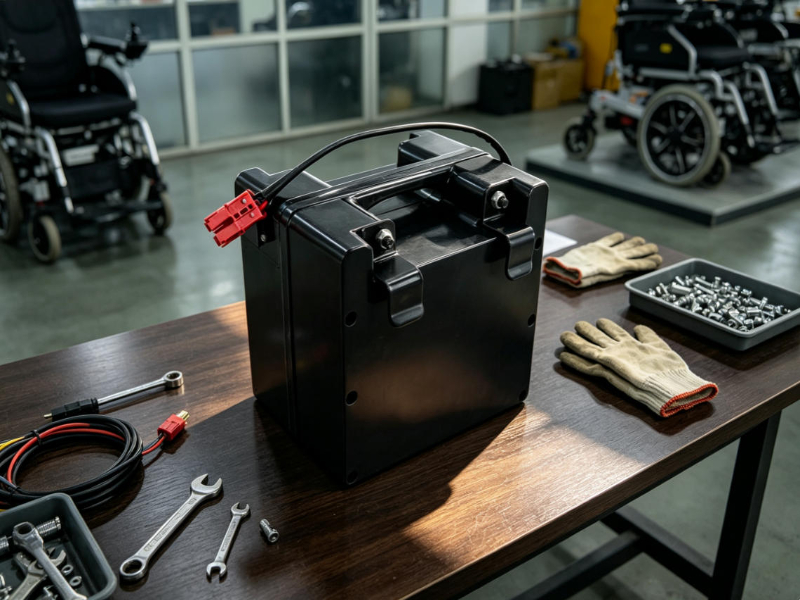
For distributors, choosing the right battery involves more than comparing product prices.
Before placing an order, ask the manufacturer whether the battery is standard or optional, which chemistry is used, what voltage and capacity are available, whether the battery is removable, which charger is included, and what replacement options are available.
It is also useful to ask about battery warranty and expected service life under normal usage. Battery performance naturally changes over time, so a distributor needs to understand not only the initial product specification but also the after-sales process.
If a customer needs a replacement battery two years after purchase, can the same specification still be supplied?
That question is particularly important when building a long-term product range.
Distributors should also ask whether different battery configurations affect the scooter’s weight, range, packaging, transport requirements or regulatory documentation. A change from lead-acid to lithium is not necessarily a simple component substitution.
For international markets, battery shipping requirements should also be considered before developing a logistics plan, especially for lithium-powered products.
Ultimately, how to choose the right battery for a mobility scooter comes down to understanding the user’s daily life.
If the scooter is used occasionally for short trips and the purchase budget is tight, a reliable lead-acid configuration may be sufficient. If the scooter is used every day, transported frequently or expected to provide more range from a lightweight package, lithium becomes increasingly attractive.
But battery chemistry is only the beginning.
The right decision also requires checking voltage, amp-hours, energy capacity, motor requirements, controller compatibility, charger specifications, user weight, terrain and expected driving distance. The battery should work as part of the scooter’s complete electrical and mechanical system.
This is why a 20 Ah battery is not automatically better than a 10 Ah battery, and a lithium battery is not automatically better than lead-acid for every customer. The value of a battery depends on what the user needs it to accomplish.
A well-matched battery should provide enough practical range without unnecessary weight or cost. It should be compatible with the scooter’s electrical system, supported by the correct charger and backed by a reliable replacement and service programme.
That is the real meaning of choosing the right battery for a mobility scooter.
The best battery is not the one with the biggest number on the specification sheet. It is the one that quietly does its job every day—providing enough energy, maintaining reliable performance and allowing the user to focus on where they want to go rather than how much battery is left.
1. What is the best battery for a mobility scooter?
There is no single battery that is best for every mobility scooter user. Lithium batteries are particularly attractive for users who prioritise low weight, portability, frequent travel and long-term convenience, while sealed lead-acid batteries can be a practical choice when lower upfront cost and local replacement availability are more important. The correct choice should match the scooter’s electrical system, expected travel distance, user load and daily environment.
2. How do I know what battery capacity I need for my mobility scooter?
Start with your typical daily travel distance, then check the scooter manufacturer’s specified voltage and battery options. Capacity is normally expressed in Ah, but voltage should also be considered because total nominal energy is related to both. For example, 24 V × 20 Ah represents approximately 480 Wh of nominal energy. You should also account for terrain, user weight, temperature, battery age and real-world driving conditions rather than relying entirely on the maximum advertised range.
3. Should I replace my mobility scooter battery with lithium?
Lithium can be an excellent upgrade when the scooter is specifically designed or approved for a compatible lithium battery system. It can reduce weight and improve portability while providing high energy density. However, you should never replace a lead-acid battery with a lithium battery solely because the voltage appears similar. The charger, battery-management system, connectors and scooter electronics must all be compatible. Always confirm the correct replacement specification with the scooter manufacturer or a qualified technician.