Our Location
Free Trade Tower, Xiyong street.
Chongqing, China

Free Trade Tower, Xiyong street.
Chongqing, China
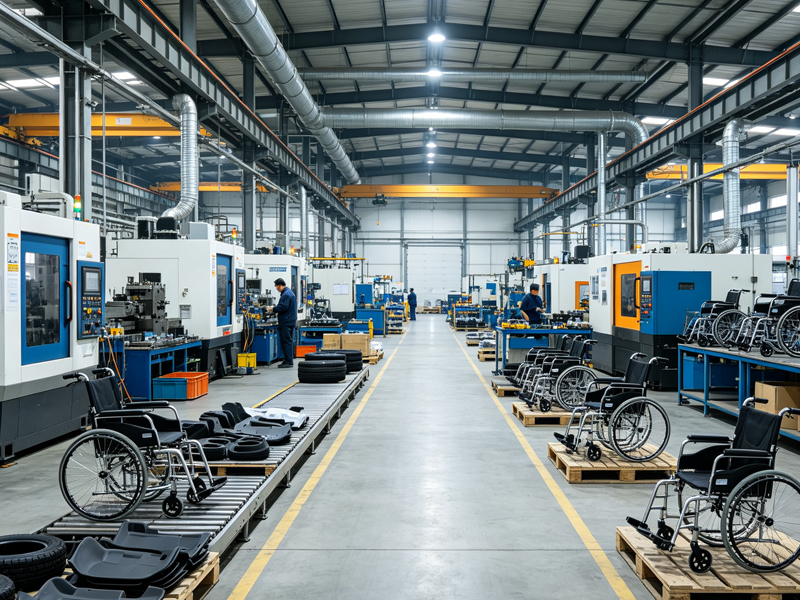
When people hear the phrase custom wheelchair manufacturing, they often imagine a standard wheelchair with a different seat width, a few extra accessories, or a personalized color. In reality, a truly customized wheelchair is much closer to a carefully engineered mobility system. Its dimensions, seating position, support components, materials, control system, and even the way weight is distributed can all be adapted around one specific user.
That difference matters.
A wheelchair is not simply something a person sits in. For many users, it becomes part of their everyday body position, mobility, work, education, travel, and social life. A poorly matched chair can create discomfort and make movement more difficult, while a well-designed wheelchair can make everyday activities considerably more efficient.
So, how does custom wheelchair manufacturing work?
The answer is not one single manufacturing technique. It is a process that combines user assessment, dimensional measurement, seating design, engineering, material selection, fabrication, assembly, testing, and final fitting. Modern manufacturers may also use CAD software, 3D scanning, pressure mapping, CNC machining, vacuum forming, and other digital production technologies.
The biggest misunderstanding about custom wheelchair manufacturing is assuming that production begins in the factory.
It usually doesn’t.
The real starting point is understanding who will use the wheelchair and how they will use it.
Before a manufacturer or seating specialist begins designing anything, they need to understand factors such as body dimensions, posture, mobility ability, daily activities, environment, transfer method, sitting tolerance, pressure-relief requirements, and the user’s preferred method of propulsion or control.
A person who spends most of the day indoors may have completely different requirements from someone who regularly travels outdoors over uneven surfaces. Likewise, an active manual wheelchair user may prioritize low weight and efficient propulsion, while another user may need more postural support, power positioning functions, or specialized controls.
This is why custom wheelchair manufacturing is better understood as a design process rather than an assembly process.
The manufacturer is essentially trying to answer a series of practical questions:
These questions influence almost every stage that follows.
International wheelchair standards also demonstrate how many different aspects of wheelchair design require structured testing. The ISO 7176 series covers areas including stability, braking, dimensions, power systems, durability, and performance.
In other words, customization does not mean “make whatever the customer asks for.” Good customization means finding the right engineering solution for a particular user.
Once the requirements are established, the next step is capturing the user’s dimensions and seated shape.
Traditional measurement is still important. A technician may measure:
But modern custom manufacturing can go much further than a tape measure.
For complex seating systems, manufacturers may use a combination of physical molding and digital shape capture. Research on custom-contoured wheelchair seating describes the process in three broad stages: shape capture, seat production, and seat completion.
This distinction is useful because it explains why a custom cushion or back support can look very different from an ordinary flat cushion.
The user is positioned in the desired posture, and the shape of the body-seat interface is recorded.
Depending on the manufacturing method, this may involve:
For a relatively straightforward seating requirement, traditional measurements may be sufficient.
For a more complex posture or highly contoured seating system, however, capturing the actual three-dimensional shape can provide much more useful information.
A digital model can also be stored and modified later, which is one of the major advantages of modern digital manufacturing.
One of the more interesting technologies used in custom wheelchair seating is pressure mapping.
A pressure mapping system typically places a thin sensor array between the user and the cushion. It can show how pressure is distributed across the seating surface.
This matters because two cushions can have exactly the same external dimensions but create very different pressure patterns.
For example, a design may appear comfortable during a quick visual inspection but produce concentrated pressure in specific areas. A customized cushion can instead be shaped to increase contact area and reduce excessive loading in problematic regions.
Recent research has explored a digital workflow in which pressure distribution is converted into a three-dimensional cushion design, followed by CAD modeling and CNC foam machining.
That does not mean pressure mapping automatically produces the “perfect cushion.” Human posture, movement, tissue characteristics, cushion materials, and daily use all influence the final result.
But it provides manufacturers and clinicians with another valuable piece of information.
Think of it as the difference between looking at a shoe and actually seeing where someone’s foot is experiencing pressure inside the shoe.
After the measurements and shape information have been collected, the manufacturer can begin turning those numbers into a real design.
For digitally manufactured wheelchairs and seating systems, this may involve CAD (computer-aided design).
The technician or engineer can create a three-dimensional model and adjust specific dimensions before physical production begins.
This is particularly useful when designing:
The digital model allows the designer to evaluate relationships between different components.
For example, changing seat height can influence foot position. Moving the rear axle can affect propulsion and stability. Altering the back angle can change posture and pressure distribution.
A custom wheelchair therefore cannot be designed by looking at individual components in isolation.
Everything interacts.
This is one reason experienced wheelchair manufacturers pay close attention to the overall geometry of the system, rather than simply adding customized parts onto a standard frame.
Material selection is another important part of the manufacturing process.
Depending on the wheelchair and its intended use, manufacturers may work with materials such as:
Each material has advantages and limitations.
Aluminum, for example, is widely used because it offers a useful combination of strength, weight, manufacturability, and cost.
Titanium can offer excellent strength-to-weight characteristics but generally comes with higher material and manufacturing costs.
Carbon fiber can be attractive when very low weight and controlled structural properties are important, but composite construction requires different manufacturing knowledge from conventional metal fabrication.
For seating components, the situation is different again.
Foam selection depends on factors such as density, firmness, durability, contouring requirements, moisture management, and the intended seating design.
A custom cushion is therefore not simply “a piece of foam cut to size.”
The geometry and material properties have to work together.
Once the design has been approved, manufacturing begins.
This is where different types of custom wheelchair manufacturing can take very different paths.
CNC machining
CNC technology is increasingly useful for customized seating.
The digital design is converted into machine instructions, allowing a CNC machine to carve a foam block into a specific three-dimensional shape.
A documented custom-cushion workflow, for example, used pressure-derived data to create a CAD model and then used CNC milling to produce a contoured foam cushion.
The advantage is repeatability.
If the same digital design needs to be reproduced later, the manufacturer has the original geometry rather than relying entirely on a physical mold.
Vacuum forming
Vacuum forming is another important technique, particularly for rigid or semi-rigid seating structures.
A plastic sheet is heated and formed over a mold using vacuum pressure. The resulting component follows the shape of the mold.
For custom seating systems, this can create a rigid shell that supports a user’s body in a specific position.
Research reviewing wheelchair seating manufacturing describes workflows in which physical forms are digitized, CNC-machined tools are produced, and thermoplastic sheets are subsequently vacuum formed over those tools.
Foam-in-place manufacturing
Another approach is foam-in-place seating.
Instead of first producing a digital model and then machining a separate cushion, specially selected materials are formed directly around the user’s seated position.
This can be particularly useful when the goal is to create a highly individualized contour.
However, this method requires careful control because the manufacturing process itself becomes part of the seating assessment.
Custom seating is only one part of custom wheelchair manufacturing.
When the wheelchair frame itself is customized, the engineering requirements become more demanding.
For a manual wheelchair, the manufacturer may need to determine:
Small changes can affect how the wheelchair behaves.
For example, changing the rear wheel position can influence propulsion efficiency and maneuverability, but it can also affect stability.
A highly active wheelchair may therefore be deliberately configured differently from a general-purpose chair.
The objective is not simply to make the chair smaller, lighter, or more attractive.
It is to find a balance between stability, mobility, strength, comfort, and user control.
Custom power wheelchair manufacturing introduces additional systems that do not exist on a basic manual wheelchair.
These can include:
The position of the joystick, for instance, may need to accommodate limited hand movement. In some cases, conventional joystick control may not be appropriate at all, requiring alternative input methods.
Power seating functions also need to be engineered carefully.
Tilt, recline, elevation, and standing mechanisms change the wheelchair’s mechanical configuration and therefore influence stability and structural loads. ISO 7176-30 specifically addresses testing requirements for wheelchairs incorporating functions such as tilt, recline, elevation, and standing.
This is an important distinction: a custom wheelchair is not exempt from engineering requirements simply because it is individually made.
Customization has to coexist with safety.
After the frame, seating components, controls, wheels, supports, and accessories are manufactured, everything comes together during assembly.
This stage can look deceptively simple.
A technician may install:
But assembly is not just fastening components together.
The final configuration needs to be checked against the original design.
Wheelchair standards include formal setup procedures because configuration can affect how a wheelchair performs during testing. ISO 7176-22 specifies setup procedures for adjustable manual and powered wheelchairs, including scooters.
This is why experienced manufacturers treat the setup stage as an engineering step rather than an afterthought.
A wheelchair that looks perfect is not necessarily a wheelchair that performs perfectly.
Before delivery, manufacturers may conduct various inspections and tests depending on the type of wheelchair and applicable requirements.
These can include checking:
The specific testing requirements depend on the wheelchair design and applicable regulations and standards.
For example, the ISO 7176 family contains standards covering static stability, dynamic stability, braking, dimensions, power and control systems, electromagnetic compatibility, batteries, and other performance characteristics.
In the United States, the FDA also recognizes a number of ISO wheelchair standards as consensus standards for relevant medical-device submissions.
The practical takeaway is simple:
Customization changes the design, but it does not eliminate the need for testing.
There is one stage that can easily be overlooked when people talk about manufacturing: the final fitting.
A wheelchair can be manufactured exactly according to the original measurements and still require adjustments.
Why?
Because sitting in a real wheelchair is different from being measured in an assessment environment.
The user may notice that:
This is normal.
Custom seating research identifies fitting appointments and final adjustments as part of the completion process, including modifications to foam, pressure-relief components, protective coatings, and removable covers.
In practice, good customization is often iterative.
Measure → design → manufacture → fit → evaluate → adjust.
That cycle may be repeated until the wheelchair works properly for the user.
The wheelchair industry is gradually moving from purely manual fabrication toward a hybrid model that combines traditional craftsmanship with digital manufacturing.
The reason is straightforward: digital information is easier to store, reproduce, modify, and transfer.
Imagine that a custom seating system was made several years ago and the user needs a replacement.
With a traditional physical mold, the manufacturer may need to recreate much of the original process.
With a digital model, the original geometry can potentially be retrieved and modified.
Digital manufacturing also allows manufacturers to connect several stages:
assessment → scanning → CAD → CNC machining → fabrication → fitting
This creates a more traceable workflow.
It can also make customization more scalable.
Instead of thinking about mass production and custom manufacturing as opposites, modern manufacturing can combine them: standardized structural components may be produced efficiently, while selected components such as seating surfaces, supports, brackets, and controls are individualized.
That hybrid approach is likely to remain important as wheelchair technology develops.
This is an important point for anyone considering a custom wheelchair.
A wheelchair does not necessarily need to be completely handmade from the ground up to qualify as customized.
In many cases, manufacturers use a modular platform and customize the elements that have the greatest impact on the user’s needs.
For example, a standard base might be combined with:
This approach can reduce manufacturing complexity while still producing a highly individualized wheelchair.
It also makes maintenance easier because certain components can be replaced without rebuilding the entire chair.
The most effective customization is therefore not necessarily the most complicated customization.
It is the customization that solves the user’s actual problems.
A good custom wheelchair should not be judged only by appearance or the number of customized components.
Several factors matter more.
Fit is fundamental. The chair should correspond appropriately to the user’s body dimensions and posture.
Function matters just as much. The wheelchair should support the activities the person actually performs every day.
Stability and safety cannot be compromised for aesthetics or weight reduction.
Adjustability can be valuable because the user’s needs may change over time.
Durability is essential because wheelchairs often experience daily mechanical stress.
Maintainability is another consideration that is frequently overlooked. A highly customized wheelchair that is extremely difficult to repair may become frustrating in real-world use.
And finally, there is user acceptance.
The best engineering solution on paper is not necessarily the best solution for a real person if it is uncomfortable, difficult to operate, or incompatible with their lifestyle.
That is why successful custom wheelchair manufacturing combines engineering with practical human-centered design.
There is no universal manufacturing timeline.
A relatively simple customized manual wheelchair may require much less production time than a highly specialized powered wheelchair with custom seating and multiple positioning functions.
The timeline can depend on:
One thing is worth remembering: manufacturing time and customization quality are not the same thing.
A rushed manufacturing process may save time initially but create additional fitting and adjustment problems later.
For a complex wheelchair, the final fitting stage is particularly important because it is where theoretical design meets actual daily use.
The future of wheelchair manufacturing is likely to be increasingly personalized without becoming entirely manual.
Three technologies are especially interesting: 3D scanning, digital pressure mapping, and automated manufacturing.
A user could potentially be scanned in a specific posture, have pressure distribution recorded, and then have those measurements converted into a digital seating model.
The model could be adjusted by a clinician and engineer before being sent directly to a CNC machine or another manufacturing system.
Research into pressure-based custom cushion production is already exploring this type of workflow.
At the same time, traditional manufacturing skills will remain important.
A machine can reproduce a digital model accurately, but it cannot replace the practical knowledge required to determine whether that model actually makes sense for the person using it.
The future is therefore unlikely to be “machines replacing technicians.”
It is more likely to be technicians using better digital tools to make more precise decisions.
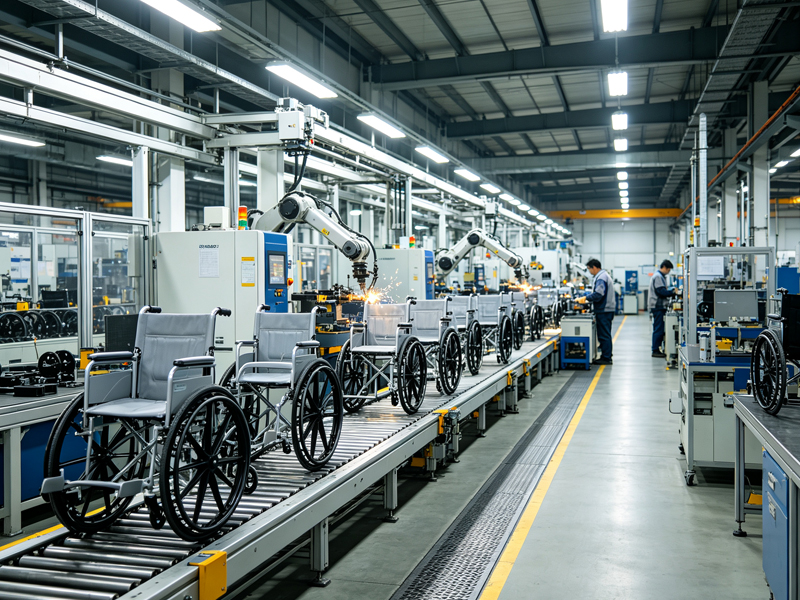
So, how does custom wheelchair manufacturing work?
It begins long before metal is cut or foam is carved.
A proper custom wheelchair starts with understanding the user. Measurements, posture, mobility goals, environment, pressure distribution, and control requirements are translated into a design. That design may then be produced using traditional fabrication, CAD, CNC machining, vacuum forming, specialized upholstery, electrical integration, or a combination of these techniques.
After assembly, the wheelchair is tested and, most importantly, fitted to the actual user.
The finished product is not simply a wheelchair with customized dimensions. It is a mobility system engineered around one individual.
That is what makes custom wheelchair manufacturing different from ordinary mass production—and why the quality of the assessment and fitting process can be just as important as the technology used inside the factory.
1. How is a custom wheelchair different from a standard wheelchair?
A standard wheelchair is generally manufactured around predefined dimensions and configurations, while a custom wheelchair can be adapted to the user’s body measurements, posture, mobility requirements, environment, and control needs.
Customization may involve the frame, seat, cushion, back support, footrests, wheels, controls, or several of these components at once.
The key difference is not simply that the chair is “made differently.” It is that the design starts with the user’s specific requirements rather than a fixed product configuration.
2. Does custom wheelchair manufacturing always use 3D scanning and CNC machines?
No.
Traditional measurement, physical molding, foam fabrication, vacuum forming, and manual machining are still useful manufacturing methods. Digital technologies such as 3D scanning and CNC machining are additional tools that can improve precision, repeatability, and data storage.
For some users, a relatively conventional customized configuration may be entirely appropriate. For complex seating needs, digital manufacturing can provide significant advantages.
3. What is the most important part of the custom wheelchair manufacturing process?
There is no single component that matters more in every case, but accurate assessment and final fitting are two of the most critical stages.
If the original requirements are misunderstood, even excellent manufacturing cannot produce the right result. Likewise, a technically accurate wheelchair may still need adjustments after the user actually sits and moves in it.
The strongest process is therefore a complete loop:
Understand the user → measure → design → manufacture → test → fit → adjust.
That is ultimately what turns a customized wheelchair from a collection of specialized components into a practical mobility solution.