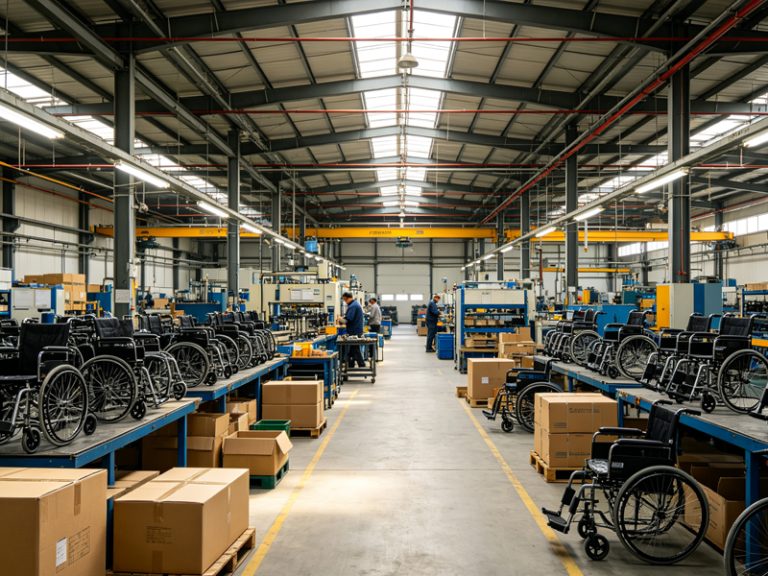
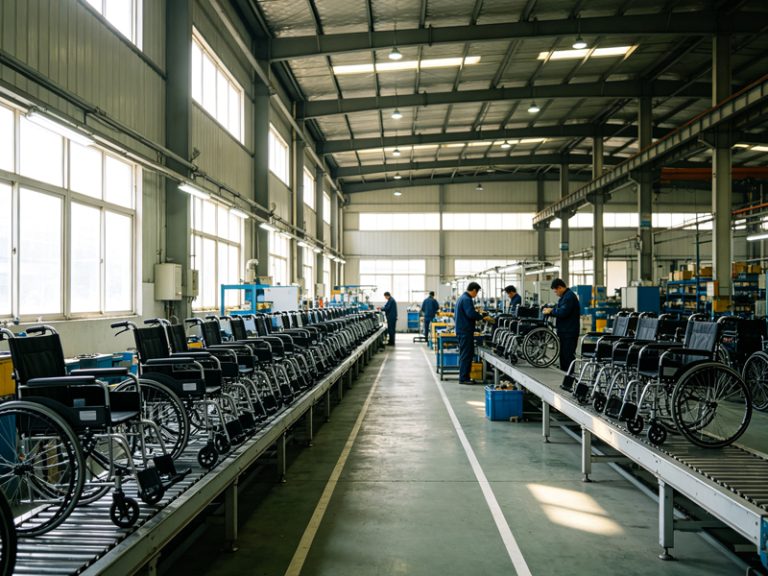
Our Location
Free Trade Tower, Xiyong street.
Chongqing, China

Free Trade Tower, Xiyong street.
Chongqing, China
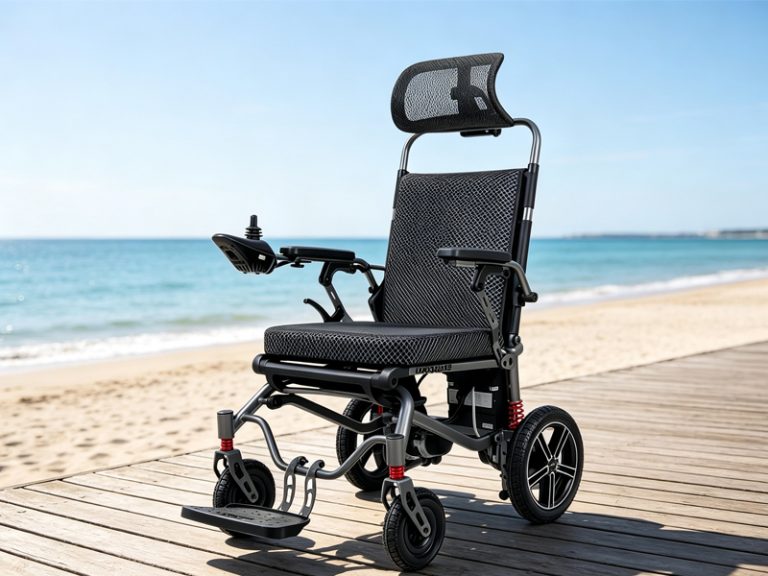
If you are planning to launch a wheelchair brand, expand an existing mobility product line, or develop a wheelchair for a specific market, you may have come across the term wheelchair ODM.
At first glance, ODM sounds similar to OEM, and the two are often used interchangeably. In reality, there is an important difference between them. Choosing the wrong production model can affect product development costs, launch time, customization options, intellectual property ownership, and even the long-term competitiveness of your brand.
So, what exactly is wheelchair ODM? How does it work? And more importantly, when should you choose wheelchair ODM instead of OEM or an off-the-shelf wheelchair?
This guide takes a practical look at wheelchair ODM from the perspective of product development, manufacturing, customization, branding, and business strategy. Whether you are a distributor, medical equipment company, retailer, startup, or established mobility brand, understanding the ODM model can help you make a more informed purchasing decision.
ODM stands for Original Design Manufacturer.
In the wheelchair industry, a wheelchair ODM manufacturer typically designs, engineers, develops, and manufactures wheelchair products on behalf of another company. The buyer can then sell the finished product under its own brand name.
In simple terms, the manufacturer provides more than a factory. It can provide the product concept, engineering design, components, prototypes, testing support, manufacturing, and production capabilities.
For example, imagine that a mobility equipment distributor wants to introduce a lightweight electric wheelchair for urban users.
Instead of designing every component from scratch, the distributor can work with a wheelchair ODM manufacturer that already has experience developing lightweight frames, folding mechanisms, motors, controllers, batteries, brakes, and seating systems.
The manufacturer may already have a basic platform that can be modified according to the distributor’s requirements. The company can then customize elements such as:
The final product can be sold under the buyer’s brand.
This is one of the major advantages of wheelchair ODM: you do not necessarily have to start product development from a blank sheet of paper.
At the same time, ODM does not always mean simply choosing a product from a catalog and adding a logo. A capable ODM manufacturer can work with a customer to modify an existing design or develop a substantially different product according to the target market.
That distinction becomes particularly important when discussing OEM versus ODM.
The terms OEM and ODM are often confused because both involve private-label manufacturing. However, the development process is different.
With OEM manufacturing, the buyer generally provides the product design, technical specifications, drawings, or detailed requirements. The manufacturer is primarily responsible for producing the product according to those specifications.
With ODM manufacturing, the manufacturer contributes significantly more to the product itself.
A simplified comparison looks like this:
| Feature | Wheelchair OEM | Wheelchair ODM |
|---|---|---|
| Product design | Usually provided by buyer | Usually provided or co-developed by manufacturer |
| Engineering support | Limited to moderate | Usually extensive |
| Product development | Buyer-led | Manufacturer-led or collaborative |
| Customization | Based on buyer specifications | Often flexible depending on platform |
| Development cost | Can be higher | Often lower for new brands |
| Development time | May be longer | Often shorter |
| Best for | Established product designs | Companies seeking faster product development |
| Technical expertise required from buyer | Higher | Lower to moderate |
Neither model is automatically better.
If your company already owns a mature wheelchair design, has its own engineering team, and needs a manufacturer capable of producing the product at scale, OEM may be the better choice.
But if you have a clear market opportunity without the engineering resources to develop a wheelchair from scratch, ODM can be much more practical.
The real question is not “Is ODM better than OEM?”
The better question is:
“Which manufacturing model matches my product development capabilities and business goals?”
A professional wheelchair ODM project usually involves several stages.
It begins with understanding the market rather than immediately discussing price.
A serious manufacturer should first understand who will use the wheelchair, where it will be sold, and what regulations and performance requirements apply.
For example, a wheelchair designed for occasional indoor use may have completely different requirements from a heavy-duty outdoor power wheelchair.
A distributor targeting elderly users may prioritize simple controls, comfortable seating, and easy folding. A premium mobility brand may instead focus on suspension, range, aesthetics, modular components, and advanced electronics.
Once the requirements are clear, the manufacturer can recommend an existing platform or propose a new design direction.
Product Concept and Design
The first stage is generally product definition.
This may include decisions about:
At this stage, experienced ODM manufacturers can provide valuable engineering advice.
For example, a customer may request a very lightweight electric wheelchair. On paper, that sounds straightforward. In practice, reducing weight can affect frame strength, battery capacity, stability, durability, and production cost.
A good ODM partner should be able to explain those trade-offs instead of simply saying yes to every requirement.
Prototype Development
After the design direction is confirmed, the manufacturer develops prototypes.
Prototypes are important because specifications on paper do not tell the whole story.
A prototype allows the customer to evaluate:
For electric wheelchairs, testing may also include battery performance, motor behavior, controller response, charging, electromagnetic compatibility, and different terrain conditions.
Several rounds of modification may be necessary before the product is ready for mass production.
Testing and Validation
A wheelchair is not an ordinary consumer product.
Depending on the product type and target market, manufacturers may need to consider applicable safety standards, electrical requirements, battery transportation requirements, labeling rules, documentation, and market-specific certifications.
For international sales, this becomes especially important.
A wheelchair that is suitable for one market may require additional testing or documentation before it can legally be sold in another.
This is why it is risky to choose an ODM manufacturer based solely on a low quotation.
A manufacturer may offer an attractive factory price but lack the testing, engineering, quality control, or regulatory knowledge necessary for international distribution.
Mass Production
Once the product has been finalized and approved, production can begin.
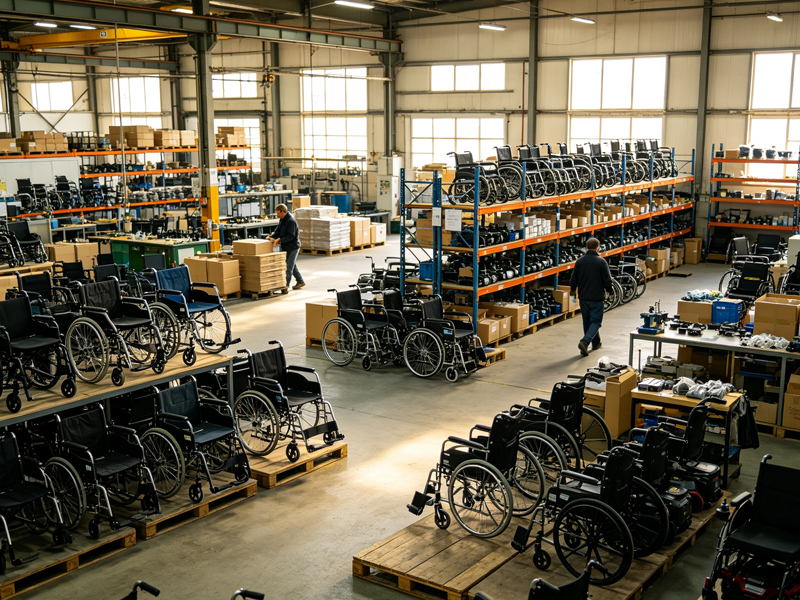
At this stage, the ODM manufacturer manages sourcing, assembly, quality control, packaging, and shipment according to the agreed specifications.
For a private-label wheelchair brand, packaging and branding are also important.
The product may carry the buyer’s:
The result is a finished wheelchair that looks and feels like part of the buyer’s own product portfolio.
Not every company needs ODM.
However, there are several situations where it makes particularly strong business sense.
1. You Want to Launch a New Wheelchair Brand
Starting a wheelchair brand from scratch can be expensive.
You need product designers, mechanical engineers, electrical engineers, suppliers, testing resources, manufacturing equipment, quality control systems, and technical documentation.
For a startup, building all of these capabilities internally may not be realistic.
Working with an ODM manufacturer allows the brand owner to focus on areas where it may have stronger capabilities, such as:
Meanwhile, the manufacturer handles much of the product development and production process.
This can significantly reduce the barrier to entering the wheelchair market.
2. You Have a Market Idea but No Complete Product Design
This is perhaps one of the clearest situations for choosing ODM.
You may know exactly what your customers want but not know how to engineer the product.
For example, you may discover that customers in your market want a folding electric wheelchair that fits into a small vehicle trunk but still provides enough battery range for daily outdoor use.
That is a market requirement, not a complete engineering specification.
An experienced ODM manufacturer can translate that requirement into a practical product design.
This is one of the biggest differences between working with an ordinary factory and working with a true ODM partner.
3. You Need to Reduce Development Time
Time is particularly important when entering a competitive market.
Developing a completely new wheelchair from zero can take months or longer, depending on complexity.
An ODM manufacturer may already have a tested platform, established suppliers, engineering drawings, production processes, and component knowledge.
Instead of starting from zero, the development process can begin from an existing technical foundation.
That does not mean the product should simply be copied from a catalog.
The objective is to use existing engineering experience to accelerate development while creating a product that fits the customer’s requirements and brand positioning.
4. You Need Customization Without Building Your Own Factory
Some companies want their products to be different from generic products available on wholesale platforms.
At the same time, they do not want to invest heavily in manufacturing infrastructure.
ODM can fill this gap.
Depending on the manufacturer’s capabilities, customization can range from relatively simple changes to deeper product modifications.
For example, a company might customize the appearance, upholstery, control panel, packaging, accessories, or color.
A more advanced project could involve changes to the frame geometry, battery configuration, seating system, drive system, or folding mechanism.
The deeper the customization, the more important engineering cooperation becomes.
5. You Want to Build a Long-Term Product Line
ODM is not only useful for one product.
It can also be used as the foundation for a broader mobility product strategy.
For example, a company may start with one lightweight manual wheelchair, then introduce a transport wheelchair, folding electric wheelchair, and more advanced power wheelchair.
If the ODM manufacturer has strong engineering and platform-development capabilities, the relationship can evolve from a simple supplier relationship into a long-term product-development partnership.
This can help maintain consistency in design, components, branding, and quality across the product portfolio.
ODM is attractive, but it is not always the right solution.
If your company already has a complete product design, detailed engineering drawings, proprietary technology, and an established product-development team, an OEM manufacturing relationship may be more appropriate.
ODM may also be unnecessary if you simply want to purchase a standard wheelchair in relatively small quantities with minimal customization.
In that situation, an off-the-shelf wholesale product may be faster and cheaper.
There is also another important consideration: product differentiation.
If your ODM manufacturer offers exactly the same product to dozens of brands, simply changing the logo may not give your company a meaningful competitive advantage.
That is why you should ask the manufacturer how much customization is actually possible.
A product being advertised as “ODM” does not automatically mean that it is exclusive.
Intellectual property is one of the most overlooked issues in ODM cooperation.
Before development begins, both parties should clearly define ownership and usage rights.
For example, suppose an ODM manufacturer modifies an existing wheelchair platform specifically for your company.
Who owns the final design?
Can the manufacturer sell the same design to another customer?
Can you modify the product later with another factory?
Who owns the tooling?
What happens if the cooperation ends?
These questions should not be left to verbal agreements.
A professional ODM contract should clearly address intellectual property, confidentiality, tooling ownership, exclusivity, product specifications, quality requirements, and responsibilities of both parties.
This is particularly important if the wheelchair contains unique mechanical structures, software, electronic systems, or other proprietary features.
A low initial price is not worth much if your successful product can immediately be offered to your competitors.
There is no universal wheelchair ODM price.
The final cost depends on many variables, including:
A standard ODM platform with cosmetic customization will generally cost much less to develop than a completely new wheelchair platform.
It is therefore useful to divide costs into two categories.
Development costs may include engineering, prototyping, tooling, testing, and certification-related expenses.
Unit costs refer to the cost of producing each wheelchair after the design enters mass production.
When comparing suppliers, buyers should avoid looking only at the unit price.
A supplier offering a slightly higher factory price may actually provide better overall value if it offers stronger quality control, fewer defects, better engineering support, more reliable components, and shorter development cycles.
The real business calculation should consider total cost of ownership, not just the initial quotation.
Finding a factory that claims to provide ODM services is easy.
Finding a manufacturer capable of delivering a successful ODM project is much harder.
There are several things worth checking.
Engineering Capability
Look for evidence that the manufacturer has its own engineering and product-development capabilities.
Ask whether they can provide:
A company that only assembles products may not be able to provide the same level of ODM support as a manufacturer with an experienced engineering team.
Manufacturing Experience
Experience matters because wheelchair design is closely connected to manufacturing.
A beautiful prototype is not enough.
The design needs to be manufacturable, repeatable, durable, and cost-effective.
An experienced manufacturer understands how material selection, welding, machining, assembly, surface treatment, and component sourcing affect the final product.
Quality Control
Quality control should cover more than checking whether the wheelchair looks good.
Depending on the product, inspection may include:
Ask the supplier how quality is controlled during incoming inspection, production, assembly, and final inspection.
Communication
This sounds simple, but it can make or break an ODM project.
Product development involves constant communication.
Requirements change. Prototypes need modification. Components may become unavailable. Costs can change.
If the manufacturer cannot communicate clearly and quickly, even a technically strong project can become frustrating.
A reliable ODM partner should be able to explain problems honestly and propose practical solutions.
One common mistake is waiting until the end of product development to think about certification.
This can create expensive redesigns.
The exact requirements depend on the destination market, wheelchair type, electrical system, battery technology, intended use, and applicable regulations.
For international markets, buyers should determine compliance requirements before finalizing the product architecture.
This is especially relevant for electric wheelchairs because they involve electrical systems and batteries in addition to mechanical structures.
Your ODM manufacturer should be able to explain which tests and certifications are applicable to the intended market and clarify which party is responsible for obtaining and maintaining them.
Do not simply accept a statement such as “the product is certified.”
Ask for the relevant documentation and verify whether the certification applies to the exact model and configuration you intend to sell.
Minimum order quantity, commonly known as MOQ, is an important issue for startups and smaller distributors.
A manufacturer may be willing to develop a customized wheelchair but require a relatively large production order.
Before beginning development, ask:
The answer may determine whether the ODM project is commercially viable.
For a new brand, it can be dangerous to commit to a very large inventory before validating market demand.
A more practical strategy may be to negotiate a staged approach: develop the product, conduct market testing, launch a controlled first batch, and then increase production as demand becomes clearer.
The biggest mistake buyers can make is viewing ODM simply as a way to obtain a cheaper wheelchair.
The real value of ODM lies in combining manufacturing experience with product development.
Suppose two companies receive the same wheelchair quotation.
Company A chooses the cheapest supplier and launches a generic product with a logo.
Company B works with an ODM manufacturer to develop a wheelchair specifically for its target customers. The company adjusts the seating configuration, packaging, accessories, control system, and overall product positioning.
Company B may pay more during development.
But if its product solves a genuine customer problem and is harder for competitors to copy, the additional investment can create a much stronger business.
This is why successful ODM projects should begin with the question:
What problem is this wheelchair supposed to solve?
Not:
How cheaply can we manufacture it?
Several mistakes appear repeatedly in ODM projects.
The first is choosing a supplier based only on price.
A low quotation may look attractive at the beginning, but poor components, inconsistent production, or weak engineering support can create much higher costs later.
The second is providing vague requirements.
“Make it lightweight and powerful” is not a technical specification.
A better requirement might define target weight, maximum user capacity, battery range, seat width, folding dimensions, terrain requirements, and intended operating environment.
The third is ignoring after-sales support.
Wheelchairs are mobility products. Customers depend on them.
If a product has a technical problem, spare parts and troubleshooting support can become critical.
Before signing a contract, ask about spare parts availability, warranty procedures, technical documentation, replacement components, and after-sales communication.
The fourth is failing to test prototypes properly.
A prototype should not only be inspected on a factory floor.
If possible, it should be tested under realistic usage conditions.
A wheelchair that performs well for ten minutes in a showroom may behave very differently after hours of use, on uneven surfaces, or during repeated folding and transportation.
Before choosing a wheelchair ODM manufacturer, prepare a clear project brief.
At minimum, it should include:
Target market:
Which country or region will the product be sold in?
Target users:
Who will use the wheelchair?
Product type:
Manual wheelchair, transport wheelchair, folding power wheelchair, lightweight wheelchair, heavy-duty model, or another category?
Performance requirements:
What weight capacity, range, speed, climbing ability, and durability are required?
Design requirements:
What dimensions, folding structure, colors, materials, and visual characteristics are needed?
Brand requirements:
What logo, packaging, manual, labels, and accessories are required?
Compliance requirements:
What standards and certifications apply to the target market?
Commercial requirements:
What is the expected annual volume, target unit cost, MOQ, and launch schedule?
Having these details prepared makes supplier communication much more efficient.
It also allows you to compare different manufacturers on the same basis.
Wheelchair ODM can be an excellent choice for companies that want to develop a branded wheelchair without building an entire product-development and manufacturing operation themselves.
It is particularly suitable for startups, distributors, medical equipment companies, mobility brands, and retailers that have a clear understanding of their target customers but do not want to develop every technical component from scratch.
The strongest ODM relationships are not simply based on factory price.
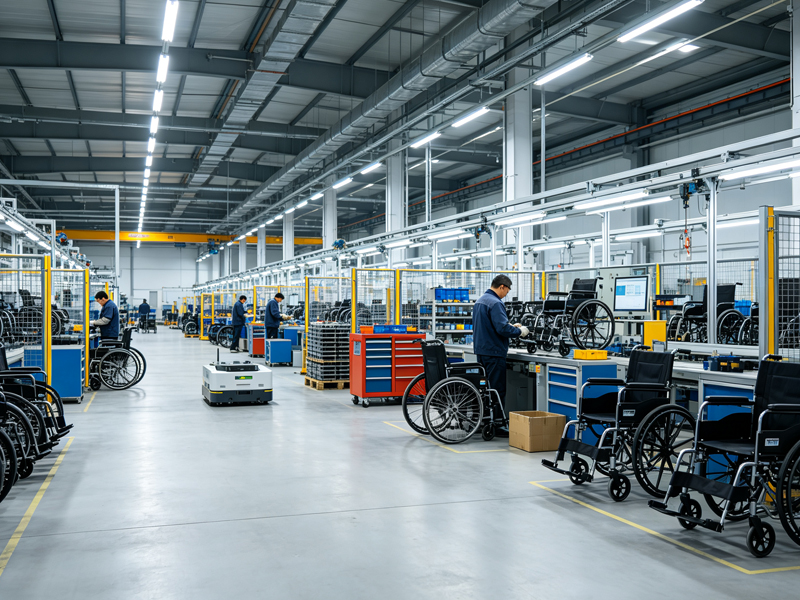
They are built around engineering capability, communication, quality control, regulatory knowledge, customization, intellectual property protection, and long-term cooperation.
If you only need a standard wheelchair, an off-the-shelf product may be enough.
If you already have a complete design, OEM manufacturing may make more sense.
But if you have a market opportunity and need a manufacturing partner that can help turn your product idea into a finished wheelchair, ODM may be the most efficient path.
The key is to choose the right manufacturer and define the project clearly from the beginning.
A good ODM partner should not just manufacture your wheelchair.
They should help you build a product that has a reason to exist in the market.
1. What is the difference between wheelchair ODM and private-label manufacturing?
Private-label manufacturing generally means selling an existing manufacturer’s product under your own brand. The customization may be limited to branding, packaging, colors, or minor components.
Wheelchair ODM can go much further. The manufacturer can participate in product design, engineering, prototyping, component selection, testing, and manufacturing.
In other words, private labeling can be relatively simple, while ODM is usually a more involved product-development relationship.
2. Is wheelchair ODM suitable for small businesses and startups?
Yes, provided that the manufacturer offers suitable MOQs and development conditions.
ODM can be especially useful for startups because it reduces the need to build an internal engineering and manufacturing team.
However, startups should carefully control inventory and development costs. It is generally better to validate market demand before committing to very large production quantities.
A well-planned first project should balance customization with realistic production volume.
3. How should I choose a reliable wheelchair ODM manufacturer?
Do not judge a manufacturer only by its website or quotation.
Look at its engineering capabilities, manufacturing experience, quality-control process, certifications, prototype process, customization options, MOQ, production capacity, spare-parts support, and communication.
Most importantly, ask detailed questions about your specific product rather than accepting general statements.
A capable ODM manufacturer should be able to discuss your requirements in technical and commercial terms, identify potential problems, and explain how those problems can be solved.
That is often a much better indicator of manufacturing capability than simply offering the lowest price.