Our Location
Free Trade Tower, Xiyong street.
Chongqing, China

Free Trade Tower, Xiyong street.
Chongqing, China
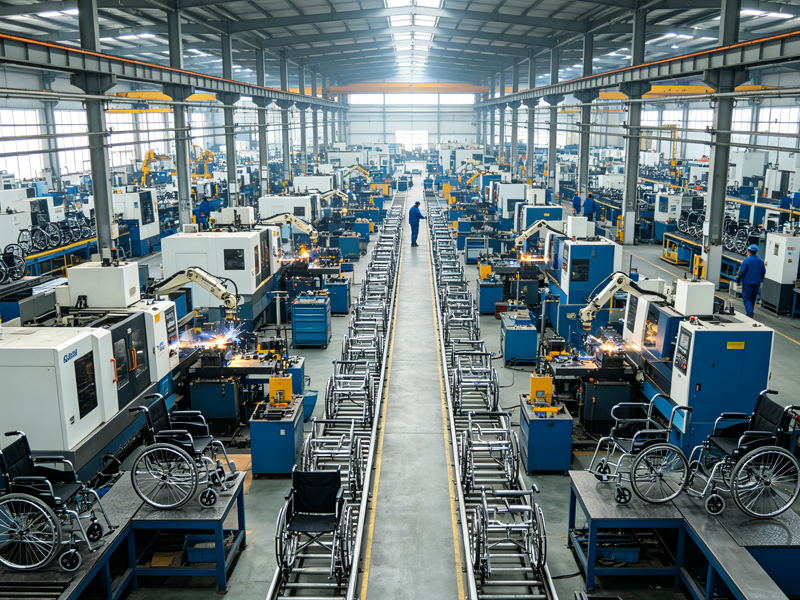
The real challenge is finding a supplier that can consistently deliver the right product, stable quality, reasonable pricing, reliable lead times, proper certifications, and responsive after-sales service.
China has one of the world’s largest medical equipment and mobility aid manufacturing industries. From manual wheelchairs and lightweight transport wheelchairs to electric wheelchairs, folding wheelchairs, sports wheelchairs, and customized mobility products, there are thousands of suppliers available.
That sounds like good news for buyers.
In reality, it can make sourcing more difficult.
Two companies may sell almost identical-looking wheelchairs, but their manufacturing capabilities, component quality, quality control systems, export experience, and service levels can be completely different. A supplier may also present itself as a “factory” while actually outsourcing most of the production.
So, how do you find a reliable China wheelchair supplier rather than simply the cheapest one?
The answer is to look beyond product photos and quoted prices.
A good sourcing process should evaluate the supplier from several angles: company background, factory capability, product quality, certifications, communication, samples, pricing, production control, packaging, shipping, and after-sales support.
One of the most common mistakes international buyers make is searching for “wheelchair supplier China” before clearly defining what they actually need.
The wheelchair market is much broader than it may appear.
For example, a basic manual wheelchair designed for occasional use is very different from a heavy-duty wheelchair intended for daily use. A lightweight aluminum wheelchair for hospitals has different requirements from a reclining wheelchair for home care. An electric wheelchair requires even more attention to motors, batteries, controllers, chargers, braking systems, and electrical safety.
Before contacting suppliers, create a simple product specification sheet.
It should include:
You do not need a complicated engineering document at the beginning.
Even a one-page specification can make a major difference.
For example, instead of telling a supplier:
“I need a cheap lightweight wheelchair.”
A professional inquiry would say:
“We are looking for a lightweight folding manual wheelchair with an aluminum frame, 18-inch seat width, minimum 120 kg user capacity, detachable footrests, PU rear wheels, and export packaging suitable for retail distribution.”
The second inquiry gives the supplier something concrete to quote.
More importantly, it allows you to compare different suppliers on the same product specification.
There are several ways to find wheelchair manufacturers and exporters in China.
B2B marketplaces are often the easiest starting point. Platforms such as Alibaba, Made-in-China, Global Sources, and other international sourcing websites can provide a large number of potential suppliers quickly.
However, a marketplace profile should be treated as a starting point rather than proof of reliability.
A supplier may have:
None of these automatically proves that the supplier is suitable for your business.
Another useful method is to search directly through Google.
Try combinations such as:
Google can sometimes help you discover manufacturers that are not heavily dependent on B2B marketplaces.
Trade shows are another valuable source.
Medical equipment exhibitions and rehabilitation product exhibitions allow buyers to meet suppliers face-to-face, inspect products, compare different factories, and discuss OEM requirements directly.
The advantage of visiting an exhibition is simple: you can touch the product.
A wheelchair may look excellent in an online photograph but feel completely different when you fold it, push it, inspect the welds, operate the brakes, and sit in it.
If your purchasing volume is significant, visiting China can also be worthwhile. A factory visit does not guarantee that everything is perfect, but it can reveal information that is difficult to obtain through email.
This is one of the most important questions when sourcing wheelchairs from China.
Not every company calling itself a “manufacturer” actually manufactures every product it sells.
There is nothing inherently wrong with working with a trading company. A professional trading company may have strong export experience and access to multiple factories.
The problem occurs when a buyer believes they are dealing directly with a manufacturer and later discovers that the supplier has little control over production.
Ask the supplier straightforward questions:
What products do you manufacture in your own factory?
Which components are outsourced?
Where is your production facility located?
How many production workers do you have?
What is your monthly production capacity?
Can I conduct a factory audit?
Can you provide recent factory videos or a live video tour?
A genuine manufacturer should normally be able to answer these questions clearly.
During a factory visit or video inspection, look beyond the showroom.
The showroom is designed to impress visitors.
The production area tells you much more.
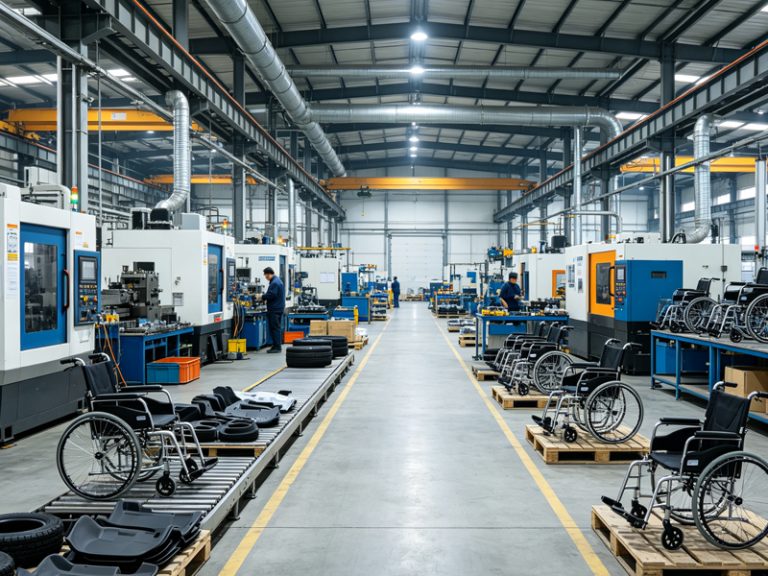
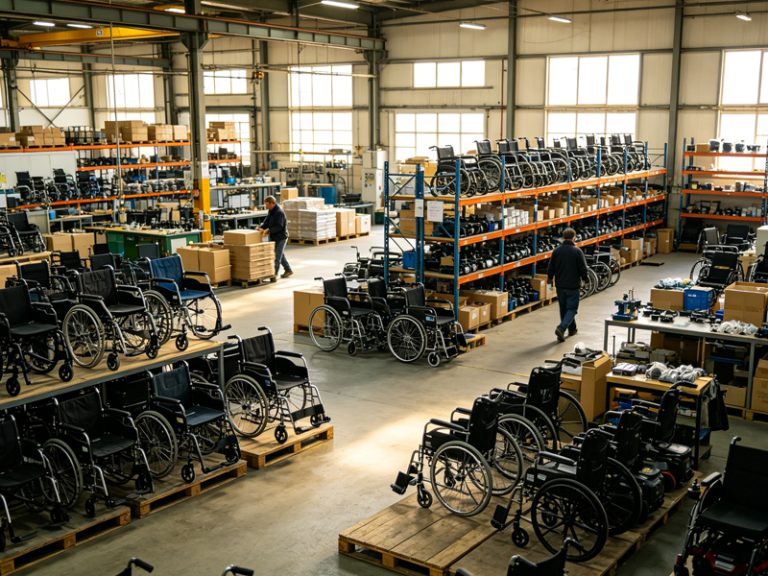
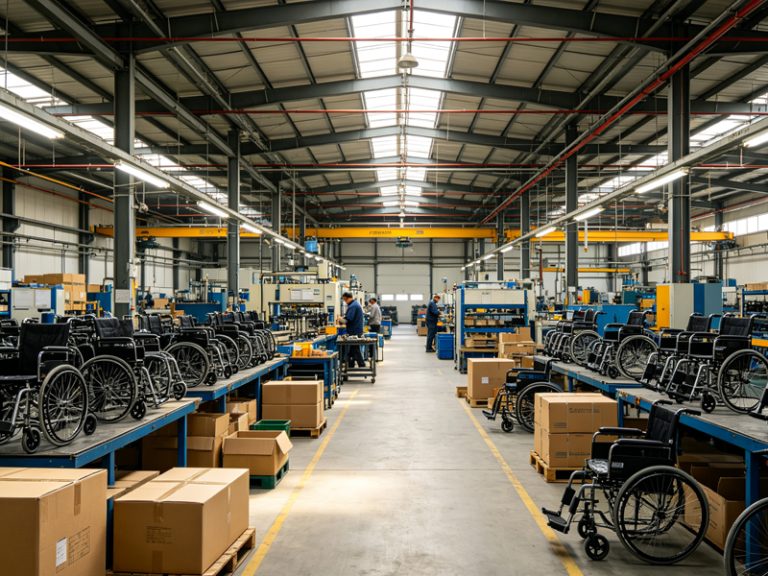
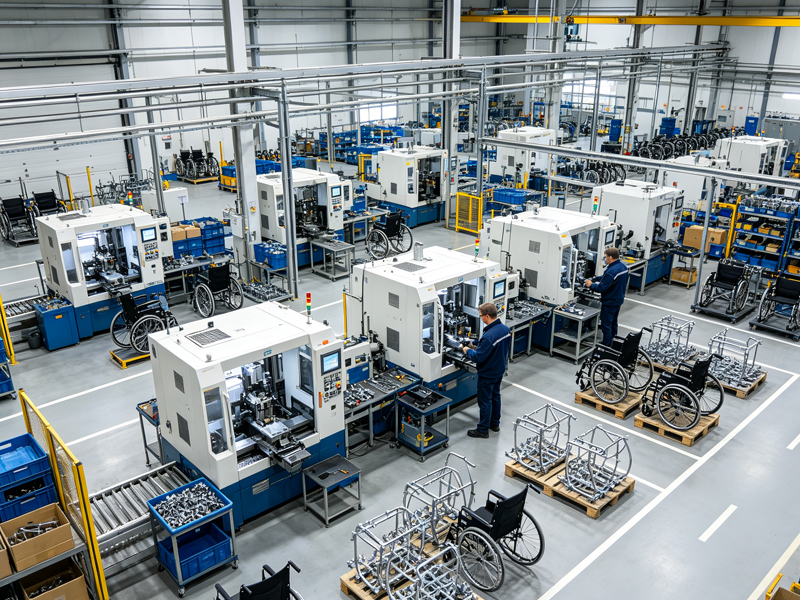
Look at the welding stations, assembly lines, powder coating areas, warehouses, incoming material storage, finished-product areas, testing equipment, and packaging operations.
A professional wheelchair factory should have some form of production organization rather than simply assembling products wherever space is available.
A wheelchair can look almost identical to another wheelchair and still have a significant difference in actual performance.
This is particularly important when buying in bulk.
For manual wheelchairs, pay attention to the frame construction, welding quality, tubing thickness, caster forks, axle structure, brake design, bearings, seat material, footrests, and wheel assembly.
Ask about the frame material and specification instead of accepting vague descriptions such as “high-quality aluminum.”
For steel wheelchairs, ask about the type of steel and surface treatment.
For aluminum models, ask about the aluminum alloy and tubing specifications when relevant.
Welding deserves special attention.
Poor welding may not be obvious in a product photograph, but after repeated folding, loading, and daily use, weak welds can become a serious problem.
Check whether the welds are consistent and whether there are obvious cracks, rough areas, incomplete joints, or excessive grinding.
The same principle applies to moving parts.
Fold the wheelchair repeatedly.
Apply the brakes.
Rotate the wheels.
Check whether the footrests lock correctly.
Move the armrests.
Inspect the folding mechanism.
If the wheelchair feels loose when new, it is unlikely to become better after months of use.
For electric wheelchairs, the evaluation needs to go much further.
You should investigate the motor supplier, battery type, controller, charger, maximum load, climbing ability, braking system, range, charging time, and relevant electrical safety requirements.
Do not simply compare electric wheelchair prices.
Compare the complete configuration.
International wheelchair buyers often ask suppliers for CE, ISO, FDA, UKCA, or other certifications.
This is reasonable, but there is an important distinction between having a certificate and actually having a compliant product.
Depending on the product type and destination market, different regulations may apply.
For example, requirements for a manual wheelchair can differ significantly from those for an electric wheelchair.
You should identify the regulations that apply to your specific market before asking suppliers for documentation.
Then ask for relevant documents, such as:
Do not simply look at a PDF and assume the supplier is compliant.
Check whether the company name on the certificate matches the supplier you are purchasing from.
Check the product model.
Check the validity period.
Check whether the certification covers the actual product you intend to import.
This is especially important when buying private-label products.
A supplier may show you a certificate for Model A while offering you Model B.
That difference matters.
A sample is not an unnecessary expense.
It is one of the cheapest forms of risk control available to an importer.
Before placing a large order, purchase one or several samples from your shortlisted suppliers.
Ideally, ask multiple suppliers to provide samples based on exactly the same specification.
Then compare them side by side.
Do not only compare appearance.
Test:
Comfort: Is the seat comfortable? Is the back support appropriate?
Handling: Is the wheelchair easy to push and turn?
Folding: Can one person fold it without difficulty?
Brakes: Do the brakes engage firmly?
Stability: Does the wheelchair remain stable during normal use?
Noise: Are there unusual sounds from the wheels or frame?
Weight: Does the actual weight match the supplier’s specification?
Finish: Is the frame coating even and durable?
Packaging: Can the product survive international transportation?
If the product is intended for commercial resale, have someone unfamiliar with the product use it.
Fresh eyes can identify problems that the buyer becomes accustomed to after handling the same sample repeatedly.
For electric wheelchairs, testing should include battery charging, driving range, turning radius, braking, incline performance, controller response, and folding or disassembly where applicable.
The goal of sampling is not simply to decide whether you “like” the wheelchair.
It is to verify whether the supplier can deliver what they promised.
The cheapest quotation is often not the cheapest purchasing option.
Imagine three suppliers quote:
| Supplier | Unit Price | Packaging | MOQ | Lead Time |
|---|---|---|---|---|
| Supplier A | $95 | Basic | 100 | 35 days |
| Supplier B | $102 | Export carton | 100 | 25 days |
| Supplier C | $108 | Reinforced | 50 | 20 days |
At first glance, Supplier A looks best.
But what if its packaging leads to a 5% damage rate during transportation?
What if replacement parts are difficult to obtain?
What if the actual product weight is higher than expected and increases freight costs?
What if production takes an additional two weeks?
The real cost can quickly become higher than the original quotation suggests.
When evaluating a China wheelchair supplier, consider the total landed cost.
This may include:
Product price + packaging + inspection + inland transportation + export costs + freight + insurance + import duties + local delivery + warranty costs + spare parts.
This is especially important for wheelchairs because they are relatively large products compared with many small medical accessories.
Packaging efficiency can have a meaningful effect on freight costs.
A supplier that designs the carton intelligently may save more money overall than a supplier offering a slightly lower unit price.
You can learn a surprising amount about a supplier before placing an order simply by communicating with them.
Send the same detailed inquiry to five or six suppliers.
Then compare their responses.
A professional supplier should be able to answer specific questions about:
Be careful with suppliers who answer every question with:
“Yes, no problem.”
That sounds friendly, but it is not necessarily professional.
A reliable supplier should sometimes tell you that a particular request is difficult, expensive, or technically unsuitable.
That is actually a positive sign.
For example, if you ask for a very lightweight wheelchair with an unusually high weight capacity, an experienced manufacturer should explain the engineering trade-off rather than simply promise everything.
Good suppliers do not just take orders.
They help buyers make better decisions.
If you are building your own wheelchair brand, OEM and customization capabilities may be extremely important.
Ask what the supplier can customize.
This can include:
But customization should not be limited to printing a logo on a product.
A serious OEM relationship may require changes to product specifications, packaging dimensions, accessories, testing, and documentation.
Ask about the MOQ for each customization.
For example, the supplier may accept an MOQ of 50 units for a standard wheelchair but require 300 or 500 units for a custom frame color.
Understanding these details before placing an order can prevent unpleasant surprises later.
This is one of the most overlooked aspects of wheelchair sourcing.
Even a well-designed wheelchair eventually needs replacement components.
Wheels can wear out.
Brakes may need replacement.
Armrests can become damaged.
Footrests can be lost or broken.
Bearings and tires may require maintenance.
For electric wheelchairs, batteries, chargers, controllers, motors, and joystick components may eventually need replacement.
Before signing a long-term supply agreement, ask the supplier:
Which spare parts are available?
How long will replacement parts remain available?
What is the price of common spare parts?
Can spare parts be shipped separately?
Can the supplier provide exploded diagrams or maintenance instructions?
A supplier that can provide a complete spare-parts system is generally more valuable than one that only focuses on selling complete wheelchairs.
For distributors, this can become a major competitive advantage.
If you are purchasing a few samples, a factory audit may not be necessary.
But if you are planning a large order or long-term cooperation, supplier verification becomes much more important.
A factory audit can examine areas such as:
You do not necessarily need to travel to China yourself.
A professional third-party inspection company can conduct a factory audit on your behalf.
You can also ask the supplier to provide a live video tour if the order size does not justify a formal audit.
The key is to verify claims rather than simply trusting marketing materials.
Even after you have approved a sample, the final bulk order can still have problems.
Why?
Because production conditions can change.
Different batches of raw materials may be used. Different workers may assemble the product. Production may be rushed before a holiday. Packaging may change.
For a significant order, consider conducting a pre-shipment inspection.
The inspection can verify:
The inspection standard should be agreed upon before production.
Do not wait until the container is already on the water to discover a problem.
A small inspection fee can protect a much larger investment.
Finding a reliable China wheelchair supplier is partly about knowing what to avoid.
Here are several warning signs.
1. The price is dramatically lower than everyone else
A low price is not automatically bad.
But if one supplier is 20–30% cheaper than the general market without a clear reason, investigate carefully.
There may be differences in materials, components, packaging, configuration, or quality control.
2. The supplier refuses a factory inspection
If a company claims to be a manufacturer but refuses reasonable verification, you should ask why.
3. The company name changes between documents
The quotation, bank account, business license, certificate, and invoice should make sense together.
Inconsistencies deserve further investigation.
4. The supplier cannot explain the product specifications
If a salesperson cannot answer basic technical questions about the wheelchair, ask to speak with a product engineer or technical representative.
5. Constantly changing prices
If the supplier repeatedly changes the price after confirming specifications, this may indicate poor internal management or an attempt to attract buyers with an unrealistically low initial quote.
6. No clear warranty policy
A supplier selling medical or mobility equipment should be able to explain how warranty claims are handled.
The best China wheelchair supplier is not necessarily the company with the lowest first-order price.
For most importers, the ideal supplier is the one that can maintain consistent quality over many orders.
After your first successful order, track supplier performance.
Measure:
After several orders, you will have actual performance data.
That data is much more valuable than a supplier’s marketing presentation.
If a supplier consistently delivers on time, communicates clearly, handles problems responsibly, and maintains product quality, it may be worth paying slightly more.
A reliable supplier can save you money in ways that are difficult to see on a quotation sheet.
Fewer customer complaints.
Fewer returns.
Less emergency shipping.
Less time spent solving production problems.
Better reviews.
Better brand reputation.
That is the real value of supplier reliability.
If you are comparing several wheelchair manufacturers, create a simple scoring system.
For example:
| Evaluation Factor | Suggested Weight |
|---|---|
| Product Quality | 25% |
| Manufacturing Capability | 15% |
| Certifications & Compliance | 15% |
| Price | 15% |
| Lead Time | 10% |
| Communication | 10% |
| OEM Capability | 5% |
| After-Sales Service | 5% |
You can change the weights according to your business.
For a medical distributor, compliance and quality may deserve greater weight.
For an online retailer, packaging, price, lead time, and OEM capability may be more important.
For a hospital procurement project, reliability and regulatory compliance should generally carry significant weight.
The purpose of the scoring system is not mathematical perfection.
It prevents one attractive factor—usually price—from dominating the entire decision.
Sourcing wheelchairs from China can be highly competitive, but successful purchasing requires more than finding a supplier on a B2B platform and asking for a quotation.
The right approach is to treat supplier selection as a risk-management process.
First, define your product requirements.
Then create a shortlist of potential manufacturers.
Verify their business background and manufacturing capabilities.
Ask for product specifications and certifications.
Order samples.
Test the samples.
Compare total costs.
Discuss OEM and packaging requirements.
Check spare-parts availability.
Consider a factory audit for larger projects.
Use pre-shipment inspection before major orders.
And most importantly, evaluate how the supplier behaves when something goes wrong.
Because problems are inevitable in international business.
The real test of a supplier is not whether they can promise “no problem.”
The real test is how they respond when there is a problem.
A reliable China wheelchair supplier should be able to communicate clearly, identify the cause, propose a solution, and take responsibility for reasonable corrective action.
That is the kind of supplier worth building a long-term relationship with.
1. How can I verify whether a China wheelchair supplier is a real manufacturer?
Start by checking the company’s business information and asking where the factory is located. Request a live factory video tour or arrange an independent factory audit for larger orders. You can also ask which parts of the wheelchair are manufactured in-house and which components are outsourced.
Do not rely only on factory photos or a B2B platform profile. A reliable supplier should be comfortable providing reasonable evidence of its production capabilities.
2. What certifications should I ask for when buying wheelchairs from China?
The answer depends on the wheelchair type and the country where you will sell or use the product. Manual and electric wheelchairs can have different regulatory requirements.
Ask the supplier for the certifications and test reports applicable to your target market, and verify that the documents correspond to the exact product model you intend to purchase.
Most importantly, do not assume that a certificate shown by a supplier automatically means your specific product is compliant.
3. Should I choose the cheapest China wheelchair supplier?
Usually, no.
Price is important, but it should be evaluated together with product quality, specifications, packaging, lead time, certifications, warranty, spare parts, and after-sales service.
A supplier with a slightly higher unit price may ultimately be cheaper if it provides better quality, fewer defects, more efficient packaging, stable delivery, and stronger support.
When comparing suppliers, focus on total cost and total risk, rather than simply choosing the lowest quotation.
Finding a reliable China wheelchair supplier takes more work than sending a few quotation requests.
But the process becomes much easier when you know what to look for.
Define the product clearly. Verify the supplier. Test the sample. Check compliance. Compare the complete cost. Inspect important orders. And evaluate the supplier’s ability to support you after the sale.
China offers a wide range of wheelchair manufacturing options, from standard manual wheelchairs to customized OEM products and advanced electric mobility solutions.
The opportunity is there.
The key is choosing the right manufacturing partner rather than simply choosing the lowest price.
For importers, distributors, hospitals, retailers, and wheelchair brands, a reliable supplier is not just a source of products. It is part of the supply chain that determines your product quality, customer experience, reputation, and long-term profitability.