Our Location
Free Trade Tower, Xiyong street.
Chongqing, China

Free Trade Tower, Xiyong street.
Chongqing, China
You find a manufacturer, compare prices, request samples, place an order, and start selling. In reality, wheelchair sourcing is much more complicated. The manufacturer you choose can directly affect your product quality, customer satisfaction, profit margins, inventory levels, warranty costs, and even the reputation of your DME business.
A wheelchair is not an ordinary consumer product. It is a mobility device that people may depend on every day to work, travel, recover, or maintain their independence. Small issues that might be acceptable in another product category—such as inconsistent dimensions, poor brakes, weak frames, uncomfortable seating, or unreliable spare parts—can become serious problems for wheelchair users.
For DME providers, distributors, medical equipment retailers, and healthcare businesses, the goal should not simply be to find the cheapest wheelchair manufacturer. The better approach is to find a manufacturing partner that can consistently deliver the right combination of quality, compliance, product range, pricing, customization, reliability, and long-term support.
Before contacting manufacturers, take a step back and define what your business actually needs.
Different DME businesses require very different wheelchair products. A company serving rehabilitation centers may have completely different requirements from an online medical equipment retailer, a home healthcare provider, or a regional DME distributor.
For example, your business may primarily sell:
You should also consider who your primary customers are.
Are you selling directly to individual wheelchair users? Are your customers hospitals, nursing homes, rehabilitation clinics, home healthcare agencies, pharmacies, or other DME distributors?
The answer will influence nearly every purchasing decision.
A wheelchair manufacturer that is excellent for a high-volume distributor may not be the right partner for a smaller DME retailer looking for flexible order quantities and customized packaging.
Before requesting quotations, define your expected sales volume, target market, preferred wheelchair categories, price range, required certifications, packaging requirements, warranty expectations, and delivery schedule.
This simple preparation can save a surprising amount of time later.
Price is naturally one of the first things DME buyers compare.
However, choosing a wheelchair manufacturer based only on the lowest quotation can create expensive problems later.
Imagine two manufacturers offering similar-looking wheelchairs. Manufacturer A offers a lower unit price, while Manufacturer B is slightly more expensive.
At first, Manufacturer A appears to be the obvious choice.
But then you discover that its packaging is less protective, spare parts are difficult to obtain, production times vary, quality inspections are inconsistent, and warranty claims take weeks to resolve.
The initial savings can quickly disappear.
The real cost of a wheelchair includes much more than the factory price.
Your total cost may include:
Product cost + shipping + import expenses + inspection + warehousing + warranty claims + replacement parts + returns + customer service + inventory risk.
This is why experienced DME buyers often look at the total cost of ownership rather than simply comparing FOB or EXW prices.
A reliable wheelchair manufacturer may not always provide the lowest initial quotation, but a stable supply chain can make your business more profitable over time.
When comparing suppliers, ask for a detailed quotation that clearly explains:
A transparent quotation is often a good early indication of how transparent the manufacturer will be after you place an order.
A company website may say that a manufacturer has been in business for many years. That is useful information, but it does not tell the whole story.
What matters is relevant manufacturing experience.
A factory that has produced mobility equipment for years may understand wheelchair design, assembly, quality control, packaging, and international distribution much better than a general metal fabrication company that recently added wheelchairs to its product catalog.
Ask potential manufacturers questions such as:
You do not necessarily need the largest factory.
A smaller manufacturer with strong wheelchair expertise, responsive communication, and consistent production may be a better fit for a growing DME company than a huge factory that treats smaller customers as low priority.
The ideal supplier is one whose capabilities match your business size and growth plans.
Wheelchair quality should be evaluated systematically rather than based on appearance.
A wheelchair can look excellent in product photographs while having problems that only become visible during actual use.
When evaluating samples, pay attention to the frame, wheels, brakes, casters, upholstery, footrests, armrests, folding mechanisms, bearings, fasteners, and overall assembly.
Frame Construction
The frame is one of the most important parts of a wheelchair.
Look for clean welds, consistent finishing, appropriate tubing, reliable joints, and a structure that feels stable during movement.
If the wheelchair folds, test the folding mechanism repeatedly. It should operate smoothly without excessive looseness or resistance.
Braking System
Brakes need to work consistently.
Check whether the brakes engage properly, whether the handles or levers are easy to operate, and whether the braking system remains stable after repeated use.
For attendant-propelled wheelchairs, push handles and attendant brakes deserve particular attention.
Wheels and Casters
Wheel quality has a significant impact on comfort and maneuverability.
Check whether the rear wheels rotate smoothly, whether the casters track correctly, and whether there is excessive play in the wheel assemblies.
Ask the manufacturer about available wheel sizes, tire materials, caster options, replacement availability, and expected service life.
Seating and Upholstery
Comfort is not a cosmetic issue.
Seat width, seat depth, cushion support, upholstery material, backrest design, and armrest positioning can all influence the user’s experience.
If your DME business serves customers with different body sizes and mobility requirements, having multiple configurations can be an important competitive advantage.
One of the most useful questions you can ask a wheelchair manufacturer is:
“What does your quality control process look like?”
A professional manufacturer should be able to explain its quality procedures clearly.
Quality control may include incoming material inspection, production-line inspection, assembly inspection, functional testing, load testing, final inspection, packaging inspection, and pre-shipment checks.
You should also ask whether quality standards are documented and whether inspection records are maintained.
If a manufacturer cannot clearly explain how it identifies defective products, that should make you cautious.
For DME businesses, consistency is just as important as quality.
A supplier may provide an excellent sample but deliver inconsistent products in larger batches. This is why you should not judge a manufacturer solely by the first sample.
If possible, order a small initial production batch and inspect multiple units from that batch.
Look for consistency in:
A manufacturer that performs well across an entire batch is much more valuable than one that produces one impressive sample.
Compliance is another critical part of selecting a wheelchair manufacturer.
Depending on your market and product type, your wheelchair products may need to meet specific regulatory, safety, labeling, testing, or documentation requirements.
For businesses selling in the United States, Europe, the United Kingdom, Canada, Australia, or other regulated markets, you should identify the requirements that apply to your specific products before finalizing your supplier.
Do not simply accept statements such as “Our products are certified.”
Ask for the actual documentation and verify that the documents correspond to the specific model you intend to purchase.
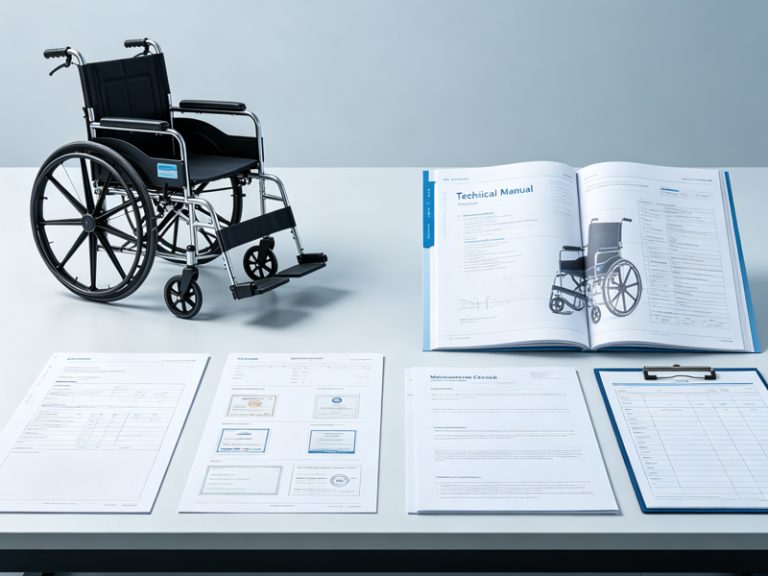
Depending on the market and product, relevant documentation may include:
The exact requirements depend on the jurisdiction, product classification, intended use, and sales channel.
This is one area where DME businesses should avoid assumptions.
A document for one wheelchair model does not automatically mean every wheelchair produced by the same factory meets the same requirements.
Your responsibility is to verify the documentation for the actual products you plan to sell.
If you want to build your own DME brand, manufacturing flexibility becomes especially important.
Some wheelchair manufacturers only sell products under their own brand. Others provide OEM services, allowing distributors to use their own branding, packaging, manuals, labels, and product configurations.
ODM capabilities can go a step further.
With ODM support, a manufacturer may help modify an existing product or develop a product according to your specifications.
For example, you might want:
However, customization often increases lead times and minimum order quantities.
Ask the manufacturer exactly what can be customized and what the associated costs are.
A good supplier should clearly distinguish between standard products and genuinely customized products.
Minimum order quantity, or MOQ, can have a major impact on cash flow.
A factory may offer an attractive price but require an order quantity that is too large for your current sales volume.
For example, purchasing thousands of wheelchairs at once may reduce the unit price, but it also means tying up a large amount of capital in inventory.
That inventory needs to be stored, managed, insured, and eventually sold.
For a growing DME business, a manufacturer with flexible MOQ options may be more practical.
Ask whether the manufacturer offers:
As your business grows, you can negotiate better pricing based on larger and more predictable orders.
The goal is not simply to achieve the lowest unit price. The goal is to maintain a healthy balance between unit economics and inventory turnover.
A wheelchair that is competitively priced but frequently late can become a serious business problem.
DME customers often need equipment within a specific timeframe. Healthcare providers and distributors also depend on reliable inventory.
When evaluating a manufacturer, ask for realistic production lead times rather than optimistic promises.
Find out:
Also ask what happens when demand suddenly increases.
Can the factory increase production?
Does it maintain safety stock of critical components?
Does it have multiple suppliers for important materials?
Can it prioritize repeat customers during peak periods?
A manufacturer with strong production planning can help you maintain inventory without carrying excessive safety stock.
This is an area that is sometimes overlooked during initial purchasing negotiations.
But wheelchair users do not only need a wheelchair. Over time, they may need replacement tires, casters, armrests, footrests, brakes, upholstery, bearings, cushions, or other components.
If spare parts are unavailable, a relatively small mechanical problem can make an otherwise usable wheelchair difficult to operate.
Before choosing a manufacturer, ask:
How will you support spare parts after the original sale?
A strong supplier should have a practical system for replacement components.
Ask about:
Ideally, commonly needed replacement parts should remain available for a reasonable period.
Your DME business can also maintain a small spare-parts inventory for frequently sold models.
This can improve customer service and reduce the time required to resolve common problems.
A manufacturer can produce an excellent wheelchair and still be a poor business partner if communication is difficult.
You should pay attention to communication from the beginning.
How quickly does the sales team respond?
Do they answer technical questions directly?
Can they provide clear specifications?
Do they communicate changes in production?
Do they admit when something is wrong?
Do they provide photographs or inspection reports when requested?
These details matter.
Imagine that you have a shipment scheduled to leave in five days and discover a problem with the packaging. If the supplier takes two days to respond to every email, a small issue can quickly become a major logistics problem.
Professional communication does not mean the manufacturer must answer every message instantly.
It means the supplier should have a clear and reliable communication process.
For long-term DME partnerships, this can be just as important as the product itself.
Never rely exclusively on product catalogs or online photographs.
Request samples.
Better yet, test samples from more than one manufacturer.
Your sample evaluation should be practical.
If possible, ask someone who understands mobility equipment to inspect the wheelchair. Test the product in realistic conditions rather than simply opening the box and checking its appearance.
You can evaluate:
Assembly: Is the wheelchair easy to assemble and adjust?
Maneuverability: Does it turn smoothly?
Braking: Do the brakes engage consistently?
Folding: Does the folding mechanism operate reliably?
Comfort: Is the seating appropriate for the intended customer?
Stability: Does the chair feel stable during normal use?
Finishing: Are welding and surface treatments consistent?
Packaging: Does the packaging adequately protect the product during transportation?
Instructions: Are the user manual and assembly instructions clear?
It is also useful to photograph the sample and record specific measurements.
This creates a reference point for future production orders.
For larger DME businesses, distributors, or private-label projects, a factory visit can provide valuable information that cannot be obtained from a website.
You can observe:
A factory visit can also help you understand whether the company actually manufactures the products it claims to produce.
Some businesses are trading companies rather than manufacturers. That is not automatically a problem. A capable trading company may provide useful sourcing and export services.
However, you should understand exactly who is manufacturing your wheelchair and where quality control takes place.
For larger contracts, knowing the supply chain can help reduce risk.
Wheelchairs are relatively large products, which makes packaging and logistics especially important.
Poor packaging can lead to scratches, bent components, damaged wheels, broken accessories, or other problems before the wheelchair reaches your warehouse.
Ask manufacturers to explain their packaging structure.
Important considerations include:
A wheelchair manufacturer may also be able to reduce your freight costs through better folding designs or optimized packaging.
For international DME businesses, this can have a meaningful impact on overall margins.
Once you have several potential suppliers, avoid making the decision based on memory or a single quotation.
Create a supplier comparison sheet.
You can evaluate each wheelchair manufacturer across categories such as:
| Evaluation Category | Key Questions |
|---|---|
| Product Quality | Is the product consistent and durable? |
| Certifications | Can required documentation be provided? |
| Manufacturing | Does the factory have relevant wheelchair experience? |
| Pricing | Is the total cost competitive? |
| MOQ | Does the minimum order fit your business? |
| Lead Time | Can production meet your schedule? |
| Customization | Can the supplier support your branding? |
| Spare Parts | Are replacement components available? |
| Warranty | Are warranty terms clear and practical? |
| Communication | Is the supplier responsive and transparent? |
| Capacity | Can production scale with your business? |
| Packaging | Is the product protected during shipping? |
| Logistics | Can the supplier support efficient export? |
| Long-Term Support | Can the relationship continue as you grow? |
This approach helps prevent one attractive feature—usually a low price—from dominating the entire decision.
A DME business should not select a wheelchair manufacturer only for today’s order.
Think about what your company may need two or three years from now.
Your business may expand into new wheelchair categories. You may develop a private-label brand. You may begin selling through additional channels. You may need larger production volumes. You may require more sophisticated packaging or product customization.
Ask yourself:
Can this manufacturer grow with us?
That question is extremely important.
A supplier may be perfect for a small trial order but become difficult to manage once your volume increases.
On the other hand, a manufacturer with established production systems, multiple product lines, technical expertise, and international experience may be able to support your growth for years.
Long-term supplier relationships can also lead to better pricing, improved production planning, faster communication, and more efficient problem solving.
Not every supplier is equally reliable.
During the sourcing process, watch for warning signs.
Extremely Low Prices
If a quotation is dramatically lower than the market range, ask why.
There may be differences in materials, components, testing, packaging, warranty, or specifications.
Vague Certification Claims
Statements such as “FDA approved,” “CE certified,” or “international standard” should not be accepted without checking the relevant documentation and whether it applies to your specific product.
Refusal to Provide Samples
A manufacturer that does not want you to inspect or test its product before placing a significant order deserves additional scrutiny.
Constant Changes in Specifications
If specifications, materials, components, or product dimensions change without clear communication, quality consistency may become a problem.
Poor Communication
Repeatedly unanswered technical questions are a warning sign, especially when the products will be sold under your own brand.
No Clear Warranty Policy
A supplier should be able to explain what happens when a product arrives damaged or develops a manufacturing defect.
Unrealistic Production Promises
Be cautious when a supplier promises extremely short production times without explaining how the capacity is achieved.
Professional manufacturers are usually more comfortable giving realistic delivery estimates than making promises simply to secure an order.
Build a Long-Term Supplier Relationship
Once you identify a manufacturer that meets your requirements, treat the relationship as a partnership rather than a series of isolated transactions.
Provide the supplier with accurate forecasts when possible.
Maintain clear product specifications.
Document approved samples.
Use consistent purchase-order requirements.
Communicate quality issues with photographs, measurements, and specific descriptions.
Review product performance regularly.
If a problem occurs, focus on finding the root cause instead of simply demanding compensation.
For example, if several cartons arrive damaged, the solution may not simply be replacing the damaged wheelchairs. The manufacturer may need to improve the internal packaging or change the loading method.
A good supplier relationship should become more efficient over time.
Both sides learn how the other operates, which reduces misunderstandings and improves order execution.
There is no universal answer to the question of which wheelchair manufacturer is best.
The right manufacturer depends on your business model, target customers, sales volume, product requirements, market regulations, budget, and long-term strategy.
For one DME business, a manufacturer specializing in standard manual wheelchairs may be the right choice.
Another company may need an OEM partner capable of developing a private-label product line.
A distributor with large monthly volumes may prioritize production capacity and logistics, while a smaller medical equipment retailer may care more about low MOQ, flexible ordering, and responsive customer support.
What matters is finding a supplier whose capabilities match your actual requirements.
A strong wheelchair manufacturing partner should provide more than a competitive price. You want consistent product quality, reliable production, appropriate documentation, reasonable lead times, dependable spare parts, clear warranty support, responsive communication, and the ability to grow alongside your business.
That combination can make a significant difference to your DME operation.
Before signing a long-term agreement or placing a large purchase order, review the following checklist:
Product
Manufacturer
Compliance
Commercial Terms
After-Sales
Logistics
If you cannot get clear answers to several of these questions, it may be better to continue evaluating suppliers before making a major commitment.
Choosing a wheelchair manufacturer for your DME business is not simply a purchasing decision. It is a supply-chain decision, a quality decision, and ultimately a customer-service decision.
The manufacturer you choose becomes part of your brand experience.
When a wheelchair arrives on time, performs as expected, has reliable replacement parts, and is supported by clear documentation, your customers may never think about the factory behind the product.
But when quality problems occur, delivery is delayed, spare parts cannot be found, or warranty claims become difficult, your DME business is the one customers will remember.
That is why supplier selection deserves careful attention.
Start by defining your product and market requirements. Compare manufacturers based on more than price. Test samples. Verify documentation. Evaluate quality control. Understand MOQ and lead times. Ask about spare parts and warranty service. Examine communication. And, when the business volume justifies it, visit the factory or arrange a professional third-party inspection.
Most importantly, think beyond the first shipment.
A reliable wheelchair manufacturer should not simply help you complete today’s purchase order. The right manufacturing partner should give your DME business the foundation to maintain product quality, control costs, serve customers effectively, and grow with confidence.
In a competitive medical equipment market, that long-term reliability can be worth far more than saving a few dollars on the initial unit price.
1. What should I look for in a wheelchair manufacturer?
Look for a manufacturer with proven wheelchair production experience, consistent quality control, appropriate product documentation, reliable lead times, competitive total costs, responsive communication, and dependable after-sales support. If you plan to sell under your own brand, also evaluate the manufacturer’s OEM and ODM capabilities.
Do not focus only on the factory price. Consider product quality, warranty costs, spare parts, packaging, shipping, minimum order quantity, and long-term supply reliability before making your decision.
2. How can I verify the quality of a wheelchair manufacturer?
Start by requesting product samples and detailed specifications. Test multiple units rather than judging the manufacturer from a single sample. Check the frame, welds, brakes, wheels, casters, upholstery, folding mechanism, hardware, and packaging.
You can also ask about the manufacturer’s quality-control procedures, inspection records, testing methods, production capacity, and experience serving international customers. For larger orders, consider using an independent third-party inspection service before shipment.
3. Should a DME business choose a wheelchair manufacturer based on the lowest price?
Not necessarily. The lowest unit price does not always result in the lowest overall business cost.
A cheaper wheelchair may involve higher warranty expenses, inconsistent quality, poor packaging, limited spare-parts availability, longer lead times, or higher return rates. For this reason, DME businesses should compare the total cost of ownership and supplier reliability rather than focusing exclusively on the initial quotation.
The right manufacturer is the one that provides a practical balance of quality, compliance, pricing, production capacity, service, and long-term reliability for your particular DME business.