Our Location
Free Trade Tower, Xiyong street.
Chongqing, China

Free Trade Tower, Xiyong street.
Chongqing, China
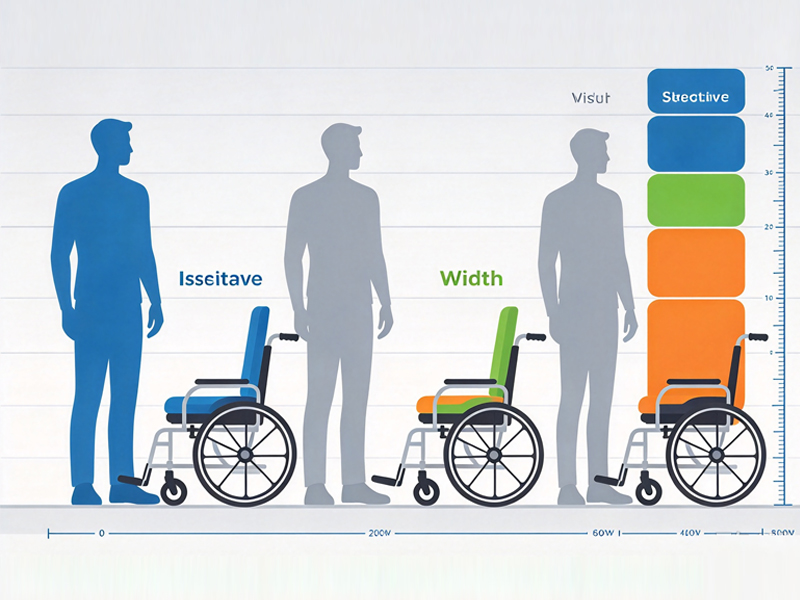
Choosing the right wheelchair is about much more than finding a chair that looks comfortable or fits within a certain budget. One of the most important decisions is something that is easy to overlook at first: wheelchair seat width.
Seat width affects how you sit, how easily you can move, how stable you feel, and how much pressure is placed on your body during everyday use. A wheelchair that is too narrow can feel restrictive and uncomfortable, while one that is too wide may make it harder to maintain a stable sitting position or move efficiently.
For someone who uses a wheelchair for several hours a day, a difference of just one or two inches can make a noticeable difference.
So, how do you choose the right wheelchair seat width?
The answer is not simply to measure your hips and choose the closest number. A good wheelchair fit takes body shape, clothing, posture, cushion thickness, transfer technique, daily activities, and the type of wheelchair into consideration.
Think of wheelchair seat width as the foundation of your sitting position.
If the width is appropriate, your pelvis can remain relatively well positioned, your legs can rest naturally, and you can make use of the chair without constantly adjusting your body. If the width is wrong, small problems can gradually become bigger ones.
A seat that is too narrow may create pressure against the hips or thighs. You may find yourself sitting with your legs in an unnatural position simply because there is not enough room. Over time, this can make the chair uncomfortable and may interfere with posture and pressure management.
A seat that is too wide creates a different problem. You may have to lean from side to side to reach the armrests or maintain your position. Some users also find it more difficult to propel a manual wheelchair efficiently when their arms cannot comfortably reach the wheels.
There is also a practical consideration: overall wheelchair width.
A wider seat generally means a wider wheelchair. That matters when you regularly use narrow doorways, elevators, hallways, bathrooms, vehicles, or other confined spaces.
In other words, the right wheelchair seat width needs to balance several things:
Body fit + posture + comfort + mobility + environment + daily use
That is why choosing a wheelchair based solely on a product specification such as “18-inch seat” is not always enough.
Wheelchair seat width normally refers to the inside width of the seating area, measured from one side of the seat to the other.
For example, a wheelchair advertised as having an 18-inch seat generally provides approximately 18 inches of usable seating width between the side supports or frame components.
Common wheelchair seat widths include:
The exact sizes available depend on the wheelchair design and manufacturer.
However, there is an important distinction between seat width and overall wheelchair width.
An 18-inch wheelchair seat does not necessarily mean the entire wheelchair is only 18 inches wide. The frame, wheels, armrests, hand rims, footrests, and other components add to the total width.
This distinction becomes especially important if you are trying to determine whether a wheelchair will fit through a particular doorway.
For example, you may measure a doorway and think, “There is 19 inches of space, so a 19-inch seat should fit.”
That assumption can be dangerously misleading.
Always check the manufacturer’s overall wheelchair width rather than calculating it from the seat width yourself.
The most useful starting point is to measure the person who will actually use the wheelchair.
You will need a measuring tape and, ideally, a firm chair.
Have the person sit upright in their normal sitting position. They should be wearing the type of everyday clothing they normally wear when using the wheelchair.
Measure the widest part of the hips or thighs, depending on the person’s body shape.
The tape should be horizontal and should not be pulled tightly against the body.
The goal is to determine the amount of space the user actually needs—not to compress the body to obtain the smallest possible measurement.
A simple measurement process
1. Sit in a stable position.
Use a firm, flat chair rather than a soft sofa. The person should sit with their weight distributed naturally.
2. Measure the widest point.
Measure across the widest part of the hips and thighs. For some people, the hips are widest. For others, the thighs may require more space.
3. Record the measurement.
Write down the measurement in inches or centimeters.
4. Consider clothing.
If the person normally wears heavier clothing, allow enough room for realistic daily use.
5. Consider the cushion.
If a wheelchair cushion will be used, remember that the cushion itself occupies space and may influence the effective seating area.
6. Compare the result with the manufacturer’s specifications.
Do not assume that every 18-inch wheelchair provides exactly the same sitting experience. Seat shape, side supports, upholstery, and cushion design can vary.
This is one of the most common questions when measuring wheelchair seat width.
A wheelchair seat generally should not be fitted so tightly that the user’s hips or thighs press continuously against the sides. At the same time, excessive extra space can reduce lateral stability and make the chair less efficient.
For many users, a small amount of additional space beyond the body measurement is appropriate.
A commonly used practical approach is to allow approximately 1 to 2 inches of total additional space beyond the widest seated hip/thigh measurement, depending on the person’s posture, clothing, cushion, and clinical needs.
For example:
If the widest seated measurement is approximately 17 inches, an 18-inch wheelchair may be a reasonable starting point.
If the measurement is closer to 19 inches, a 20-inch wheelchair may provide a better fit.
But this should not be treated as a universal mathematical rule.
Someone with significant postural needs may require a different configuration. A person who transfers frequently may have different requirements from someone who remains seated for most of the day. A wheelchair user with asymmetric posture may also need individualized seating rather than simply choosing the next standard width.
When the fit is particularly important—for example, for a full-time wheelchair user—professional seating assessment can be much more valuable than choosing a size based on a measurement chart alone.
A wheelchair seat that is too narrow tends to reveal itself fairly quickly.
You may notice:
For someone who spends several hours in a wheelchair every day, persistent pressure should not simply be dismissed as “getting used to the chair.”
A narrow seat can also affect posture. When the pelvis does not have enough room to settle naturally, the user may compensate by leaning, rotating, or changing leg position.
This is particularly important for people who already have limited trunk control or other positioning challenges.
A seat that is too wide may initially seem attractive because it provides plenty of room.
More space does not necessarily mean more comfort, however.
A seat may be too wide if:
For manual wheelchair users, seat width can have a direct effect on propulsion.
If the chair is too wide, the user’s shoulders and arms may have to work from a less efficient position. Over many repetitions, that can make everyday propulsion feel more demanding.
This does not mean a narrow wheelchair is automatically better.
The objective is the correct width for the individual, not the smallest possible width.
Wheelchair seating is closely connected to posture.
A properly fitted seat gives the pelvis a stable base while allowing the thighs to be supported without excessive pressure.
If the seat is excessively wide, the user may have more freedom to move sideways than is desirable. If the seat is excessively narrow, the user may feel compressed.
Posture becomes even more important when a person spends most of the day in a wheelchair.
For occasional wheelchair users, comfort during a short outing may be the primary concern. For full-time users, however, seating should be considered as part of a larger positioning system.
That system can include:
This is why buying a wheelchair based on seat width alone can sometimes lead to disappointing results.
A person can have the “correct” seat width but still have an uncomfortable wheelchair because the seat depth or cushion is wrong.
Seat width is only one dimension.
Seat width measures how much horizontal space is available from side to side.
Seat depth measures how far the seating surface extends from the back toward the front.
Both are important.
Imagine someone with relatively narrow hips but long legs. They may need a standard or narrow seat width but a longer seat depth.
Conversely, a person with a wider body and shorter legs may need a wider seat without needing a particularly deep seat.
An inappropriate seat depth can create pressure behind the knees or fail to support the thighs properly.
As a general seating principle, the seat should provide adequate thigh support without pressing directly into the back of the knees.
Therefore, when choosing a wheelchair, don’t stop after measuring your hips. Ask yourself:
Does the seat support my thighs correctly?
That question can be just as important as seat width.
Real-world wheelchair use is rarely done in minimal clothing.
Winter coats, thick trousers, compression garments, blankets, and other layers can change the amount of space a person needs.
This does not mean you should automatically buy a wheelchair several sizes larger.
Instead, think about how the chair will actually be used.
If the wheelchair is primarily used indoors with lightweight clothing, your measurement may be relatively straightforward.
If it is regularly used outdoors in cold weather, consider whether additional clothing changes the fit.
The wheelchair cushion is another factor.
Some cushions have a relatively thin profile, while others are thicker or shaped to provide additional positioning and pressure management.
A contoured cushion may also change how the pelvis and thighs sit within the chair.
If you already use a specific cushion, take it into account when assessing the wheelchair.
Ideally, the wheelchair and cushion should be considered as a single seating system, rather than as two completely separate products.
Manual wheelchair users often need to pay particular attention to the relationship between seat width and propulsion.
The wheels should be positioned so that the user can comfortably reach the hand rims without excessive shoulder movement.
A chair that is too wide may force the user to reach outward.
That can make propulsion less efficient and may increase strain during repeated movement.
For active manual wheelchair users, the goal is often a relatively close relationship between the user’s body, the wheels, and the seating system.
However, this does not mean that every active wheelchair should have a narrow seat.
The correct width still depends on the person’s body measurements and seating requirements.
If you are purchasing a manual wheelchair for independent daily mobility, consider not only whether you can sit comfortably in the chair, but also whether you can propel, turn, brake, transfer, and perform everyday tasks efficiently.
Travel introduces another consideration: space.
If you frequently place the wheelchair in a vehicle, a compact configuration may be valuable.
A wider wheelchair may require more storage space, and the overall frame dimensions can affect whether it fits easily into a trunk, vehicle compartment, or other storage area.
For air travel, public transportation, taxis, and rideshare vehicles, the folded or disassembled dimensions may matter as much as seat width.
This is where many buyers make a common mistake.
They focus heavily on the seat measurement and forget to check:
folded width, folded height, total wheelchair width, total weight, and removable components.
If transportation is part of your normal routine, these specifications should be checked before purchasing.
There is no single wheelchair seat width that is correct for everyone.
That said, 18 inches is a very common standard size across many conventional adult wheelchairs.
An 18-inch wheelchair is often considered a middle-of-the-range option, but that does not mean it will fit every adult.
Depending on body size and wheelchair design, users may need something narrower or considerably wider.
Typical options may include:
| Seat Width | Typical Consideration |
|---|---|
| 16 inches | Smaller adults or users with a narrower body |
| 17 inches | Narrower adult seating needs |
| 18 inches | Common standard adult size |
| 20 inches | Wider adult seating needs |
| 22 inches | Bariatric or larger seating requirements |
| 24 inches | Specialized wider seating |
These are general examples rather than medical fitting recommendations.
Manufacturers may also use different measurement methods, so always check the product’s technical specifications.
Usually, there should be enough room to accommodate the user’s body without creating excessive lateral movement.
The key is not simply to make the seat wider than the hips.
A wheelchair seat that is dramatically wider than the user’s body may make positioning less stable. A seat that is only slightly wider may provide a better balance between comfort and support.
A useful way to think about it is:
The seat should provide enough space to avoid compression, but not so much space that the user loses useful support.
This is especially relevant for people who have limited trunk control.
In those situations, a seating professional may recommend additional positioning components rather than solving the problem simply by increasing seat width.
For larger-bodied wheelchair users, seat width becomes an even more important consideration.
A standard 18-inch wheelchair may not provide adequate space or weight capacity.
Bariatric wheelchairs are designed with wider seating and stronger frames to accommodate higher user weights. Available seat widths vary considerably by manufacturer and model.
However, seat width and weight capacity are two different specifications.
A wheelchair can have a wide seat without having the appropriate weight capacity for a particular user.
Always check both.
You should also consider the strength and construction of:
If a user requires a bariatric wheelchair, it is especially important to follow the manufacturer’s stated maximum user weight rather than estimating whether the chair “looks strong enough.”
One of the easiest mistakes is to reduce the entire buying decision to one number.
For example:
“My hip measurement is 18 inches, so I’ll buy an 18-inch wheelchair.”
That may or may not be correct.
Before purchasing, look at the entire seating configuration.
Check these measurements together:
Seat width
Does the user have enough room without excessive side-to-side movement?
Seat depth
Does the seat support the thighs without pressing behind the knees?
Seat height
Can the user position their feet appropriately and perform transfers safely?
Back height
Does the backrest provide appropriate support for the user’s trunk?
Armrest height
Can the user rest their arms comfortably without raising or dropping the shoulders?
Footrest position
Can the feet be supported without forcing the knees into an uncomfortable position?
Overall width
Will the wheelchair fit through the user’s normal doors and spaces?
Weight capacity
Is the chair rated for the user’s body weight?
Looking at these specifications together will give you a much better understanding of whether a wheelchair is genuinely suitable.
Suppose a user measures approximately 18.5 inches at the widest seated point.
An 18-inch wheelchair may feel restrictive, particularly if the user wears heavier clothing or uses a cushion that changes their positioning.
A 20-inch wheelchair might provide more usable space.
But imagine the user also has a narrow bathroom doorway and regularly propels the chair independently.
Now the decision becomes more complicated.
The wider wheelchair could provide additional sitting room, but the overall wheelchair width may create a practical problem in the home.
This is a good example of why wheelchair selection is a balancing exercise rather than a single measurement exercise.
If neither standard width provides a good solution, an adjustable, customized, or differently configured wheelchair may be worth considering.
Measuring while standing
Standing measurements do not accurately represent the space needed when seated.
The body changes shape when weight is placed through the pelvis and thighs.
Always measure in a normal seated position.
Pulling the measuring tape too tightly
The goal is not to get the smallest possible number.
Compressing the body during measurement can result in a wheelchair that feels too narrow.
Measuring only the hips
Some users are wider through the thighs than through the hips.
Measure the widest relevant area.
Ignoring the cushion
A cushion can change the user’s effective seating position.
If possible, measure and test the seating system as it will actually be used.
Forgetting winter clothing
A wheelchair that fits perfectly in summer may feel surprisingly restrictive when the user wears bulky clothing.
Assuming seat width equals overall wheelchair width
It doesn’t.
Always check the manufacturer’s overall dimensions.
Choosing the widest chair for extra comfort
More space is not automatically better.
Excessive width can affect posture, propulsion, and maneuverability.
For a person who uses a wheelchair occasionally, basic measurements may be enough to narrow down suitable products.
For someone who uses a wheelchair full-time, has significant positioning needs, experiences recurrent discomfort, or requires specialized seating, professional assessment can be extremely valuable.
A rehabilitation professional, occupational therapist, physical therapist, or qualified wheelchair seating specialist can assess more than just body width.
They may evaluate:
This is particularly important when the wheelchair is expected to be used for many hours every day.
A few minutes spent measuring at home can help you understand the basic dimensions. A professional seating assessment can help address the much bigger question:
How should the wheelchair support the person throughout an entire day?
Before ordering a wheelchair, run through this checklist.
Body measurement
Wheelchair fit
Other dimensions
Practical use
Safety and capacity
This simple checklist can prevent many of the problems that occur when people choose a wheelchair based on seat width alone.
Choosing the right wheelchair seat width may seem like a straightforward measurement task, but in practice it is part of a much larger seating decision.
The ideal width should give the user enough room to sit comfortably without creating unnecessary gaps. It should support a stable posture while allowing normal movement. For manual wheelchair users, it should also work with the person’s natural reach and propulsion technique.
Most importantly, the wheelchair needs to work in the person’s real life.
A wheelchair can have an excellent seat width on paper and still be a poor choice if it cannot fit through the bathroom door, does not work with the user’s cushion, is difficult to transfer from, or makes everyday propulsion unnecessarily difficult.
The best approach is therefore to start with an accurate seated measurement, compare it with the manufacturer’s specifications, and then look at the complete seating system.
If the wheelchair will be used every day or for long periods, don’t hesitate to seek a professional seating assessment. A properly fitted wheelchair is not simply more comfortable—it can make everyday mobility more practical and predictable.
1. How do I know what wheelchair seat width I need?
Start by sitting upright on a firm chair and measuring the widest part of your hips or thighs. The measurement should represent your normal seated position rather than a compressed measurement.
In many cases, a small amount of additional space is needed so the body is not pressed against the sides of the wheelchair. However, the exact fit depends on clothing, cushion design, posture, and the user’s mobility needs.
For example, someone measuring around 17 inches may find an 18-inch wheelchair appropriate, while someone measuring closer to 19 inches may need a 20-inch option.
The measurement should be treated as a starting point rather than an absolute rule.
2. Is an 18-inch wheelchair seat suitable for most adults?
An 18-inch seat is a common adult wheelchair size, but it is not automatically suitable for most people.
Adults have very different body shapes, and wheelchair users may have different posture, mobility, and seating requirements.
An 18-inch seat may work well for one person and feel too narrow or too wide for another.
Instead of choosing 18 inches simply because it is a common size, measure the intended user and compare that measurement with the wheelchair manufacturer’s specifications.
Also remember that an 18-inch seat does not mean the entire wheelchair is 18 inches wide. Always check the overall wheelchair width when doorway access or transportation is important.
3. What happens if a wheelchair seat is too wide or too narrow?
A seat that is too narrow can create pressure around the hips and thighs, restrict movement, and make prolonged sitting uncomfortable.
A seat that is too wide can make it harder to maintain a stable sitting position. Some users may lean sideways, slide within the chair, or have difficulty reaching the hand rims efficiently.
Neither extreme is ideal.
The goal is to find a width that provides adequate space without sacrificing useful support and control.
If the wheelchair is used for many hours each day, or if the user has significant postural or positioning needs, a professional wheelchair seating assessment can help determine the appropriate configuration.
Bottom line: The right wheelchair seat width is the width that fits the person—not simply the number printed on the wheelchair specification sheet. Measure carefully, consider the cushion and other dimensions, check the wheelchair’s overall size, and think about how the chair will actually be used every day.