Our Location
Free Trade Tower, Xiyong street.
Chongqing, China

Free Trade Tower, Xiyong street.
Chongqing, China
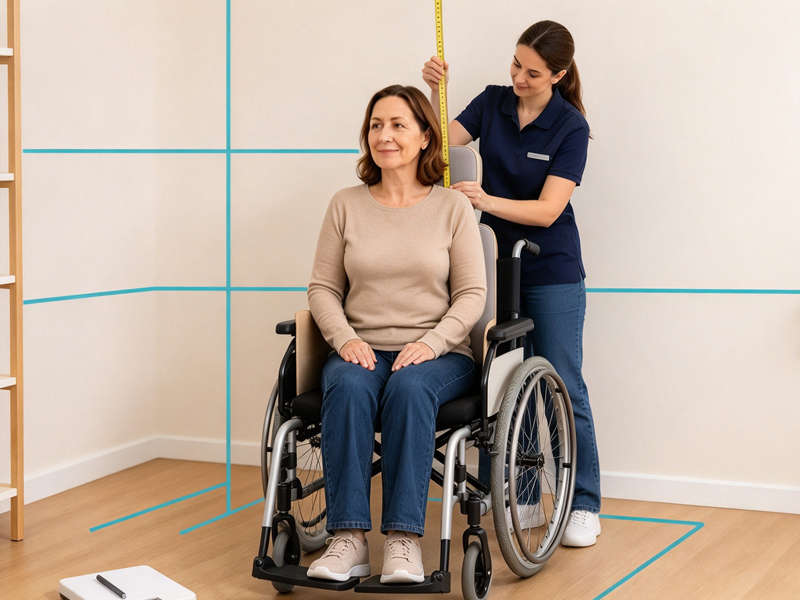
Choosing a wheelchair that fits properly starts with accurate measurements. A chair that is too narrow may feel uncomfortable and put unnecessary pressure on the hips, while one that is too wide can make it harder to sit securely, move through doorways and control the wheelchair. Seat depth, lower-leg length, footrest position and the user’s weight also affect whether a wheelchair is suitable for everyday use.
The good news is that you can take several important measurements at home with a tape measure, a firm chair and a little preparation. You do not need specialist equipment to get started. What matters is knowing which measurements to take, where to measure from and how to use the results when comparing wheelchair sizes.
A wheelchair is more than a seat with wheels. Its dimensions affect comfort, posture, movement and how easily the user can manage everyday activities. The right measurements help you narrow down suitable models before buying, hiring or arranging a professional assessment.
An incorrectly sized wheelchair can cause practical problems even when it looks suitable at first glance. For example, a chair with a seat that is too narrow may press against the hips and thighs. If the seat is too wide, the user may struggle to reach the wheels comfortably or maintain a stable sitting position. A seat that is too deep can press against the backs of the knees, while one that is too short may not support enough of the thighs.
The footrests matter, too. If they are set too high, the thighs may be pushed upwards and pressure can build beneath them. If they are too low, the feet may hang without adequate support or the footplates may come too close to the floor.
Measurements also need to work in the user’s actual surroundings. A wheelchair may fit the person perfectly but still be too wide for the bedroom doorway, bathroom entrance or narrow hallway. It may also be difficult to manoeuvre around furniture or fit into a car boot.
Taking measurements at home helps you identify these issues early. It gives you useful information to compare with the manufacturer’s specifications and discuss with a wheelchair supplier, occupational therapist or other relevant professional.
However, home measurements are a starting point rather than a substitute for a professional assessment when one is needed. Someone who has complex postural needs, reduced sensation, a history of pressure injuries, significant muscle weakness or difficulty maintaining a stable sitting position may require individual assessment to determine the most appropriate wheelchair and seating configuration.
For many people, the first step is straightforward: measure the user, measure the space the wheelchair must travel through, and then compare those figures with the dimensions of the wheelchair itself.
Before picking up a tape measure, it is important to understand that a wheelchair’s seat width and overall width are two different measurements. Confusing them is a common reason for choosing a chair that does not fit the user or the home.
Seat width describes the usable width of the seating area, usually measured from one side of the seat to the other. It is the measurement most directly related to the space available for the user’s hips and thighs.
Overall width describes how wide the entire wheelchair is from its outermost point on one side to its outermost point on the other. Depending on the design, this may include the wheels, hand rims, frame or other components that extend beyond the seat.
The overall width is particularly important when checking whether the wheelchair can pass through a doorway or move between furniture. A seat advertised as 18 inches wide does not necessarily mean the wheelchair itself is only 18 inches wide. The wheels and frame add to the total.
For example, imagine that a person needs a seat approximately 18 inches wide. That figure helps identify an appropriate seating size, but it does not tell you whether the wheelchair will fit through a 28-inch doorway. You must check the model’s published overall width separately.
Manufacturers may provide overall dimensions with the wheelchair open, folded or configured with particular accessories. These figures are not interchangeable. If you need the wheelchair to pass through a narrow entrance, check the exact dimension that applies when it is ready for use.
It is also worth checking whether removable armrests, footrests or other parts affect the space needed for manoeuvring. Even if a wheelchair can technically pass through an entrance, there still needs to be enough room to turn and position it safely on the other side.
Keep these two questions separate throughout the measuring process:
Both are essential. Neither can replace the other.
Seat width is one of the most important measurements when choosing a wheelchair. The aim is to provide enough space for the user’s hips and thighs without leaving so much room that the person sits insecurely or struggles to reach the wheels.
To begin, ask the user to sit upright on a firm, level chair. Their feet should be supported, and their pelvis should be positioned as naturally as possible rather than tilted to one side. If they usually wear bulky clothing or use a seating cushion, consider how these will affect the final fit.
Use a tape measure to establish the widest part of the hips while the person is sitting. This is generally more useful than measuring around the hips while standing because sitting changes the way the soft tissue spreads across the seat.
Measure straight across the widest part from one side to the other. Keep the tape level, and avoid pressing it tightly into the body. The measurement should reflect the space the user actually needs when seated.
Write down the result in inches or centimetres. If you use centimetres, convert the figure carefully when comparing it with a wheelchair advertised in inches. One inch equals 2.54 centimetres.
The measured hip width is a starting point, not automatically the exact seat width to order. The wheelchair seat normally needs a little additional space so the user can sit comfortably without the sides pressing into the hips or thighs. The appropriate allowance depends on the person’s build, clothing, cushion, posture and the wheelchair’s design.
Too little space can create pressure and make transfers uncomfortable. Too much space can also be a problem. The user may lean to one side, slide into an awkward position or find it difficult to reach the hand rims efficiently on a self-propelled wheelchair.
If the person has prominent hips or thighs, wears thick clothing, or needs a particular cushion, account for these factors when confirming the required seat width. Do not simply choose a wider chair to make it feel more spacious; the width should be suitable for both comfort and function.
Once you have the measurement, compare it with the manufacturer’s stated seat widths. If the user’s measurement falls between two available sizes, ask the supplier which option is appropriate rather than assuming that the larger one is always better.
It is also worth checking the seat width of an existing wheelchair if the user already has one that fits reasonably well. This can provide a useful point of comparison, but only if the current chair is comfortable and suitable. A familiar chair is not necessarily the correct size if the user has gained or lost weight, changed posture or begun using a different cushion.
Seat depth is the distance from the front edge of the wheelchair seat to the back of the seating area. It determines how much of the thighs is supported and how much clearance remains behind the knees.
A suitable seat depth helps distribute body weight across the seating surface. If the seat is too short, the thighs may not receive enough support. If it is too long, the front edge can press against the backs of the knees, causing discomfort and potentially affecting circulation or sitting posture.
To measure at home, ask the user to sit upright on a firm chair with their pelvis positioned towards the back of the seat. Their feet should be supported, and their knees should be bent comfortably.
Measure from the back of the buttocks to the area just behind the knees. Keep the tape measure in line with the thigh, following the direction of the seat rather than measuring diagonally.
The measurement is intended to estimate the usable length of the thigh when seated. It is not the distance from the hip to the ankle, and it should not be confused with the lower-leg measurement used to determine footrest height.
A wheelchair seat should generally be shorter than the user’s measured buttock-to-knee length. The World Health Organization’s wheelchair provision guidance describes a seat depth that is around 30–60 mm shorter than the user’s buttock-to-knee measurement. This clearance helps prevent the front of the seat from pressing against the backs of the knees.
The exact fit should still be confirmed against the wheelchair manufacturer’s instructions and the person’s seating needs. A user with particular postural requirements may need a more individualised approach.
When checking seat depth, pay attention to where the front edge would sit relative to the knees. There should be appropriate clearance rather than a seat edge that pushes directly into the back of the leg.
Also consider the cushion. A thick cushion can change the effective seat depth, and a cushion with a raised front edge or a shaped surface may affect how the thighs are supported. If the user will routinely sit on a cushion, measure and assess the fit with that cushion in mind.
If you are measuring an existing wheelchair, check whether the seat depth is listed by the manufacturer. The fabric seat may be difficult to measure accurately if it sags or has an unusual shape. For this reason, the manufacturer’s specifications are often more reliable for comparing the dimensions of different models.
Lower-leg length is important because it helps determine where the footplates should sit. The user’s feet need adequate support, while the footplates must remain clear of the floor and avoid catching on door thresholds or uneven surfaces.
For a practical measurement, have the user sit on a firm chair with their knees bent at approximately a right angle and their feet resting flat on the floor. Their usual footwear should be on, because shoes affect the distance between the underside of the foot and the floor.
Measure vertically from the underside of the thigh, near the front edge of the seat, down to the floor. Keep the tape measure straight and avoid following the curve of the leg.
This measurement provides a useful starting point for estimating the required lower-leg length and footrest setting. However, it should be interpreted alongside the wheelchair’s own measurement method, because manufacturers may specify seat-to-footplate dimensions differently.
The aim is to support the feet without placing unnecessary pressure beneath the thighs. When the footplates are set too high, the knees may rise and the thighs may press harder against the seat. This can reduce comfort and change the user’s sitting position.
If the footplates are set too low, the feet may not be properly supported. The user might allow their feet to slide backwards, or the footplates could sit dangerously close to the ground.
Once the wheelchair is assembled and adjusted, check the position with the user seated on the actual wheelchair. Their feet should rest securely on the footplates, and the thighs should be supported without being pushed upwards by the footrests.
The footplates also need adequate ground clearance. A practical reference is around 10 cm, while NHS Wales guidance advises that the clearance should not be less than 5 cm. These figures are useful checks rather than a universal setting for every wheelchair or every environment. Follow the manufacturer’s instructions and consider the surfaces the chair will travel over.
Too little clearance increases the risk of the footplates striking the floor, door thresholds or uneven ground. On the other hand, setting the footplates excessively high simply to achieve more clearance can leave the feet unsupported or change the user’s posture.
If you are unsure whether the lower-leg measurement translates correctly to the selected wheelchair, ask the supplier to confirm the appropriate footrest adjustment. This is particularly important when the user has limited joint movement, unusual lower-leg proportions or specific seating requirements.
A wheelchair cushion is not just an optional extra to consider after choosing the frame. It can change the way the user sits and affect several of the measurements that determine the final fit.
A cushion adds height to the seating surface. This changes the effective distance between the seat and the footplates, and it can influence the amount of space available beneath the thighs. Depending on its thickness and shape, it may also affect the usable seat depth.
For example, a person measured on a flat chair may appear to need a particular footrest height. If a thick cushion is then placed on the wheelchair seat, the person’s body sits higher relative to the footplates. The footrests may need to be adjusted so the feet remain properly supported.
The cushion can also change the way the hips and thighs occupy the seat. A shaped cushion may position the pelvis differently from a flat one, while a cushion intended to help manage pressure may have specific instructions for positioning and use.
For these reasons, if the user intends to use a cushion every day, take it into account when confirming the wheelchair’s dimensions. Where possible, assess the final sitting position with the actual cushion rather than assuming that measurements taken without it will remain accurate.
If the cushion has not yet been selected, tell the wheelchair supplier that one may be required. They can help establish whether the proposed wheelchair will accommodate it and whether adjustments to the footrests or seating configuration will be necessary.
This is especially important for people who need a specialist cushion because of reduced sensation, pressure-injury risk or postural support needs. In these circumstances, the cushion and wheelchair should be considered together, rather than selecting a standard chair first and trying to make the cushion fit afterwards.
Once you have established the user’s seating measurements, turn your attention to the home. A wheelchair that fits the person but cannot pass through essential doorways will be difficult to use in everyday life.
Start with the routes the wheelchair must travel. These may include the front door, hallway, bedroom, bathroom, kitchen and the entrance to any room where the user will spend time. If the wheelchair will be used outside, also consider the route to the garden, driveway or accessible entrance.
Measure the clear opening of each doorway at its narrowest usable point. Do not assume that the nominal door size shown on a building plan is the same as the space available when the door is open. The door leaf, handles, hinges and surrounding frame can reduce the usable opening.
Compare these measurements with the wheelchair’s published overall width. Leave some allowance for steering and manoeuvring where possible. A wheelchair that is only just narrower than a doorway may pass through in a straight line but be awkward to position, particularly if the user needs help from a carer.
As a general reference, a 30-inch door leaf, commonly found in England and Wales, does not necessarily provide a full 30 inches of clear passage. Always measure the actual opening rather than relying on the nominal door size.
The wheelchair’s overall width may also vary depending on the model and its configuration. Check the manufacturer’s specifications rather than calculating it from seat width alone. Wheels, hand rims and frame components can extend beyond the seating area, and different designs have different dimensions.
If a doorway is particularly narrow, ask the supplier whether the wheelchair can pass through it in its normal configuration. Do not assume that removing a footrest will solve a width problem, since footrests typically affect length more than overall width.
Doorways are only part of the picture. Think about the space needed to turn at the end of a hallway, manoeuvre beside a bed or approach a toilet. A wheelchair may fit through an entrance but still be difficult to turn in the room beyond it.
Furniture can also make a significant difference. Measure narrow gaps between tables, cupboards and other obstacles, and consider whether the user will need to reverse or turn in those spaces.
If possible, mark the wheelchair’s approximate width on the floor using removable tape. This gives you a simple way to visualise the space it will occupy and can help you identify tight corners or awkward approaches before the wheelchair arrives.
When comparing models, keep a note of both the seat width and overall width. These figures answer different questions, and recording them separately makes it easier to choose a wheelchair that works for the person and the home.
The user’s weight is another essential part of wheelchair selection. Every wheelchair has a maximum user weight, and this limit must not be exceeded.
Measure or confirm the user’s current weight and compare it with the maximum user weight stated by the manufacturer. Do not rely on a general figure taken from another wheelchair, even if the two chairs look similar.
Many standard adult wheelchairs have a maximum user weight around 114 kg, or 18 stone, but this is only a broad reference. Some models have lower limits, while reinforced or specialist models may support more. The exact specification for the chosen wheelchair is what matters.
It is also important not to assume that a wider wheelchair automatically has a higher weight capacity. Seat width and weight capacity describe different characteristics. A chair with a wider seat may still have a weight limit that is unsuitable for the user.
Likewise, do not assume that a model will support a greater weight simply because it has a heavier frame or larger wheels. The manufacturer’s stated maximum user weight should always guide the decision.
Weight capacity is not the only consideration when choosing a chair for a larger user. The seat width, frame dimensions, comfort, ease of transfer and the user’s ability to operate the wheelchair all need to be considered together.
If the user’s weight is close to the stated maximum, check the specification carefully and ask the supplier for clarification before purchasing. Avoid treating the limit as a flexible guideline.
The same principle applies when the wheelchair will be used with accessories. If you are unsure whether a particular configuration is suitable, confirm it with the manufacturer or supplier rather than making assumptions.
If the user already has a wheelchair, checking its dimensions can provide a useful starting point. This can be particularly helpful when the chair is reasonably comfortable and you are looking for a replacement.
First, establish whether the existing wheelchair is actually a good fit. Does the user sit comfortably without the hips pressing against the sides? Is there adequate support beneath the thighs? Do the feet rest securely on the footplates? Can the user move through the home’s doorways without repeated difficulty?
If the current chair fits well, record its seat width and seat depth. Check the manufacturer’s label, product manual or specification sheet if available. The listed measurements are often more reliable than trying to estimate dimensions from a fabric seat or curved frame.
Next, record the overall width, especially if the wheelchair fits through the home’s entrances. A replacement with a similar seat width may have a different overall width because of its wheel arrangement, frame construction or design.
Compare the footrest configuration as well. If the user is comfortable with the existing setup, note the current lower-leg support and whether the footplates provide enough clearance. However, do not assume that every wheelchair uses the same measurement system or adjustment range.
It is also important to remember that an existing wheelchair may no longer be suitable. Changes in weight, posture, mobility, clothing or cushion use can affect the fit. A chair that was appropriate several years ago may now be too narrow, too deep or otherwise unsuitable.
If the current chair causes discomfort, pressure marks, repeated sliding or difficulty reaching the wheels, do not simply copy its dimensions. Use the measurements as background information and seek advice about correcting the fit.
When replacing a wheelchair, compare like with like wherever possible. Check whether both models list seat width in the same way, whether seat depth is measured using the same reference points, and whether overall width refers to the chair in its normal usable configuration.
A supplier can help interpret differences between models and identify whether an apparently small dimensional change will affect comfort or access at home.
Measurements are useful, but the way the user sits and moves in the wheelchair provides important information too. After the chair has been fitted, look for signs that the dimensions or adjustments may not be suitable.
One common sign is pressure around the hips or thighs. If the seat feels tight, the user’s clothing is caught against the sides or the body appears compressed between the armrests, the seat may be too narrow. Persistent redness, skin discoloration or other skin changes should not be ignored, particularly for someone who has reduced sensation.
A seat that is too wide can create a different set of problems. The user may lean to one side, struggle to maintain a balanced position or have difficulty reaching the hand rims. If they need to propel the chair independently, the distance between the body and the wheels can affect how comfortably they reach them.
Seat depth may be unsuitable if the front edge presses into the backs of the knees. At the other extreme, inadequate thigh support can occur when the seat is too short. Either situation can affect comfort during longer periods of sitting.
Watch for repeated sliding forward or a tendency to sit in an awkward position. These behaviours can have several causes, including seating dimensions, cushion choice, posture and the need for additional support. They should not automatically be attributed to one measurement alone.
Footrest position is another useful indicator. If the thighs are pushed upwards, the footrests may be too high or the seating arrangement may need adjustment. If the feet are not supported securely or the footplates frequently strike the ground, the footrest height or ground clearance may need attention.
Shoulder discomfort can also occur when the wheelchair is difficult to propel or when the user has to reach awkwardly for the wheels. The problem may relate to the overall design, wheel position, seat width or other factors rather than the seat measurement alone.
Finally, pay attention to practical access. If the wheelchair repeatedly catches on door frames, cannot pass through the bathroom entrance or is difficult to manoeuvre around furniture, check its overall width and the available turning space.
These observations are not a diagnosis. Discomfort can have several causes, and pressure damage can develop for reasons beyond wheelchair dimensions. If the user develops persistent pain, skin changes or problems maintaining a safe sitting position, seek appropriate professional advice rather than trying to resolve everything by changing the size.
Before contacting a supplier or comparing wheelchair models, gather the measurements and details in one place. This makes it easier to check the specifications and reduces the risk of overlooking an important dimension.
Use the following checklist to organise your information.
Measurements of the user
Measurements and specifications of the wheelchair
Measurements of the home
You can record these details in a simple note on your phone or on paper. Include the units for every measurement, and label user measurements separately from wheelchair dimensions. This prevents confusion when comparing a seat width in inches with a doorway measurement in centimetres.
If a supplier gives you a specification sheet, compare each figure with your notes. Ask for clarification if the meaning of a measurement is unclear, particularly when the seat width, overall width or footrest adjustment range is not explicitly stated.

Once you have the measurements, use them to identify models that are worth considering. Avoid choosing a wheelchair based on seat width alone. A suitable chair needs to accommodate the user’s body, provide appropriate foot support, meet the required weight capacity and fit the home.
Start with the seating dimensions. Compare the user’s hip width and buttock-to-knee length with the manufacturer’s recommended seat width and depth. Confirm the fit rather than assuming that the nearest advertised size will automatically be correct.
Next, check the overall width against the home’s doorways and routes. If access is tight, ask the supplier whether the wheelchair can pass through the relevant entrances in its normal configuration. Consider manoeuvring space as well as straight-line clearance.
Then confirm the lower-leg support and footrest adjustment. If the user will use a cushion, make sure the final setup accounts for it. The feet should be supported, the thighs should not be pushed upwards by the footplates, and the footplates should have suitable ground clearance.
Finally, verify the maximum user weight. This should be checked against the exact model, not inferred from the wheelchair’s appearance or seat width.
If you are replacing an existing wheelchair, compare its dimensions with the proposed replacement and identify any changes that could affect comfort or access. A new model may have a similar seat width but a different overall width or adjustment range.
Remember that the goal is not simply to find a wheelchair that matches a list of numbers. The measurements help identify a suitable starting point, but comfort, stability, posture, ease of movement and the person’s everyday needs all matter.
For a straightforward manual wheelchair, accurate home measurements and a careful check of the manufacturer’s specifications may be enough to narrow the options considerably. If the user has complex seating needs, difficulty maintaining posture, significant pain or a history of pressure injuries, professional assessment is particularly important.
A supplier or occupational therapist can help confirm whether the measurements are appropriate, explain any differences between models and identify adjustments that may be needed.
1. Can I measure for a wheelchair at home without professional help?
Yes. You can take useful preliminary measurements at home, including seated hip width, buttock-to-knee length, lower-leg length and the clear width of doorways. You can also confirm the user’s weight and compare it with the manufacturer’s maximum user weight.
These measurements help you narrow down suitable wheelchair models. However, they do not replace a professional assessment when the user has complex postural needs, reduced sensation, pressure-injury risks or difficulty sitting safely. If you are uncertain about the correct size or adjustments, ask a qualified professional or wheelchair supplier to help confirm the fit.
2. What is the difference between wheelchair seat width and overall width?
Seat width is the width of the seating area available for the user’s hips and thighs. Overall width is the width of the entire wheelchair, including the components that extend beyond the seat, such as the wheels and frame.
Seat width helps you assess whether the wheelchair is likely to fit the user. Overall width helps you determine whether it can pass through doorways and move around the home. Always check both measurements in the manufacturer’s specifications, because a wheelchair’s overall width is not the same as its seat width.
3. Should I measure for a wheelchair with the cushion and shoes in place?
For lower-leg measurements, the user should wear their usual shoes because footwear affects the distance between the feet and the floor. If the wheelchair will be used with a cushion, take the cushion into account when confirming the final fit.
A cushion can change the user’s seated height and effective seat depth, which may affect footrest positioning. If a cushion is required, the wheelchair and cushion should be considered together. Check the finished setup to ensure that the feet are supported, the thighs are comfortable and the footplates have adequate clearance from the ground.