Our Location
Free Trade Tower, Xiyong street.
Chongqing, China

Free Trade Tower, Xiyong street.
Chongqing, China
Choosing the right wheelchair is about more than comfort or appearance. For distributors and dealers, it means understanding what users actually need, identifying the right equipment for different environments, and working with manufacturers that can provide reliable products and long-term support. When customers search for a tilt in reclining wheelchair, they may be looking for better sitting comfort, improved positioning, easier daily mobility, or a solution that helps them navigate challenging home environments.
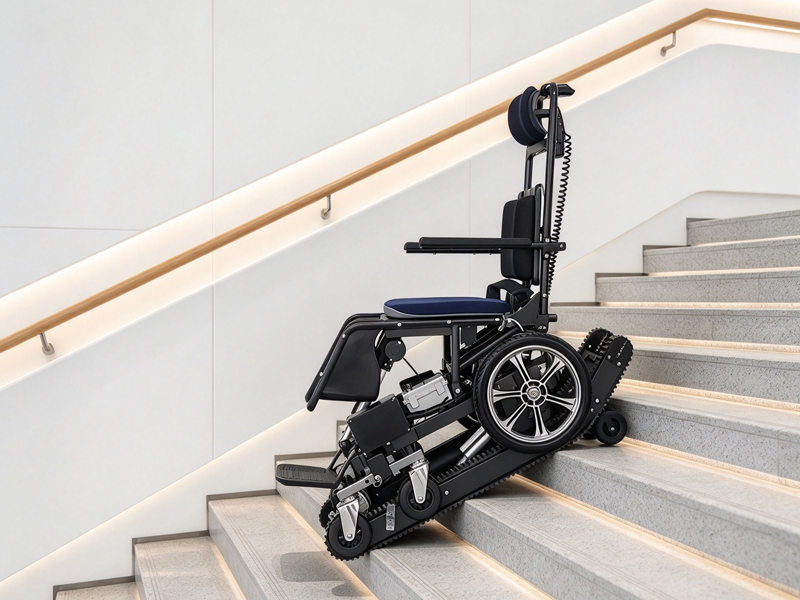
These requirements do not always point to the same product. Some users benefit from a conventional reclining wheelchair, while others require a tilt-in-space seating system. In homes and buildings where stairs create an additional barrier, a stair-climbing wheelchair may be a more relevant option.
For mobility equipment businesses, understanding these differences is essential to building a product range that meets real customer needs. It also creates opportunities to recommend specialized equipment rather than relying on a one-size-fits-all approach.
IYASOCARE offers two stair-climbing wheelchair models worth considering for distributors serving residential users, caregivers, hospitals, rehabilitation providers, and other professional buyers: the Dual-Use Stair-Climbing Wheelchair and the Automatic Stair-Climbing Wheelchair YSE210. Both address mobility challenges associated with stairs, but their specifications and intended selling points differ.
The terms tilt-in-space wheelchair and reclining wheelchair are often used interchangeably in general product searches. However, they describe different seating mechanisms, and distributors should understand the distinction before recommending equipment.
A reclining wheelchair changes the angle between the seat and the backrest. The backrest moves backward, allowing the user to adopt a more reclined posture. Depending on the design and the user’s needs, this may help with resting, positioning, and certain care routines.
A tilt-in-space wheelchair moves the seat and backrest together while maintaining their relative angle. This changes the user’s overall orientation without necessarily changing the angle at the hips. For some users who spend extended periods sitting, this function can support postural management and pressure redistribution.
Neither design is automatically suitable for every person. The appropriate choice depends on trunk control, pelvic stability, range of motion, transfer requirements, skin condition, and individual clinical recommendations. Reclining can also cause the body to slide if the seating system is poorly configured, so the complete seating arrangement matters.
For dealers, the most important point is that seating and positioning functions are different from stair-climbing functions. A wheelchair with a reclining backrest does not automatically provide tilt-in-space positioning, and a stair-climbing wheelchair should not be advertised as a tilt-in-space model unless the manufacturer confirms that capability.
This distinction is particularly important when sourcing products for healthcare providers and professional distributors. Accurate product descriptions help customers understand what they are buying and reduce the risk of recommending equipment that does not meet their requirements.
A successful purchasing decision begins with the user, not the catalogue. Before selecting a wheelchair, dealers should consider the person’s weight, body dimensions, mobility limitations, sitting tolerance, transfer needs, and daily environment.
Seat width and depth are among the first measurements to check. A seat that is too narrow can cause discomfort, while an excessively wide seat may reduce lateral support. Backrest height, foot support, armrests, head support, and cushion compatibility also affect the user’s overall experience.
For reclining and tilt-in-space wheelchairs, positioning requirements deserve particular attention. Some users need additional trunk support or specialized pressure-management cushions. Others may need a seating configuration that accommodates limited joint movement. Where clinical positioning is involved, recommendations should be made with appropriate professional input.
Weight capacity is equally important. Dealers should compare the manufacturer’s stated maximum load with the user’s complete operating weight and never exceed the approved limit. Frame material, braking systems, battery configuration, and the availability of replacement components should also be reviewed.
The environment in which the wheelchair will be used can be just as important as the user’s physical requirements. A wheelchair intended for a single-storey home may not solve the problems faced by someone living in a multi-level building without an elevator. In such cases, a stair-climbing model may be worth evaluating.
Finally, distributors should assess the supplier’s after-sales capabilities. Warranty coverage, spare-parts availability, technical documentation, battery replacement, product training, and maintenance support all affect the long-term value of a purchase. A competitive wholesale price is useful, but it should not come at the expense of product suitability or service reliability.
For dealers looking to expand beyond conventional wheelchairs, the IYASOCARE Dual-Use Stair-Climbing Wheelchair is worth evaluating. Identified as model YSE205 in the product specifications, this wheelchair combines movement on flat ground with a powered stair-climbing function.
Its dual-use design addresses a practical challenge for people who have difficulty moving between floors. In residential buildings, older homes, and some care environments, stairs can limit access even when the user has a suitable wheelchair for everyday movement.
The YSE205 offers an alternative for compatible staircases, while its reclining backrest provides another feature that dealers can discuss with customers who value a more relaxed seating position. However, the reclining function should not be confused with a dedicated tilt-in-space mechanism or presented as a guaranteed pressure-injury prevention feature.
The manufacturer publishes the following specifications:
| Specification | YSE205 |
|---|---|
| Frame material | Steel |
| Motor | 24V DC, 370W |
| Battery | 20Ah lithium |
| Maximum load | 150 kg |
| Seat width | 48 cm |
| Seat depth | 43 cm |
| Seat height | 44 cm |
| Maximum stated driving range | Up to 15 km |
| Maximum stated speed | Up to 8 km/h |
| Stair-climbing speed | Approximately 15 steps per minute |
| Stated climbing capacity | Up to 500 steps |
| Minimum stated stair width | 700 mm |
| Stated stair slope | Below 45° |
| Overall dimensions | 108 × 68 × 130 cm |
| Folded dimensions | 68 × 77 × 88 cm |
| Net weight | 93 kg |
Source: IYASOCARE Dual-Use Stair-Climbing Wheelchair. Specifications and available configurations should be confirmed with the manufacturer before ordering.
One of the model’s most notable features is its stated maximum load of 150 kg. This provides dealers with an option for customers whose weight requirements exceed the capacity of some lighter stair-climbing models. The 48 cm seat width may also be worth considering for users who need more seating space, although individual measurements remain essential.
The wheelchair uses a steel frame and a 370W motor, supported by a 20Ah lithium battery. The manufacturer states a maximum driving range of up to 15 km and a climbing capacity of up to 500 steps. These figures are useful for product comparisons, but actual performance depends on user weight, battery condition, staircase characteristics, operating conditions, and the route involved.
The manufacturer also describes manual and electromagnetic braking and a climbing-lock system. These features are relevant when assessing how the wheelchair controls movement during operation. Dealers should obtain the current technical documentation and ensure that users and caregivers receive appropriate training before the equipment is used on stairs.
The YSE205 may be particularly relevant to residential mobility dealers, home-care providers, and healthcare equipment suppliers serving customers who need a higher stated load capacity and a reclining seat. Its net weight of 93 kg, however, means that transportation and handling arrangements must be considered carefully.
Before recommending the model, dealers should confirm that the staircase meets the manufacturer’s requirements and that the folded dimensions are compatible with the intended storage area or vehicle.
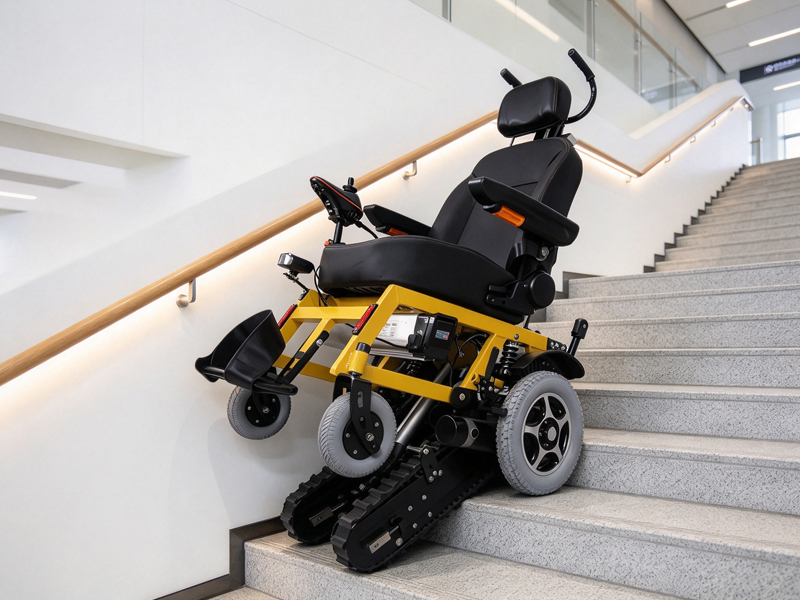
The IYASOCARE Automatic Stair-Climbing Wheelchair YSE210 offers a different combination of features. Rather than emphasizing the wider seat and higher stated load capacity of the YSE205, it uses an aluminum-alloy frame and a larger-capacity lithium battery.
The manufacturer positions the YSE210 as an automatic stair-climbing wheelchair designed to help users navigate stairs in compatible environments. Its operating system is intended to simplify stair climbing, but this should not be interpreted as a guarantee that every user can operate the wheelchair independently or without assistance. Suitability depends on the user’s abilities, the staircase, and the manufacturer’s operating instructions.
The published specifications are as follows:
| Specification | YSE210 |
|---|---|
| Frame material | Aluminum alloy |
| Motor | 250W |
| Battery | 29.4V, 30Ah lithium |
| Maximum load | 100 kg |
| Seat width | 40 cm |
| Seat depth | 45 cm |
| Overall dimensions | 116 × 75 × 118 cm |
| Folded dimensions | 116 × 75 × 58 cm |
| Net weight | 65 kg |
| Gross weight | 90 kg |
| Maximum stated driving range | Up to 30 km |
| Stated climbing capacity | Up to 800 steps |
| Stair-climbing speed | Approximately 15 steps per minute |
| Minimum stated stair width | Greater than 700 mm |
| Stated stair slope | Below 45° |
Source: IYASOCARE Automatic Stair-Climbing Wheelchair YSE210. Confirm current specifications and the applicable landing-clearance requirements with the manufacturer.
The YSE210’s 30Ah lithium battery is a key selling point. The manufacturer states a driving range of up to 30 km and a climbing capacity of up to 800 steps. These figures describe different operating scenarios and should not be treated as guaranteed simultaneous performance. Dealers should ask the supplier about testing conditions and the expected effect of load, terrain, battery condition, and stair configuration.
The aluminum-alloy frame and published net weight of 65 kg distinguish the YSE210 from the heavier steel-framed YSE205. While it is still substantial equipment that requires appropriate handling, the lower net weight may be attractive to distributors and customers who place a higher priority on transport and storage.
Its folded height is listed as 58 cm, which can help when evaluating storage options. However, the complete folded footprint must still be checked against the dimensions of the customer’s vehicle, storage area, or transport equipment.
The 100 kg maximum load is a critical purchasing consideration. Dealers should not recommend this model to a user whose complete operating weight exceeds the stated limit. Its 40 cm seat width is also narrower than the YSE205’s 48 cm seat, so a proper fit assessment is necessary.
The YSE210 may suit buyers who meet its seating and weight requirements and prioritize a larger battery, a lower equipment weight, and automatic stair-climbing functionality. It is not necessarily the better choice for every user; the right decision depends on the complete set of requirements.
For distributors, the two IYASOCARE models are best viewed as complementary options. Stocking both may help a business serve different customer profiles, provided demand, demonstration facilities, service capacity, and inventory costs justify the investment.
The YSE205 has a published maximum load of 150 kg, a 48 cm seat width, a reclining backrest, a 370W motor, and a 20Ah lithium battery. Its primary advantages for product positioning are its higher stated load capacity, wider seat, and combination of everyday mobility and stair climbing.
The YSE210 has a published maximum load of 100 kg, a 40 cm seat width, a 250W motor, and a 30Ah lithium battery. Its lower net weight and longer stated driving range may appeal to a different group of buyers.
The specifications should always be compared in context. A larger battery does not automatically mean that one wheelchair is more suitable for every staircase, and a higher motor rating alone does not establish superior safety or performance. Actual suitability depends on the complete design, user requirements, operating conditions, and verified manufacturer guidance.
Before placing a wholesale order, dealers should establish which customer groups they serve most often. If their market includes users who need a wider seat and a higher load rating, the YSE205 may deserve closer attention. If their customers prioritize battery capacity and a lower net equipment weight while remaining within the YSE210’s load limit, the YSE210 may be a more appropriate option.
The manufacturer’s current specification sheets should be used for final purchasing decisions, quotations, and product listings.
A stair-climbing wheelchair cannot be recommended based on the building’s general appearance or staircase angle alone. Stair dimensions, landing space, surface conditions, and operating procedures must all be checked before purchase.
Both IYASOCARE models publish a stair-width requirement around 700 mm and a supported slope below 45°. These are initial screening criteria, not a guarantee that a particular staircase is suitable.
Dealers should obtain measurements for the clear width between obstructions, step height, tread depth, staircase slope, landing width, landing depth, and turning space at both ends. Handrails, doorways, floor coverings, and other obstacles can affect the available operating space.
The product pages also provide different landing-clearance specifications. The YSE205 lists a corner width and depth of at least 1.3 m, while the YSE210 lists a corner width of at least 1.5 m and a depth of 1.2 m. Because staircase layouts vary, dealers should request the manufacturer’s technical drawings and confirm how these measurements apply to the intended installation.
Users and caregivers should receive training on the controls, braking system, approach to the stairs, and emergency procedures. The wheelchair must be operated according to the manufacturer’s instructions and within its approved limits. A staircase that meets a basic width requirement may still be unsuitable because of its shape, surface, or landing arrangement.
These checks protect customers and caregivers while reducing the risk of returns, complaints, and unsuitable product recommendations.
For distributors and dealers, a profitable product portfolio is not simply a collection of popular models. It is a range in which each product serves a clearly defined purpose.
A conventional reclining wheelchair may be appropriate for a customer who needs a change in backrest angle. A tilt-in-space wheelchair may be more suitable for someone who needs a different approach to postural management. A stair-climbing wheelchair addresses the separate problem of accessing stairs in compatible environments.
Keeping these categories clear makes it easier for sales teams to explain differences and recommend equipment responsibly.
Before buying wholesale, request technical specification sheets, user manuals, battery and charger information, spare-parts lists, warranty terms, and maintenance instructions. Confirm which conformity documents apply in the destination market and verify the manufacturer’s current certification status rather than relying on general marketing claims.
It is also worth discussing sample orders, product training, shipping arrangements, and the availability of replacement components before committing to larger quantities. For dealers supplying healthcare providers, reliable technical support can be just as important as the initial purchase price.
Businesses interested in sourcing directly can review the IYASOCARE product catalogue and explore its OEM and ODM services. These are useful starting points for discussing available models, product documentation, and potential distribution arrangements. Current service scope, customization options, minimum order quantities, and commercial terms should be confirmed directly with the manufacturer.
A thoughtful purchasing strategy allows dealers to offer a broader range of mobility solutions while keeping customer needs at the centre of every recommendation.
The right wheelchair is the one that matches the user’s physical requirements, daily environment, and practical mobility challenges. For tilt-in-space and reclining wheelchairs, seating support, posture, comfort, and clinical recommendations should guide the decision. When stairs are the main obstacle, a specialized stair-climbing model may provide a more relevant solution.
The IYASOCARE Dual-Use Stair-Climbing Wheelchair YSE205 is worth considering for customers who need a wider seat, a reclining backrest, and a higher stated load capacity. The Automatic Stair-Climbing Wheelchair YSE210 offers a different balance of battery capacity, frame material, equipment weight, and stair-climbing functionality.
For distributors and dealers, the best approach is to compare verified specifications, assess the intended staircase, understand the user’s needs, and establish a reliable after-sales process before making a recommendation.
A well-matched mobility product can improve everyday access and make caregiving more manageable. A well-informed buying decision also strengthens customer confidence and supports long-term business relationships.
1. What is the difference between a tilt-in-space wheelchair and a reclining wheelchair?
A tilt-in-space wheelchair moves the seat and backrest together while maintaining their relative angle. A reclining wheelchair changes the angle between the seat and backrest. The appropriate option depends on the user’s posture, positioning requirements, comfort, and professional assessment.
2. Can the IYASOCARE YSE210 be used on any staircase?
No. The staircase must meet the manufacturer’s dimensional and operating requirements. The published specifications include a stair width greater than 700 mm and a slope below 45°, along with landing-clearance requirements. Dealers should confirm all measurements against the current technical documentation before recommending the model.
3. Which IYASOCARE stair-climbing wheelchair is better for distributors to stock?
The YSE205 may be more suitable for customers who need a higher stated load capacity of 150 kg, a 48 cm seat, and a reclining backrest. The YSE210 may appeal to customers who meet its 100 kg load limit and prioritize its 30Ah battery and lower net equipment weight. Dealers should consider local demand, user fit, staircase compatibility, service requirements, and inventory costs before choosing one or both models.