Our Location
Free Trade Tower, Xiyong street.
Chongqing, China

Free Trade Tower, Xiyong street.
Chongqing, China
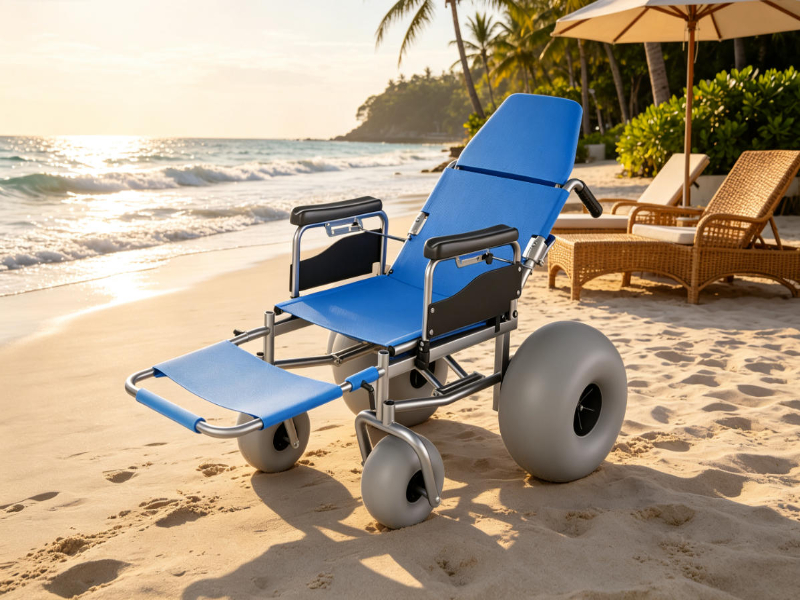
A beach should be a place where everyone can relax, explore, and enjoy the outdoors. Yet for many wheelchair users, the moment a paved path turns into soft sand, ordinary mobility equipment can become difficult to use. Small wheels sink into loose surfaces, narrow tires lose traction, and pushing a conventional wheelchair across a beach can quickly become exhausting for both the user and the caregiver.
Table of Contents
ToggleThis is exactly why an All-Terrain Beach Wheelchair Balloon Tires design can make such a difference. Instead of relying on narrow, high-pressure wheels designed mainly for hard surfaces, beach wheelchairs use wider wheels and larger contact areas to distribute weight more effectively across sand. The result is a mobility solution designed around environments where conventional wheelchairs often struggle.
Whether the destination is a sandy beach, lakeside, riverside, camping area, garden, park, or another outdoor environment, an All-Terrain Beach Wheelchair Balloon Tires configuration can open up more possibilities for outdoor mobility. Wide wheels are particularly important because soft sand behaves very differently from pavement. A wheelchair needs to remain stable while avoiding excessive sinking, and the tires need to move over changing surfaces rather than simply cutting into them.
For families, rehabilitation facilities, hotels, resorts, accessible tourism operators, and mobility equipment distributors, choosing the right beach wheelchair is therefore not simply about finding a chair with large wheels. It means considering tire width, frame construction, seating comfort, stability, corrosion resistance, maneuverability, user capacity, transfer requirements, and the environments where the wheelchair will actually be used.
The biggest problem with ordinary wheelchair wheels on a beach is not necessarily the wheelchair itself. It is the interaction between the wheels and the surface.
Hard pavement provides a relatively firm base. A standard wheelchair tire can roll across that surface with limited deformation, and the wheel remains supported across a small but predictable contact area. Sand is completely different. Loose particles move under pressure, meaning that a narrow wheel can sink into the surface rather than rolling smoothly over it.
Imagine pushing a suitcase with tiny wheels across dry sand. The wheels quickly become trapped, requiring much more force to move forward. A wheelchair can experience the same problem, but the consequences are more significant because the chair is carrying both the user’s weight and its own frame.
This is where wide wheels become valuable.
A wider tire creates a larger contact area between the wheelchair and the ground. By distributing the load across a broader section of sand, the wheel can reduce the tendency to sink. Balloon-style tires take this principle further by providing a broad, compliant surface that can move more naturally across softer terrain.
That does not mean every beach surface will feel effortless. Wet sand, dry sand, steep dunes, loose gravel, and uneven ground can all behave differently. However, an All-Terrain Beach Wheelchair Balloon Tires design is specifically intended to handle conditions that are challenging for conventional wheelchair configurations.
The difference becomes especially noticeable when a user wants to move beyond the paved promenade and actually approach the water, sit near the shoreline, or enjoy an area where the surface is predominantly sand.
The defining feature of a beach wheelchair is often its wheels.
For sand use, narrow wheels are generally less suitable because their smaller contact area concentrates the load on a limited section of the ground. Wider wheels spread that pressure over a larger area, helping the wheelchair remain closer to the surface instead of digging deeply into soft sand.
Balloon tires are particularly associated with beach and all-terrain mobility because they can provide a large, relatively soft contact patch. Their design allows the wheel to adapt to uneven outdoor surfaces while maintaining a broad footprint.
For an All-Terrain Beach Wheelchair Balloon Tires system, this can provide several practical advantages:
Better flotation on soft sand: Wide tires can distribute weight over a larger area, helping reduce sinking.
Improved outdoor stability: A broad wheel configuration can provide greater confidence when crossing irregular surfaces.
Smoother movement over uneven ground: Larger pneumatic tires can absorb some of the small irregularities found on outdoor paths.
Greater versatility: The same wheelchair can potentially be used on beaches, grass, packed trails, and other outdoor environments depending on the specific design.
Reduced caregiver effort: When the wheels are appropriately designed for the terrain, pushing can become more manageable than using a conventional wheelchair.
The tire design should nevertheless be considered alongside the entire wheelchair structure. Wide tires alone do not automatically make a wheelchair suitable for sand. Weight distribution, frame geometry, seat position, wheel placement, and overall stability all contribute to performance.
The YSB01 Beach Wheelchair is one of the IYASOCARE products worth considering for customers looking for a dedicated beach mobility solution.
The fundamental advantage of a beach-specific wheelchair is that the design starts with the terrain rather than attempting to adapt a conventional indoor wheelchair after the fact. The wide-wheel configuration is intended to provide better interaction with soft outdoor surfaces, making the chair more appropriate for sandy environments.
For families, this type of wheelchair can be useful during holidays, weekend trips, and outdoor recreation. Instead of leaving the wheelchair on a paved walkway while the rest of the family moves toward the beach, a purpose-designed beach chair can provide an opportunity to bring the user closer to the same outdoor environment.
That distinction is important.
Accessibility is not only about entering a building. It is also about being able to participate in everyday experiences. A family trip to the beach, for example, may involve walking along the shoreline, sitting near the water, taking photographs, watching children play, or simply enjoying the landscape.
A properly designed beach wheelchair can help make these experiences more accessible.
For commercial users, the YSB01 can also be considered by hotels, resorts, accessible tourism providers, rehabilitation facilities, and recreational organisations that want to provide mobility equipment for visitors.
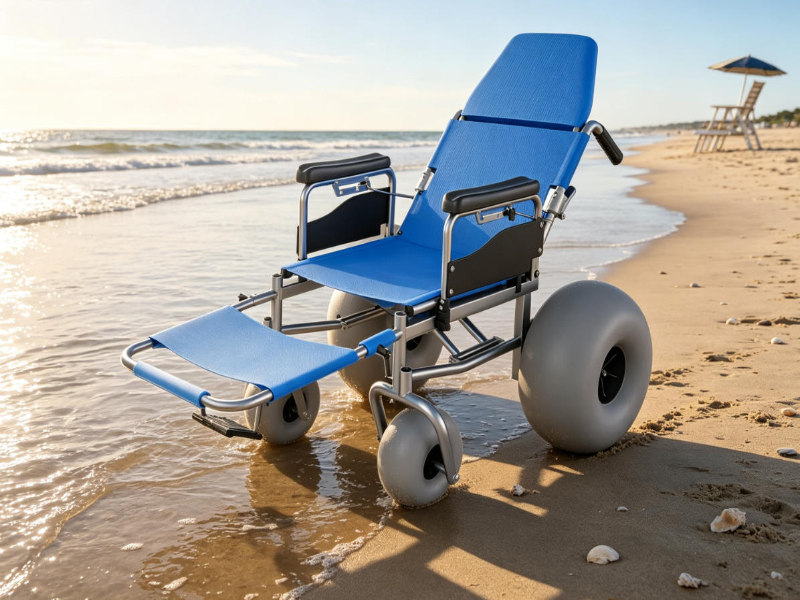
The YSB02 Beach Wheelchair provides another option within IYASOCARE’s beach mobility range.
When selecting between beach wheelchair models, buyers should consider the actual environment in which the chair will be used rather than simply comparing appearance. A resort located directly beside a sandy beach may have different requirements from a rehabilitation centre that needs occasional outdoor mobility or a family that primarily uses the chair during holidays.
The YSB02 is worth evaluating as part of a broader beach wheelchair purchasing process because it is designed specifically around outdoor mobility rather than conventional indoor transportation.
For professional buyers, this distinction can also influence product positioning. A distributor selling standard manual wheelchairs may benefit from offering a dedicated beach mobility category for customers who have outdoor recreation, tourism, hospitality, and accessibility requirements.
A beach wheelchair is not necessarily intended to replace a user’s everyday wheelchair. In many cases, it works better as a specialised mobility solution for environments where a standard chair is not practical.
That is one of the most important points for consumers to understand before purchasing.
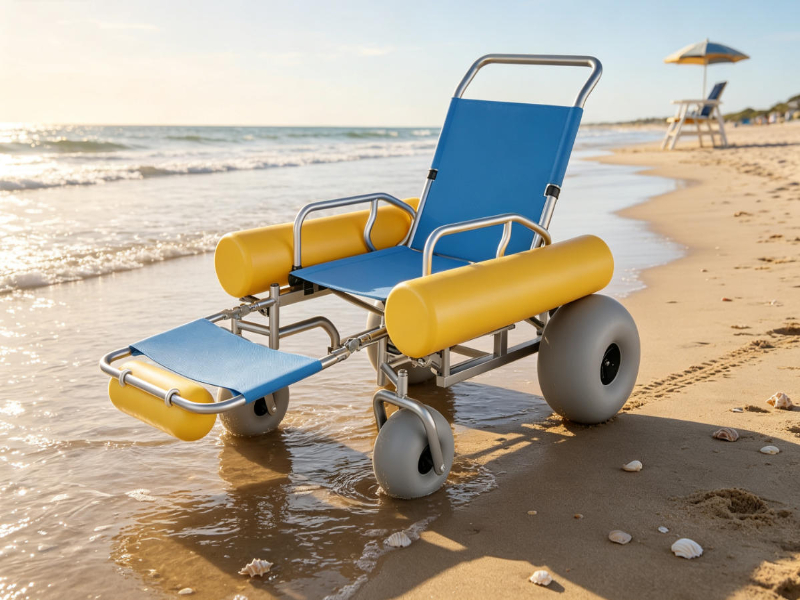
A common mistake when shopping for an All-Terrain Beach Wheelchair Balloon Tires model is to focus almost entirely on tire size.
The wheels are obviously important, but a successful beach wheelchair needs to work as a complete system.
Frame stability
The frame should provide a stable platform for the user. On uneven terrain, the wheelchair can experience forces that are less common on smooth indoor floors, so structural design becomes especially important.
Seat support
Beach activities can last several hours. Comfortable seating and appropriate support can therefore make a major difference to the overall experience.
Wheel placement
The position of the wheels influences stability, maneuverability, and how easily the chair can be controlled on different surfaces.
User weight capacity
The wheelchair should be selected according to the manufacturer’s stated capacity. Buyers should consider the user’s weight together with clothing, equipment, and any accessories carried on the chair.
Transfer accessibility
Users who need caregiver assistance should consider how easily they can transfer into and out of the chair. The seating height and armrest configuration can affect this process.
Corrosion resistance
Beach environments expose mobility equipment to saltwater, humidity, sand, and other potentially damaging conditions. Materials and maintenance procedures should therefore be considered carefully.
Storage and transportation
A beach wheelchair may be wider and heavier than a standard travel wheelchair because of its specialized wheels. Buyers should make sure they have an appropriate way to transport and store it.
A well-designed beach wheelchair should balance these factors rather than maximizing only one specification.
To understand why balloon tires are useful, it helps to look at how pressure is distributed.
A wheelchair with a narrow tire places a relatively concentrated load onto the sand. The softer the sand, the more easily the wheel can sink.
A wide balloon-style tire spreads that load over a larger surface area. Instead of creating a narrow track, the tire can distribute the wheelchair’s weight more broadly.
This is particularly useful on dry, loose sand, where conventional wheels often struggle.
The effect can be compared to walking on a beach. A person wearing narrow shoes may sink more deeply than someone wearing a wider shoe or beach sandal. The principle is similar: a larger contact area can reduce the pressure applied to each part of the surface.
For an All-Terrain Beach Wheelchair Balloon Tires design, this broad contact area is one of the key reasons the chair can perform differently from an ordinary wheelchair.
However, buyers should avoid assuming that balloon tires make every terrain effortless. Very deep sand, steep slopes, soft dunes, and areas close to moving water can still require significant effort. The wheelchair should always be operated according to its intended use and manufacturer’s safety guidance.
Although beach mobility is the primary reason people purchase this type of wheelchair, wide-wheel designs can potentially be useful in several other outdoor environments.
Grass is one example.
A conventional wheelchair may perform adequately on short, firm grass but struggle when the ground becomes wet, soft, or uneven. Wider tires can help distribute weight and may provide more practical performance depending on the surface.
Parks and recreational areas are another possibility. Outdoor trails, picnic areas, gardens, campsites, and event grounds can contain a mixture of paved paths, compacted earth, grass, and loose surfaces.
The versatility of an All-Terrain Beach Wheelchair Balloon Tires configuration can therefore extend beyond the shoreline.
This is particularly valuable for accessible tourism businesses. A hotel or resort does not need to think of the chair purely as “beach equipment.” It can become part of a broader accessibility program that supports guests throughout outdoor recreational areas.
Accessible tourism is becoming increasingly important for hotels, resorts, travel companies, public beaches, and recreational organisations.
A destination may have an accessible entrance and accessible parking, yet still offer limited access to the actual recreational environment.
For a beach, that might mean a wheelchair-accessible path ends several metres before the sand. For a lakeside park, it might mean the paved trail does not reach the picnic area. For an outdoor event, it might mean the accessible route does not extend across the grass.
Dedicated beach wheelchairs can help address part of this gap.
Hotels and resorts can offer them as guest equipment. Public beaches can provide them through accessibility programs. Tour operators can include them in accessible travel packages. Rehabilitation centres can use them to support outdoor activities.
From a business perspective, specialised mobility equipment can therefore become part of the customer experience rather than simply another piece of medical equipment.
Even the best All-Terrain Beach Wheelchair Balloon Tires should be used carefully.
Sand can be unpredictable. A surface that appears firm may become soft a few metres away. Slopes near the shoreline can create lateral instability, while wet sand may behave differently from dry sand.
Users and caregivers should pay attention to:
Going directly into seawater should never be assumed to be safe simply because a wheelchair is marketed for beach use. Unless the manufacturer specifically states that the product is designed for immersion or aquatic use, the chair should be protected from unnecessary exposure to saltwater.
After beach use, sand should be removed from moving components, and the wheelchair should be cleaned according to the manufacturer’s maintenance recommendations.
Salt and sand can be particularly harsh on mechanical components, fasteners, bearings, and finishes, so regular maintenance is essential for long-term performance.
The ideal beach wheelchair depends on who will use it and where.
For families
Families should prioritise comfort, stability, ease of transfer, and transportation. If the wheelchair will only be used during holidays, storage and vehicle compatibility become particularly important.
For elderly users
Seniors may benefit from a stable seating platform and wide wheels that reduce the difficulty of moving across soft outdoor surfaces. Caregiver handling should also be considered.
For people with disabilities
Users with limited mobility should consider seating support, transfer requirements, stability, and the type of terrain they expect to encounter.
For hotels and resorts
Commercial operators should consider durability, cleaning, storage, ease of use, and the needs of multiple users. A beach wheelchair can become a useful addition to an accessible tourism program.
For rehabilitation centres
Rehabilitation facilities may require specialised mobility equipment that can support outdoor activities while remaining suitable for supervised use.
The important point is that the best All-Terrain Beach Wheelchair Balloon Tires solution is not necessarily the most expensive or largest model. It is the model that best matches the user’s actual environment.
Beach equipment requires more attention than equipment used exclusively indoors.
Sand can enter moving components, while saltwater and humidity can accelerate corrosion. After every beach trip, users should inspect the wheelchair rather than simply putting it into storage.
The wheels should be checked for damage and abnormal wear. Sand should be removed from areas where it can accumulate. If the wheelchair has pneumatic tires, tire condition and pressure should be checked according to the manufacturer’s instructions.
The frame should be rinsed or cleaned using an appropriate method recommended by the manufacturer, especially after exposure to salt or seawater.
Storage is also important. The wheelchair should be allowed to dry thoroughly before being placed in a confined storage area.
These simple habits can help preserve the performance of an All-Terrain Beach Wheelchair Balloon Tires system and reduce unnecessary maintenance problems.
IYASOCARE’s beach wheelchair range provides specialised options for customers who need mobility beyond conventional indoor and paved environments.
The YSB01 and YSB02 are designed around the specific requirements of beach and outdoor mobility, with wide-wheel configurations that are better suited to soft surfaces than typical narrow wheelchair wheels.
For international distributors, the products may also fit naturally into a broader mobility equipment portfolio. A supplier can offer everyday manual wheelchairs for indoor and urban use while adding beach wheelchairs for resorts, accessible tourism businesses, recreation centres, and customers with active outdoor lifestyles.
IYASOCARE’s broader range includes manual wheelchairs, electric wheelchairs, standing wheelchairs, stair-climbing wheelchairs, rehabilitation equipment, children’s wheelchairs, and other mobility products. This allows buyers to approach wheelchair sourcing as a complete product category rather than selecting individual products from unrelated manufacturers.
Outdoor mobility is changing because users increasingly expect wheelchairs to support lifestyles rather than simply provide basic transportation.
A person may want to spend the morning at a café, visit a park in the afternoon, and go to the beach in the evening. A conventional wheelchair can handle some of these environments very well, but specialised terrain may require specialised equipment.
The All-Terrain Beach Wheelchair Balloon Tires concept represents one response to this need. By combining wide wheels, a stable frame, appropriate seating, and outdoor-oriented design, a beach wheelchair can help users access environments that were previously difficult to navigate.
The goal is not to make every surface identical. Instead, it is to create mobility equipment that is better adapted to the reality of different outdoor environments.
That is what makes beach wheelchairs particularly valuable. They are not simply larger versions of standard wheelchairs. They are purpose-built mobility tools designed around the physics and practical challenges of sand.
For users and caregivers, this can mean more freedom. For families, it can mean more shared experiences. For resorts and tourism businesses, it can mean a more inclusive guest experience. For distributors, it represents a specialised mobility category with applications across recreation, hospitality, healthcare, and accessible tourism.
An All-Terrain Beach Wheelchair Balloon Tires design can make a significant difference when standard wheelchair wheels are no longer suitable for the environment. Wide tires help distribute weight across soft surfaces, while a purpose-built beach wheelchair can provide greater stability and practical outdoor mobility.
The YSB01 Beach Wheelchair is worth considering for users and organisations seeking a dedicated beach mobility solution, while the YSB02 Beach Wheelchair provides another option for outdoor and sandy environments.
The right choice should always be based on the user’s physical needs, expected terrain, transportation requirements, seating preferences, weight capacity, maintenance expectations, and safety considerations.
Most importantly, a beach wheelchair should be viewed as a tool for participation. The real benefit is not simply being able to move across sand. It is being able to join family activities, enjoy nature, travel to recreational destinations, and experience outdoor spaces with fewer mobility barriers.
When wide wheels, suitable tires, stable construction, comfortable seating, and responsible operation come together, the beach becomes more accessible—and mobility becomes less about where a wheelchair cannot go and more about where the user wants to go next.
1. Why are balloon tires useful on a beach wheelchair?
Balloon tires provide a wider contact area than conventional narrow wheelchair tires. This helps distribute the wheelchair’s weight across a larger section of sand, reducing the tendency to sink into loose surfaces. They are particularly useful for soft sand and other outdoor environments where ordinary wheelchair wheels may struggle.
2. Can an All-Terrain Beach Wheelchair Balloon Tires model be used away from the beach?
Potentially, yes. Wide-wheel beach wheelchairs may also be suitable for certain grass, parks, compacted outdoor paths, and other uneven surfaces, depending on the specific model. However, buyers should always follow the manufacturer’s intended-use guidelines and consider the firmness, slope, and condition of the terrain.
3. Which IYASOCARE beach wheelchair should I choose?
The YSB01 Beach Wheelchair and YSB02 Beach Wheelchair are both worth evaluating when dedicated beach and outdoor mobility is required. The final choice should be based on the user’s size and mobility needs, seating requirements, terrain, transportation method, and the specific specifications provided by IYASOCARE for each model.
WhatsApp us