Our Location
Free Trade Tower, Xiyong street.
Chongqing, China

Free Trade Tower, Xiyong street.
Chongqing, China
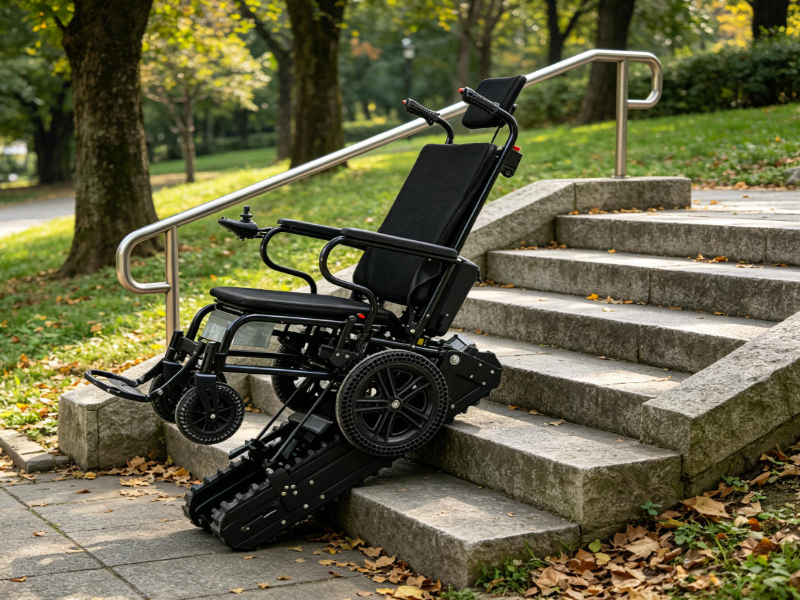
A staircase can be only a few metres long, yet for someone using a conventional wheelchair, those few metres can become a serious barrier. The same is true of gravel paths, uneven paving, grass, cobblestones, speed bumps and other outdoor surfaces that ordinary wheelchair wheels are not designed to handle comfortably. When mobility equipment is expected to work beyond smooth indoor floors, the design of the drive system becomes particularly important.
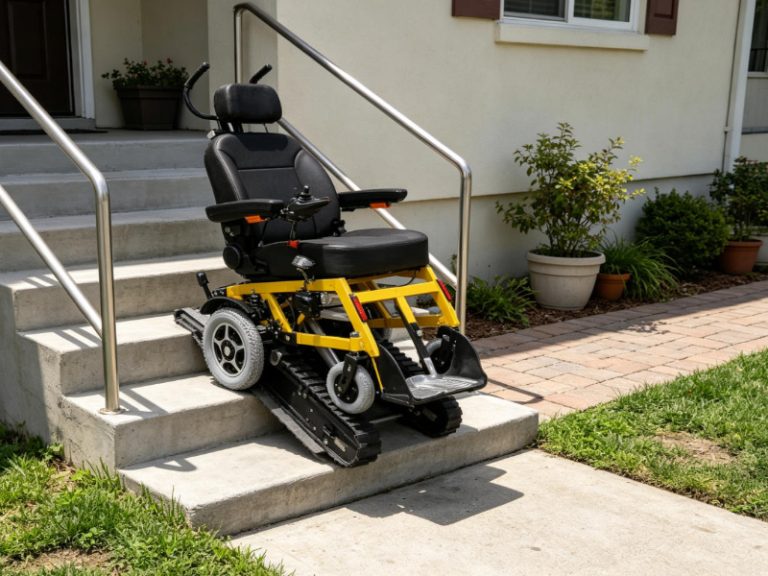
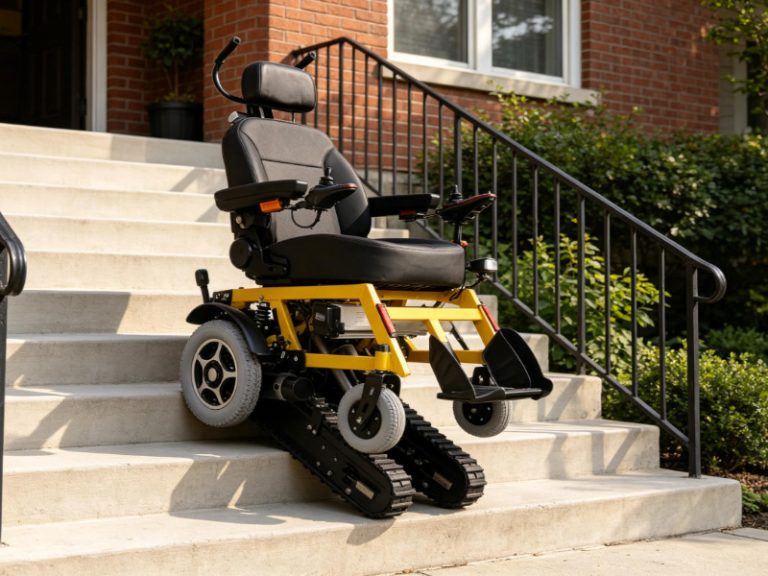
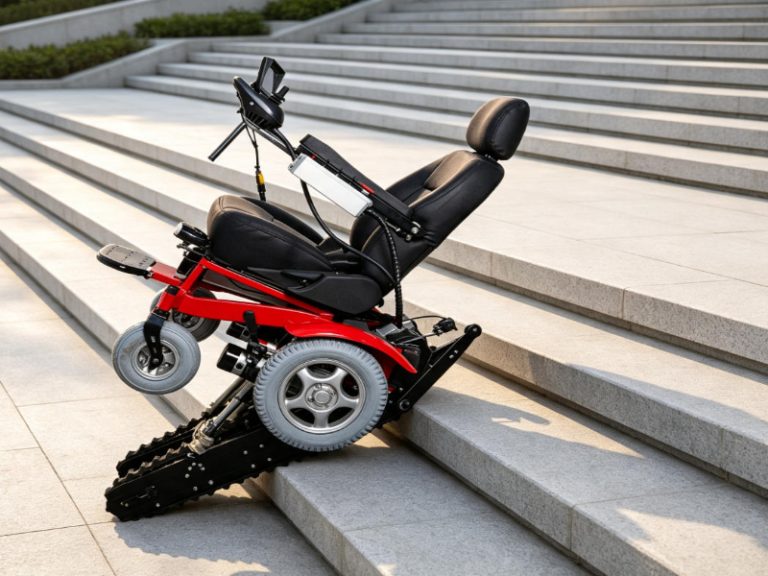
This is where a Tracked Wheelchair with Rubber Tracks offers a fundamentally different approach. Instead of relying entirely on conventional wheels, a tracked wheelchair uses a continuous track system to create a larger contact area with the ground. In stair-climbing applications, rubber tracks can follow the edges and surfaces of individual steps, helping the chair maintain traction while moving in a controlled direction. For outdoor use, the same principle can improve contact with uneven surfaces where narrow wheels may lose grip or become unstable.
For elderly users, disabled adults, rehabilitation centres, nursing homes, caregivers and mobility-equipment distributors, the attraction is not simply the ability to climb stairs. A well-designed Tracked Wheelchair with Rubber Tracks can provide a more versatile mobility solution for environments where traditional wheelchairs reach their practical limits.
The most important difference between a tracked wheelchair and a conventional wheelchair is the way weight and traction are distributed.
A traditional wheelchair depends on relatively small areas of contact between its tyres and the ground. This works extremely well on smooth floors, pavements and other predictable surfaces. However, once the ground becomes uneven, soft, steep or irregular, the wheels must constantly adapt to changes in elevation and traction.
Rubber tracks approach the problem differently. Instead of concentrating the contact area at several individual wheels, the track creates a longer continuous surface against the ground. This can help distribute the user’s weight and the wheelchair’s weight across a wider area, while the tread pattern provides mechanical grip.
For a Tracked Wheelchair with Rubber Tracks, this becomes particularly valuable on stairs. A tracked mechanism can engage with several steps during the climbing process rather than depending on a single wheel to overcome the edge of each step. Modern stair-climbing wheelchair designs may also incorporate braking, locking and control systems intended to maintain a controlled position during ascent and descent.
IYASOCARE describes tracked stair-climbing designs as systems intended to improve traction and stability when navigating stairs and uneven outdoor surfaces. Its product information also highlights tracked mechanisms, dual-purpose operation and controlled stair travel as important characteristics of this category.
That does not mean that every tracked wheelchair can safely handle every staircase or every outdoor environment. Stair dimensions, slope, surface condition, user weight, battery condition and operating procedure all matter. Buyers should always check the manufacturer’s specifications and operating instructions before use.
One of the strongest reasons to consider a Tracked Wheelchair with Rubber Tracks is versatility.
A wheelchair designed exclusively for stairs may be useful in a building with several floors but inconvenient when the user reaches a flat corridor or needs to cross a courtyard. Carrying a second wheelchair or manually transferring the user between devices can make the mobility process more complicated.
Dual-purpose tracked wheelchairs attempt to reduce this problem by combining ordinary driving with stair-climbing functionality.
The basic idea is simple: use the conventional drive system for flat ground, then activate the stair-climbing mechanism when stairs are encountered. This creates a more continuous mobility experience between different environments.
For example, imagine an elderly user living in a two-storey home. The wheelchair may be used on the ground floor, moved across a driveway, taken through an entrance and then used to negotiate the staircase. Without a dual-purpose system, the user might need a conventional wheelchair plus a separate stair-climbing device. A suitable tracked model can potentially simplify this process.
The same concept can be useful in nursing homes, rehabilitation facilities, older apartment buildings, schools, hotels and other environments where complete accessibility infrastructure is not always available.
However, the operator must understand the difference between flat-ground driving mode and stair-climbing mode. These are not interchangeable operating conditions. Proper positioning, speed control, battery capacity and staircase dimensions must be checked before climbing.
For buyers who want portability without giving up tracked stair-climbing capability, the YSE203 Portable Folding Electric Stair Climbing Wheelchair is one of the most interesting models in the range.
The YSE203 uses a tracked stair-climbing design and is intended for both stair travel and flat-surface driving. According to IYASOCARE’s product information, the tracks are designed to maintain close contact with stair surfaces and support climbing on slopes below 45°. The manufacturer specifies a 24V 250W × 2 driving motor system, a 24V 250W climbing motor and a 20Ah lithium battery.
One of the notable characteristics is its claimed combination of range and climbing capability. The published specifications list a driving range of up to 15 km and climbing capacity of approximately 500 stair steps under the stated conditions. The listed climbing speed is about 15 stair steps per minute, while the maximum speed for driving is 8 km/h.
Portability is another major consideration. The YSE203 has a steel frame and a folding structure intended to make transportation and storage easier. IYASOCARE lists a folding size of approximately 70 × 58 × 93 cm and a net/gross weight of about 60/69 kg, with a stated load capacity of 150 kg.
For families, nursing homes and distributors, this combination can make the YSE203 particularly interesting when the wheelchair needs to move between buildings rather than remain permanently installed in one location.
The seating system also deserves attention. The manufacturer describes a breathable sponge cushion and adjustable pillow, while the published dimensions list a 44 cm seat depth and 44 cm seat height. These details matter because a tracked wheelchair is still a wheelchair first: climbing performance is important, but the user may spend substantial time sitting in it on flat ground.
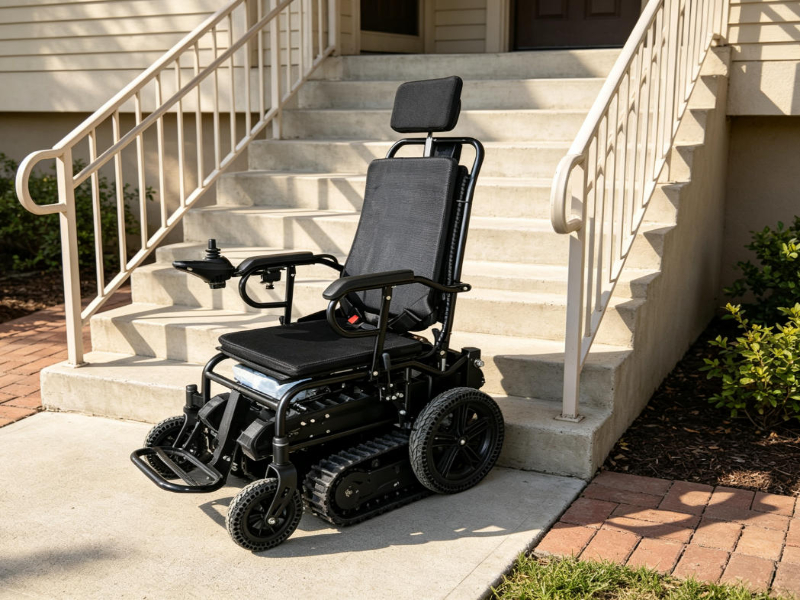
The YSE201M takes a somewhat different direction. Rather than focusing only on maximum ruggedness, this model is positioned around a lighter, more portable approach to stair mobility.
IYASOCARE’s published material describes the YSE201M as a lightweight electric stair-climbing wheelchair with dual-mode functionality. It can be used manually on flat surfaces and switched to electric climbing when stairs need to be negotiated. The manufacturer lists a 55 kg net weight, 68 kg gross weight, 150 kg load capacity, a 120W motor and a 20Ah lithium battery.
The company also states that the YSE201M can climb around 15 steps per minute and up to approximately 500 steps continuously under specified conditions.
This type of configuration can be especially relevant to users who primarily encounter stairs in residential or urban environments rather than demanding outdoor trails.
The key point is that a Tracked Wheelchair with Rubber Tracks does not necessarily need to be an enormous off-road machine. A more compact design can make sense when the principal challenge is access between floors, particularly in homes, apartments, care facilities and other buildings where stairs are a regular obstacle.
The YSE201M demonstrates an important trend in mobility equipment: manufacturers are increasingly designing specialist wheelchairs around specific real-world environments instead of treating every user as if they has the same mobility requirements.
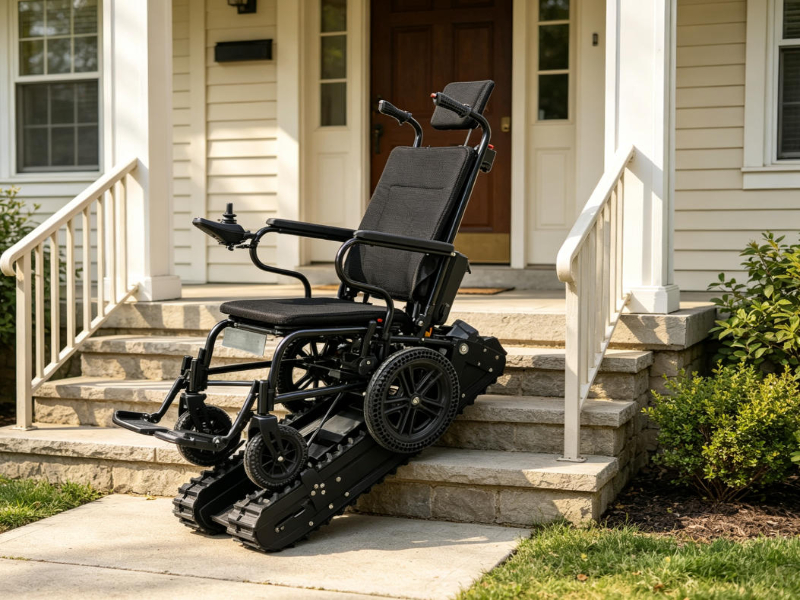
Another model worth considering is the YSE207 Single Electric Stair Climbing Wheelchair, which combines universal-wheel functionality with a crawler-based stair-climbing system.
The YSE207 is positioned within IYASOCARE’s stair-climbing category as a model designed for users who need a practical solution for stair mobility. IYASOCARE’s broader product information describes the YSE207 as a compact stair-climbing option intended to balance stability, maneuverability and everyday use.
Its position within the product range makes it worth considering when the buyer’s priorities are different from those of a heavy-duty outdoor user.
A rehabilitation centre, for example, may value straightforward operation and compact manoeuvrability more than extreme off-road capability. A nursing home may need a stair-climbing wheelchair that can move between rooms, corridors and staircases without requiring a large amount of storage space.
This is why comparing models only by motor power can be misleading. The most appropriate wheelchair depends on the environment in which it will actually be used.
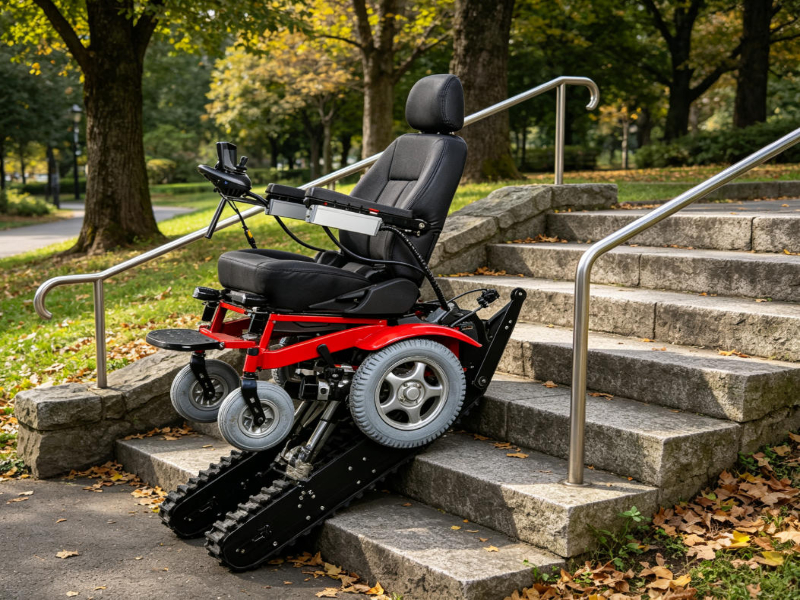
The phrase “all-terrain” is attractive, but it should be examined carefully.
Outdoor terrain is not one single category. A paved park path, wet grass, gravel driveway, cobblestone road, sandy beach and forest trail can place very different demands on a wheelchair.
A Tracked Wheelchair with Rubber Tracks can offer advantages on certain uneven surfaces because the continuous track distributes contact over a larger area. This can help maintain traction where conventional wheels may struggle.
IYASOCARE’s own discussion of tracked off-road wheelchairs identifies grass, gravel, dirt and uneven outdoor surfaces as environments where tracked designs can offer advantages over conventional wheels.
But buyers should not assume that a stair-climbing wheelchair automatically becomes an unrestricted off-road vehicle.
The track system, motor torque, ground clearance, waterproofing, battery capacity, suspension, frame strength and centre of gravity all influence outdoor performance. A wheelchair designed primarily for stairs may perform very differently from a specialist off-road wheelchair designed for long-distance outdoor travel.
The correct question is therefore not simply, “Can this wheelchair go outdoors?”
A better question is:
What type of outdoor terrain was this wheelchair actually designed and tested for?
That distinction protects users from choosing a product based purely on marketing language.
A tracked wheelchair may have impressive technical specifications, but the staircase itself determines whether the system can be used safely.
The width of the staircase, depth of each step and slope are particularly important.
For example, the published YSE203 specifications specify a required stair width greater than 700 mm, stair depth greater than 1100 mm and a stair slope below 45°.
These figures demonstrate why a buyer should measure the staircase before purchasing.
Do not rely on visual estimation. Measure the actual staircase at the narrowest point, check the step dimensions and identify obstacles such as handrails, walls, doorways or landings that could affect manoeuvrability.
The landing is equally important. Even if the track can climb the steps, the user still needs sufficient space at the top or bottom to transition safely between stair-climbing and flat-ground modes.
For commercial buyers, this should become part of the product consultation process. A distributor selling a Tracked Wheelchair with Rubber Tracks should ask customers for staircase dimensions before recommending a model.
Battery specifications are often treated as a range calculation, but for a stair-climbing wheelchair, battery condition has an additional significance.
Climbing stairs requires more power than moving across a flat surface. Repeated ascent and descent can therefore consume energy differently from ordinary driving.
A user should never begin a long stair-climbing journey without adequate battery capacity.
The YSE203, for example, is specified with a 20Ah lithium battery and published capability of approximately 500 stair steps or 15 km of driving under the manufacturer’s stated conditions.
These figures should not be interpreted as guaranteed real-world results in every situation. Actual performance can vary according to user weight, staircase geometry, temperature, battery condition, driving style, terrain and other factors.
For healthcare facilities, battery management should become part of daily operating procedures. Staff should know how to check the battery, charge it correctly and recognise when the wheelchair should not be used for a demanding climbing task.
A wheelchair that can climb stairs but leaves the user uncomfortable after an hour is not a complete mobility solution.
Users may spend significant periods sitting in the chair before or after climbing. The seat width, cushion, backrest, head support, footrest, armrests and seating position therefore remain important.
A tracked wheelchair can also generate different sensations from a conventional wheelchair because of the mechanical movement associated with the track system. Good seating support can help improve the overall experience.
The YSE203, for example, includes a breathable cushion and adjustable pillow, while IYASOCARE describes its design as intended to support longer periods of comfortable use.
For buyers selecting between models, it is useful to think about the entire journey rather than just the staircase.
The user may leave home, cross a driveway, enter a building, travel through a corridor, climb two floors, wait in a room and then return downstairs. A successful mobility device needs to work across that entire sequence.
The biggest advantage of a stair-climbing wheelchair is potentially greater independence, but stair climbing should never be treated as a casual driving activity.
The user and caregiver should understand the operating procedure before attempting stairs. The staircase should be clear of people and obstacles. The battery should have sufficient charge. The correct mode should be selected. The wheelchair should be operated according to the manufacturer’s instructions.
IYASOCARE describes tracked designs, stair locks, independent control systems and other mechanisms intended to support stability during stair travel.
Nevertheless, technology does not eliminate risk.
A wheelchair should never be used outside its specified staircase dimensions or load capacity. Wet, damaged or unusually shaped steps may also create conditions different from those used during product testing.
For professional caregivers, training is especially important. A well-designed machine still depends on correct operation.
The ideal user is not defined only by age or diagnosis. The environment is often the more important factor.
A Tracked Wheelchair with Rubber Tracks can be particularly relevant to elderly users who live in multi-level homes, wheelchair users who regularly encounter stairs, rehabilitation centres, nursing homes, home-care providers, mobility-equipment rental companies and organisations operating in older buildings without elevators.
It can also be valuable for wheelchair distributors looking to add specialist mobility equipment to their product portfolio.
For an individual buyer, the decision should begin with a practical assessment:
Where will the wheelchair be used?
How many stairs must it climb?
Are the stairs straight or irregular?
What is the user’s weight?
Will the chair also be used outdoors?
Does it need to fit into a vehicle?
Will the user operate it independently or with caregiver assistance?
How frequently will it climb stairs?
These questions are more useful than simply asking which model has the highest motor power.
The three models in this article can be viewed as different answers to different mobility requirements.
YSE203 is particularly compelling when portability, tracked stair climbing, flat-ground driving and a relatively broad set of specifications are required. Its 20Ah lithium battery, dual 250W driving motors, tracked climbing system, folding structure and 150 kg stated load capacity create a versatile configuration for home, care and mixed indoor/outdoor use.
YSE201M is better positioned around lightweight residential and urban stair mobility. Its dual-mode concept and comparatively lower weight can be attractive when the primary problem is moving between floors rather than tackling demanding outdoor terrain.
YSE207 offers another compact approach to stair-climbing mobility and is worth considering for users and facilities prioritising manoeuvrability and everyday stair access. IYASOCARE places it within its specialist tracked/crawler stair-climbing range.
The important point is that none of these models should automatically be considered “the best” for every user. The best Tracked Wheelchair with Rubber Tracks is the one whose dimensions, load capacity, operating system, portability and terrain capability match the user’s actual environment.
Accessibility is often discussed in terms of ramps, elevators and redesigned buildings, and these remain extremely important. However, infrastructure improvements take time, and millions of buildings still contain physical barriers.
Tracked stair-climbing wheelchairs provide another layer of accessibility.
They do not replace architectural accessibility, and they should not be treated as an excuse to ignore proper accessible design. Instead, they can provide an assistive solution for environments where structural changes are unavailable, impractical or still awaiting implementation.
For a person living in an older apartment, a stair-climbing wheelchair can potentially make a previously difficult route manageable. For a nursing home, it may simplify movement between floors. For a rehabilitation facility, it can become a specialised training and mobility tool.
The larger trend is clear: modern wheelchair engineering is moving beyond the idea that mobility equipment only needs to work on flat floors.
A wheelchair can now be designed around stairs, uneven ground, outdoor recreation, standing, reclining, sports and other specific mobility requirements. IYASOCARE’s product catalogue reflects this broader direction, with separate categories for electric wheelchairs, off-road wheelchairs, stair-climbing wheelchairs, standing wheelchairs, sports wheelchairs, beach wheelchairs and other mobility products.
A Tracked Wheelchair with Rubber Tracks represents a significant step away from conventional flat-ground mobility. By combining continuous-track traction with electric drive systems, modern stair-climbing wheelchairs can address environments that would otherwise require substantial physical assistance.
For users who regularly encounter stairs, the technology can provide a new level of flexibility. For outdoor users, tracked systems can offer better traction on selected uneven surfaces. For caregivers and healthcare facilities, they can reduce the need to physically lift or transfer users between floors.
But choosing the right model requires more than reading a product title.
The staircase must be measured. The user’s weight must be considered. Battery requirements must be understood. Flat-ground use should be evaluated alongside stair climbing. Storage and transportation requirements should also be considered. Most importantly, the wheelchair must be operated according to the manufacturer’s safety instructions and within its specified operating limits.
Among the models discussed here, the YSE203 stands out for its combination of tracked stair climbing, folding portability, dual-purpose driving and a 150 kg stated load capacity. The YSE201M offers a lighter approach for residential and urban stair mobility, while the YSE207 provides another compact solution for everyday stair access.
For distributors, hospitals, nursing homes and home-care providers, these models also demonstrate why specialist mobility equipment should be evaluated according to application rather than appearance.
A wheelchair is not simply a seat with wheels. In the right environment, it becomes a bridge between a person and the places they need to reach.
1. What is a Tracked Wheelchair with Rubber Tracks used for?
A Tracked Wheelchair with Rubber Tracks is primarily designed to help wheelchair users navigate environments where conventional wheels may have limitations, particularly stairs and selected uneven outdoor surfaces. Depending on the model, it may also operate as an electric wheelchair on flat ground. However, users should always check the manufacturer’s specified terrain, stair dimensions, slope limits and operating instructions before use.
2. Can a tracked wheelchair be used both indoors and outdoors?
Yes, some tracked stair-climbing wheelchairs are designed for both indoor and outdoor use. The YSE203, for example, is described by IYASOCARE as a dual-purpose model capable of electric driving on flat surfaces and tracked stair climbing, while its product information also discusses use on surfaces such as cobblestones, grass and speed bumps. However, “outdoor use” does not mean unrestricted all-terrain operation, so the exact model specifications should always be checked.
3. Which is better: YSE203, YSE201M or YSE207?
There is no single best model for every user. The YSE203 is a strong choice when tracked stair climbing, folding portability, flat-ground driving and a 150 kg stated load capacity are priorities. The YSE201M is positioned as a lighter and more portable solution for residential and urban stair use, while the YSE207 provides another compact option for everyday stair-climbing mobility. Buyers should select the model according to staircase dimensions, user weight, terrain, frequency of use and transportation requirements rather than choosing solely by motor power or price.