Our Location
Free Trade Tower, Xiyong street.
Chongqing, China

Free Trade Tower, Xiyong street.
Chongqing, China
For many wheelchair users, stairs remain one of the biggest obstacles in daily life. While modern buildings increasingly provide elevators and ramps, many homes, small businesses, older apartments, and public facilities still contain unavoidable steps. For elderly people, individuals with disabilities, and caregivers, navigating these environments can create safety concerns, physical challenges, and limitations on independence.
Table of Contents
ToggleThis is why more people are choosing Stair Climbing Tracked Wheelchairs as an advanced mobility solution.
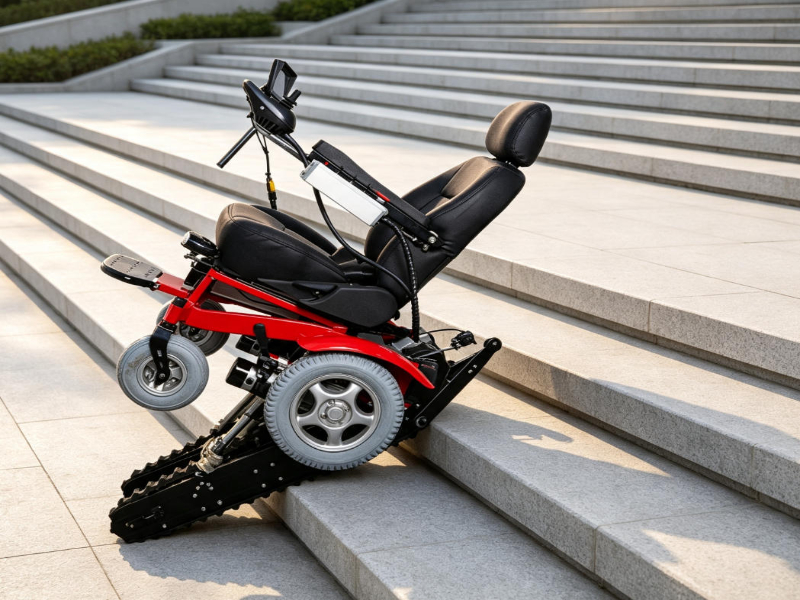
Unlike traditional wheelchairs that are mainly designed for flat surfaces, a stair climbing tracked wheelchair combines mobility technology with a tracked climbing system that allows users to overcome stair barriers more safely and efficiently. These innovative mobility devices are changing how people think about accessibility by providing greater freedom inside homes, buildings, and outdoor environments.
cWhether for elderly users who want to maintain independence, disabled adults seeking better mobility options, or caregivers looking for safer transportation solutions, tracked wheelchair technology provides a practical answer.
Traditional wheelchairs have improved significantly over the years, offering better comfort, lighter materials, and improved maneuverability. However, one limitation remains: stairs.
For wheelchair users, stairs can create several challenges:
A person may have a lightweight folding wheelchair or a powerful electric wheelchair, but without a suitable solution for stairs, mobility remains restricted.
This is where Stair Climbing Tracked Wheelchairs provide a major advantage.
The tracked system works differently from traditional wheels. Instead of relying only on wheel rotation, specially designed tracks create continuous contact with stair surfaces. This allows the wheelchair to move upward and downward while maintaining stability.
For many users, this technology represents more than a product upgrade—it represents greater independence.
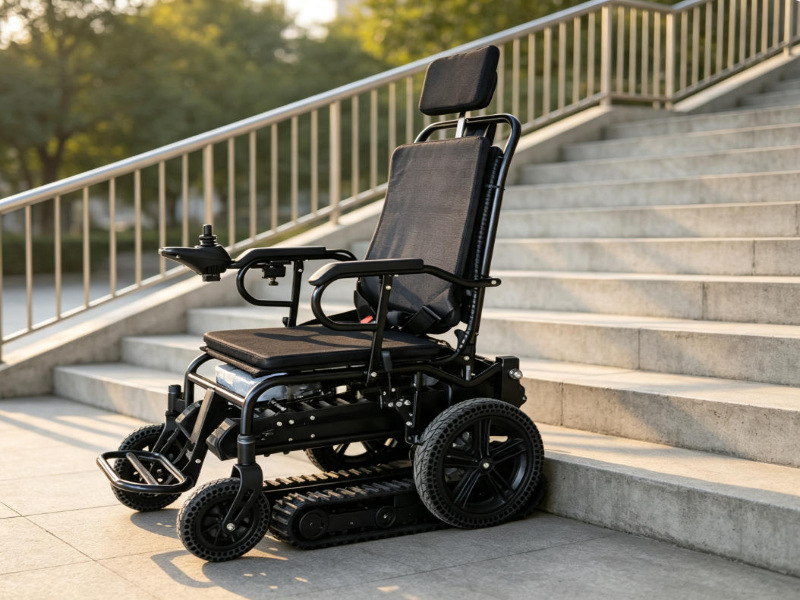
A Stair Climbing Tracked Wheelchair is an advanced mobility device designed to help wheelchair users safely navigate stairs and uneven environments.
Unlike standard wheelchairs that require ramps or elevators, tracked wheelchairs use motorized tracks to climb stairs.
The main components usually include:
Motorized Track System
The tracked mechanism is the core technology.
It provides:
The track system helps distribute weight more evenly compared with traditional wheels.
Electric Drive System
Most modern stair climbing wheelchairs use electric motors powered by rechargeable batteries.
Advantages include:
Safety Control System
Safety is one of the most important factors in stair mobility.
Advanced models may include:
These features help users and caregivers feel more confident during operation.
1. Improved Independence for Elderly and Disabled Users
One of the biggest reasons people choose Stair Climbing Tracked Wheelchairs is independence.
Mobility is not only about transportation—it is about maintaining an active lifestyle.
For elderly users, being unable to access certain areas of their home can create frustration and dependence. A tracked wheelchair can help users move between different floors and access more areas without requiring constant assistance.
For disabled adults, improved mobility can mean:
The ability to overcome stairs changes the relationship between users and their environment.
Instead of asking, “Can I access this place?” users can focus on “Where do I want to go?”
2. Safer Alternative for Caregivers
Caregivers often face physical challenges when helping wheelchair users navigate stairs.
Manually lifting or transferring a wheelchair user can create risks for both parties.
Common problems include:
A Stair Climbing Tracked Wheelchair reduces these challenges by providing a controlled mechanical solution.
Caregivers can assist users with less physical strain while improving overall safety.
This is particularly valuable in:
For professional care providers, investing in reliable stair mobility equipment can improve service quality and operational efficiency.
Another reason behind the popularity of tracked wheelchairs is versatility.
Traditional wheelchairs perform best on smooth, flat surfaces. However, real-life environments are not always predictable.
Users may encounter:
A tracked wheelchair expands mobility possibilities.
Depending on the design, it can support different environments including:
This flexibility makes it an attractive option for both individual users and organizations.
4. Better Stability Compared with Traditional Mobility Solutions
Safety and stability are key concerns when dealing with stairs.
A traditional wheelchair is not designed to move directly over steps. Attempting stair movement without proper equipment can create serious risks.
Tracked systems provide several stability advantages:
The track design allows the wheelchair to maintain a more stable position during climbing.
This is especially important for elderly users who may require additional support and confidence.
5. Advanced Technology Improves User Experience
Modern mobility equipment is becoming smarter and more user-friendly.
Today’s Stair Climbing Tracked Wheelchairs are designed with features that improve convenience.
Common improvements include:
Compact Folding Structures
Some models focus on easier transportation and storage.
A foldable design allows users to:
Electric Control Systems
Simple controls allow users or caregivers to operate the wheelchair more efficiently.
Comfortable Seating Designs
Longer mobility activities require comfortable support.
Manufacturers increasingly focus on:
For businesses and users searching for reliable mobility equipment, product selection should focus on safety, durability, and practical application.
IYASOCARE Official Website provides a range of mobility solutions designed for different user requirements.
The company develops various wheelchair products, including:
For users who require stair assistance, stair climbing models are designed to provide additional accessibility in environments where traditional wheelchairs may not be enough.
Selecting the right model requires understanding user needs.
Important factors include:
User Weight Capacity
The wheelchair should match the user’s body weight requirements.
A suitable weight capacity ensures:
Battery Performance
Electric stair climbing systems depend on reliable battery power.
Consider:
Stair Environment
Different buildings have different stair designs.
Consider:
User Operation Ability
Some users operate equipment independently, while others require caregiver assistance.
The control system should match the user’s ability.
The demand for accessible mobility solutions continues to grow worldwide.
Future developments in Stair Climbing Tracked Wheelchairs may focus on:
Smarter Navigation
Artificial intelligence and sensor technology may improve automatic movement control.
Lighter Materials
Advanced materials may reduce product weight while maintaining strength.
Greater Comfort
Future designs will continue improving seating systems and user experience.
Wider Applications
As accessibility awareness increases, tracked wheelchair technology may become more common in:
Mobility technology continues to evolve because people’s needs continue to change.
A wheelchair should not only help users move—it should help them live more freely.
The increasing popularity of Stair Climbing Tracked Wheelchairs reflects a global shift toward safer, smarter, and more inclusive mobility solutions.
For elderly users, disabled adults, caregivers, and healthcare providers, tracked wheelchair technology provides a practical way to overcome one of the most difficult mobility barriers: stairs.
By combining stability, electric power, and innovative engineering, these wheelchairs are creating new possibilities for independent living.
The future of mobility is not about accepting limitations. It is about designing solutions that allow everyone to access more spaces, experience more activities, and enjoy greater freedom.
1. What makes a Stair Climbing Tracked Wheelchair different from a normal wheelchair?
A Stair Climbing Tracked Wheelchair uses a motorized track system designed to move safely over stairs, while traditional wheelchairs are mainly designed for flat surfaces.
2. Are Stair Climbing Tracked Wheelchairs suitable for elderly users?
Yes. They are designed to help elderly users overcome stair barriers and provide safer mobility assistance when used according to manufacturer instructions.
3. How do I choose the right stair climbing wheelchair supplier?
Choose a supplier with professional manufacturing experience, strict quality control, reliable after-sales support, and a complete mobility product range suitable for international markets.
WhatsApp us