Our Location
Free Trade Tower, Xiyong street.
Chongqing, China

Free Trade Tower, Xiyong street.
Chongqing, China
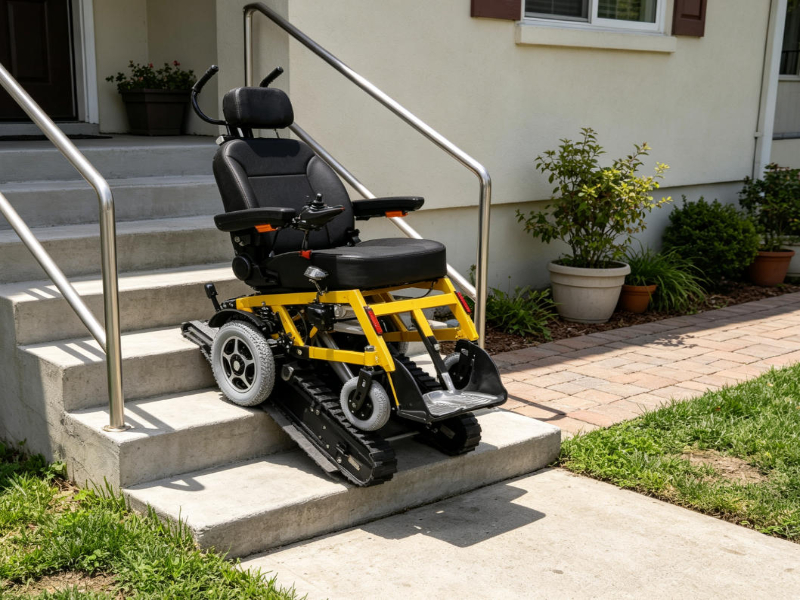
For someone who uses a wheelchair, stairs can turn an otherwise accessible day into a difficult journey. A short staircase at the entrance of a home, a flight between floors, or several steps leading to a public building may be enough to stop a conventional wheelchair completely. Ramps and elevators remain excellent accessibility solutions where they are available, but they are not practical in every building. Older homes, small apartment blocks, historic buildings, hospitals, care facilities, and temporary locations may have limited options for permanent accessibility improvements.
Table of Contents
ToggleThis is where a Tracked Wheelchair for Stairs can offer a different approach.
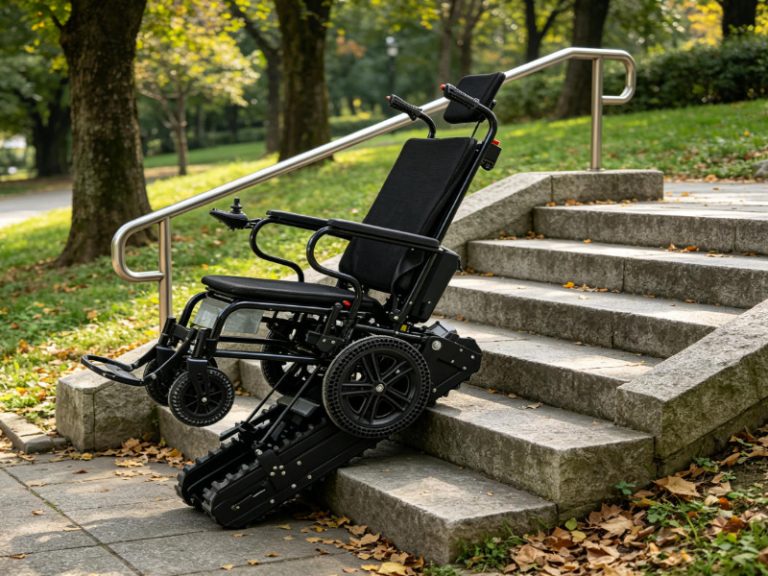
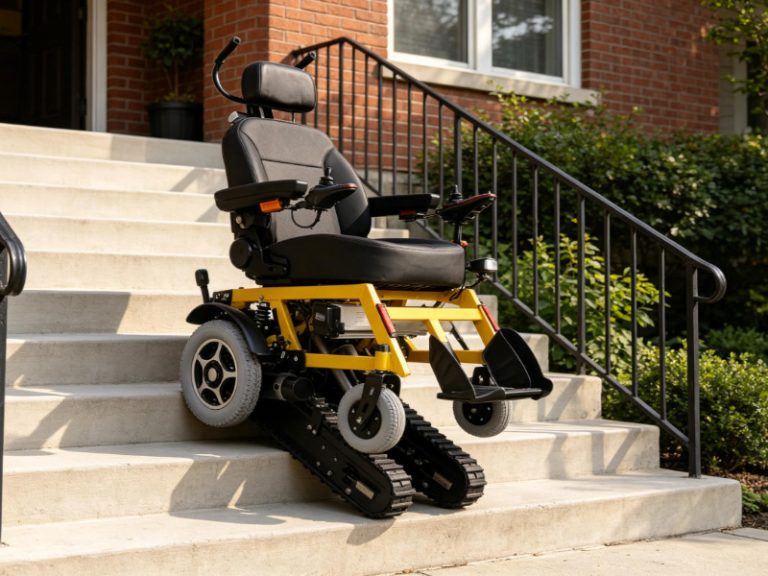
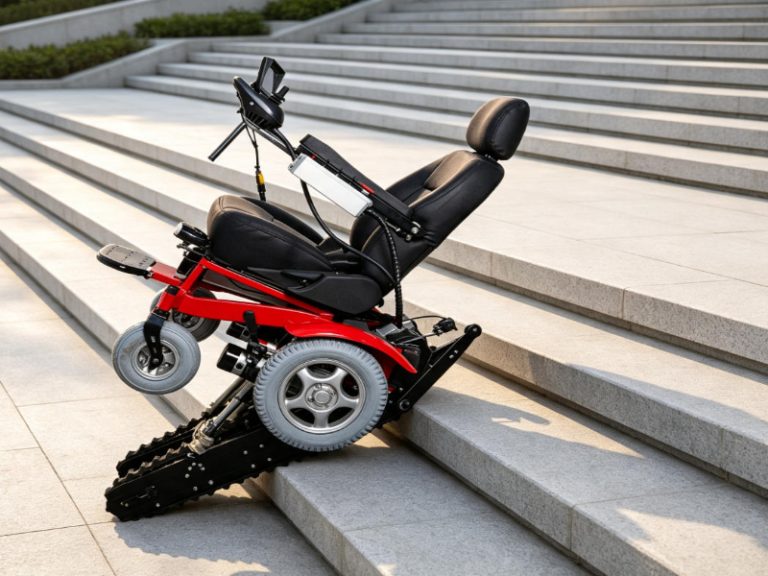
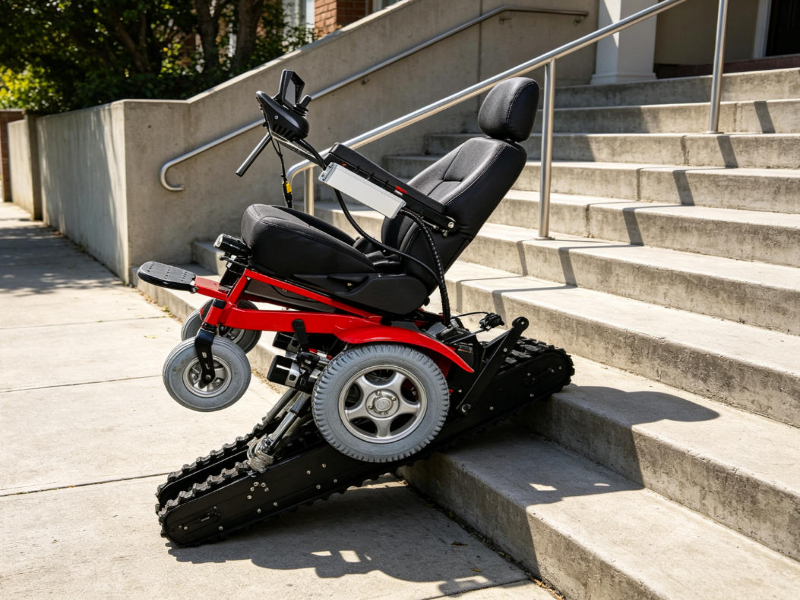
Instead of relying only on conventional wheels, a tracked stair-climbing wheelchair uses a crawler-style mechanism to maintain contact with the steps while the chair moves upward or downward. The concept is similar to a compact tracked vehicle: the continuous track distributes contact over a larger area and allows the wheelchair to negotiate a staircase in a controlled sequence.
However, choosing the right model is not simply a matter of finding the wheelchair with the strongest motor. Stair geometry, user weight, battery capacity, operating method, braking technology, chair dimensions, comfort, transportation requirements, and caregiver involvement all affect whether a tracked wheelchair is actually suitable.
A good purchase should therefore begin with the staircase and the user’s daily routine—not with a product brochure.
A standard electric wheelchair is primarily designed to move across relatively stable surfaces. Its wheels provide propulsion and steering, but a conventional wheelchair is not normally intended to climb a flight of stairs.
A tracked wheelchair approaches the problem differently. The crawler mechanism creates a longer contact area with the staircase, allowing the machine to move progressively over individual steps. This is particularly useful when the wheelchair needs to travel where ramps or elevators are unavailable.
The technology is especially interesting for older homes and buildings where installing a permanent lift would be expensive or structurally difficult. It can also provide a practical mobility option for healthcare facilities, rehabilitation centres, nursing homes, hotels, schools, and other locations where stairs remain part of the daily environment.
Modern models can also combine stair climbing with normal driving. This dual-use concept is important because the user should not have to transfer to a second wheelchair every time the environment changes.
For example, a user may drive across a hallway, approach a staircase, activate the stair-climbing function, travel between floors, and then continue moving across a flat surface. The experience is more continuous than using a conventional wheelchair together with a separate stair-climbing device.
The Dual-Use Stair Climbing Wheelchair from Iyasocare is designed around exactly this concept. Its published specifications describe a 24V DC 370W motor, a 20Ah lithium battery, a stated range of up to 15 km, and a stair-climbing capability for slopes of up to 45°. It also combines manual and electromagnetic braking with a climbing-lock system.
That said, dual-use does not mean universal use. Every tracked wheelchair has operating limits, and buyers must verify whether their particular staircase is compatible.
The most important part of selecting a Tracked Wheelchair for Stairs happens before you compare batteries, motors, or seat materials.
Measure the staircase.
A tracked wheelchair needs enough space to approach, climb, turn, and transition safely at the top and bottom. The staircase itself must also fall within the manufacturer’s specified dimensions.
Pay attention to:
For example, Iyasocare states that its YSE208 is designed for staircases with a slope below 45° and requires a stair width of just over 700 mm. The model is positioned for residential and commercial environments, including houses, apartments, hospitals, and care facilities.
This illustrates why simply asking whether a wheelchair “can climb stairs” is not enough.
The relevant question is:
Can this specific wheelchair safely climb my specific staircase?
A staircase that looks suitable from a distance may have a narrow landing, an unusually deep first step, a sharp turn, or a handrail that interferes with the wheelchair.
For B2B distributors and mobility-equipment dealers, this is also an important sales consideration. Before recommending a stair-climbing wheelchair, ask the customer to provide measurements or photographs of the staircase.
A stair-climbing wheelchair carries a much greater safety responsibility than an ordinary powered wheelchair because the user is being transported on an inclined surface.
The climbing mechanism therefore needs to work together with braking and control systems.
A good Tracked Wheelchair for Stairs should provide controlled movement rather than simply high motor power. Features such as stair locks, reverse locks, electromagnetic brakes, controlled speed, and reliable steering can make a significant difference.
The Dual-Use Stair Climbing Wheelchair, for example, uses a climbing-lock system that automatically slows movement and engages a reverse lock during stair operation. It also combines manual and electromagnetic braking. Iyasocare lists a maximum user load of 150 kg and a steel frame designed for stability and durability.
The YSE207 takes a similar safety-focused approach. Its published product information includes a stair lock with deceleration and reverse-lock functions, as well as a reversing camera intended to improve visibility during operation.
These features should not be interpreted as eliminating risk. They are support systems, not substitutes for proper training and operating procedures.
Before using a tracked wheelchair on stairs, the operator should understand how to:
The safest product is ultimately the one that the user or caregiver can operate confidently and correctly.
Battery performance is another major consideration when choosing a Tracked Wheelchair for Stairs.
Stair climbing consumes more energy than ordinary movement across a flat floor because the motor has to overcome gravity while transporting both the wheelchair and user. Frequent stair climbing can therefore have a different energy demand from simple indoor driving.
For this reason, buyers should consider both ordinary driving range and stair-climbing capacity.
The Dual-Use model uses a 20Ah lithium battery and is specified for up to 15 km of travel on a charge.
The YSE207 also uses a 20Ah lithium battery, with a stated range of approximately 15 km, a climbing speed of around 15 steps per minute, and the ability to continuously climb up to 500 steps under the manufacturer’s stated conditions.
The YSE208 uses a 13Ah lithium battery and is specified for up to 15 km of driving range, with a climbing capacity of up to 500 steps.
These figures should be treated as published product specifications rather than guaranteed real-world results. Actual performance can vary with user weight, staircase conditions, battery age, temperature, driving habits, and how frequently the climbing function is used.
For a household where the wheelchair climbs one flight of stairs several times a day, battery management becomes particularly important.
For buyers who want one wheelchair to handle both flat ground and stairs, the Iyasocare Dual-Use Stair Climbing Wheelchair is one of the most versatile options in this comparison.
Its biggest advantage is the dual-use design. Rather than functioning only as a stair-climbing machine, it is intended to operate on flat ground as well as stairs. Iyasocare describes the model as suitable for hallways, ramps, multiple flights of stairs, and indoor or outdoor environments.
The 24V DC 370W motor provides the driving force, while the 20Ah lithium battery gives a stated range of up to 15 km. The manufacturer also specifies a maximum load of 150 kg, making this model particularly interesting for users who need a higher load capacity.
Comfort has also been considered. The wheelchair uses a 48 cm seat with an artificial-leather cushion and a reclining backrest. This can be useful for users who spend extended periods seated rather than using the chair only for short stair transfers.
The combination of manual and electromagnetic brakes is another practical feature. The chair is designed to maintain controlled movement not only during stair travel but also when stopping on slopes or uneven ground.
Best suited for:
The main advantage of this model is flexibility. Instead of buying one device for stairs and another for flat ground, the dual-use concept attempts to bring both functions into one wheelchair.
The Iyasocare YSE208 Electric Stair-Climbing Wheelchair is particularly interesting for homes and care facilities where stairs are a regular part of daily life.
The manufacturer describes it as a height-adjustable and foldable electric stair-climbing wheelchair designed around real residential and commercial staircases. It is specified for slopes under 45° and stair widths above 700 mm.
One of its strongest selling points is the combination of electric flat-ground driving and tracked stair climbing. This reduces the need to manually lift the wheelchair or transfer the user to another device when reaching a staircase.
The steel frame supports a stated maximum load of 120 kg. While this is lower than the 150 kg capacity specified for the Dual-Use model and YSE207, it still provides a substantial capacity for many users.
Portability is another important consideration. The YSE208 uses a foldable structure, making it easier to store and transport when compared with a permanently fixed mobility solution. This can be valuable for families who need to place the wheelchair in a vehicle or store it when it is not being used.
Its 13Ah lithium battery provides a published driving range of up to 15 km, while the stair-climbing system is specified for up to 500 steps.
Best suited for:
The YSE208 is therefore a good example of a Tracked Wheelchair for Stairs designed around practical everyday mobility rather than stair climbing alone.
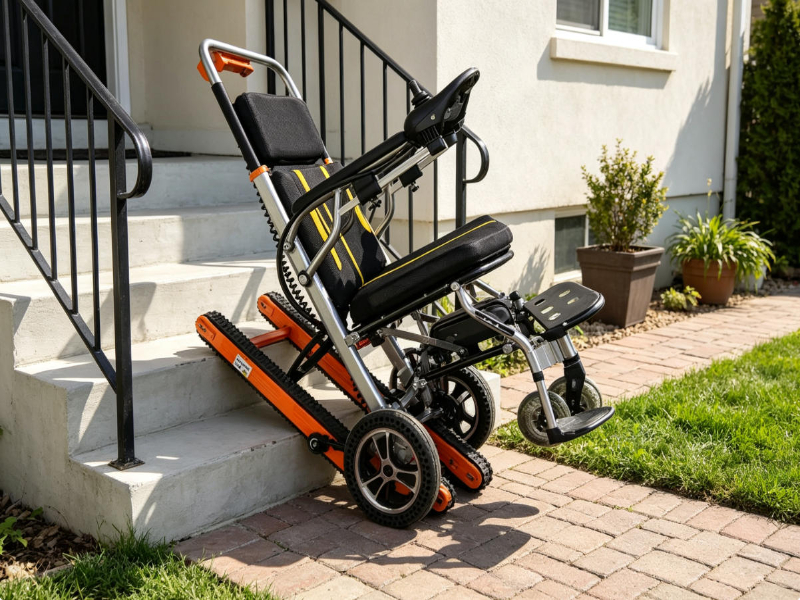
The Iyasocare YSE207 Electric Stair-Climbing Wheelchair takes a particularly interesting approach to independent stair mobility.
Its tracked climbing system is combined with a universal controller, and Iyasocare describes the model as designed so that one person can operate the wheelchair during stair climbing.
That emphasis on operation is important. For many families, the problem is not simply whether a wheelchair can climb stairs, but whether a caregiver can operate it without excessive physical effort.
The YSE207 also features a universal front wheel capable of 360-degree steering, which can be useful when manoeuvring in confined areas such as hallways, elevators, and narrow spaces.
For safety, the product incorporates a stair lock with deceleration and reverse-lock functions, together with a reversing camera. These features are intended to give the operator greater control and visibility.
The chair uses a steel frame and has a stated load capacity of 150 kg. Its automotive-style leather seat is designed to provide support during longer periods of sitting.
The 20Ah lithium battery provides a published range of up to 15 km, while the climbing speed is specified at approximately 15 steps per minute and continuous climbing capacity at up to 500 steps.
Best suited for:
The YSE207 stands out particularly for its focus on controllability and manoeuvrability.
| Feature | Dual-Use Model | YSE208 | YSE207 |
|---|---|---|---|
| Stair climbing | Yes | Yes | Yes |
| Flat-ground driving | Yes | Yes | Yes |
| Battery | 20Ah lithium | 13Ah lithium | 20Ah lithium |
| Stated range | Up to 15 km | Up to 15 km | Up to 15 km |
| Stated load capacity | Up to 150 kg | Up to 120 kg | Up to 150 kg |
| Maximum stair slope | Up to 45° | Under 45° | Check manufacturer specification |
| Continuous stair capacity | — | Up to 500 steps | Up to 500 steps |
| Folding design | — | Yes | — |
| Reclining backrest | Yes | Product-dependent | Yes |
| Safety system | Climbing lock + dual brakes | Stair-climbing system | Stair lock + reversing camera |
| Strongest use case | Versatile dual-use mobility | Residential + portable use | Independent manoeuvrability |
The specifications above are based on the manufacturers’ published product information.
A common mistake is assuming that a more powerful motor automatically means a better wheelchair.
That is not necessarily true.
Stair climbing is a complete system involving the motor, track design, braking, controller, frame geometry, battery, user weight, staircase dimensions, and operator technique.
A wheelchair with a powerful motor may still be unsuitable if its track system does not match the staircase or if the chair is too wide for the landing.
Similarly, a lighter wheelchair may be more convenient for transportation but may not offer the same load capacity or stability as a heavier model.
The right balance depends on the user’s environment.
For home use, stair compatibility and manoeuvrability may matter more than maximum power. For nursing facilities, durability, ease of operation, battery performance, and user capacity may become more important. For distributors, product versatility, foldability, serviceability, and market positioning can influence the best choice.
A staircase is only one part of the user’s route.
Imagine a typical journey:
Bedroom → hallway → staircase → landing → entrance → pavement → vehicle.
A wheelchair that performs brilliantly on stairs but cannot manoeuvre comfortably through the hallway may still create problems.
This is why the dual-use design can be attractive. The user does not necessarily need to switch mobility devices immediately after reaching the bottom of the stairs.
The YSE208 is similarly designed around both flat-ground driving and tracked stair climbing.
The YSE207’s 360-degree front-wheel steering is another example of designing for the spaces surrounding the staircase rather than the staircase alone.
When evaluating a Tracked Wheelchair for Stairs, therefore, walk through the user’s entire daily route and identify every point where mobility could become difficult.
Technical performance should never completely overshadow comfort.
A user may spend considerable time in the wheelchair before and after climbing stairs. A narrow or poorly supported seat can become uncomfortable quickly, particularly for elderly users or people who rely on the chair for most of their daily mobility.
Look at seat width, backrest support, cushion material, foot positioning, armrests, and reclining functions.
The Dual-Use model has a 48 cm seat and reclining backrest, while the YSE207 uses an ergonomic automotive-grade leather seat.
These details may appear secondary when compared with climbing capability, but they can have a major effect on the user’s experience over weeks and months of regular use.
A stair-climbing wheelchair should not feel like a machine that happens to carry a person. It should still function as a wheelchair.
A Tracked Wheelchair for Stairs contains more mechanical components than a basic manual wheelchair, so maintenance should be considered before purchase.
Ask the supplier about:
The tracks should be kept clean and inspected regularly. Battery condition should also be monitored, particularly when the wheelchair is used frequently on stairs.
For commercial buyers, after-sales support can be just as important as the initial purchase price. A stair-climbing wheelchair that sits unused because a replacement component is unavailable provides little value to a care facility or distributor.
This is one reason it is useful to purchase from an established manufacturer that can provide product documentation, technical support, spare parts, and OEM/ODM services where required. Iyasocare’s website identifies stair-climbing wheelchairs as one of its product categories and provides manufacturer and OEM/ODM information.
Choosing the right Tracked Wheelchair for Stairs requires more than comparing product photographs or motor specifications. The best wheelchair is the one that matches the staircase, the user’s weight and mobility needs, the operating environment, and the way the chair will be transported and maintained.
The Dual-Use Stair Climbing Wheelchair is a strong option for buyers who want one wheelchair for both flat surfaces and stairs, with a 150 kg stated load capacity, 20Ah battery, reclining seat, dual braking system, and climbing-lock technology.
The YSE208 is particularly appealing for residential and institutional environments where foldability, storage, stair compatibility, and dual-use electric operation are important. Its published specifications include a 120 kg load capacity, 13Ah battery, up to 15 km driving range, and support for up to 500 stair steps.
The YSE207 is worth considering for users who prioritise manoeuvrability and controlled stair operation. Its universal front wheel, tracked system, reversing camera, stair lock, 20Ah battery, and 150 kg stated load capacity make it an interesting choice for everyday stair mobility.
Most importantly, do not purchase a stair-climbing wheelchair until you have checked the staircase itself. Measure the width, step dimensions, slope, landings, and surrounding space. Then match those measurements with the manufacturer’s specifications.
A Tracked Wheelchair for Stairs can open up spaces that would otherwise remain inaccessible, but its real value comes from using the right technology in the right environment.
1. What should I check before buying a Tracked Wheelchair for Stairs?
Start with the staircase. Measure its width, step depth, slope, landings, and surrounding clearance. Then check the wheelchair’s maximum user weight, climbing angle, track specifications, battery capacity, braking system, and operating requirements. For example, Iyasocare specifies that the YSE208 is intended for stair slopes below 45° and stair widths above 700 mm.
2. Can a tracked wheelchair be used on flat ground as well as stairs?
Yes, some models are specifically designed for dual-use operation. The Iyasocare Dual-Use Stair Climbing Wheelchair and YSE208 are designed to provide powered movement on flat surfaces as well as tracked stair climbing. This can reduce the need to transfer between different mobility devices. However, users should always follow the specific operating instructions and terrain limits for the selected model.
3. Which tracked wheelchair is best: the Dual-Use model, YSE208, or YSE207?
There is no universal winner. The Dual-Use Stair Climbing Wheelchair is a strong choice for users who want broad versatility and a 150 kg stated load capacity. The YSE208 is particularly suitable for buyers who value foldability, residential stair compatibility, and storage convenience. The YSE207 is a compelling option when manoeuvrability, controlled stair operation, and a 150 kg stated load capacity are priorities. The final choice should be based on the user’s staircase, weight, mobility needs, caregiver involvement, and transportation requirements rather than price or motor power alone.
WhatsApp us