Our Location
Free Trade Tower, Xiyong street.
Chongqing, China

Free Trade Tower, Xiyong street.
Chongqing, China
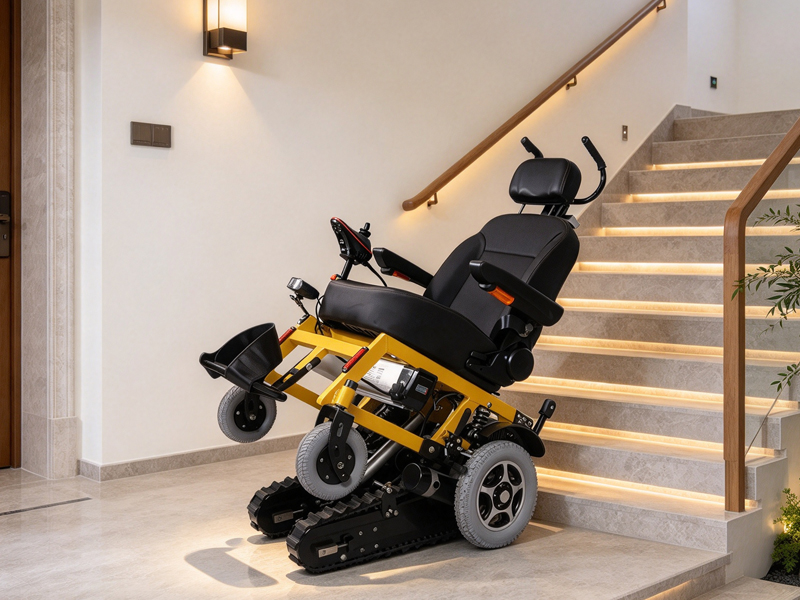
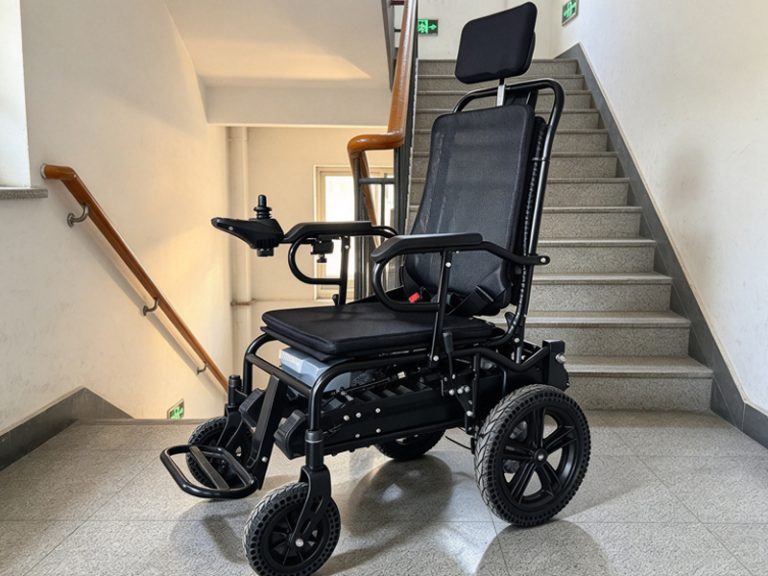
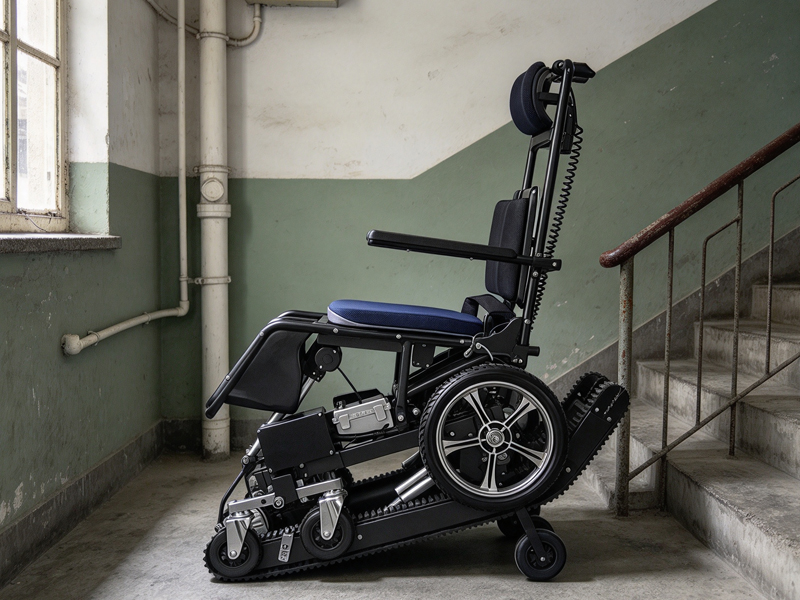
Stairs remain a significant obstacle for wheelchair users, particularly in older residential buildings, small clinics, nursing homes, hotels, and public facilities without suitable elevators or accessible ramps. In these environments, an electric stair climbing wheelchair can offer a valuable alternative when the staircase, user, and operating conditions meet the manufacturer’s requirements.
For wholesale buyers, the opportunity goes beyond the end-user market. Electric stair climbing wheelchairs can help distributors expand their rehabilitation equipment portfolio, serve specialized customer groups, and establish relationships with healthcare providers looking for more flexible mobility solutions.
However, not every model is designed for the same purpose. Some prioritize automatic stair-climbing operation and battery capacity, while others combine stair climbing with everyday mobility on flat surfaces and offer a wider seat or higher maximum load capacity.
Two models worth examining are the IYASOCARE Automatic Stair Climbing Wheelchair YSE210 and the IYASOCARE Dual-Use Stair Climbing Wheelchair YSE205. Both address stair-related mobility challenges, but their specifications and design priorities make them suitable for different purchasing requirements.
For distributors building a long-term product line, understanding these differences is the first step toward making a sound sourcing decision.
The mobility equipment market covers a wide range of products, from standard manual wheelchairs and lightweight electric wheelchairs to transfer chairs, standing wheelchairs, and specialized rehabilitation equipment.
Stair climbing wheelchairs occupy a more specific segment. They are intended for situations where a user needs assistance navigating compatible staircases, rather than simply moving across a level floor.
This distinction matters to wholesale buyers because the customer is often looking for a solution to a clearly defined problem.
A rehabilitation equipment dealer may receive inquiries from families whose homes have multiple floors. A medical equipment supplier may need mobility equipment for a facility with limited elevator access. A mobility retailer may want to serve customers who require both everyday movement and a way to navigate suitable stairs.
In each case, the product must be evaluated according to the actual environment in which it will be used.
Electric stair climbing wheelchairs can also complement an existing range of mobility products. A distributor that already supplies electric wheelchairs, walkers, patient transfer equipment, and other rehabilitation products may be able to reach new customers without moving into an entirely unrelated product category.
There is an important qualification, though. A stair climbing wheelchair is not a universal substitute for an accessible building entrance, a properly installed ramp, or an elevator. Its suitability depends on the staircase dimensions, the user’s physical needs, the product’s operating limits, and the availability of appropriate training.
For professional buyers, responsible product positioning is just as important as the product itself.
When comparing electric stair climbing wheelchairs for wholesale purchasing, it helps to begin with the intended customer rather than the product price.
The YSE210 focuses on automatic stair-climbing functionality, an aluminum-alloy frame, and a larger-capacity lithium battery. The YSE205 combines stair climbing with flat-ground mobility, a wider seat, a reclining backrest, and a higher stated maximum load.
Neither model is automatically the right choice for every customer. The more appropriate option depends on user fit, operating requirements, transportation arrangements, and the type of equipment a distributor expects to sell.
Product page: https://www.iyasomed.com/products/automatic-stair-climbing-wheelchair-yse210/
The YSE210 Automatic Stair Climbing Wheelchair is worth considering for distributors targeting customers who prioritize automatic stair-climbing functionality and a relatively high-capacity battery.
Its design combines a powered climbing system with an aluminum-alloy frame and a foldable configuration. These features make it a potential option for home-care mobility, selected institutional applications, and specialist mobility retailers.
Key specifications
These specifications are published on the manufacturer’s product page. Buyers should confirm the latest technical documentation, packaging information, and applicable operating limits before ordering.
Battery capacity is an important consideration for powered mobility equipment, especially when the product may be used repeatedly throughout the day.
The YSE210 features a 29.4V, 30Ah lithium battery. The manufacturer lists a driving range of up to 30 km and a stair-climbing capacity of up to 800 steps.
These figures describe different operating scenarios and should not be interpreted as guaranteed performance under every condition. Actual range and climbing endurance can vary with user weight, staircase configuration, battery condition, operating technique, and other factors.
For wholesale buyers, the larger battery provides a clear specification to discuss with customers who are comparing powered mobility solutions. It is still important to ask the manufacturer about charging time, battery replacement, expected service life, and performance under realistic operating conditions.
Frame material can influence the way a wheelchair is positioned in the market.
The YSE210 uses an aluminum-alloy frame, and its published net weight is 65 kg. Its folded dimensions are 116 × 75 × 58 cm.
These details can be useful when evaluating storage arrangements, transport requirements, and handling procedures. However, the product should not be described as lightweight without context: at 65 kg net, it remains substantial equipment that requires appropriate lifting, loading, and storage arrangements.
Distributors should consider the complete package dimensions and gross weight as well as the folded wheelchair itself. These factors affect warehouse planning, delivery costs, and the practical arrangements required when supplying customers.
The YSE210 has a published seat width of 40 cm and a seat depth of 45 cm, with a maximum stated load of 100 kg.
These figures should be part of the initial suitability assessment. A customer may appreciate the automatic climbing function and battery capacity, but the wheelchair must also provide an appropriate seating fit and remain within its specified load limit.
For distributors, this is a useful reminder that feature comparisons should never replace an individual fit assessment.
The YSE210 may be worth presenting to customers who meet its seating and load requirements and prioritize automatic stair-climbing functionality, an aluminum-alloy frame, and battery capacity.
It is not appropriate for every user or every staircase. The manufacturer must confirm the intended operating procedure and any requirements for supervision or assistance before a dealer recommends independent operation.
Product page: https://www.iyasomed.com/products/dual-use-stair-climbing-wheelchair/
The IYASOCARE YSE205 Dual-Use Stair Climbing Wheelchair takes a different approach by combining movement on flat surfaces with powered stair-climbing functionality.
This dual-use design is particularly relevant to distributors serving customers who need a wheelchair for everyday mobility as well as access to compatible staircases.
Rather than evaluating the product only as a stair-climbing device, buyers can consider how its combined functions fit into the customer’s daily mobility routine.
Key specifications
The figures above reflect the manufacturer’s published specifications. Wholesale buyers should request the current model-specific datasheet to verify any changes before preparing quotations or product listings.
One of the clearest differences between the YSE205 and the YSE210 is their seating configuration and maximum stated load.
The YSE205 has a 48 cm seat width and a stated maximum load of 150 kg. The YSE210 has a 40 cm seat width and a stated maximum load of 100 kg.
For distributors, this difference can be commercially significant because customers have different body dimensions and support requirements.
A wider seat may be more appropriate for some users, but seat width alone does not establish a good fit. Seat depth, posture, armrest clearance, foot positioning, transfer needs, and the user’s overall dimensions should also be considered.
The YSE205’s higher stated load capacity may make it relevant to customers who exceed the YSE210’s specified limit, provided they remain within the YSE205’s own limit and meet the other suitability requirements.
This gives distributors a practical reason to keep the two models distinct in their product catalogs instead of presenting them as interchangeable options.
The YSE205 is equipped with a 24V DC, 370W motor and a 20Ah lithium battery. The manufacturer lists a driving range of up to 15 km and a stair-climbing speed of approximately 15 steps per minute.
Its dual-use design allows the wheelchair to serve both flat-ground mobility and stair-climbing purposes, reducing the need to treat those functions as separate product requirements.
For buyers supplying home-care providers, selected rehabilitation facilities, and specialist mobility retailers, this combination may be worth evaluating.
The product also includes a manual brake and an electromagnetic brake. The manufacturer describes a climbing-lock system intended to help control movement during stair operation.
These features should be assessed alongside the complete operating instructions, maintenance requirements, and safety procedures. Their presence does not remove the need for user training, staircase inspection, and appropriate supervision where required.
The YSE205 uses a steel frame and features an artificial-leather cushion and reclining backrest.
These details can matter when evaluating comfort, maintenance, and intended use. For customers who spend extended periods seated, seating support and positioning deserve attention alongside the climbing mechanism.
Distributors should avoid treating a reclining backrest as a substitute for a professional seating assessment. The suitability of the chair depends on the individual user’s needs, posture, and ability to maintain a safe position during movement.
The manufacturer’s published net weight of 93 kg also has practical implications. Dealers should plan for suitable delivery equipment, storage space, and staff handling procedures.
The YSE205 may be a strong candidate for buyers who prioritize a wider seat, a higher stated load capacity, a reclining backrest, and a combined flat-ground and stair-climbing function.
Its weight, dimensions, and staircase requirements should be checked carefully before it is recommended for a particular household or facility.
The best product selection starts with the type of customer a distributor serves.
A dealer whose customers prioritize battery capacity and an aluminum-alloy frame may want to evaluate the YSE210 first. A distributor whose customers require a wider seat and a higher stated load capacity may find the YSE205 more relevant.
The following comparison highlights the differences that matter most during initial product selection.
| Purchasing factor | YSE210 | YSE205 |
|---|---|---|
| Main design emphasis | Automatic stair climbing | Dual-use flat-ground and stair mobility |
| Frame material | Aluminum alloy | Steel |
| Motor | 250W | 24V DC, 370W |
| Battery | 29.4V, 30Ah lithium | 20Ah lithium |
| Maximum stated load | 100 kg | 150 kg |
| Seat width | 40 cm | 48 cm |
| Seat depth | 45 cm | 43 cm |
| Net weight | 65 kg | 93 kg |
| Published driving range | Up to 30 km | Up to 15 km |
| Published climbing capacity | Up to 800 steps | Up to 500 steps |
| Published climbing speed | About 15 steps/min | About 15 steps/min |
Specifications are based on the manufacturer’s published product information. Verify current specifications and operating conditions before purchase.
The comparison should not be reduced to a simple question of which wheelchair has the better specifications.
The YSE210 has a larger-capacity battery and a lower net weight, while the YSE205 has a wider seat and a higher stated load capacity. The products also differ in frame material, dimensions, and intended positioning.
Motor wattage alone does not determine climbing performance, and battery capacity alone does not establish overall suitability. The actual staircase, operating procedure, user requirements, and complete product design all matter.
For some distributors, carrying both models may make commercial sense. A small initial order or sample evaluation can help establish which customer groups respond best before committing to deeper inventory.
A product that looks attractive in a catalog still needs to work within the distributor’s commercial and service model.
Before purchasing electric stair climbing wheelchairs in bulk, buyers should review several practical areas.
1. Staircase compatibility
Ask for the manufacturer’s current staircase measurement guide. Confirm the minimum width, landing dimensions, turning clearance, supported slope, and any other restrictions. A staircase that meets one dimension may still be unsuitable because of its landing layout or geometry.
2. User suitability and safety procedures
Confirm the maximum load, seat dimensions, positioning requirements, and intended operating method. Ask whether a trained caregiver or operator is required for any part of the process. Do not assume that an automatic function means a user can safely operate the wheelchair without assistance.
3. Battery and charging information
Request battery specifications, charging instructions, expected charging time, replacement options, and relevant transport documentation. If the wheelchair will be used in a care facility, establish how charging and battery maintenance will be managed.
4. Product documentation and compliance
Request the user manual, technical datasheet, labeling information, warranty terms, and applicable test reports or conformity documents. Requirements vary by destination market and intended distribution channel, so buyers should verify the documentation needed for their particular market rather than relying on a general certification claim.
5. Spare parts and after-sales service
Ask which replacement parts are available, how they are ordered, and what support the supplier can provide for troubleshooting and maintenance. A service plan matters because distributors are responsible for helping their customers resolve problems after delivery.
6. Packaging and logistics
Compare net weight, gross weight, carton dimensions, packaging protection, and loading arrangements. These details affect freight costs, warehouse capacity, delivery planning, and the final landed cost of each unit.
7. Sample evaluation
Where practical, arrange a sample assessment before placing a large order. Evaluate the product using the manufacturer’s recommended procedures and a suitable test environment. Obtain professional guidance when necessary, particularly for demonstrations involving actual users or staircases.
A well-prepared purchasing process reduces the likelihood of avoidable returns, unsuitable recommendations, and expensive after-sales issues.
For medical equipment distributors, profitability depends on more than the difference between factory price and selling price.
Freight, import duties, insurance, storage, delivery, demonstration equipment, staff training, warranty claims, replacement parts, and customer service all affect the final margin.
This is especially important for stair climbing wheelchairs because they are more specialized than conventional mobility products and may require additional explanation before purchase.
A practical approach is to define the target customer groups first. These may include specialist mobility retailers, rehabilitation equipment suppliers, home-care providers, institutional purchasers, or distributors serving customers with specific stair-access challenges.
Next, identify the product features those customers value most.
For example, the YSE210 can be positioned around its automatic stair-climbing design, aluminum-alloy frame, and 30Ah lithium battery. The YSE205 can be positioned around its wider seat, higher stated load capacity, reclining backrest, and dual-use functionality.
This is more useful than competing on price alone. Customers need to understand which model is appropriate for their needs, and dealers need a clear reason for recommending one model over another.
Product education also supports online sales. Detailed product pages, specification comparisons, demonstration videos, and practical buying guides can help answer questions before a customer contacts the sales team.
For wholesale inquiries, make it easy for buyers to request quotations, discuss order quantities, obtain current product documentation, and clarify shipping arrangements.
If a supplier offers OEM or ODM services, ask about the available customization options, minimum order quantities, lead times, and documentation implications. Confirm the actual scope of these services before including them in a purchasing plan.
A smaller, carefully selected product range with reliable documentation and service support can be a better starting point than a large inventory of models that have not been tested against local demand.
A reliable supplier relationship should continue after the first shipment.
For distributors, product consistency, communication, spare-parts availability, and technical support can influence customer satisfaction as much as the initial purchase price.
IYASOCARE offers a range of stair climbing wheelchairs and other mobility and rehabilitation products. Buyers can explore the company’s stair climbing wheelchair range to review additional models and identify options that may complement their existing portfolio.
For businesses evaluating the YSE210 or YSE205, the next step is to request current quotations and technical documentation directly from the supplier. Buyers should confirm minimum order quantities, production lead times, packaging specifications, warranty conditions, available spare parts, and the documents required for their target market.
It is also worth asking for a product demonstration or video showing the recommended operating procedure. A demonstration can help sales teams understand the product more clearly, but it should not replace hands-on training or the manufacturer’s safety instructions.
The most effective wholesale strategy is to match the product to the customer, verify the specifications, and establish a service process before scaling inventory.
1. What should wholesale buyers look for in an electric stair climbing wheelchair?
Wholesale buyers should evaluate maximum load capacity, seat dimensions, frame material, battery specifications, climbing performance, staircase compatibility, product weight, packaging, documentation, warranty terms, and spare-parts availability.
They should also consider the intended customer group and verify that the product meets the requirements of the destination market. A low purchase price is not enough if the wheelchair is unsuitable for the customer’s staircase or difficult to maintain after delivery.
2. What is the difference between the IYASOCARE YSE210 and YSE205?
The YSE210 features an aluminum-alloy frame, a 29.4V 30Ah lithium battery, a 40 cm seat width, and a maximum stated load of 100 kg. The YSE205 features a steel frame, a 20Ah lithium battery, a wider 48 cm seat, a reclining backrest, and a maximum stated load of 150 kg.
The YSE210 may appeal to buyers who prioritize battery capacity and a lower net equipment weight. The YSE205 may be more appropriate for customers who need a wider seat, a higher load rating, and combined flat-ground and stair-climbing functionality. The final choice should depend on individual suitability and the operating environment.
3. How can medical equipment distributors source stair climbing wheelchairs for wholesale?
Distributors can begin by identifying their target customer groups, comparing suitable models, and contacting manufacturers for quotations and technical documentation. Before placing a bulk order, they should confirm minimum order quantities, lead times, shipping costs, product compliance documentation, warranty coverage, spare-parts availability, and after-sales support.
Requesting a sample or arranging a product demonstration can also help a business evaluate the wheelchair before committing to larger inventory. For IYASOCARE’s options, buyers can start with the YSE210 Automatic Stair Climbing Wheelchair and the YSE205 Dual-Use Stair Climbing Wheelchair.
Electric stair climbing wheelchairs can be a valuable addition to a medical equipment distributor’s portfolio when they address a clear customer need and are supported by appropriate training, documentation, and after-sales service.
The IYASOCARE YSE210 and YSE205 offer two distinct approaches to stair-related mobility. Comparing their seating dimensions, load limits, battery specifications, weight, and intended applications gives wholesale buyers a practical starting point for product selection.
The goal is not simply to purchase a wheelchair with impressive specifications. It is to select a suitable product, support it properly, and build a distribution business that customers can trust.