Our Location
Free Trade Tower, Xiyong street.
Chongqing, China

Free Trade Tower, Xiyong street.
Chongqing, China
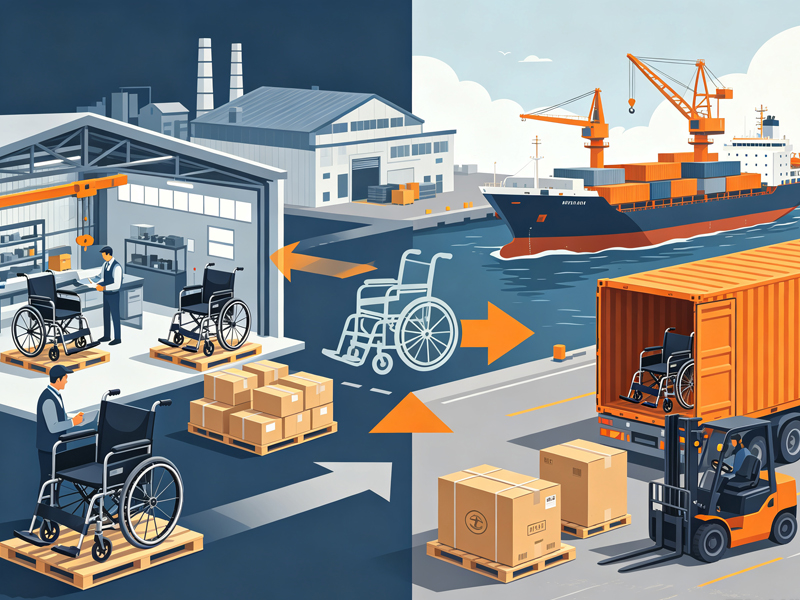
A wheelchair supplier may quote $120 under EXW and another manufacturer may offer $135 under FOB. At first glance, the EXW offer looks cheaper. But once you add inland transportation, export clearance, terminal handling, documentation, and other logistics charges, the final cost may tell a very different story.
This is why international wheelchair buyers should understand the difference between EXW and FOB Incoterms before comparing supplier quotations.
For distributors, wholesalers, medical equipment companies, online retailers, and wheelchair importers, choosing the right trade term can affect not only the purchase price but also shipping control, risk allocation, customs procedures, cash flow, and the total landed cost of every wheelchair.
So, between EXW and FOB, which one is better for wheelchair buyers?
The short answer is: neither is universally better. The right choice depends on your shipping volume, logistics experience, destination country, relationship with freight forwarders, and how much control you want over the international transportation process.
EXW stands for Ex Works.
Under EXW, the seller generally makes the goods available at its premises, such as a wheelchair factory or warehouse. The buyer is responsible for arranging transportation from that point onward.
In a typical EXW wheelchair transaction, the process may look like this:
Wheelchair factory → local pickup → export procedures → port/airport → ocean freight → destination port → customs → local delivery → buyer’s warehouse
The buyer takes responsibility for a large portion of this supply chain.
FOB stands for Free On Board.
Under FOB, the seller is generally responsible for getting the goods through export formalities and delivering them on board the vessel at the agreed port. Once the goods are loaded on board, the risk transfers to the buyer.
A typical FOB transaction looks more like:
Wheelchair factory → domestic transportation → export clearance → loading onto vessel → ocean freight → destination port → import clearance → local delivery
The important point is that FOB does not mean the supplier pays for the entire shipping process.
Under FOB, the buyer normally still pays the international ocean freight, insurance if desired, destination charges, import duties, customs clearance, and inland transportation at the destination.
This distinction is often misunderstood by new importers.
A simple example
Imagine a wheelchair manufacturer in China gives you these two quotations:
| Trade Term | Wheelchair Price |
|---|---|
| EXW | $110/unit |
| FOB Shanghai | $123/unit |
The EXW price looks significantly lower.
But suppose your logistics costs from the factory to the export port and associated export procedures amount to $9 per wheelchair when spread across the shipment.
Your effective comparison becomes:
EXW: $110 + $9 = $119
versus
FOB: $123
The apparent $13 difference has now become only $4.
And if your EXW shipment has additional local charges, the difference could disappear entirely.
This is why comparing EXW and FOB based only on the unit price is a common purchasing mistake.
EXW is not necessarily a bad option.
In fact, for some experienced importers, EXW can provide considerable flexibility.
The biggest advantage is control.
If you already work with a reliable freight forwarder, you may be able to negotiate transportation rates more effectively than a small or medium-sized wheelchair manufacturer.
For example, an established distributor importing several containers of wheelchairs every month may have negotiated rates with a logistics company.
The buyer may be able to arrange:
through one logistics provider.
In this situation, EXW can make sense because the buyer controls the transportation chain.
Another advantage is shipping flexibility.
Suppose you purchase manual wheelchairs, electric wheelchairs, rollators, and wheelchair accessories from several suppliers in the same industrial region.
With a well-organized logistics operation, you may arrange for multiple suppliers to send goods to one consolidation warehouse.
Instead of shipping each order separately, your freight forwarder can consolidate the cargo into a single shipment.
For a professional importer, this can potentially improve freight efficiency.
However, there is an important catch.
EXW places more responsibility on the buyer.
A buyer unfamiliar with Chinese export procedures, local transportation, or customs documentation may discover that the apparently cheap EXW quotation is not actually cheaper.
One of the biggest problems with EXW quotations is that buyers sometimes compare an EXW factory price with an FOB port price as though they were equivalent.
They are not.
An EXW quotation may exclude several costs that you still need to pay.
Depending on the shipment and country involved, these may include:
The exact cost structure varies by country, shipment type, port, logistics provider, and contractual arrangement.
For wheelchair buyers, there is another issue worth paying attention to: cargo volume.
Wheelchairs are relatively large products compared with their weight.
A standard folding manual wheelchair may be lightweight, but several hundred units can occupy substantial container space.
Electric wheelchairs can be even more complicated because of their batteries, packaging dimensions, and transportation requirements.
This means that the efficiency of your loading plan can have a significant effect on freight cost.
For example, if your supplier can efficiently load 100 wheelchairs into a container but your independent logistics arrangement leaves unused space, the theoretical savings from EXW may not translate into actual savings.
Therefore, when considering EXW, don’t ask only:
“What’s your EXW price?”
Ask:
“What will my complete origin cost be from your factory to the port?”
That is a much more useful question.
For many wheelchair importers, especially those who are still building their international supply chain, FOB is easier to manage.
The supplier typically handles the transportation from its facility to the named port and the export formalities required under the agreed Incoterm.
This creates a cleaner purchasing process.
Instead of managing the supplier’s local transportation yourself, you can focus on the part of the logistics chain you already understand:
FOB port → destination port → customs → warehouse
For a buyer in the United States, Europe, Australia, the Middle East, or Southeast Asia, this can simplify communication with the supplier.
You can ask your freight forwarder for the ocean freight from the specified origin port to your destination port.
The supplier handles the origin side according to the FOB agreement.
This makes it easier to compare quotations between manufacturers.
Suppose three wheelchair factories provide the following prices:
| Supplier | Quotation |
|---|---|
| Supplier A | $118 FOB |
| Supplier B | $121 FOB |
| Supplier C | $125 FOB |
Although price should never be the only purchasing factor, these quotations are at least based on a more comparable delivery point.
You can then calculate your estimated landed cost:
Product price + international freight + insurance + import duty/tax + destination charges + inland delivery
That gives you a much more realistic basis for comparison.
A practical way to understand the difference is to look at responsibility.
| Cost / Responsibility | EXW | FOB |
|---|---|---|
| Product manufacturing | Buyer pays | Buyer pays |
| Factory preparation | Seller | Seller |
| Pickup from factory | Buyer | Seller |
| Export transportation | Buyer | Seller |
| Export clearance | Generally buyer | Seller |
| Delivery to export port | Buyer | Seller |
| Loading on vessel | Buyer-side responsibility under EXW structure | Seller |
| Main ocean freight | Buyer | Buyer |
| Import clearance | Buyer | Buyer |
| Import duties/taxes | Buyer | Buyer |
| Destination delivery | Buyer | Buyer |
This table is useful for a basic comparison, but international buyers should remember that the exact contractual obligations can depend on the specific Incoterm version and named place.
Don’t simply write “FOB China” on a purchase order.
A professional purchase contract should identify the agreed port or location clearly.
For example:
FOB Shanghai, Incoterms® 2020
is considerably clearer than simply saying:
FOB China
The same principle applies to EXW.
If your company has a strong logistics department, EXW generally gives you more direct control over transportation arrangements.
You select the trucker.
You select the freight forwarder.
You negotiate the freight rate.
You decide whether to consolidate cargo.
You can coordinate shipments from multiple factories.
For large importers, these capabilities can be valuable.
But control comes with responsibility.
If the truck arrives late, the buyer may need to solve the problem.
If export paperwork is incomplete, the buyer may need to coordinate with the supplier and logistics company.
If the pickup arrangement is incorrect, the buyer may have to absorb additional costs.
FOB shifts more of the origin-side logistics responsibility to the supplier.
For smaller wheelchair distributors, that simplicity can be worth more than a slightly lower EXW unit price.
Risk is another major difference.
Under EXW, the buyer assumes responsibility very early in the logistics process.
The buyer needs to be comfortable with what happens at the supplier’s factory and during the origin transportation stage.
Under FOB, risk generally transfers when the goods are loaded on board the vessel at the agreed port.
This doesn’t mean the supplier is responsible for the goods until they reach your warehouse.
It means the point at which the buyer assumes the risk is later in the transportation chain.
For international wheelchair buyers, this distinction matters because a shipment can pass through several stages before it reaches the destination.
Consider this example.
You order 300 manual wheelchairs.
The supplier completes production.
Under an EXW arrangement, your transportation company picks up the goods from the factory. During the local transportation process, damage occurs.
Who bears the risk?
The answer depends on the agreed contract and applicable Incoterm, but under EXW the buyer has generally taken on the transportation risk from a much earlier point.
Under FOB, the risk transfer generally occurs later, when the goods are loaded on board the vessel.
This is one reason why buyers should understand risk transfer separately from cost responsibility.
They are not always the same thing.
The decision becomes more interesting when the product is an electric wheelchair.
Electric wheelchairs may contain lithium-ion batteries or other battery systems subject to transportation and dangerous-goods requirements.
This can make international shipping more complicated than shipping a basic manual wheelchair.
A buyer using EXW may need to coordinate closely with the freight forwarder regarding:
FOB can sometimes simplify the origin-side process because the supplier is handling the export side of the transaction.
However, FOB does not remove the buyer’s responsibility for ensuring that the goods can legally enter the destination country.
Before placing a large order of electric wheelchairs, buyers should verify applicable battery and transportation requirements with their freight forwarder and relevant authorities.
This is particularly important when importing into countries with detailed product, battery, safety, or medical-device regulations.
Wheelchair buyers sometimes compare:
EXW vs FOB vs DDP
as if these were simply three different prices.
They are actually different approaches to allocating transportation responsibilities.
With DDP, the seller takes responsibility for much more of the delivery process, potentially including import clearance and duties, depending on the exact arrangement and destination.
That can be convenient, but it can also create other issues.
For example, the supplier may not be familiar with your country’s import requirements.
In some countries, the importer of record must satisfy specific legal requirements that cannot simply be ignored by using a different commercial term.
For professional wheelchair distributors, it is usually better to understand exactly who is responsible for what, rather than selecting a trade term solely because the final quoted price looks attractive.
This is perhaps the most important point in the entire EXW vs FOB discussion.
The cheapest factory price is not necessarily the cheapest import price.
Suppose you receive:
Supplier A: $105 EXW
and
Supplier B: $117 FOB
You might initially think Supplier A is cheaper by $12.
But imagine the EXW origin expenses are:
Now the EXW price becomes approximately:
$105 + $10 = $115
The real difference is only $2.
If your actual origin expenses are higher, FOB could even become cheaper.
This is why experienced buyers calculate landed cost, not simply supplier price.
A basic landed-cost formula is:
Landed Cost = Product Cost + Origin Costs + International Freight + Insurance + Import Duty/Tax + Destination Charges + Inland Delivery
The formula can be expanded depending on your business.
You may also need to include:
For a wheelchair importer, this calculation is much more meaningful than comparing EXW and FOB prices in isolation.
Instead of asking “Is EXW better than FOB?”, ask five questions.
1. How large is your order?
If you’re purchasing a small trial order of 20 or 30 wheelchairs, the convenience of FOB may be more important than optimizing every origin-side logistics charge.
If you’re importing multiple containers every month, EXW may become more attractive because the savings from controlling logistics can accumulate.
2. Do you already have a freight forwarder?
If you have a trusted forwarder who understands your origin country and destination market, EXW becomes easier to manage.
If you don’t, FOB may offer a simpler starting point.
3. Can you consolidate shipments?
If you buy from multiple wheelchair factories or accessory suppliers, your own logistics network may give you an advantage.
If you’re purchasing everything from one supplier, the benefit of independent consolidation may be smaller.
4. How complicated is the product?
Manual wheelchairs are relatively straightforward compared with electric wheelchairs containing batteries.
If your products have special transportation requirements, make sure your logistics provider understands them before choosing the trade term.
5. What matters more: control or simplicity?
This is ultimately a business decision.
EXW tends to favor control.
FOB tends to favor simplicity on the origin side.
Neither automatically produces a lower total cost.
A professional buyer should not stop at the question:
“What is your FOB price?”
Ask for enough information to build a complete cost model.
For example:
1. What is the exact EXW price?
2. What is the FOB price and named port?
3. What are the product dimensions and packing dimensions?
4. How many wheelchairs fit in a 20-foot or 40-foot container?
5. What is the gross weight per carton?
6. Are batteries included for electric wheelchair models?
7. What battery type and capacity are used?
8. What export documents can the supplier provide?
9. Can the supplier support third-party inspection before shipment?
10. What is the production lead time?
These questions can reveal more about a supplier than simply asking for the lowest price.
A wheelchair with a slightly higher purchase price but better packaging, lower damage rates, consistent quality, and more efficient container loading may produce a better overall business result than a cheaper product.
Packaging deserves more attention than it usually receives.
Two wheelchair manufacturers may sell nearly identical products, but their packaging dimensions can be very different.
For example:
Supplier A: 10 wheelchairs per cubic meter
Supplier B: 13 wheelchairs per cubic meter
If the second supplier uses better folding mechanisms or optimized packaging, the freight cost per wheelchair may be lower.
This becomes particularly important when shipping large quantities.
For buyers comparing EXW and FOB quotations, ask suppliers for:
You can then calculate the approximate freight cost per unit.
This is especially useful for wheelchair wholesalers because transportation expenses are effectively part of the product’s selling cost.
EXW may be worth considering if:
For established importers, these factors can make EXW commercially attractive.
FOB may be more convenient if:
For many growing wheelchair distributors, FOB is a practical middle ground between factory-level pricing and fully managed international delivery.
Imagine you’re comparing two factories.
Factory A
EXW price: $108
Estimated origin costs: $11
Effective origin price: $119
Factory B
FOB price: $121
International freight and destination costs are identical.
At first glance, Factory A appears cheaper.
But the difference is only:
$121 – $119 = $2
Now suppose Factory B offers better packaging and fits 10% more wheelchairs into each container.
The actual landed cost could potentially become lower with Factory B.
This is why procurement decisions should not be based on one number.
A more useful comparison table might include:
| Factor | Supplier A | Supplier B |
|---|---|---|
| Product price | $108 EXW | $121 FOB |
| Estimated origin cost | $11 | Included in FOB |
| Effective origin cost | $119 | $121 |
| Container loading efficiency | Medium | High |
| Packaging | Standard | Optimized |
| Logistics control | High | Medium |
| Origin-side responsibility | Buyer | Supplier |
| Final landed cost | Calculate | Calculate |
The final decision should come from the complete landed-cost model and your operational requirements, not simply from the lowest advertised quotation.
So, which is better?
There isn’t a single answer that works for every wheelchair buyer.
EXW can be attractive for experienced importers who have strong logistics capabilities and want maximum control over the supply chain.
FOB can be easier for buyers who want the supplier to handle the origin-side transportation and export process.
For a first-time wheelchair importer, FOB can often make the purchasing process easier to manage.
For a high-volume distributor with established freight relationships, EXW may provide greater flexibility.
But the most important lesson is this:
Don’t compare EXW and FOB by unit price alone. Compare them by total landed cost, responsibility, risk, and operational complexity.
When sourcing wheelchairs internationally, the right trade term should fit your entire supply chain.
A good supplier should also be willing to explain the quotation clearly rather than simply offering the lowest possible number.
Before signing a purchase order, make sure the contract clearly states the Incoterm, named location, product specifications, packaging information, payment terms, shipping responsibilities, and documentation requirements.
That small amount of preparation can prevent much larger problems later.
For wheelchair distributors and importers, the goal isn’t simply to buy a wheelchair at the lowest factory price.
The real goal is to bring a compliant, well-packed, quality wheelchair to your warehouse at a predictable total cost.
That’s the number that ultimately matters.
1. Is EXW cheaper than FOB for importing wheelchairs?
Not necessarily.
EXW usually has a lower quoted product price because the buyer takes responsibility for more of the transportation and export process. Once factory pickup, origin transportation, export-related costs, handling, and other charges are included, the difference between EXW and FOB may become much smaller.
The best approach is to calculate the total landed cost for both options before making a purchasing decision.
2. Is FOB better for first-time wheelchair importers?
FOB can be easier for first-time importers because the supplier generally manages the origin-side transportation and export procedures under the agreed FOB arrangement.
However, buyers still need to arrange and pay for the international freight and destination-side costs.
Before ordering, make sure you understand the exact named port, shipping responsibilities, import requirements, and all additional charges.
3. Should I ask a wheelchair manufacturer for both EXW and FOB prices?
Yes, this can be a very useful way to evaluate a supplier.
Requesting both prices allows you to estimate the cost of moving the goods from the factory to the export port and compare that with the supplier’s FOB quotation.
For example, ask for:
EXW price + estimated origin charges + international freight
and compare it with:
FOB price + international freight
Then add destination charges, import taxes, customs clearance, and inland delivery to calculate the final landed cost.
This gives you a much more accurate picture of what the wheelchair will actually cost your business.