Our Location
Free Trade Tower, Xiyong street.
Chongqing, China

Free Trade Tower, Xiyong street.
Chongqing, China
Mobility equipment plays a much bigger role in healthcare than many people realize. A wheelchair is not simply a device that helps someone move from one place to another. For patients with limited mobility, older adults, and individuals recovering from surgery or living with long-term physical conditions, it can determine how independently they participate in everyday life.
For hospitals, rehabilitation centers, nursing homes, assisted living facilities, and home healthcare providers, selecting the right wheelchair is equally important. Equipment must be dependable, comfortable, easy to operate, and suitable for the physical needs of different users. It should also offer a practical service life under regular use.
This is why heavy duty steel frame wheelchairs for healthcare providers continue to attract attention from medical equipment buyers.
Steel remains a practical frame material because of its structural strength, established manufacturing processes, and suitability for reinforced wheelchair designs. When properly engineered and maintained, a steel wheelchair frame can provide the stability needed for daily mobility.
However, choosing a wheelchair based on frame material alone is rarely enough. Weight capacity, seat dimensions, motor performance, braking systems, suspension, folding mechanisms, and user transfer requirements all deserve careful consideration.
For healthcare providers looking for dependable powered mobility solutions, Iyasocare offers two models worth examining: the YSE118 Foldable Electric Wheelchair and the YSE101 Heavy Power Wheelchair.
Although both models use steel frames, they serve different mobility requirements. Understanding those differences can help healthcare organizations select equipment that better matches their patients and operating environments.
A wheelchair used in a healthcare environment may experience considerably more demanding conditions than one used occasionally at home.
It may travel across indoor flooring, outdoor walkways, ramps, parking areas, and uneven surfaces. Depending on the care setting, the equipment may also be transported between locations, stored for extended periods, or used for several hours each day.
Frame construction therefore deserves particular attention.
Steel is widely used in wheelchair manufacturing because it offers a useful combination of strength, rigidity, and manufacturing flexibility. It can be fabricated into different structural configurations, allowing manufacturers to develop frames for standard mobility, reinforced applications, and powered wheelchair systems.
For healthcare providers, several practical advantages stand out.
Structural stability: A properly designed steel frame provides a solid foundation for the seat, backrest, wheels, motors, and other components. This is especially important for powered wheelchairs, where the frame must support both the user and the additional mechanical and electrical systems.
Reinforcement possibilities: Steel tubing and structural joints can be engineered to accommodate different load requirements. Reinforced designs are particularly relevant for users who need higher weight capacities or additional structural support.
Practical maintenance: Steel wheelchair frames are familiar to many medical equipment service teams. Their construction and mechanical components can generally be inspected using established maintenance procedures. Regular checks should still include joints, fasteners, welds, brakes, and signs of corrosion.
Long-term purchasing value: For institutions managing multiple wheelchairs, equipment durability can influence total ownership costs. A suitable frame, combined with replaceable components and appropriate maintenance, may help reduce unnecessary equipment replacement.
There is one important distinction worth making: a steel frame does not automatically make a wheelchair heavy-duty. The actual weight capacity, structural design, manufacturer specifications, and intended application must all be evaluated.
Healthcare procurement teams should always check the manufacturer’s stated maximum user weight rather than relying on a product name or material description.
Selecting mobility equipment is not simply a matter of finding the strongest available model. The right wheelchair should match the user’s physical requirements and the environment in which it will operate.
A thoughtful purchasing decision usually starts with five considerations.
1. Weight Capacity and Structural Requirements
Weight capacity is one of the first specifications to review.
A wheelchair that cannot safely accommodate the intended user’s weight may experience excessive structural stress, reduced stability, and premature component wear.
Healthcare buyers should also remember that different markets use different classifications. In the United States, for example, Medicare’s manual wheelchair classification identifies K0006 heavy-duty wheelchairs as having a weight capacity greater than 250 pounds, while K0007 extra-heavy-duty manual wheelchairs have a capacity greater than 300 pounds.
These classifications apply to specific manual wheelchair billing categories. They should not automatically be applied to powered wheelchair models.
For electric wheelchairs, buyers should evaluate the manufacturer’s actual maximum load specification and confirm that it meets the intended user’s needs.
2. Seat Dimensions and Sitting Comfort
Seat width and depth influence comfort, posture, and the user’s ability to maintain a stable sitting position.
A seat that is too narrow may create pressure and discomfort. An excessively wide seat may make it harder to maintain proper positioning.
Healthcare providers should consider the user’s body measurements, posture, transfer ability, and anticipated sitting duration.
Backrest height is also important, especially for individuals who require additional upper-body support.
For patients who spend extended periods in a wheelchair, an appropriate seating assessment by a qualified rehabilitation professional is recommended.
3. Mobility Environment
A wheelchair designed primarily for indoor corridors may not perform equally well on outdoor paths.
Hospitals and nursing facilities often need equipment that moves smoothly over thresholds, ramps, and different floor surfaces. Home healthcare providers may encounter gravel, uneven paving, garden paths, and other outdoor obstacles.
Wheel size, tire construction, suspension, motor output, and braking performance all influence how well a powered wheelchair handles these conditions.
4. Safety and User Control
Safety features should never be treated as optional purchasing extras without proper evaluation.
Important features include reliable braking, controlled acceleration, anti-rollback protection where applicable, safety belts, and an intuitive controller.
For elderly users or individuals unfamiliar with electric mobility equipment, gentle starting and predictable steering can make daily operation considerably easier.
5. Transportation and Storage
Not every healthcare provider has the same storage and transportation requirements.
A rehabilitation facility may prioritize a wheelchair that can be moved between departments. A home healthcare provider may need a foldable model that fits inside a vehicle.
A larger powered wheelchair may offer advantages in load capacity and outdoor performance but require more storage space.
The most suitable model is therefore the one that balances the user’s mobility requirements with the provider’s actual operating conditions.
For healthcare providers who need a practical powered wheelchair with convenient transportation and storage, the Iyasocare YSE118 Foldable Electric Wheelchair deserves consideration.
Product link: https://www.iyasomed.com/products/foldable-electric-wheelchair-yse118/
The YSE118 combines a steel frame with an electric drive system, adjustable seating features, and a folding structure. Its design is particularly relevant for users who need powered assistance but also value flexibility when traveling or moving between different care environments.
Rather than focusing exclusively on maximum load capacity, this model emphasizes everyday usability, seating adaptability, and convenient transportation.
The YSE118 features a steel frame designed to support its powered mobility system and seating structure.
Its maximum user weight capacity is 130 kg, making it suitable for users whose requirements fall within the manufacturer’s specified limit.
For healthcare providers, this figure is an important starting point when matching equipment to individual users.
The model should be considered an everyday powered mobility solution rather than a substitute for a higher-capacity bariatric wheelchair when a user’s weight exceeds its rated limit.
One of the most practical features of the YSE118 is its folding structure.
Its folded dimensions are approximately 79 × 39 × 74 cm, which helps reduce the space needed for storage and transportation.
This is particularly useful in situations where the wheelchair needs to be loaded into a vehicle, stored between appointments, or transported between home and a healthcare facility.
For home healthcare providers, transportation convenience can make a meaningful difference to daily operations.
Instead of relying on a permanently assembled wheelchair, caregivers can fold the equipment when it is not in use.
The product’s listed overall dimensions are 120 × 60 × 130 cm, while its packing dimensions are 84 × 42 × 77 cm.
These measurements should be checked against the available vehicle storage space before purchasing.
Another notable feature is the adjustable backrest.
The YSE118 allows users to switch between a high-back and low-back configuration, providing additional flexibility for different seating preferences and support requirements.
Its backrest height is listed as 76 cm.
The seat measures 45 cm in width and 47 cm in depth, with a seat height of 48 cm.
These dimensions offer healthcare providers a useful reference when assessing whether the wheelchair is appropriate for a particular user’s body measurements.
The flip-up armrests are another practical addition.
They make side access easier and can simplify certain transfer situations, depending on the user’s physical condition and the caregiver’s transfer procedure.
For patients who need assistance moving between a wheelchair and a bed, chair, or examination table, this feature may improve accessibility.
However, healthcare staff should always follow appropriate patient transfer protocols rather than relying on the armrest design alone.
The YSE118 is equipped with two 250W motors and a 24V 12Ah lead-acid battery.
According to the manufacturer, it offers a driving range of up to 15 km and a maximum speed of 6 km/h.
These specifications make it a practical option for routine mobility around residential environments, healthcare facilities, and suitable outdoor areas.
The wheelchair also features independent shock absorption and pneumatic tires.
Its 16-inch rear wheels and 10-inch front wheels are designed to help improve ride stability and reduce the impact of uneven surfaces.
This can be useful when moving across outdoor walkways, paved paths, and other moderately uneven terrain.
The manufacturer lists a climbing ability of up to 15 degrees. Actual performance will depend on user weight, surface conditions, battery status, and operating conditions.
An electric wheelchair should remain practical even when motorized operation is unavailable.
The YSE118 supports switching between electric and manual modes, giving users and caregivers additional flexibility.
Its braking configuration includes a manual brake and an electronic parking brake.
The combination provides different ways to control the wheelchair during everyday use and when parked.
The battery charging time is listed as approximately 4–6 hours.
Available cushion colors include black, red, and blue, allowing buyers to select a finish that suits their preferences or equipment requirements.
The YSE118 is particularly suitable for:
For healthcare buyers, the YSE118 offers a combination of folding convenience, powered mobility, adjustable seating, and a steel frame.
Its 130 kg maximum load capacity should be checked carefully before assigning it to a patient.
When the priority shifts from convenient transportation to higher load capacity, stronger motor output, and more demanding outdoor conditions, the YSE101 becomes a more relevant option.
Product link: https://www.iyasomed.com/products/heavy-power-wheelchair-yse101/
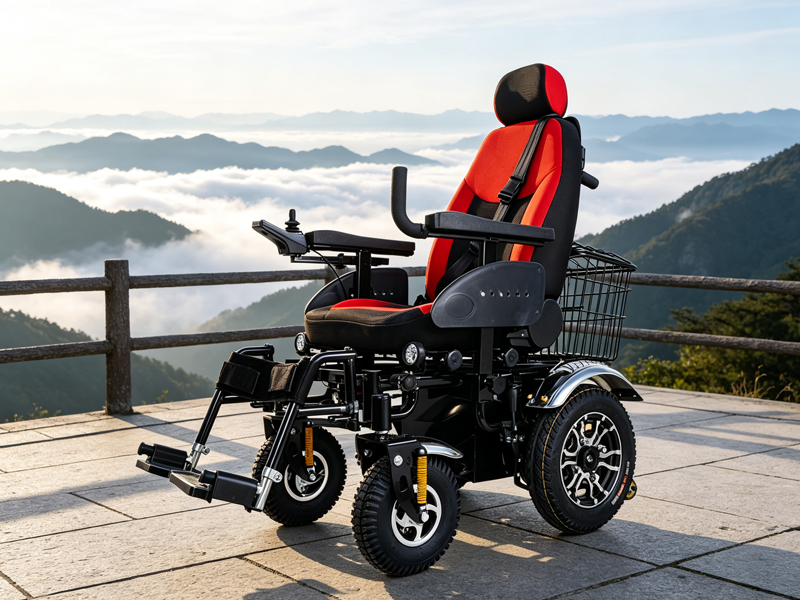
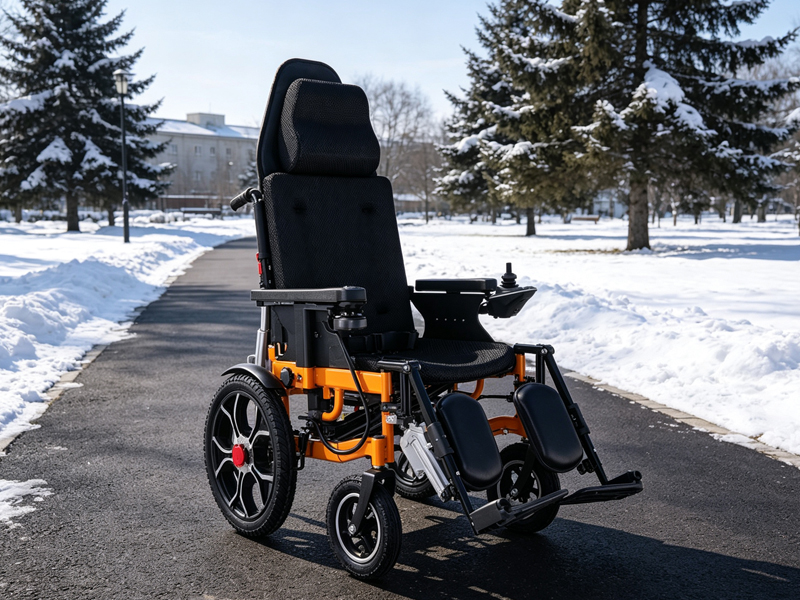
The Iyasocare YSE101 Heavy Power Wheelchair is designed for users who require a more substantial powered mobility solution.
Its reinforced steel frame, dual 350W motors, off-road wheel configuration, and reclining seating system distinguish it from compact foldable electric wheelchairs.
For healthcare providers supporting users with greater weight requirements or those who frequently travel across uneven outdoor surfaces, these specifications deserve close attention.
The most significant specification of the YSE101 is its maximum load capacity of 200 kg.
This is considerably higher than the YSE118’s 130 kg capacity.
The YSE101 uses a reinforced steel frame designed to provide structural support for its higher-capacity powered wheelchair configuration.
For healthcare organizations, this creates additional flexibility when selecting mobility equipment for users who require a higher-rated load capacity.
It is important to distinguish between a manufacturer’s stated load capacity and a formal bariatric or regulatory classification. Buyers should confirm the applicable certification, documentation, and intended-use requirements before procurement.
The YSE101 is powered by two 350W motors operating on a 24V system.
Compared with the YSE118’s dual 250W motors, the YSE101 provides a higher motor power specification.
This configuration is intended to support more demanding outdoor mobility applications, including ramps, slopes, and uneven pathways.
The manufacturer lists a climbing ability of up to 15 degrees and an obstacle-crossing capability of approximately 10 cm.
These specifications are particularly relevant to users who need to travel beyond smooth indoor flooring.
For example, a user may need to move across an outdoor walkway, navigate a sloped entrance, or travel along an uneven paved surface.
The YSE101’s motor configuration and off-road wheel design are intended to provide greater capability in these situations.
Actual obstacle clearance and climbing performance should always be verified under the relevant operating conditions. Healthcare providers should also observe manufacturer guidance regarding slopes, obstacle height, and safe operation.
Wheel configuration plays an important role in powered wheelchair performance.
The YSE101 features 14-inch rear wheels and 10-inch front wheels.
Its off-road wheel setup is designed to improve traction and ground contact when traveling across uneven surfaces.
This makes the model worth considering for users whose daily mobility extends beyond indoor corridors and smooth floors.
For healthcare providers, the distinction matters because a wheelchair’s intended operating environment should influence the purchasing decision.
A facility that mainly operates indoors may have different priorities from a home healthcare provider serving patients in suburban or rural areas.
The YSE101 is more appropriate to consider when outdoor terrain and higher load capacity are important factors.
Comfort is another major part of the YSE101’s design.
The wheelchair features a reclining seat that can adjust to a maximum of 180 degrees, allowing the user to adopt a fully reclined position.
This offers additional flexibility for resting during longer outings and daily mobility activities.
Its seat width and depth are both listed as 45 cm, while the backrest height is 78 cm.
The seat height is 56 cm, which should be considered when evaluating transfer requirements.
For healthcare professionals, reclining functionality may be useful when a patient needs a different resting position during periods of extended wheelchair use.
Nevertheless, a fully reclining position is not automatically appropriate for every patient.
Postural support, pressure management, respiratory considerations, and individual clinical needs should be assessed before use.
Braking performance is particularly important for powered wheelchairs used on sloped surfaces.
The YSE101 incorporates an intelligent electronic braking system and an electromagnetic parking brake.
Its anti-slip and anti-rollback design is intended to help prevent unintended backward movement when stopping on inclines.
The model also features a low-speed starting function.
For elderly users and individuals who are new to electric wheelchairs, controlled acceleration can make operation more predictable.
Additional equipment includes a safety belt and a standard USB charging port.
Optional accessories, such as a storage basket, can provide additional convenience depending on the user’s requirements.
Healthcare providers should still conduct an initial user assessment and practical operation training before allowing independent use.
Battery performance is another reason to consider the YSE101.
The manufacturer lists a driving range of approximately 30–60 km and a charging time of 6–8 hours.
This range is designed to support extended daily mobility with fewer charging interruptions.
Actual range will vary depending on user weight, terrain, driving speed, temperature, battery condition, and other operating factors.
For care providers planning longer outdoor journeys, the stated range offers a useful starting point for evaluating whether the model fits their mobility requirements.
The YSE101 is worth considering for:
Its combination of a reinforced steel frame, dual 350W motors, off-road wheels, and reclining seat makes it a more substantial outdoor-oriented mobility solution than a compact foldable wheelchair.
Although both models use steel frame construction and powered mobility systems, they are designed around different priorities.
The YSE118 emphasizes foldability, everyday convenience, and transportation flexibility.
The YSE101 focuses more on higher load capacity, outdoor performance, and additional seating flexibility.
The following comparison highlights their main specifications.
| Specifications | YSE118 | YSE101 |
|---|---|---|
| Frame material | Steel | Reinforced steel |
| Maximum load | 130 kg | 200 kg |
| Motor | 250W × 2 | 350W × 2 |
| Battery | 24V 12Ah lead-acid | 24V system |
| Maximum speed | 6 km/h | Confirm with manufacturer |
| Driving range | Up to 15 km | Approximately 30–60 km |
| Charging time | 4–6 hours | 6–8 hours |
| Seat width | 45 cm | 45 cm |
| Seat depth | 47 cm | 45 cm |
| Backrest | Adjustable high/low | Reclines up to 180° |
| Rear wheels | 16 inches | 14 inches |
| Front wheels | 10 inches | 10 inches |
| Folding design | Yes | Confirm with manufacturer |
| Climbing ability | Up to 15° | Up to 15° |
| Additional features | Flip-up armrests, manual mode, shock absorption | Anti-rollback design, safety belt, USB port |
Specifications are based on the manufacturer’s published product information. Buyers should confirm the latest configuration, battery options, accessories, and applicable certifications before ordering.
If your organization frequently transports wheelchairs between locations, the YSE118 is the more practical choice to investigate.
Its compact folding dimensions, adjustable backrest, and flip-up armrests make it suitable for users who need an electric wheelchair that can also be transported conveniently.
It is especially relevant to home healthcare providers and rehabilitation services where storage space and vehicle transportation are important considerations.
If the primary concern is a higher maximum user weight, stronger motor specifications, and more demanding outdoor mobility, the YSE101 deserves priority.
Its 200 kg load capacity provides a higher rated limit, while its reinforced steel frame and dual 350W motors support its intended heavy-power application.
The reclining seat and anti-rollback features also add practical value for users who need more flexibility during daily mobility.
Ultimately, the better wheelchair is not necessarily the one with the largest motor or highest load capacity. It is the one that meets the user’s actual mobility needs without introducing unnecessary complexity.
Purchasing mobility equipment for a healthcare organization involves more than comparing product specifications.
A hospital, nursing home, rehabilitation center, or medical equipment distributor may need several different wheelchair configurations to support different users.
A practical procurement strategy should begin with an assessment of the people who will use the equipment.
Understand the user population.
Review typical user weight ranges, seating requirements, mobility limitations, and transfer needs. This helps determine whether standard powered wheelchairs, foldable models, or higher-capacity options are required.
Separate indoor and outdoor applications.
Not every wheelchair needs off-road capabilities. For users who primarily travel through indoor corridors, a convenient and compact design may be more appropriate.
For individuals who regularly travel outdoors, wheel configuration, suspension, braking, and motor performance deserve greater attention.
Consider the total cost of ownership.
The initial purchase price is only one part of the overall investment.
Battery replacement, tire maintenance, component availability, service support, and equipment downtime can all affect long-term operating costs.
Healthcare organizations should ask suppliers about spare parts, warranty coverage, maintenance documentation, and after-sales service arrangements.
Evaluate cleaning and maintenance requirements.
Shared mobility equipment should be maintained according to the manufacturer’s cleaning and disinfection instructions.
Healthcare providers should establish inspection procedures covering the frame, upholstery, wheels, tires, brakes, controller, battery, and electrical connections.
Any damaged component should be assessed before the wheelchair returns to service.
Request product documentation.
Before purchasing, ask the supplier for technical specifications, user manuals, applicable conformity documentation, warranty information, and details of available accessories.
Where regulatory compliance is required, verify the relevant documentation for the destination market rather than assuming that a product’s general description establishes compliance.
A well-planned purchasing process helps organizations select equipment based on real operational needs rather than marketing descriptions alone.
Choosing a wheelchair supplier is an important part of the procurement process.
Healthcare providers and medical equipment distributors need more than a product that looks suitable in a catalog. They also need clear specifications, reliable communication, appropriate product recommendations, and access to technical information.
Iyasocare offers different electric wheelchair configurations to address different mobility requirements.
The YSE118 provides a foldable powered mobility option for users who value transportation convenience and adjustable seating.
The YSE101 offers a higher-capacity alternative with a reinforced steel frame, stronger dual motors, off-road wheels, and reclining functionality.
Having access to both configurations allows buyers to compare solutions based on intended use instead of treating every wheelchair as interchangeable.
For distributors, medical equipment wholesalers, rehabilitation organizations, and healthcare procurement teams, it is worthwhile to discuss specific purchasing requirements directly with the supplier.
Before placing an order, consider confirming:
These details can help buyers make more informed decisions and establish a clearer procurement plan.
Heavy duty steel frame wheelchairs remain an important part of modern healthcare mobility solutions.
Their value comes from more than frame construction. A suitable wheelchair must combine structural support, appropriate weight capacity, comfortable seating, dependable braking, and practical operation.
For healthcare providers seeking a foldable electric wheelchair for everyday mobility, the Iyasocare YSE118 offers a useful combination of steel frame construction, adjustable backrest, dual 250W motors, pneumatic tires, and compact folding dimensions.
For users who need a higher load capacity and stronger outdoor mobility capabilities, the Iyasocare YSE101 provides a different solution, featuring a reinforced steel frame, a maximum load of 200 kg, dual 350W motors, off-road wheels, and a 180-degree reclining seat.
Neither model is universally better than the other. The right choice depends on user weight, mobility environment, seating requirements, transportation needs, and clinical suitability.
For healthcare organizations, the most effective purchasing decision is one that balances safety, comfort, usability, and long-term value.
Explore the Iyasocare wheelchair range and contact the team to discuss the right mobility solution for your healthcare or distribution requirements.
1. What Are the Benefits of Heavy Duty Steel Frame Wheelchairs for Healthcare Providers?
Heavy duty steel frame wheelchairs offer a practical combination of structural strength, stability, and adaptable design. They can support different mobility configurations and are suitable for various healthcare applications when their specifications match the user’s needs.
For healthcare providers, important advantages include reinforced frame options, practical maintenance, and compatibility with powered mobility systems. However, buyers should always verify the manufacturer’s maximum load capacity rather than assuming that every steel wheelchair is suitable for bariatric use.
2. What Is the Difference Between the Iyasocare YSE118 and YSE101 Electric Wheelchairs?
The main differences are load capacity, motor power, folding convenience, and intended operating environments.
The YSE118 has a maximum load capacity of 130 kg, dual 250W motors, a 15 km stated driving range, and a foldable design. It is suitable for users who prioritize convenient transportation, everyday mobility, and adjustable backrest support.
The YSE101 supports up to 200 kg, features dual 350W motors, offers a stated driving range of approximately 30–60 km, and includes off-road wheels and a 180-degree reclining seat.
In short, the YSE118 focuses on convenience and portability, while the YSE101 emphasizes higher load capacity and outdoor mobility.
3. How Should Healthcare Providers Choose the Right Heavy Duty Electric Wheelchair?
Healthcare providers should evaluate several factors before purchasing:
For users who require a foldable wheelchair for everyday mobility, the YSE118 is worth considering. For those who need a higher load capacity and more demanding outdoor performance, the YSE101 may be the more appropriate option.
The final selection should always be based on the user’s individual requirements and a professional mobility assessment.