Our Location
Free Trade Tower, Xiyong street.
Chongqing, China

Free Trade Tower, Xiyong street.
Chongqing, China
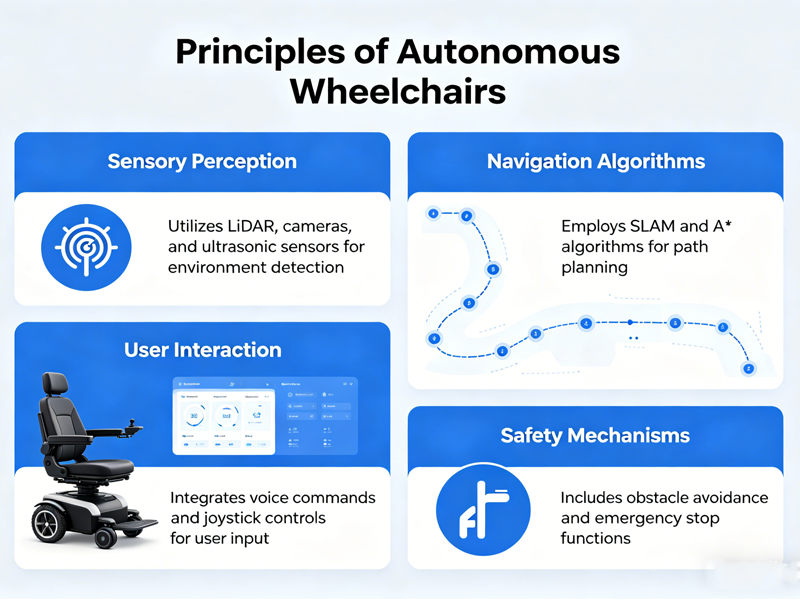
Mobility is more than movement—it’s autonomy, dignity, and connection to the world. Over the past decade, autonomous wheelchair technology has shifted from research labs into real-world environments, quietly transforming how people with mobility impairments navigate daily life. Yet behind the sleek designs and intuitive interfaces lies a sophisticated interplay of robotics, artificial intelligence, sensor fusion, and human-centered design.
Autonomous wheelchairs exist on a spectrum. At one end are assistive systems—they enhance user input, helping avoid collisions or smooth navigation. At the other end are fully autonomous systems, capable of navigating complex environments with minimal or no user control.
The distinction matters because most real-world deployments today fall somewhere in between. Users are not replaced by the machine—they are empowered by it. This hybrid philosophy defines the design principles of modern systems.
Every autonomous wheelchair begins with perception. Without understanding its surroundings, navigation is impossible.
Typical systems rely on a combination of:
But raw data alone isn’t useful. The real magic happens in sensor fusion, where inputs from multiple sensors are combined to create a coherent model of the environment.
Imagine entering a crowded hospital hallway. A camera identifies people, LiDAR maps distances, and ultrasonic sensors detect nearby objects. Together, they allow the wheelchair to “understand” both static obstacles (walls, furniture) and dynamic ones (people walking).
This layered perception is what enables safe and responsive navigation.
Perception answers “What’s around me?”
Localization answers “Where am I?”
Autonomous wheelchairs rely on techniques such as:
SLAM is particularly important indoors, where GPS signals are unreliable. It allows the wheelchair to build a map while simultaneously determining its position within that map.
This is critical in environments like airports, malls, or rehabilitation centers—places where users need reliable navigation without external infrastructure.
Once the system understands its environment and location, it must decide how to move.
Path planning operates on two levels:
Global planning
Local planning
Advanced algorithms consider:
A well-designed wheelchair doesn’t just find the shortest path—it finds the most appropriate path for the user.
Once a path is defined, the wheelchair must execute it smoothly and safely.
Control systems handle:
Modern systems often use feedback loops, constantly adjusting based on sensor input. If an obstacle suddenly appears, the wheelchair can slow down or reroute instantly.
The goal is not just accuracy—but predictability. Users need to trust how the chair will behave.
Technology alone is not enough. Autonomous wheelchairs must be usable, intuitive, and adaptable.
Interfaces vary widely:
The key principle here is adaptability. Users have different physical and cognitive abilities, and the system must adjust accordingly.
For example:
Good design minimizes cognitive load. The system should feel like a natural extension of the user—not a complicated machine.
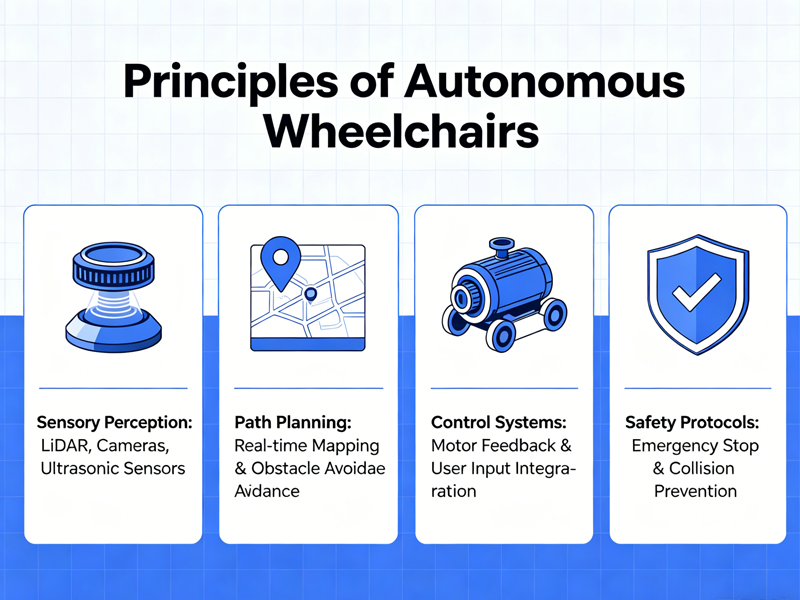
Safety is not a feature—it’s the foundation.
Autonomous wheelchairs must operate in unpredictable environments filled with people, obstacles, and changing conditions. Key safety principles include:
Regulatory standards are still evolving, but real-world deployment demands rigorous testing. Unlike industrial robots, these devices operate in close proximity to humans—often in sensitive environments like hospitals or homes.
Artificial intelligence is increasingly central to autonomous wheelchairs.
Machine learning enables:
Over time, a wheelchair can adapt to its user:
This personalization is what transforms a device into a companion.
Autonomous wheelchairs are not isolated systems. Increasingly, they are part of a broader ecosystem.
Integration with:
allows for enhanced functionality.
For example, a wheelchair could:
This connectivity expands autonomy beyond movement—it enables participation in daily life.
As with any autonomous system, there are deeper questions.
There’s also a social dimension. Autonomous wheelchairs challenge traditional perceptions of disability—not as limitation, but as an opportunity for technological empowerment.
Designing these systems requires not just engineering skill, but empathy and ethical awareness.
Despite rapid progress, several challenges remain:
Perhaps the biggest challenge is not technological—but practical. Systems must work reliably in messy, unpredictable, real-world conditions—not just controlled environments.
The future of autonomous wheelchairs is not just about better navigation—it’s about integration into daily life.
We can expect:
Ultimately, the goal is simple: to give users more control over where they go, how they move, and how they live.
Autonomous wheelchairs represent a convergence of engineering, design, and human need. They are not just machines—they are mobility solutions shaped by empathy and innovation.
The principles behind them—perception, localization, planning, control, and human interaction—are not just technical building blocks. They are the foundation of independence for millions of people worldwide.
And as technology evolves, so too will the definition of mobility itself.
1. What makes an autonomous wheelchair different from a traditional powered wheelchair?
An autonomous wheelchair goes beyond user-controlled movement. It uses sensors, AI, and navigation algorithms to assist or fully manage movement, enabling safer and more independent mobility, especially in complex environments.
2. Are autonomous wheelchairs safe to use in crowded public spaces?
Modern systems are designed with multiple safety layers, including obstacle detection, real-time path adjustment, and emergency stop features. While not perfect, they are increasingly reliable in dynamic environments like hospitals and airports.
3. Will autonomous wheelchairs replace human control entirely?
Unlikely. Most designs prioritize a hybrid approach, where users remain in control while the system provides intelligent assistance. This balance ensures both safety and user autonomy.