Our Location
Free Trade Tower, Xiyong street.
Chongqing, China

Free Trade Tower, Xiyong street.
Chongqing, China

As people grow older, everyday activities that once seemed effortless can gradually become more challenging. Bathing is a good example. Reduced muscle strength, limited joint movement, poor balance, and age-related mobility problems can make stepping into a shower or standing for several minutes increasingly difficult. For older adults who rely on wheelchairs or caregiver assistance, even a simple shower can become a physically demanding and potentially risky experience.
This is where a high-quality shower wheelchair for elderly care makes a meaningful difference.
Unlike an ordinary wheelchair, a shower wheelchair is designed to support personal hygiene in wet environments. It allows users to remain seated while being moved into an appropriate bathroom area, reducing unnecessary standing and transfers. Depending on its design, it may also provide commode functionality, making toileting and bathing more convenient within a single care routine.
However, not every wheelchair with wheels is suitable for shower use. A product that looks comfortable in a showroom may become difficult to manage when exposed to water, soap, slippery flooring, and frequent cleaning. For families, nursing homes, rehabilitation centers, and medical equipment distributors, choosing the right model requires looking beyond appearance and price.
So, what actually makes a shower wheelchair suitable for elderly care? The answer involves several important factors: material quality, structural stability, braking performance, seating comfort, hygiene, maneuverability, and practical functionality.
Bathing is not simply about cleanliness. It is also closely connected to comfort, dignity, independence, and overall quality of life.
For an elderly person with reduced mobility, walking from the bedroom to the bathroom may already require assistance. Standing under running water introduces additional challenges. Wet floors can increase the likelihood of slipping, while bending, turning, or reaching for bathing products may place extra pressure on the user’s joints and muscles.
A conventional wheelchair is generally designed for everyday mobility rather than direct exposure to shower water. Its upholstery, mechanical components, cushions, and frame may not be intended for repeated wet use. Moving someone from a regular wheelchair to a separate shower chair can also involve additional transfers, which may be uncomfortable or difficult for both the user and caregiver.
A properly designed shower wheelchair helps simplify this process.
Depending on the model and bathroom layout, it can support movement between different care areas, provide a stable seated position during bathing, and reduce the number of transfers required throughout the day.
For caregivers, this can mean a more organized bathing routine and less unnecessary physical handling. For elderly users, it offers an opportunity to participate more comfortably in personal hygiene.
The benefits are particularly relevant for:
It is important to remember that a shower wheelchair is not a complete substitute for bathroom safety measures. Proper supervision, suitable grab bars, accessible shower entrances, appropriate drainage, and a well-planned bathing area remain essential.
A good shower wheelchair should solve real problems rather than simply combine a seat and four wheels. When evaluating a product, the following seven characteristics deserve particular attention.
The frame is the foundation of any wheelchair. In a shower environment, its importance becomes even greater.
Bathroom equipment is regularly exposed to moisture, cleaning products, soap residue, and temperature changes. Materials that perform well in a dry indoor environment may deteriorate more quickly when exposed to these conditions.
Aluminum alloy is a popular choice for lightweight shower and commode wheelchairs because it offers a practical balance between strength, weight, and corrosion resistance.
A well-designed aluminum frame can make the wheelchair easier for caregivers to move, fold, and store. It can also help reduce the physical effort involved in transporting the chair between rooms.
However, choosing aluminum does not automatically guarantee long-term durability. Frame construction, welding quality, surface treatment, connection points, and hardware materials all matter.
Before purchasing, buyers should check whether the manufacturer provides clear information about the frame material, recommended load capacity, and maintenance requirements.
For institutional buyers, requesting relevant product testing documentation is also worthwhile.
A shower wheelchair must remain securely positioned during bathing and transfers.
Unlike ordinary indoor mobility, bathroom movement often takes place on wet or damp surfaces. Even a small amount of unwanted movement can create problems when a user is sitting down, standing up, or being assisted.
For this reason, reliable brakes are among the most important features to examine.
Ideally, each wheel should have an effective locking mechanism that is easy for caregivers to operate. Before use, all brakes should be checked to ensure the chair cannot roll unexpectedly.
Wheel size and configuration also influence maneuverability.
Smaller caster wheels can make it easier to navigate narrow bathroom entrances, compact shower spaces, and tight corners. Larger wheels may be more appropriate for ordinary wheelchair movement across longer distances.
There is no universally perfect wheel configuration. The right choice depends on whether the wheelchair is intended primarily for bathroom use, general mobility, or both.
It is also important to distinguish between a wheelchair that can be used in a shower and one that is suitable for every type of wet-floor condition. Users should never assume that locked wheels alone guarantee stability on slippery surfaces.
Comfort is often underestimated when selecting a shower wheelchair.
Some elderly users may remain seated for longer than expected because bathing, drying, dressing, and personal care can take considerable time. A poorly designed seat may cause discomfort, increase pressure on sensitive areas, or make it difficult to maintain a natural sitting posture.
Three measurements are especially important:
A seat that is too high may make transfers uncomfortable, while one that is too low can make standing assistance more difficult.
The seat surface also deserves attention. It should be comfortable, easy to clean, and appropriate for the intended bathing environment.
For commode shower wheelchairs, the opening should be positioned correctly so that it supports practical toileting without compromising the user’s sitting stability.
Buyers should always check the actual dimensions rather than assuming that one standard size will suit every elderly person.
Hygiene is a major consideration in elderly care, particularly when the same wheelchair is used frequently.
Water, body fluids, soap, and cleaning products can accumulate around the seat, frame connections, wheels, and commode components. If these areas are difficult to reach, routine cleaning may become unnecessarily time-consuming.
A high-quality shower wheelchair should therefore have a practical, easy-to-maintain design.
Useful features include:
A detachable commode bucket is particularly useful because it allows caregivers to remove and clean the container separately.
However, waterproof construction should not be confused with unlimited resistance to water exposure. Buyers should confirm the manufacturer’s intended usage conditions, especially regarding prolonged immersion, cleaning chemicals, and maintenance.
For nursing homes and healthcare facilities, establishing a consistent cleaning and disinfection procedure is just as important as choosing the right equipment.
Many elderly people need assistance with more than one daily activity.
They may require a wheelchair for indoor mobility, a commode chair for toileting, and a shower chair for bathing. Using three separate products can occupy valuable storage space and increase the number of transfers required throughout the day.
This explains the growing interest in multifunctional shower commode wheelchairs.
A 3-in-1 design combines several related functions into one piece of equipment. Depending on its specifications, it can be used as a manual wheelchair, a commode chair, and a shower chair.
For home caregivers, this arrangement can make daily routines easier to organize. For care facilities, it may help simplify equipment storage and management.
Nevertheless, multifunctionality should never come at the expense of safety.
The chair must be suitable for the user’s body size, mobility level, transfer requirements, and bathroom layout. Each function should be evaluated individually before purchase.
Space is a practical issue in many homes and care facilities.
Bathrooms are often designed around standard household needs rather than wheelchair access. A large, permanently assembled chair may be difficult to store, transport, or move between rooms.
A folding shower wheelchair can help address this challenge.
When folded, it takes up less storage space and may be easier to transport in a suitable vehicle. This is particularly useful for families who provide care at home or need to take mobility equipment when traveling.
However, the folding mechanism should be straightforward and secure. Caregivers should be able to operate it without excessive force, and all locking components should be checked before the chair is used.
Portability should also be considered alongside product weight. A lightweight wheelchair is easier to handle, but it must still provide sufficient structural strength and support for its intended user.
The quality of a shower wheelchair should be evaluated from both the user’s and caregiver’s perspectives.
For an elderly person, adjustable armrests and detachable footrests may improve sitting comfort and provide additional flexibility during transfers.
For caregivers, these features can make it easier to position the chair and assist the user.
A well-designed product should also provide accessible brake controls, a manageable frame structure, and components that are simple to remove and reinstall.
One important point: a standard shower wheelchair should not automatically be treated as a dedicated patient transfer lift. If the user cannot safely support their own body during transfers, additional equipment or trained assistance may be required.
Before purchasing, caregivers should consider how the user will get onto the chair, how the chair will enter the bathroom, and how the user will be transferred out after bathing.
These practical details often determine whether a wheelchair is genuinely useful in daily care.
Understanding product specifications is easier when comparing real equipment.
IYASOCARE offers different wheelchair configurations for elderly users, home-care environments, and rehabilitation applications. Two models worth examining are the 3-in-1 Folding Wheelchair and the Aluminum Folding Manual Wheelchair YSM2057.
Although both feature folding aluminum structures and commode-related functionality, they are designed with somewhat different priorities.
Product: IYASOCARE 3-in-1 Folding Wheelchair with Commode & Shower Function
For families or healthcare providers looking for a multifunctional shower wheelchair for elderly care, the IYASOCARE 3-in-1 Folding Wheelchair is a particularly relevant option.
Its main advantage is the combination of three functions: manual wheelchair mobility, commode use, and shower seating.
Instead of requiring separate equipment for each activity, the chair is designed to support several everyday personal-care tasks within one integrated structure.
This approach can be useful in smaller homes, assisted-living environments, and rehabilitation settings where storage space and caregiver efficiency are important considerations.
Product specifications at a glance
| Specification | Details |
|---|---|
| Model | YSM2007 |
| Frame material | Aluminum |
| Product dimensions | 100 × 54 × 93 cm |
| Folded dimensions | 81 × 26 × 86 cm |
| Seat width | 41 cm |
| Seat depth | 41 cm |
| Seat height | 47 cm |
| Net weight | 13 kg |
| Maximum stated load | 100 kg |
| Armrests | Adjustable leather armrests |
| Footrests | Detachable |
| Wheels | Four small wheels with individual brakes |
| Commode | Detachable bucket |
| Package dimensions | 67 × 60 × 66 cm |
Specifications are based on the published product information. Confirm the latest configuration with the manufacturer before ordering.
What makes this model stand out?
Three functions in one design
The most noticeable feature is its 3-in-1 configuration.
The chair can serve as a manual wheelchair, a commode chair, and a shower chair. This gives caregivers more flexibility when organizing daily routines.
For example, an elderly person may use the wheelchair for indoor movement, the commode function when toileting assistance is needed, and the shower function during personal hygiene routines.
Reducing unnecessary movement between different chairs can make care more manageable, provided the user’s transfer needs and the bathroom layout are suitable.
Lightweight aluminum frame
With a published net weight of 13 kg, the YSM2007 is relatively easy to handle compared with many heavier mobility products.
Its aluminum frame also provides a practical balance between portability and structural support.
For caregivers who regularly move equipment between bedrooms, bathrooms, and storage areas, this can be a meaningful advantage.
Independent wheel brakes for better positioning
The model features four small wheels with individual brakes.
This compact wheel configuration is designed for maneuverability in indoor environments, while the independent braking arrangement helps caregivers secure the chair during appropriate stationary tasks.
As with any shower wheelchair, the brakes should be checked before every use, particularly on wet flooring.
Adjustable armrests and detachable footrests
The adjustable leather armrests provide flexibility when positioning the user.
The detachable footrests can also be removed when additional access is needed during certain transfers or care procedures.
These features are particularly relevant for elderly users who require assistance getting seated or repositioned.
Compact folding dimensions
The wheelchair folds to approximately 81 × 26 × 86 cm.
This makes storage more convenient in homes with limited space and can simplify transportation when suitable vehicle storage is available.
Who should consider this model?
The YSM2007 is worth considering for:
Its 41 cm seat width and 100 kg stated load capacity should be checked against the individual user’s measurements and requirements.
It is also important to confirm the manufacturer’s instructions for direct shower use, including cleaning, drying, and maintenance procedures.
For buyers who prioritize multifunctionality and compact storage, this model offers a practical combination of features.
Product: IYASOCARE Aluminum Folding Manual Wheelchair YSM2057 with Commode
Not every elderly user needs the same type of shower wheelchair.
Some people spend more time in their wheelchair during the day and only occasionally require assistance with toileting or personal hygiene. In these situations, a lightweight manual wheelchair with an integrated commode may be a more appropriate choice.
The IYASOCARE YSM2057 is designed around this type of everyday care requirement.
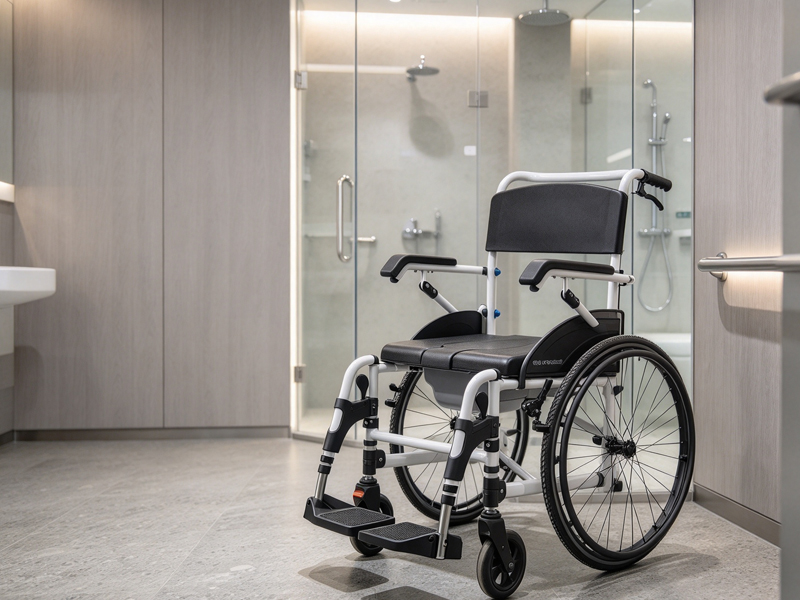
It combines a folding aluminum frame, a cushioned seat, PU wheels, and a removable bedpan. Its design focuses on daily mobility, convenient toileting, and manageable transportation.
Product specifications at a glance
| Specification | Details |
|---|---|
| Model | YSM2057 |
| Frame material | Aluminum |
| Product dimensions | 91 × 57 × 90 cm |
| Folded dimensions | 91 × 25 × 70 cm |
| Front wheel diameter | 6 inches |
| Rear wheel diameter | 20 inches |
| Backrest height | 40 cm |
| Net weight | 13 kg |
| Recommended load capacity | 100 kg |
| Seat | Sofa-style cushioned seat |
| Commode | Integrated opening with removable bedpan |
| Toilet opening | 26 × 22 cm |
| Bedpan dimensions | 26 × 15 × 37 cm |
| Package dimensions | 71 × 29 × 70 cm |
| Packing weight | 14 kg |
Why is the YSM2057 worth considering?
A lightweight structure for easier handling
The YSM2057 weighs approximately 13 kg net.
This is useful for caregivers who need to fold, move, or transport the wheelchair regularly.
Its aluminum frame helps keep the weight manageable while providing the structure needed for its stated 100 kg load capacity.
For families who frequently move mobility equipment between different rooms or transport it by car, a manageable product weight can make everyday handling less demanding.
A comfortable cushioned seat
One of the model’s practical features is its sofa-style cushion.
Compared with a basic hard seat, cushioning can provide a more comfortable sitting experience during everyday use.
The chair also has a 40 cm backrest height, offering support for the upper body while maintaining a relatively compact overall structure.
For elderly users who spend extended periods sitting, comfort should be considered alongside seat dimensions, posture, and individual pressure-management needs.
Integrated commode with removable bedpan
The YSM2057 includes a toilet opening measuring 26 × 22 cm and a removable bedpan measuring 26 × 15 × 37 cm.
This arrangement can be especially useful for elderly people who have difficulty walking to the bathroom or transferring repeatedly between mobility equipment and a separate commode.
Caregivers can remove the bedpan for separate cleaning, helping make routine hygiene management more straightforward.
It is a practical feature for home-care environments where bathroom accessibility may be limited.
PU wheels for smoother everyday movement
The wheelchair uses 6-inch front wheels and 20-inch rear wheels.
Its PU wheels are designed to provide shock absorption and smoother movement across suitable indoor and light outdoor surfaces.
The larger rear wheels also support practical maneuverability during ordinary wheelchair use.
However, buyers should note that the YSM2057 is primarily presented as a folding manual wheelchair with commode functionality. It should not automatically be considered a dedicated shower wheelchair simply because it has a waterproof and easy-clean design.
If frequent direct shower use is required, confirm the manufacturer’s approval for that application before purchasing.
Convenient folding and storage
The folded dimensions are approximately 91 × 25 × 70 cm.
This compact profile can make the wheelchair easier to store in a bedroom, care facility, or vehicle.
For families with limited storage space, this is a useful advantage.
Who is the YSM2057 suitable for?
This model may be a good option for:
The YSM2057 is particularly relevant when daily mobility and convenient toileting are the main priorities.
If bathing directly in the chair is an essential requirement, buyers should first confirm whether the intended shower environment and cleaning procedures are supported by the manufacturer.
Both IYASOCARE models have a published net weight of 13 kg, use aluminum frames, and provide a stated load capacity of 100 kg.
However, their configurations serve slightly different purposes.
| Comparison | 3-in-1 YSM2007 | YSM2057 |
|---|---|---|
| Main design | Multifunctional care wheelchair | Folding manual wheelchair with commode |
| Shower function | Specifically listed | Confirm with manufacturer |
| Commode function | Detachable bucket | Removable bedpan |
| Seat | 41 × 41 cm | Cushioned seat |
| Seat height | 47 cm | Confirm current specification |
| Wheel configuration | Four small wheels | 6-inch front, 20-inch rear |
| Armrests | Adjustable | See current configuration |
| Footrests | Detachable | See current configuration |
| Net weight | 13 kg | 13 kg |
| Stated load capacity | 100 kg | 100 kg |
The YSM2007 is the more direct option for buyers specifically searching for a folding shower commode wheelchair. Its combination of shower, toileting, and wheelchair functions makes it particularly relevant to assisted bathing routines.
The YSM2057, on the other hand, is a practical choice for people who prioritize everyday mobility, a cushioned seat, integrated toileting support, and easy transportation.
Neither model should be selected based on specifications alone. The user’s body measurements, transfer ability, bathroom configuration, and level of caregiver assistance should all be considered.
A product can have excellent specifications and still be unsuitable for a particular user.
Before making a purchasing decision, families and professional buyers should work through a few practical questions.
First, understand the user’s mobility level.
Can the person sit independently? Can they support their upper body? Do they need help with every transfer, or can they move between seats with limited assistance?
These questions determine whether a basic shower wheelchair is sufficient or whether additional transfer equipment and professional assistance are necessary.
Second, measure the bathroom carefully.
Check the width of the bathroom door, shower entrance, available turning space, and distance between the toilet and bathing area.
A wheelchair that fits comfortably in a bedroom may not fit through a narrow bathroom doorway.
Also consider whether the shower has a raised threshold. A wheeled shower chair cannot safely overcome every type of step or curb.
Third, check the user’s weight and body dimensions.
Never choose a wheelchair based solely on its advertised weight capacity.
Seat width, depth, height, armrest position, and foot support all influence comfort and safety.
For heavier users or people with specific postural needs, a more specialized wheelchair may be required.
Fourth, consider how frequently the chair will be used.
A family that uses the chair occasionally may prioritize easy folding and storage. A nursing home that uses it several times a day may place greater emphasis on cleaning efficiency, structural durability, and replacement-part availability.
Finally, evaluate the supplier.
A professional manufacturer should provide clear product specifications, operating instructions, cleaning guidance, load-capacity information, and support for product-related questions.
For distributors and healthcare equipment retailers, it is also sensible to confirm customization options, packaging details, minimum order quantities, and delivery arrangements before placing an order.
Even the best shower wheelchair cannot compensate for a poorly designed bathroom.
A safe bathing environment should be planned around the user’s mobility and the caregiver’s working space.
Several improvements can make a meaningful difference:
Bathroom layout is especially important when using a wheeled shower commode chair. Caregivers need sufficient room to position the wheelchair, operate the brakes, and assist the user without awkward movements.
The U.S. Access Board’s accessibility guidance also emphasizes appropriate shower-seat dimensions, positioning, and structural support. Its recommendations provide a useful reference when planning accessible bathing spaces.
Most importantly, caregivers should follow the wheelchair manufacturer’s operating instructions. Before every bathing session, check the brakes, inspect the frame, confirm that removable components are securely installed, and ensure that the user is properly positioned.
Never leave a person who requires assistance unattended simply because they are seated in a shower wheelchair.
When purchasing elderly-care equipment, it is tempting to focus primarily on the initial price.
However, the real value of a shower wheelchair is determined by how well it performs over time.
A product that is difficult to clean, uncomfortable to use, or inconvenient to move may create additional work for caregivers. A poorly matched seat or unsuitable wheel configuration may also reduce the user’s willingness to use the equipment.
By contrast, a properly selected wheelchair can support a more consistent bathing routine, improve convenience, and reduce unnecessary transfers.
For healthcare facilities, product selection also affects staff workflows, equipment maintenance, and storage requirements.
For distributors, offering more than one wheelchair configuration makes it easier to serve different customer groups. Some buyers need a dedicated multifunctional shower commode wheelchair, while others are primarily looking for a lightweight manual wheelchair with integrated toileting support.
This is why understanding the differences between products matters as much as understanding their specifications.
IYASOCARE’s YSM2007 and YSM2057 illustrate two practical approaches to elderly mobility and personal care. One focuses on combining wheelchair, shower, and commode functions, while the other emphasizes everyday mobility, cushioned seating, and convenient toileting.
The better choice depends on the intended application rather than simply which model has more features.
A high-quality shower wheelchair for elderly care should do more than provide a place to sit. It should make bathing more manageable, support appropriate positioning, simplify cleaning, and offer practical convenience for both users and caregivers.
The most important features to consider are a durable frame, reliable brakes, suitable seat dimensions, easy-clean materials, practical functionality, convenient folding, and caregiver-friendly operation.
For buyers who need a multifunctional solution for bathing and toileting, the IYASOCARE 3-in-1 Folding Wheelchair (YSM2007) is worth considering.
For users who prioritize everyday manual mobility, comfortable cushioning, and integrated commode support, the IYASOCARE Aluminum Folding Manual Wheelchair YSM2057 offers another practical option.
Ultimately, the right wheelchair is the one that matches the user’s physical needs, the caregiver’s routine, and the actual bathroom environment.
Good elderly care is not about adding more equipment. It is about choosing equipment that makes everyday life safer, more comfortable, and easier to manage.
Frequently Asked Questions
1. What is the difference between a regular wheelchair and a shower wheelchair for elderly people?
A regular wheelchair is primarily designed for everyday mobility, while a shower wheelchair is specifically designed for personal hygiene activities in wet environments.
A shower wheelchair generally uses materials and components selected for easier cleaning and moisture exposure. Depending on the model, it may also include a commode opening, removable bucket, compact wheels, and individual locking brakes.
A regular wheelchair should not be used directly in the shower unless its manufacturer specifically confirms that it is suitable for wet-environment use.
2. What features should I look for when buying a shower wheelchair for an elderly person?
The most important features include a strong corrosion-resistant frame, reliable locking brakes, comfortable and properly sized seating, easy-clean materials, stable wheels, and a suitable weight capacity.
A folding structure can also be helpful for homes with limited storage space.
If the elderly person requires assistance with toileting as well as bathing, a multifunctional shower commode wheelchair may be more convenient than purchasing separate devices.
Always check the user’s body measurements, mobility level, and bathroom dimensions before selecting a model.
3. Is the IYASOCARE 3-in-1 Folding Wheelchair suitable for elderly people who need help with bathing and toileting?
The IYASOCARE YSM2007 3-in-1 Folding Wheelchair is designed to combine manual wheelchair, commode, and shower-chair functions.
It features an aluminum frame, a detachable commode bucket, adjustable armrests, removable footrests, four small wheels with individual brakes, and a folding structure.
Its published net weight is 13 kg, seat dimensions are 41 × 41 cm, and stated load capacity is 100 kg.
These features make it worth considering for elderly users who need support with daily mobility, bathing, and toileting.
However, suitability depends on the user’s physical condition, body measurements, and bathroom environment. Buyers should confirm the manufacturer’s operating and shower-use instructions before use.