Our Location
Free Trade Tower, Xiyong street.
Chongqing, China

Free Trade Tower, Xiyong street.
Chongqing, China
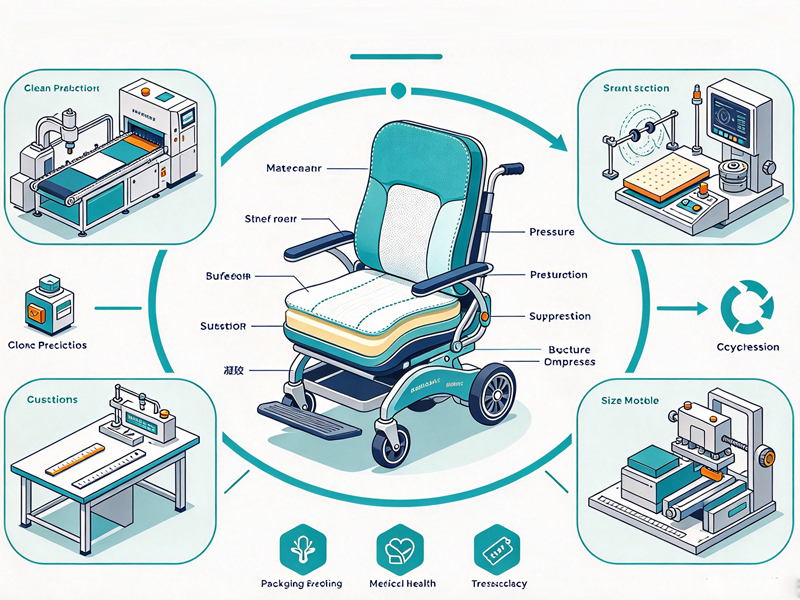
Choosing a wheelchair cushion manufacturer is about much more than finding a company that can produce a seat cushion at an attractive price. For healthcare distributors, rehabilitation equipment brands, medical supply retailers, and institutional buyers, the right manufacturing partner can influence product performance, customer satisfaction, long-term business costs, and brand reputation.
A wheelchair cushion may look like a relatively simple product, but its design involves several important considerations. Foam density, pressure distribution, material durability, cover construction, dimensional accuracy, and manufacturing consistency all affect how the cushion performs in everyday use. For users who spend extended periods in a wheelchair, these details can make a meaningful difference in comfort, posture, and skin protection.
The challenge is that not every manufacturer offers the same level of expertise. Some specialize in standard foam cushions for general seating, while others develop advanced pressure redistribution products, custom seating solutions, or private-label products for established healthcare brands. Their production capabilities, quality control systems, and experience with medical product requirements can vary considerably.
So, how do you identify a wheelchair cushion manufacturer that genuinely meets your needs?
The best approach is to evaluate the entire manufacturing operation rather than focusing on a product catalog or quotation alone. From material selection and engineering capabilities to quality assurance and after-sales support, several factors deserve careful attention before you commit to a supplier.
A large product catalog can be impressive, but it does not automatically indicate manufacturing expertise. What matters more is whether a manufacturer understands the functional requirements of different wheelchair cushion designs and can explain how those products are developed, produced, and tested.
Wheelchair cushions are not interchangeable. Different users have different mobility needs, seating requirements, body shapes, activity levels, and risks associated with prolonged sitting. A cushion intended for everyday comfort may have different design priorities from one developed for pressure redistribution or postural support.
A knowledgeable manufacturer should understand these distinctions and help buyers identify products that suit their intended market.
For example, polyurethane foam cushions are commonly selected for their affordability, lightweight construction, and versatility. Memory foam can provide a conforming seating surface, although its performance depends on the formulation, thickness, and overall cushion design. Gel-based cushions may offer a different combination of pressure redistribution, temperature characteristics, and support. Air-cell cushions can provide adjustable immersion and pressure redistribution when properly designed, maintained, and fitted.
These materials serve different purposes. None is automatically the best choice for every wheelchair user.
When assessing a potential wheelchair cushion manufacturer, ask how its products differ in construction and intended application. A capable supplier should be able to explain the practical advantages and limitations of each option without relying entirely on marketing language.
It is also worth asking whether the company has experience supplying rehabilitation centers, hospitals, long-term care facilities, mobility equipment distributors, or direct-to-consumer brands. Relevant experience can indicate familiarity with the expectations of different customer groups.
However, industry experience alone is not enough. Look for evidence that the manufacturer can translate that experience into consistent products, useful technical guidance, and dependable production.
A useful question to ask is: Can this manufacturer explain why a particular cushion design is suitable for my target market, and can it support that explanation with technical information?
If the answer is clear and specific, you are more likely to be dealing with a knowledgeable manufacturing partner rather than a company that simply resells standard products.
Materials are among the most important factors to investigate when selecting a wheelchair cushion manufacturer. They influence comfort, weight, resilience, maintenance requirements, product lifespan, and overall cost of ownership.
A cushion that performs well during an initial demonstration may not maintain the same characteristics after months of repeated use. For B2B buyers, inconsistent materials can lead to customer complaints, replacement costs, and unnecessary pressure on customer service teams.
For foam wheelchair cushions, buyers should look beyond the word “high-density.” Density is an important material specification, but it does not independently determine firmness, comfort, durability, or pressure redistribution.
Two foam materials with similar densities may perform differently because of variations in formulation, cell structure, resilience, and compression behavior.
Ask the manufacturer for relevant technical specifications, including foam density, indentation force deflection where applicable, thickness, and any available durability test results. The appropriate specifications depend on the intended cushion design, so comparisons should be made between products with similar functions rather than across unrelated categories.
You should also ask how the manufacturer controls material consistency between production batches. A dependable supplier should have a process for checking incoming materials and ensuring that approved specifications remain consistent during manufacturing.
For specialized seating products, material selection may require additional attention to load distribution, bottoming-out resistance, and long-term deformation. These characteristics should be evaluated through suitable testing rather than assumed from a material description.
The cushion cover is another critical component. It affects skin contact, moisture management, cleaning, durability, and the overall user experience.
Common options include polyester fabrics, polyurethane-coated textiles, stretch covers, and other materials designed for specific seating applications. Some products prioritize breathability, while others emphasize fluid resistance or ease of disinfection.
Before choosing a cover, consider where the cushion will be used.
A cushion intended for home use may have different cleaning requirements from one used in a hospital, rehabilitation center, or residential care facility. Institutional buyers may prioritize compatibility with specified cleaning agents, removable covers, and clear maintenance instructions.
Ask whether the cover is removable, whether replacement covers are available, and which cleaning methods the manufacturer recommends. If the product is described as waterproof, fluid-resistant, or antimicrobial, request supporting documentation that clarifies exactly what the claim means.
For instance, a fluid-resistant cover is not necessarily designed to withstand every disinfectant or cleaning procedure. Similarly, an antimicrobial treatment should not be confused with a guarantee that the entire cushion prevents infection.
Durability testing should also extend beyond the foam. Zippers, seams, handles, closures, and fabric coatings can all influence how long a cushion remains serviceable.
Even excellent materials can produce a disappointing product when the overall construction is poorly designed.
The foam may be too soft for the intended application, the cover may restrict the cushion’s ability to conform, or the dimensions may not fit the wheelchair seat correctly. A well-designed cushion requires the materials, shape, cover, and intended use to work together.
Request samples whenever possible. Examine the stitching, surface finish, shape retention, cover fit, and overall workmanship. If the product will be sold under your own brand, sample evaluation is especially important before approving mass production.
Ultimately, a reliable wheelchair cushion manufacturer should be able to explain not only what materials it uses, but also why those materials were selected and how their quality is verified.
Pressure redistribution is a major consideration in wheelchair seating, particularly for people who remain seated for long periods or have an elevated risk of pressure injuries.
For manufacturers, developing a cushion that supports pressure management requires more than choosing a soft material. Product geometry, immersion, envelopment, stability, user fit, and the interaction between the cushion and the seating system can all influence performance.
For buyers, this means that broad claims such as “maximum pressure relief” or “medical-grade comfort” should never be accepted without further investigation.
Ask the manufacturer what evidence supports its performance claims. Depending on the product, relevant information may include laboratory testing, pressure mapping assessments, material characterization, durability testing, or evaluations conducted according to recognized methods.
It is important to understand the limitations of each type of evidence. A pressure map can provide useful information about pressure distribution under specific testing conditions, but it does not independently prove that a cushion will prevent pressure injuries for every user.
Clinical suitability depends on the individual, the seating configuration, and other relevant factors. A wheelchair cushion should not be selected solely on the basis of a general marketing claim.
A qualified manufacturer should also recognize that different users need different levels of support and positioning. Some may benefit from a relatively simple foam design, while others may require specialized contouring, adjustable air systems, or additional postural support.
In these cases, collaboration with an appropriate healthcare professional or seating specialist may be necessary.
Buyers should also ask whether the cushion has clearly defined intended-use information, fitting instructions, maintenance guidance, and warnings relevant to its design. These documents help distributors communicate product limitations accurately and support appropriate use.
For products marketed specifically for pressure redistribution, it is particularly important to establish which performance claims are supported by evidence and which are simply promotional language.
The goal is not to find a manufacturer that promises the most impressive results. It is to find one that can explain its product’s capabilities, limitations, and intended applications with technical clarity.
That approach supports more responsible purchasing decisions and reduces the risk of selling a product that does not match the customer’s needs.
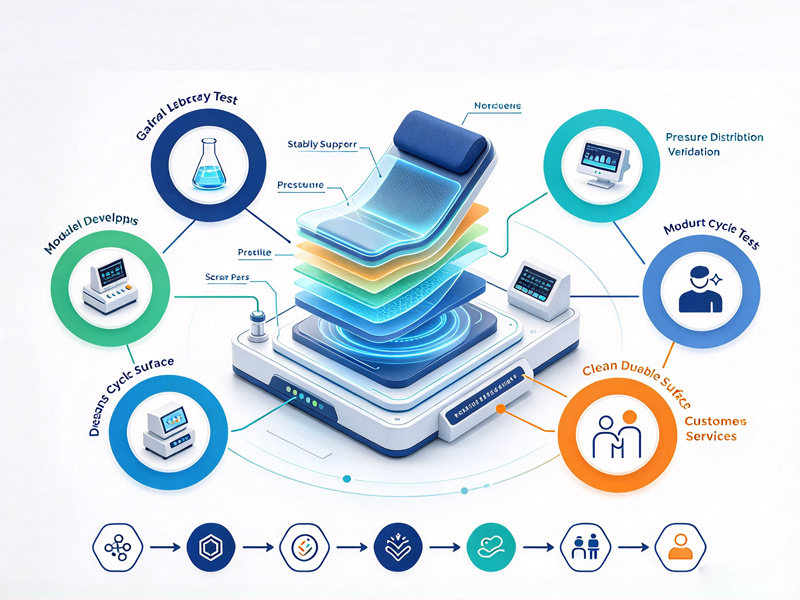
A wheelchair cushion may pass an initial sample inspection and still become a problem if the manufacturer cannot reproduce the same quality at scale.
This is why production capability and quality control deserve as much attention as product design.
A professional wheelchair cushion manufacturer should have clearly defined production procedures covering material inspection, cutting or molding, assembly, cover production, final inspection, and packaging. The precise workflow will depend on the product and the factory’s manufacturing model.
Ask how quality is monitored at each stage rather than assuming that a final visual inspection is sufficient.
For example, foam products may require checks for thickness, dimensions, density, and consistency. Cushions with shaped contours may require additional dimensional checks. Products incorporating air cells, valves, gel components, or adjustable mechanisms may need functional inspections appropriate to those components.
Cover production should also be controlled. Uneven stitching, incorrect dimensions, weak seams, and poorly fitted covers can affect both appearance and usability.
Production capacity is another important consideration, particularly for distributors and private-label brands.
A supplier might be able to produce a few excellent samples but struggle when an order increases from several hundred units to several thousand. Material availability, staffing, equipment capacity, and production planning can all affect delivery schedules and consistency.
Ask about normal lead times, available production capacity, peak-season constraints, and the process used to manage large orders.
It is also useful to understand whether the manufacturer produces the core cushion components itself or relies on subcontractors. Outsourcing is not automatically a problem, but buyers should know which processes are controlled internally and how external suppliers are evaluated.
If multiple production locations or subcontractors are involved, clarify how the company maintains consistent specifications across them.
For healthcare-related products, documented quality procedures can provide valuable assurance.
Depending on the manufacturer and product, relevant documentation may include inspection records, material specifications, batch identification, nonconformance procedures, and records showing how customer complaints are investigated.
Ask how defective products are handled, how recurring problems are addressed, and whether the manufacturer can trace affected production batches when necessary.
A documented quality management system can be a positive indicator, but certification alone does not guarantee that every product is suitable for every application. Buyers should verify the scope, validity, and relevance of any certification presented.
The same principle applies to factory audits. A visit or third-party assessment can provide useful insight into production conditions, quality procedures, and the organization’s ability to meet contractual requirements.
If an in-person visit is impractical, request a virtual factory tour, relevant audit documentation, or a detailed explanation of the quality control process.
Consistency is what turns a promising sample into a dependable product line. Before placing a large order, make sure the manufacturer can demonstrate how it maintains that consistency from the first unit to the last.
For businesses building a differentiated product range, customization can be one of the strongest reasons to work directly with a wheelchair cushion manufacturer.
Standard products may be sufficient for basic distribution, but established brands often need specific dimensions, materials, cover designs, packaging, and product features to serve their target markets.
OEM and ODM services can help meet these requirements, although buyers should understand the distinction.
OEM generally refers to manufacturing products according to the buyer’s specifications or agreed design. ODM typically involves a manufacturer offering an existing design or developing a product that the buyer can customize and market under its own brand, subject to the agreed commercial and intellectual property terms.
A capable manufacturing partner should explain which services it provides and what each option requires from the buyer.
Wheelchair seats come in different widths and depths, and some users require specialized seating configurations.
Depending on its capabilities, a manufacturer may offer different cushion thicknesses, shaped profiles, foam combinations, cover materials, or other design variations.
Before requesting a custom product, define the intended application, target users, dimensions, performance requirements, and any compatibility constraints. The more clearly these requirements are documented, the easier it becomes to evaluate samples and prevent misunderstandings during production.
Not every manufacturer can accommodate every customization. Some may offer only minor changes to existing products, while others have the engineering resources to support more substantial development.
Ask about tooling requirements, sample development costs, minimum order quantities, and the expected timeline for approving a new design.
Private-label services may include logo printing, sewn labels, custom packaging, product inserts, instruction sheets, and retail-ready cartons.
For distributors and online sellers, these details can influence how professional the finished product appears and how easily it fits into an existing brand portfolio.
However, branding should not come at the expense of accurate product information. Packaging and marketing materials must reflect the actual product specifications, intended use, and applicable regulatory requirements.
If the cushion is sold in multiple countries, confirm whether the manufacturer can support the necessary language versions, labeling formats, and documentation for each target market.
Intellectual property deserves attention when developing a custom wheelchair cushion.
Before sharing proprietary designs or paying for tooling, clarify who owns the design files, molds, patterns, and other development assets. Establish whether the manufacturer can sell the same design to other customers and under what conditions.
These questions are particularly important when your product’s dimensions, appearance, or construction provide a competitive advantage.
A written agreement should define confidentiality, permitted use of designs, approval procedures, and responsibilities if the project ends.
Customization is most valuable when it helps a business serve its customers more effectively without creating unnecessary complexity. Choose a manufacturer that can balance flexibility with realistic production planning, transparent costs, and dependable quality.
Compliance is an area where buyers should be especially careful. A wheelchair cushion may be sold as a general mobility accessory, a pressure redistribution product, or a product subject to specific medical-device requirements, depending on its intended purpose and the jurisdiction in which it is marketed.
Requirements can differ between countries and product categories. Buyers should therefore avoid assuming that one certificate automatically makes a cushion suitable for every market.
Start by identifying where the product will be sold, how it will be marketed, and which regulatory obligations apply to the finished product.
Then ask the manufacturer to provide documentation relevant to those requirements.
Potentially relevant documentation may include quality management system certificates, product test reports, material safety information, technical specifications, labeling documentation, and other records required for the particular product and market.
For example, ISO 13485 is a quality management system standard associated with medical devices. A manufacturer’s certification may be relevant when evaluating its quality processes, but buyers should verify the certificate’s validity, scope, and applicability rather than relying on a logo displayed on a website.
Likewise, compliance with a material or product test does not automatically establish compliance with every requirement applicable to the finished cushion.
If a supplier claims that a product is FDA registered, FDA cleared, or FDA approved, ask what the statement specifically refers to. These terms are not interchangeable, and the appropriate status depends on the product and its regulatory pathway.
For European markets, determine whether the product falls within the scope of applicable medical device legislation or other relevant product rules. Do not assume that CE marking requirements are identical for every wheelchair cushion.
At a minimum, consider the following questions:
If the supplier cannot answer these questions, additional verification may be necessary before moving forward.
For specialized medical products, an independent regulatory consultant may help determine the obligations that apply to the product and market.
A responsible wheelchair cushion manufacturer should be willing to discuss compliance openly. It should never pressure a buyer to rely on vague claims or treat a single certificate as universal proof of product suitability.
Price is an important factor, but the lowest quotation is not always the most economical choice.
When comparing wheelchair cushion manufacturers, buyers should evaluate the full cost of acquiring, distributing, maintaining, and potentially replacing the product.
A quotation may cover only the cushion itself, while another includes packaging, custom branding, inspection, or other services. Without a clear breakdown, two apparently similar offers may represent very different levels of value.
Request an itemized quotation whenever possible.
Clarify the unit price, minimum order quantity, sample charges, customization fees, packaging costs, shipping terms, payment conditions, and any additional expenses associated with product development.
For international orders, consider freight, customs duties, insurance, and other import-related costs where applicable. Confirm the agreed Incoterms and which party is responsible for transportation, clearance, and delivery obligations.
Minimum order quantity, or MOQ, can have a significant impact on cash flow and inventory planning.
Large production runs may reduce the unit price, but they can also tie up working capital and increase the risk of unsold inventory. Smaller orders may cost more per unit while allowing a business to test demand and introduce a product with less financial exposure.
The right MOQ depends on your sales forecast, storage capacity, available budget, and the stability of customer demand.
If you are launching a new product, ask whether the manufacturer can offer a pilot order or a staged production arrangement. Once demand becomes more predictable, you can negotiate larger orders and more favorable commercial terms.
A cheaper cushion may become more expensive if it wears out quickly, generates frequent returns, or requires excessive customer support.
Consider a simple example. Supplier A offers a lower unit price but provides limited documentation and inconsistent lead times. Supplier B charges slightly more but delivers consistent quality, offers replacement covers, and provides reliable technical support.
Depending on the business model, Supplier B may produce a lower overall cost by reducing operational disruptions and customer complaints.
When evaluating value, consider product durability, expected replacement frequency, defect rates, packaging quality, warranty terms, and the administrative effort required to manage the supplier.
A realistic cost comparison should also include the cost of quality failures. A batch of defective cushions can create expenses far beyond the original purchase price, particularly when products have already reached distributors or end users.
The objective is not to pay the highest price or negotiate every supplier down to the lowest possible number. It is to find a manufacturer whose pricing is transparent and whose product quality, service, and commercial terms support a sustainable business relationship.
Manufacturing relationships are tested most clearly when something does not go according to plan.
A delayed shipment, unexpected material shortage, quality issue, or urgent product change can quickly reveal whether a supplier is organized and accountable.
This is why communication should be part of your evaluation from the beginning.
Pay attention to how the manufacturer responds to technical questions, quotation requests, sample feedback, and changes in specifications. Clear communication during the sales process is not a guarantee of excellent service, but vague answers and repeated misunderstandings can indicate future difficulties.
A dependable supplier should be able to explain its production schedule, identify potential bottlenecks, and provide realistic delivery estimates. It should also have a process for communicating delays before they disrupt your business.
Ask whether you will have a dedicated account manager or technical contact, particularly if you expect regular orders or customized products.
Even well-manufactured products can occasionally develop problems. What matters is how those problems are investigated and resolved.
Before signing a contract, clarify the warranty period, the scope of warranty coverage, the procedure for reporting defects, and the responsibilities of each party for returns or replacements.
Ask how the manufacturer distinguishes between manufacturing defects, transportation damage, improper use, and normal wear. The process should be practical, documented, and consistent with the product’s intended use.
For B2B buyers, replacement parts and accessories may also be important. If a cushion has a removable cover, determine whether compatible replacement covers will remain available and whether the design is likely to change without notice.
You should also ask how product complaints are recorded and investigated. A manufacturer that identifies recurring issues and implements corrective actions can help prevent the same problem from affecting future orders.
For larger customers, a supplier agreement may establish expectations for defect reporting, response times, corrective action, delivery performance, and advance notice of product changes.
These arrangements are especially useful when your business depends on maintaining consistent inventory or supplying healthcare organizations with scheduled deliveries.
A strong manufacturing partner does more than ship products. It helps your business manage risk, respond to customer concerns, and maintain a dependable supply chain.
After reviewing product quality, customization, compliance, and commercial terms, the next step is to compare potential suppliers using the same evaluation criteria.
This avoids a common purchasing mistake: choosing a manufacturer because it performs exceptionally well in one area while overlooking weaknesses elsewhere.
Start by creating a shortlist of suppliers whose capabilities match your intended product category and target market. Then request comparable information from each company.
A practical evaluation process can be divided into three stages.
Stage one: Initial screening. Review the manufacturer’s product range, industry experience, production capabilities, documentation, and responsiveness. Eliminate suppliers that cannot meet essential requirements.
Stage two: Sample evaluation. Order representative samples and assess dimensions, materials, cover quality, workmanship, product information, and packaging. Where relevant, review independent test results or arrange additional testing.
Stage three: Commercial verification. Compare itemized quotations, MOQs, lead times, warranty terms, quality procedures, and communication arrangements. For significant orders, consider a factory audit or third-party inspection.
The following scorecard can help organize the decision.
| Evaluation Area | What to Check | Suggested Weight |
|---|---|---|
| Product quality | Materials, construction, durability, sample performance | 25% |
| Manufacturing capability | Production capacity, process control, consistency | 20% |
| Compliance and documentation | Relevant certificates, test reports, labeling support | 15% |
| Customization | OEM/ODM services, design flexibility, packaging | 10% |
| Pricing and commercial terms | MOQ, total cost, payment terms, warranty | 10% |
| Delivery reliability | Lead times, planning, shipping coordination | 10% |
| Communication and support | Technical assistance, complaint handling, responsiveness | 10% |
| Total | 100% |
These weights are a starting point, not a universal formula. A healthcare provider purchasing specialized seating products may prioritize technical performance and documentation more heavily. A retailer launching a private-label range may place greater emphasis on customization, packaging, and commercial flexibility.
Score each supplier consistently and document the reasons behind your assessment. If a manufacturer receives a high overall score but fails an essential safety or regulatory requirement, it should not automatically remain on the shortlist.
For a first order, consider a pilot batch where commercially feasible. A smaller initial order allows you to confirm that mass-produced units match the approved sample and that packaging, delivery, and documentation meet expectations.
Once the order arrives, inspect a representative selection of products against the agreed specifications. Record any discrepancies and resolve them before expanding the relationship.
This structured approach takes more effort than selecting the lowest quotation, but it can substantially reduce uncertainty when establishing a new supply chain.
Some suppliers present an attractive product range but struggle to provide the evidence needed for a confident purchasing decision.
Recognizing warning signs early can save time and prevent expensive mistakes.
Unclear material specifications. If a supplier cannot explain the basic characteristics of its foam, cover, or other major components, it may be difficult to assess whether the product meets your requirements.
Unsupported performance claims. Promises of guaranteed pressure injury prevention, universal comfort, or exceptional durability should be examined carefully. Ask for relevant evidence and clear explanations of product limitations.
Certificates that cannot be verified. A certificate should identify the issuing organization, scope, validity, and relevant certified entity. Confirm the details independently when necessary.
Inconsistent samples. Noticeable differences in dimensions, stitching, material feel, or cover fit between samples may indicate problems with specification control.
Unrealistic lead times. Extremely short delivery promises are not necessarily evidence of superior efficiency. Confirm production capacity, stock availability, and the assumptions behind the quoted schedule.
Reluctance to provide written specifications. Verbal promises are difficult to enforce and may lead to disagreements over dimensions, materials, packaging, or quality standards.
No clear process for handling defects. A supplier should be able to explain how complaints are investigated and how defective products are corrected, replaced, or otherwise resolved.
Unclear manufacturing responsibilities. If the company acts as an intermediary, ask who actually manufactures the product and who controls quality. Trading companies can be valuable sourcing partners, but their role should be transparent.
One warning sign alone does not necessarily disqualify a supplier. However, several unresolved concerns should prompt further investigation before you place an order.
The most reliable manufacturers tend to welcome reasonable questions because they understand that clear expectations benefit both parties.
Finding the right wheelchair cushion manufacturer requires a balanced assessment of product performance, material quality, production consistency, customization capabilities, compliance, pricing, and service.
A good-looking catalog and an attractive quotation are useful starting points, but they cannot replace technical information, sample evaluation, and clear commercial agreements.
For distributors and private-label brands, the decision can influence far more than the cost of a single order. It can affect customer confidence, product returns, inventory planning, and the ability to develop a competitive product range over time.
Start by defining your product requirements and target market. Then evaluate manufacturers against the same criteria, verify their documentation, inspect representative samples, and establish written expectations before moving into mass production.
Most importantly, look for a company that communicates honestly about what its products can do, what they cannot do, and how it ensures consistent quality.
The strongest long-term partnerships are built on more than manufacturing capacity. They depend on technical competence, transparency, accountability, and a shared commitment to delivering products that meet clearly defined requirements.
Whether you are sourcing standard foam wheelchair cushions or developing a specialized private-label seating product, taking the time to select the right manufacturing partner can help build a more reliable and sustainable business.
1. What should I look for in a wheelchair cushion manufacturer?
Look for a manufacturer with relevant product expertise, consistent material quality, documented quality control procedures, appropriate testing and regulatory documentation, reliable production capacity, and responsive customer support. If you need private-label products, also evaluate its OEM/ODM capabilities, minimum order quantities, customization options, and intellectual property terms. Request samples and verify important claims before placing a large order.
2. How can I verify whether a wheelchair cushion manufacturer is reliable?
Start by reviewing its manufacturing experience, product specifications, quality management documentation, and relevant test reports. Ask how materials are inspected, how production defects are handled, and whether the company can maintain consistent quality across large orders. Evaluate samples, check references where available, and consider a factory audit or independent inspection for significant purchases. A reliable manufacturer should provide clear answers and written specifications rather than relying exclusively on marketing claims.
3. Is it better to choose a wheelchair cushion manufacturer that offers OEM and ODM services?
It depends on your business goals. OEM services are useful when you already have product specifications or a defined design and need a manufacturing partner to produce it. ODM services can be helpful when you want to adapt an existing design or develop a product with the manufacturer’s support. Both options can support private-label growth, but buyers should compare development costs, MOQs, sample approval procedures, quality control, design ownership, and regulatory responsibilities before making a decision.