Our Location
Free Trade Tower, Xiyong street.
Chongqing, China

Free Trade Tower, Xiyong street.
Chongqing, China
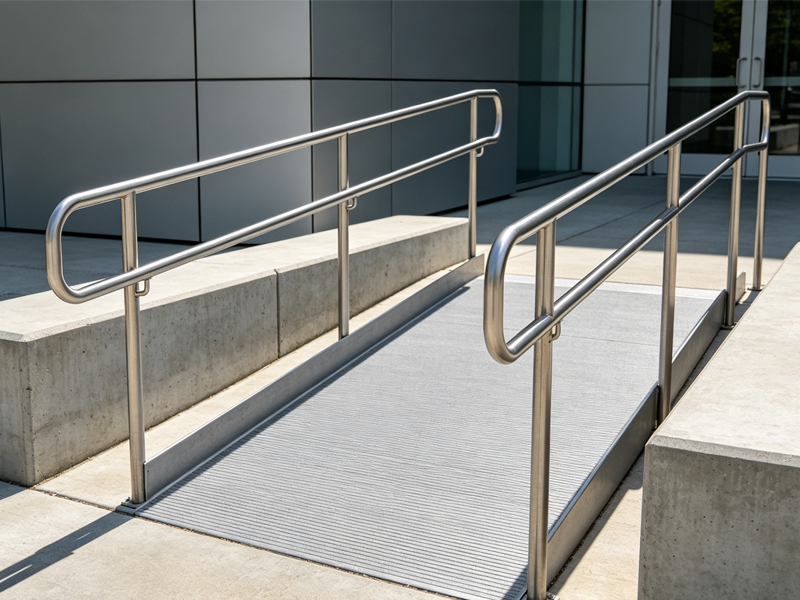
Designing accessible spaces is never just a matter of meeting regulations—it is about making sure people can move safely, confidently, and independently through the environments we build. For commercial properties, public facilities, and even residential entryways that receive frequent visitors, wheelchair ramps are one of the most important accessibility features. Yet despite how common ramps are, the details behind ADA ramp slope requirements are often misunderstood or oversimplified.
The Americans with Disabilities Act (ADA) sets clear standards that determine how ramps must be built in order to ensure safety and usability for individuals who rely on wheelchairs, scooters, walkers, or other mobility aids. These standards are not arbitrary. They are based on biomechanics, real-world usability, and safety research that considers what slope a person can realistically navigate without risking injury or exhaustion.
One of the most critical points is that a ramp is not simply a slanted surface—it is a carefully measured structure where slope, length, width, landings, surface material, and supporting features all work together. Missing even one requirement can make a ramp unsafe or non-compliant.
This article takes a practical, in-depth look at ADA ramp slope requirements and the full set of guidelines surrounding wheelchair ramp construction. Instead of treating these rules as isolated technical numbers, we’ll explore what they mean in real usage, how they affect design decisions, and why they matter for everyday accessibility.
At its core, the ADA framework is built around one central idea: a person using a mobility device should be able to travel independently and safely without needing assistance or excessive physical effort. That means ramps must be gentle enough to ascend without strain, stable enough to prevent slipping or tipping, and structured in a way that allows rest and directional changes.
When we talk about slope, we are referring to the relationship between vertical rise and horizontal run. In simpler terms, how steep the ramp is. A steep ramp may save space, but it creates significant risk. A shallow ramp may take more room, but it dramatically improves usability and safety.
The ADA establishes a maximum slope of 1:12 for most new construction. This means that for every inch of height, there must be at least 12 inches of horizontal ramp length. This ratio is widely accepted as the threshold that balances safety with practical construction limits.
To visualize it, imagine a doorway that sits 24 inches above ground level. A compliant ramp would need to be at least 24 feet long to reach that height safely. While this may seem long, the extended distance reduces strain, prevents wheel slippage, and makes the ramp usable for a wide range of individuals with different mobility levels.
There is also another important but less discussed measurement: cross slope. While the main slope runs up and down the ramp, cross slope refers to the side-to-side tilt. The ADA limits this to 1:48, which is extremely slight. Even a small sideways angle can cause a wheelchair to drift or require constant correction from the user, so this tight restriction helps maintain stability throughout the ramp’s surface.
The 1:12 ratio is not random. It reflects the maximum incline that most wheelchair users can safely manage independently. Steeper slopes require more force to ascend and more braking control when descending. For manual wheelchair users, especially, a steep ramp can quickly become exhausting or even impossible without assistance.
In practical construction terms, the 1:12 rule also serves as a universal baseline. Contractors, architects, and inspectors across the United States rely on it as the default requirement for compliance in new builds. While there are limited exceptions for existing structures where space is constrained, those exceptions typically require alternative accommodations such as lifts or redesigned entry points.
What is important to understand is that even if a steeper ramp “technically fits” in a space, it does not necessarily make it usable. ADA standards prioritize usability over convenience in construction.
While most attention goes to ramp steepness, cross slope plays an equally important role in accessibility. A ramp that tilts sideways, even slightly, can create a constant correction challenge for wheelchair users. Over time, this leads to fatigue and increased risk of slipping off the intended path.
The ADA limits cross slope to 1:48, which is almost flat to the human eye but critical in function. This ensures that water drainage can still occur without compromising stability.
Builders often have to carefully grade the ramp surface or use specialized materials to maintain this balance. In outdoor environments, where weather and drainage are factors, maintaining proper cross slope becomes even more essential.
Another essential requirement is ramp width. The ADA specifies a minimum clear width of 36 inches. This measurement is taken between handrails or the usable edges of the ramp.
While 36 inches is the baseline, wider ramps are often recommended, especially in high-traffic public environments. A wider ramp provides several advantages:
In environments where ramps include turns, switchbacks, or heavy pedestrian flow, width becomes even more important. Designers often exceed minimum standards to create a more natural and intuitive flow of movement.
One of the more practical ADA requirements involves limiting the length of continuous ramp runs. According to the guidelines, no single ramp segment should exceed 30 feet in length without a landing.
This rule exists because continuous climbing—even at a safe slope—can still cause fatigue. Landings act as resting points and transition zones where users can pause, adjust, or change direction safely.
To calculate ramp length in real design situations, professionals start with the total vertical rise and apply the 1:12 ratio. However, they must also break that total into segments that include mandatory landings.
For example, a structure with a 60-inch rise cannot be built as a single long ramp. Instead, it would need multiple sections, each separated by level platforms.
Landings are flat platforms placed at the top, bottom, and intermediate points along a ramp. They are not optional—they are a core part of ADA compliance.
Each landing must meet specific requirements:
Landings serve several critical functions beyond compliance. They allow wheelchair users to rest, safely change direction, and stabilize before continuing. In ramps with turns or switchbacks, landings become transition hubs that make navigation possible.
Intermediate landings are required for every 30 inches of vertical rise. This ensures that no user is forced to travel an excessively long incline without relief.
In practice, landings also improve safety in emergency situations, where rapid evacuation or assistance may be required.
Handrails are another key feature of ADA-compliant ramps, though they are not required in every case. They become mandatory when the ramp has a rise greater than 6 inches.
When installed, handrails must meet several strict guidelines:
Handrails provide stability for users who may need additional support when ascending or descending. They are especially important for individuals with limited upper-body strength or balance challenges.
Edge protection is required when there is a drop-off greater than half an inch and no wall or barrier is present. This may include curbs, raised edges, or structural barriers that prevent wheels from slipping off the side of the ramp.
Together, handrails and edge protection form a safety system that supports users in both expected and unexpected situations.
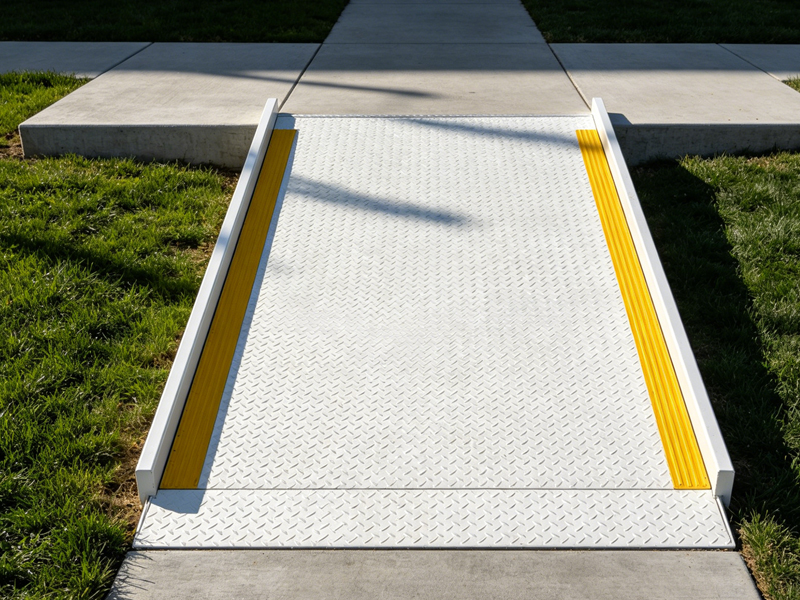
Even the perfect slope and structure can become hazardous if the surface is not properly designed. ADA guidelines require ramp surfaces to be firm, stable, and slip-resistant.
This means avoiding loose materials such as gravel or uneven textures that could interfere with wheelchair movement. Instead, ramps are typically constructed using concrete, treated wood, metal, or specialized modular systems designed for traction.
Drainage is another essential factor. Standing water can create slipping hazards, while ice in colder climates can make ramps unusable without proper treatment or maintenance.
A well-designed ramp considers year-round conditions, not just ideal weather. Regular maintenance, including snow removal, surface cleaning, and inspection for wear, is essential for long-term safety.
While ADA requirements are legally enforced in commercial and public spaces, their importance extends far beyond compliance. A properly designed ramp communicates inclusion, accessibility, and respect for all users.
Non-compliant ramps can lead to more than fines or legal consequences—they can create real barriers that prevent individuals from entering buildings safely or independently. For businesses, this also affects reputation, customer experience, and public trust.
In many cases, property owners underestimate how complex ramp design can be. What appears to be a simple structure actually involves engineering, measurement precision, and knowledge of accessibility standards.
This is why many organizations rely on professionals who specialize in mobility solutions and ADA-compliant installations. Experienced providers ensure that every detail—from slope ratio to landing spacing—is executed correctly.
Companies such as Williams Lift Company, with decades of experience in accessibility equipment, often support both residential and commercial projects, offering not only ramp installation but also additional mobility solutions such as stair lifts and lift recliners.
The most effective ramps are not just technically compliant—they are genuinely easy to use. That means thinking beyond minimum standards and considering how people will interact with the structure daily.
A ramp that meets ADA requirements but feels awkward, narrow, or exhausting to use still falls short of its purpose. Good design anticipates movement patterns, weather conditions, and the diversity of users who will rely on it.
In modern accessibility planning, ramps are often integrated into broader design systems that include elevators, automatic doors, and barrier-free pathways. This holistic approach ensures that accessibility is seamless rather than segmented.
Understanding ADA ramp slope requirements is ultimately about understanding people. Every measurement, from the 1:12 slope to the 36-inch width rule, exists to support independence and safety in real-life situations.
Whether for a commercial building, a public facility, or a private residence, the goal remains the same: creating a path that anyone can use without hesitation or risk. When properly designed, a ramp becomes more than a structure—it becomes a bridge to inclusion.
1. What does a 1:12 ramp slope actually mean in everyday terms?
A 1:12 slope means that for every inch of height, the ramp must extend 12 inches horizontally. In practical terms, a small step of 2 feet in height would require a 24-foot-long ramp to remain compliant and safe.
2. When are landings required on a wheelchair ramp?
Landings are required at the top and bottom of every ramp, as well as at any point where the ramp changes direction. They are also required after every 30 feet of ramp run or 30 inches of vertical rise, ensuring users always have a safe resting and turning space.
3. What is the minimum width required for ADA ramps?
The minimum clear width is 36 inches between handrails or edges. However, wider ramps are often recommended in public or high-traffic areas to improve maneuverability and comfort for wheelchair and scooter users.