Our Location
Free Trade Tower, Xiyong street.
Chongqing, China

Free Trade Tower, Xiyong street.
Chongqing, China
Power wheelchairs have evolved far beyond simple mobility devices. Today, they are part of a broader lifestyle solution designed to improve independence, reduce caregiver strain, and create a safer daily experience for users with limited mobility. Yet while buyers often focus on motors, batteries, seat comfort, suspension systems, or folding designs, one feature is frequently overlooked until it becomes essential: attendant control.
For many families, caregivers, rehabilitation centers, and senior care facilities, the ability to assist or fully control a power wheelchair can dramatically change daily life. A well-designed control system improves safety in crowded environments, makes transportation easier, reduces stress for users with declining hand coordination, and gives caregivers greater confidence during long outings.
The challenge is that there is no universal answer. Some people benefit most from a rear-mounted joystick operated by a caregiver. Others prefer the flexibility of wireless remote control. A growing number of modern users are also exploring smartphone-based systems that allow wheelchair operation through a mobile app.
Choosing the right solution depends on far more than convenience. It involves lifestyle, environment, user condition, caregiver habits, indoor accessibility, outdoor usage, and long-term adaptability. Understanding these differences can help avoid frustration later and ensure the powerchair remains practical as mobility needs evolve over time.
Mobility needs rarely stay static. Someone who initially drives independently may later need occasional assistance in busy environments, steep ramps, airports, shopping centers, or medical facilities. In other cases, a caregiver may need temporary control while navigating narrow hallways, elevators, or uneven outdoor terrain.
Attendant control systems bridge the gap between independence and support.
Instead of transferring the user into another mobility device or manually pushing a heavy powerchair, caregivers can safely guide the wheelchair while maintaining smooth powered movement. This reduces physical strain on both parties and makes mobility far more manageable in real-world situations.
The demand for caregiver-friendly wheelchair technology has increased significantly because modern mobility care is no longer limited to hospitals or nursing homes. Many users now live independently, travel frequently, attend social events, and remain active in their communities. Families want solutions that preserve dignity while still offering practical assistance when needed.
This is where the choice of control system becomes important.
A poorly matched setup can create communication problems, awkward movement patterns, and unnecessary stress during everyday activities. On the other hand, the right control method can make the wheelchair feel intuitive, collaborative, and much safer in both indoor and outdoor environments.
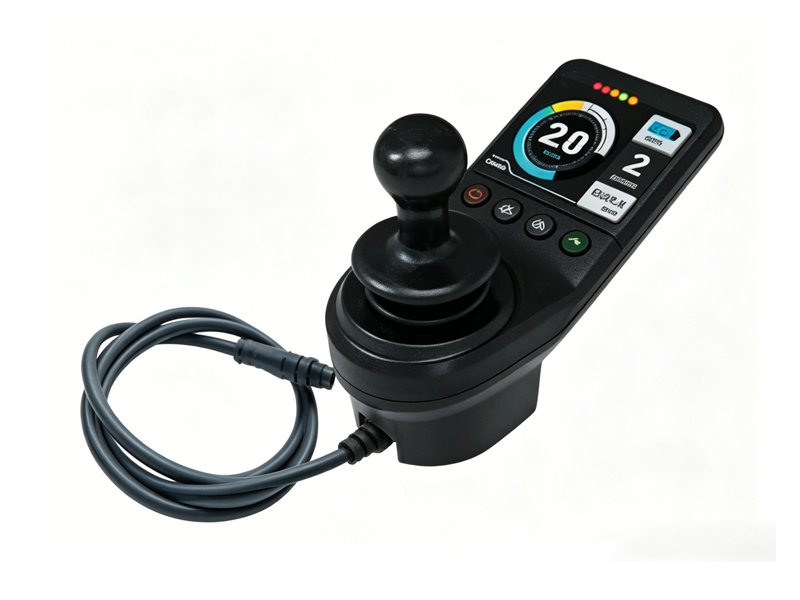
The most traditional and widely trusted option is the rear-mounted attendant joystick system.
This setup places a secondary joystick or control module on the back of the power wheelchair so a caregiver can directly operate the chair while walking behind it. In many cases, the primary user controls can either remain active or be temporarily disconnected depending on the wheelchair model and configuration.
What makes this system so popular is its precision.
Because the caregiver is physically connected to the wheelchair through the control interface, movement feels stable and predictable. Turning radius, stopping distance, speed adjustments, and directional changes are easier to manage compared to remote systems that rely on wireless communication.
This level of direct control becomes especially valuable in environments where accuracy matters:
Caregivers often feel more comfortable using rear-mounted systems because the wheelchair responds instantly without concerns about wireless interference or signal delays.
Another advantage is reliability. Since the controls are hardwired into the wheelchair system, there is little risk of connection loss. For users with severe mobility limitations or neurological conditions, this reliability can become essential.
Still, rear-mounted systems are not perfect for every lifestyle.
Walking behind the wheelchair at all times can feel restrictive, particularly during outdoor activities or longer social outings. Some caregivers prefer walking beside the user to maintain easier conversation and visual interaction. A rear-only position may feel less natural in these situations.
There is also a learning curve involved. Operating a powerchair from behind differs from pushing a standard wheelchair because the caregiver must anticipate movement using joystick sensitivity rather than physical pushing force.
Once mastered, however, rear-mounted attendant controls remain one of the safest and most dependable solutions available.
Wireless control systems represent a newer generation of mobility assistance designed around flexibility and freedom of movement.
Instead of requiring the caregiver to remain behind the wheelchair, wireless remotes allow operation from several feet — and sometimes dozens of yards — away. This creates a very different caregiving dynamic.
Rather than acting as a “driver from behind,” the caregiver can walk beside the user, slightly ahead, or even manage movement remotely while opening doors or preparing pathways.
This side-by-side mobility experience feels more natural to many families. Conversations become easier, eye contact improves, and social outings feel less clinical. For users who value dignity and emotional comfort, these details matter more than many people realize.
Wireless systems also simplify installation because they often avoid permanent hardware modifications. In many designs, pairing the remote is straightforward and requires minimal setup.
Outdoor environments are where wireless systems truly shine.
Large sidewalks, parks, airports, shopping districts, cruise terminals, and open recreational spaces allow caregivers to benefit from the increased flexibility without constantly staying directly behind the wheelchair.
However, convenience comes with trade-offs.
Wireless systems depend on signal stability. Although modern remotes are far more reliable than earlier generations, interference can still occur in crowded electronic environments. Large public venues with heavy wireless traffic may occasionally impact responsiveness.
Distance management also matters. Most systems have a maximum operational range, and exceeding it may temporarily stop wheelchair movement as a safety precaution. While this is designed to protect users, it can still create confusion if caregivers are unaware of range limitations.
Battery maintenance introduces another responsibility as well. A remote with low power becomes useless during critical moments, so regular charging or battery replacement becomes part of the routine.
Despite these considerations, wireless systems continue gaining popularity because they offer something traditional setups cannot: mobility support that feels less institutional and more socially natural.
As smart mobility technology expands, app-based wheelchair control systems are becoming increasingly common.
Instead of carrying a dedicated remote, caregivers and users can control the wheelchair directly from a smartphone or tablet using Bluetooth connectivity. On paper, this sounds like the ideal solution because nearly everyone already carries a mobile device daily.
App-based systems introduce several appealing advantages.
First, there is no additional hardware to remember or store. Users simply access the control application on their existing device. Second, modern mobile interfaces are familiar and intuitive, reducing the learning curve for many users.
Some systems also offer customization features beyond basic directional control. Speed settings, driving modes, diagnostics, battery monitoring, and positioning adjustments may all become accessible through the app interface.
For technologically comfortable users, this level of integration feels modern and efficient.
Still, smartphone control systems also reveal practical limitations in real-world caregiving situations.
Phone battery dependency becomes an immediate concern. If the smartphone dies, overheats, crashes, or disconnects unexpectedly, wheelchair control may become temporarily unavailable.
Bluetooth connectivity can also introduce occasional pairing problems, particularly in environments with numerous active wireless devices. While these issues are usually manageable, they can create stress during travel or time-sensitive situations.
Another challenge is multitasking. Walking while simultaneously monitoring a phone screen and guiding a powerchair may not feel as safe or comfortable for every caregiver.
For this reason, smartphone controls are often best viewed as supplementary systems rather than primary full-time caregiver solutions.
They work exceptionally well for tech-oriented users, occasional assistance scenarios, or short-distance adjustments, but many caregivers still prefer physical joystick or remote systems for consistent everyday use.
One of the biggest mistakes buyers make is choosing a control system without considering where the wheelchair will actually be used most often.
Indoor environments place different demands on control systems compared to outdoor mobility.
Inside homes, rehabilitation centers, and medical offices, precision matters more than flexibility. Narrow corridors, sharp turns, furniture navigation, and elevator positioning require exact movement control. Rear-mounted joystick systems usually perform best in these settings because they offer immediate responsiveness and stable directional handling.
Outdoor mobility shifts the priority toward flexibility and communication.
Parks, sidewalks, community events, and shopping areas allow caregivers to benefit more from wireless movement freedom. Walking beside the user often feels socially smoother and less restrictive than remaining directly behind the chair.
Weather also becomes a factor outdoors.
Rain, strong sunlight, cold temperatures, or dust exposure may affect smartphone usability more than traditional controls. Physical joysticks generally maintain greater consistency under challenging environmental conditions.
Long-term users often discover that no single control method dominates every scenario perfectly. Instead, the best choice depends on balancing lifestyle habits with practical caregiving needs.
Comfort and convenience matter, but safety remains the most important factor when evaluating attendant control systems.
A power wheelchair is not a lightweight mobility device. Improper operation can lead to collisions, tipping risks, ramp accidents, or injuries in crowded spaces. Any caregiver using attendant controls should spend time practicing operation before assisting users in complex environments.
Several safety considerations deserve special attention:
Speed Management
Caregivers should begin with lower speed settings until they fully understand the wheelchair’s responsiveness and turning sensitivity.
Terrain Awareness
Steep inclines, uneven pavement, loose gravel, wet flooring, and curb transitions all require careful handling regardless of control type.
Communication Between User and Caregiver
Even when the caregiver controls movement, users should remain informed about directional changes, stops, and speed adjustments to prevent discomfort or anxiety.
Emergency Stop Familiarity
Every caregiver should understand how to stop the wheelchair immediately in case of unexpected movement or environmental hazards.
Battery Preparedness
Wireless remotes and smartphones introduce additional battery-related risks. Backup charging habits become essential for longer outings.
The safest control system is ultimately the one both caregiver and user feel fully confident operating consistently.
Rather than asking which control system is universally “best,” it makes more sense to ask which one fits specific real-life needs.
A rear-mounted attendant joystick may work best for:
Wireless remote systems may fit best for:
Smartphone-based controls may suit:
The reality is that mobility needs evolve. A user who initially values independence may later prioritize caregiver support. Choosing adaptable systems that can accommodate future changes often proves more practical than focusing only on immediate needs.
Choosing the right attendant control for a power wheelchair is less about finding the “most advanced” technology and more about identifying the system that best matches everyday life.
Rear-mounted joystick controls remain the gold standard for precision, reliability, and structured caregiving environments. Wireless remotes offer freedom, flexibility, and a more natural social experience for active users and families. Smartphone controls bring modern convenience and digital integration for users comfortable with mobile technology.
Each solution has strengths. Each also has limitations.
The most successful mobility setups are usually the ones built around real-world routines rather than marketing features. A control system should reduce stress, improve safety, and support both the wheelchair user and the caregiver without creating unnecessary complications.
As powerchair technology continues evolving, attendant control systems will likely become even smarter, more customizable, and more intuitive. But regardless of future innovation, the goal remains the same: helping people move through daily life with greater comfort, confidence, and independence.
What is an attendant control for a power wheelchair?
An attendant control is a secondary control system that allows a caregiver or assistant to operate a power wheelchair safely, usually from the rear of the chair or through a wireless device.
Are wireless wheelchair remotes reliable?
Modern wireless remotes are generally reliable and include built-in safety protections, though signal range and battery management still require attention during regular use.
Can caregivers walk beside a power wheelchair while controlling it?
Yes. Wireless remote systems are specifically designed to allow side-by-side assistance rather than requiring caregivers to remain directly behind the chair.
Is smartphone wheelchair control practical for daily use?
It can be practical for users comfortable with mobile technology, though smartphone battery life and Bluetooth connectivity may occasionally create limitations.
Which control option is safest for elderly users?
For seniors who cannot independently operate a joystick, rear-mounted attendant controls are often considered the safest and most stable solution, especially indoors or in assisted living environments.