Our Location
Free Trade Tower, Xiyong street.
Chongqing, China

Free Trade Tower, Xiyong street.
Chongqing, China
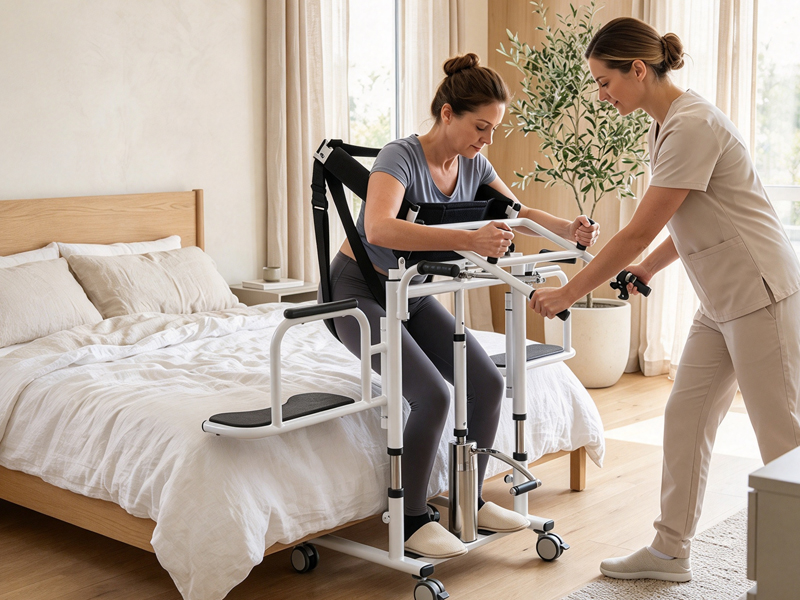
Providing daily care for people with limited mobility is not always easy. Simple activities such as moving from a bed to a wheelchair, using the toilet, sitting at a dining table, or adjusting to a comfortable sitting position can become challenging without the right equipment. For family caregivers, nurses, and professional care facilities, these everyday tasks often require considerable physical effort, patience, and attention to safety.
This is where a well-designed patient transfer wheelchair can make a meaningful difference.
The Hydraulic Transfer Wheelchair YSM2303 with Built-in Toilet, Safety Brakes, and Dining Table is designed to bring several essential care functions together in one practical mobility solution. Combining hydraulic seat height adjustment, an integrated commode system, compact silent wheels, a comfortable PU seat, and a detachable dining table, this model supports a more convenient daily care routine.
Rather than requiring separate equipment for transferring, toileting, and seated activities, the YSM2303 integrates these functions into a single steel-framed design. Its adjustable seat height, removable toilet seat, and compact overall structure make it suitable for a variety of home care and institutional environments.
A traditional wheelchair is primarily designed to help users move from one place to another. However, people with more significant mobility limitations may need additional support when transferring between a bed, wheelchair, toilet, or dining area.
A hydraulic transfer wheelchair addresses these needs by combining mobility with adjustable seating and transfer assistance.
The YSM2303 is designed around three important functions:
What makes this combination particularly useful is that caregivers do not need to rely on several separate pieces of equipment for every daily task.
For example, a caregiver may need to move a user from the bedroom to the bathroom in the morning, assist with toileting, and then help the user sit comfortably for breakfast. With the appropriate setup, the YSM2303 can support different stages of this routine.
Its hydraulic height adjustment is especially important because transfer situations are not always identical. Bed heights, seating arrangements, and caregiver requirements can vary from one environment to another.
The YSM2303 offers an adjustable seat height from 420 mm to 650 mm, providing a useful adjustment range for different care settings.
One of the most important features of the YSM2303 is its hydraulic seat height adjustment system.
Unlike a fixed-height wheelchair, this model uses a hydraulic foot pedal and hydro-cylinder mechanism to raise or lower the seat. The adjustment range is approximately 42–65 cm, allowing caregivers to adapt the seating position to the surrounding furniture and transfer requirements.
Why does this matter?
Imagine helping an older adult move from a bed into a wheelchair. If the wheelchair seat is significantly lower or higher than the bed, the transfer may become more difficult. The user may need to make additional movements, while the caregiver may have to work in an uncomfortable position.
Being able to adjust the wheelchair height can help reduce these differences.
The hydraulic foot pedal allows the caregiver to operate the adjustment mechanism without manually lifting the seat. This provides a more convenient way to position the chair before a transfer.
The adjustment system can be particularly helpful in the following situations:
Bed-to-wheelchair transfers: The seat can be adjusted to a suitable height relative to the bed, helping create a more manageable transfer position.
Bathroom assistance: The adjustable seat height offers additional flexibility when positioning the chair near a suitable toilet or bathroom fixture.
Dining activities: The seat can be raised or lowered to better accommodate different table heights and seating arrangements.
Caregiver convenience: The hydraulic mechanism provides a controlled adjustment method, reducing the need to manually reposition the chair’s seating structure.
It is important to understand that hydraulic height adjustment is a positioning aid, not a substitute for proper transfer technique. Caregivers should always follow appropriate patient-handling procedures and use additional transfer equipment when required.
Toileting is one of the most demanding parts of daily care for people with limited mobility.
Moving a person from a wheelchair to a conventional toilet can involve several steps. Depending on the user’s physical condition, caregivers may need to provide substantial assistance with standing, turning, repositioning, and sitting.
Repeated transfers can also create unnecessary physical strain for both the user and caregiver.
The YSM2303 addresses this challenge with an integrated commode system.
Its built-in toilet arrangement features a removable PP toilet seat, providing a practical toileting option without requiring a separate bedside commode for every situation.
The removable design is useful for cleaning and routine maintenance. Caregivers can remove the relevant component when necessary, making it easier to maintain hygiene and prepare the chair for its next use.
The commode function can be particularly valuable in:
The removable PP toilet seat is designed for practical daily use. Polypropylene is commonly used in healthcare and household products because it is lightweight and suitable for molded components.
However, proper hygiene remains essential. The commode should be emptied, cleaned, and disinfected according to the manufacturer’s instructions and the facility’s infection-control procedures.
Caregivers should also confirm that the chair is correctly positioned, the brakes are engaged, and the user is safely supported before using the commode.
A built-in toilet does not simply add another feature to the wheelchair. It helps make an essential daily care activity more manageable and convenient.
Mobility equipment needs to provide more than movement. It must also offer reliable control when the user is sitting, transferring, or receiving assistance.
The YSM2303 comes with 3-inch silent wheels and a rear-wheel brake arrangement.
These compact wheels are designed to support smooth movement across suitable indoor surfaces, including many residential floors and institutional environments.
Their smaller size helps maintain the chair’s compact structure, which can be useful when navigating confined areas such as bedrooms, bathrooms, and care rooms.
The silent wheel design is another practical consideration. In environments where patients rest frequently, reducing unnecessary rolling noise can contribute to a more comfortable atmosphere.
The rear safety brakes are particularly important during stationary activities.
For example, when a caregiver is helping a user move onto the seat or preparing the commode, unwanted wheelchair movement can create an avoidable safety risk.
Engaging the brakes before these activities helps keep the wheelchair stationary.
For everyday operation, caregivers should develop a consistent safety routine:
The wheels and brakes are intended to support indoor mobility and positioning. They should not be interpreted as a guarantee of safe operation on slopes, uneven ground, or other unsuitable surfaces.
For users with significant mobility limitations, caregiver supervision is recommended throughout transfers and movement.
Comfort is often overlooked when comparing patient transfer wheelchairs, but it has a direct impact on the user’s daily experience.
People with limited mobility may spend considerable time sitting. A poorly designed seat can become uncomfortable, particularly when the user has difficulty changing position independently.
The YSM2303 features a PU surface combined with high-elasticity sponge cushioning for the seat and backrest.
This combination is designed to provide a supportive and comfortable sitting experience.
The PU material offers a smooth surface that is relatively easy to wipe clean during routine maintenance. The high-elasticity sponge provides cushioning, helping reduce the feeling of sitting on a hard structural surface.
The backrest also contributes to a more supported sitting position during everyday activities.
These materials are particularly relevant in care environments where equipment needs to balance comfort with practical cleaning requirements.
The specified seating dimensions are:
A 45 cm seat width provides a useful reference when assessing whether the chair is suitable for a particular user. However, body measurements, clothing, posture, and the need for additional positioning support should all be considered before purchase.
The 40 cm seat depth is another important measurement. A suitable seat depth should allow the user to sit comfortably without excessive pressure behind the knees.
For users who require extended sitting support, caregivers should regularly check posture, skin condition, and pressure points. Additional cushions or positioning accessories should only be used when compatible with the chair and appropriate for the user’s care requirements.
A wheelchair is not only a mobility device. For many users, it also serves as their primary seating space throughout the day.
Having a convenient surface for meals and other activities can make everyday life easier.
The YSM2303 includes a detachable ABS dining table measuring approximately 56 × 35 cm according to the main product specifications.
This table provides a practical surface for eating, drinking, reading, or keeping small personal items within reach.
For older adults and individuals with limited mobility, being able to eat while seated in a familiar position can reduce the need for additional transfers.
The table can also be useful in rehabilitation environments, where patients may spend time participating in simple seated activities.
ABS is commonly used for molded components because it offers a practical balance of rigidity, durability, and ease of cleaning.
The detachable design makes the table more flexible than a permanently fixed surface. Caregivers can remove it when it is not required or when the user needs more room for transfers.
When using the dining table, caregivers should check that it is properly installed and stable. It should not be used as a transfer handle, lifting point, or weight-bearing support.
A dining table may appear to be a small accessory, but it contributes to a more complete daily care experience.
Another important advantage of the YSM2303 is its relatively compact overall design.
According to the supplied product specifications, its overall dimensions are approximately 82 × 57 × 84–107 cm.
The adjustable overall height reflects the hydraulic seat adjustment range.
Its 57 cm overall width may be particularly useful in environments where available space is limited. Bedrooms, residential bathrooms, and nursing facility rooms often contain furniture and other equipment that restrict movement.
A compact wheelchair can make positioning and maneuvering more manageable, provided that the available doorway and turning space are suitable.
The packaging dimensions are approximately 72 × 60 × 42 cm, offering a more compact shipping format than the assembled product dimensions.
This can be beneficial for transportation, warehousing, and distribution.
However, packaging dimensions should not be confused with the wheelchair’s assembled dimensions. Buyers should also consider the package weight, delivery access, and whether assembly is required before use.
With a net weight of approximately 33.5 kg and a gross weight of approximately 35 kg, the YSM2303 is a substantial piece of equipment rather than a lightweight portable wheelchair.
Its steel construction provides a solid structural foundation, although transportation and lifting should be planned accordingly.
The frame is one of the most important structural components of any patient transfer wheelchair.
The YSM2303 uses a steel frame designed to provide a stable foundation for its seat, hydraulic mechanism, wheels, and other functional components.
Steel is widely used in mobility and medical-care equipment because of its strength and suitability for structural applications.
For buyers, the material choice is relevant for several reasons.
First, a steel frame provides a rigid supporting structure for everyday care activities.
Second, it offers a practical foundation for integrating a hydraulic lifting mechanism.
Third, it is suitable for equipment intended for repeated use in home care and institutional environments.
The specified maximum load capacity is 100 kg.
This means that the intended user weight should not exceed the manufacturer’s stated limit.
It is important not to treat the load capacity as a suggested operating target. Buyers should allow for an appropriate safety margin and consider the user’s actual weight, posture, and transfer requirements.
Before purchasing, it is also advisable to confirm the manufacturer’s maintenance recommendations for the frame, hydraulic cylinder, wheels, brakes, and other moving components.
Routine inspections can help identify loose fasteners, unusual movement, worn wheels, or changes in hydraulic performance before they become more serious problems.
For buyers comparing different hydraulic patient transfer wheelchairs, having all the main measurements in one place makes product evaluation easier.
The following table summarizes the supplied specifications.
| Specification | YSM2303 Details |
|---|---|
| Product name | Hydraulic Transfer Wheelchair with Built-in Toilet |
| Model | YSM2303 |
| Frame material | Steel |
| Seat width | 45 cm |
| Seat depth | 40 cm |
| Adjustable seat height | 42–65 cm |
| Overall product size | 82 × 57 × 84–107 cm |
| Wheel size | 3 inches |
| Wheel configuration | Rear-drive wheels with brakes |
| Height adjustment | Hydraulic foot pedal and hydro-cylinder |
| Toilet system | Removable PP toilet seat |
| Dining table material | ABS |
| Dining table size | 56 × 35 cm |
| Seat and backrest | PU + high-elasticity sponge |
| Net weight | 33.5 kg |
| Gross weight | 35 kg |
| Maximum load capacity | 100 kg |
| Package size | 72 × 60 × 42 cm |
Note: The supplied product information also lists the dining table as 555 × 355 mm and the package size as 715 × 600 × 420 mm. These measurements are close to the rounded dimensions above. Buyers should confirm the final production specification and packaging measurements with the supplier before ordering.
The YSM2303 is designed for users who need assistance with mobility, transfers, and daily personal care.
Its integrated functions make it relevant to several different care environments.
Elderly people with limited mobility
Older adults may experience reduced strength, balance difficulties, or limited ability to stand independently. The adjustable height and built-in commode can help caregivers organize everyday care more conveniently.
People recovering from surgery or injury
Some patients need temporary assistance while recovering from procedures or injuries. A transfer wheelchair may help support daily movement and toileting during the recovery period, subject to clinical advice and individual transfer requirements.
Home caregivers and family members
For families providing care at home, managing several different pieces of equipment can be difficult. A wheelchair combining transfer assistance, toileting, and dining functions may help simplify the daily routine.
Nursing homes and elderly care facilities
Care facilities often need equipment that can support repeated daily use. The steel frame, hydraulic adjustment, removable toilet seat, and detachable dining table provide several practical functions in one unit.
Rehabilitation and long-term care environments
In rehabilitation settings, patients may require different levels of assistance throughout the day. Adjustable seating can help caregivers adapt the chair to suitable transfer positions and daily activities.
However, not every user is automatically suitable for this model. People who cannot maintain a safe seated posture, have complex positioning needs, or require specialized transfer equipment may need a more suitable alternative.
A professional assessment is recommended when the user’s transfer ability or medical condition creates uncertainty.
Choosing the right transfer wheelchair involves more than comparing product prices and specifications.
A model may offer several useful functions, but it still needs to match the user’s physical condition and the intended care environment.
Here are five important considerations before purchasing the YSM2303.
1. Check the user’s weight and body measurements
The maximum load capacity is 100 kg. The seat width is 45 cm, and the seat depth is 40 cm.
Measure the user’s body dimensions and compare them with the available seating space. Consider clothing, posture, and any additional positioning support that may be needed.
2. Measure the available indoor space
The overall width is approximately 57 cm. Check bedroom and bathroom doorways, turning areas, and the distance between furniture.
A compact wheelchair is only useful if it can be maneuvered safely in the intended environment.
3. Confirm bed and toilet compatibility
The adjustable seat height ranges from 42 to 65 cm. Measure the height of the bed and any other furniture involved in transfers.
For the commode function, confirm the required bathroom arrangement and the compatibility of the product with the intended toileting setup.
4. Understand the hydraulic adjustment mechanism
The hydraulic foot pedal is an important part of the product. Buyers should ask about adjustment operation, maintenance requirements, and the availability of replacement components.
It is also worth confirming whether the chair is delivered fully assembled or requires installation.
5. Consider cleaning and long-term maintenance
The removable PP toilet seat and PU upholstery support routine cleaning, but a clear cleaning procedure is still necessary.
Ask the supplier about approved cleaning products, hydraulic maintenance, spare parts, warranty coverage, and after-sales support.
These details are particularly important for nursing homes, hospitals, and distributors purchasing multiple units.
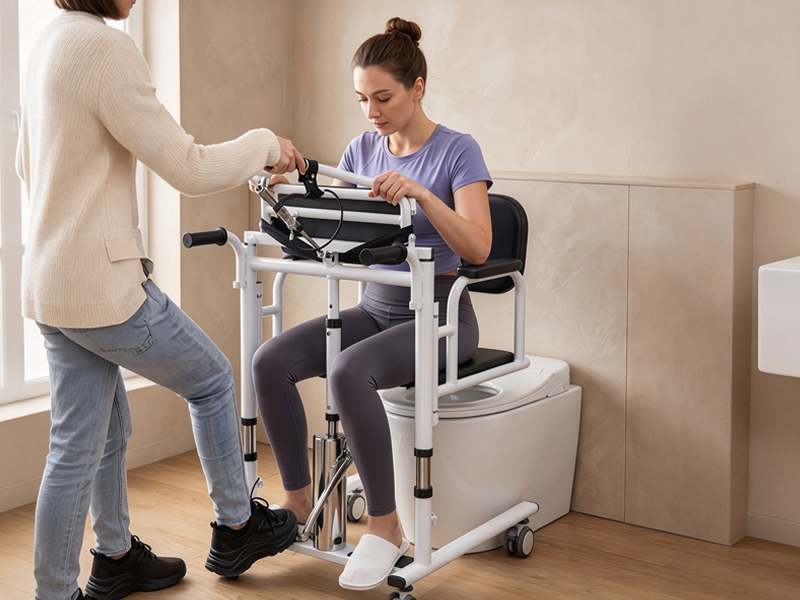
When evaluating patient care equipment, it is useful to look beyond the initial purchase price.
A conventional wheelchair may meet basic mobility requirements, but it does not necessarily provide toileting support or adjustable transfer positioning.
A separate commode chair and additional seating equipment may also be required.
The YSM2303 combines several functions in one product:
For home caregivers, combining these functions may help reduce the need to move between different pieces of equipment.
For care facilities, an integrated design may simplify equipment planning and provide additional flexibility in everyday care routines.
However, the actual value depends on the user’s needs, frequency of use, available space, and compatibility with the care environment.
The most suitable product is not necessarily the one with the most features. It is the one that provides the right combination of safety, comfort, functionality, and practicality for the intended user.
The Hydraulic Transfer Wheelchair YSM2303 with Built-in Toilet, Safety Brakes, and Dining Table is designed to address several common challenges in daily patient care.
Its hydraulic foot pedal adjustment system offers a seat height range of 42–65 cm, helping caregivers adapt the chair to different transfer situations. The removable PP commode provides integrated toileting support, while the detachable ABS dining table creates a convenient surface for everyday seated activities.
Additional features, including 3-inch silent wheels, rear safety brakes, PU cushioning, and a steel frame, contribute to its practical design.
With a 45 cm seat width, 40 cm seat depth, and maximum load capacity of 100 kg, the YSM2303 provides a defined set of dimensions and operating limits that buyers can evaluate against their requirements.
For families, caregivers, nursing facilities, and medical equipment distributors looking for a multifunctional patient transfer wheelchair, this model is worth considering.
Ultimately, the right choice should always be based on the user’s physical condition, transfer ability, body measurements, and care environment. When these factors are carefully evaluated, a suitable hydraulic transfer wheelchair can become a valuable part of a safer and more organized daily care routine.
Q1: What is the seat height adjustment range of the YSM2303 hydraulic transfer wheelchair?
The YSM2303 features a hydraulic foot pedal and hydro-cylinder adjustment system. Its seat height can be adjusted from 42 cm to 65 cm (420–650 mm), allowing caregivers to position the chair at a more suitable height for different transfer situations.
Q2: Does the YSM2303 come with a built-in toilet and dining table?
Yes. The wheelchair features a removable PP toilet seat for commode use and a detachable ABS dining table measuring approximately 56 × 35 cm. These integrated accessories provide additional convenience for daily toileting, meals, and other seated activities.
Q3: What is the maximum weight capacity of the YSM2303, and is it suitable for home care?
The YSM2303 has a specified maximum load capacity of 100 kg. With its compact overall dimensions, hydraulic height adjustment, built-in commode, safety brakes, and comfortable seating, it can be considered for suitable home care environments. Buyers should first confirm that the user’s body measurements, weight, transfer ability, and available indoor space are compatible with the product.