Our Location
Free Trade Tower, Xiyong street.
Chongqing, China

Free Trade Tower, Xiyong street.
Chongqing, China
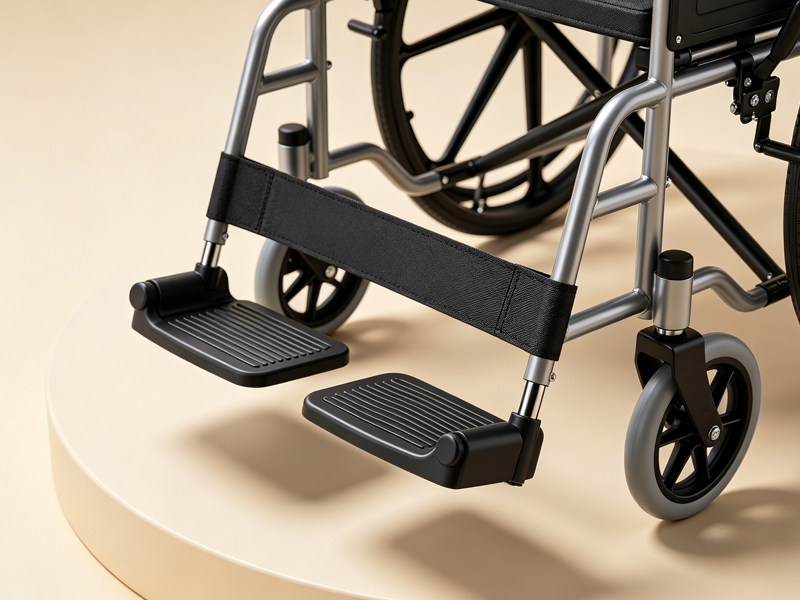
When looking at a manual or transport wheelchair, one of the first things people may notice is the pair of footplates positioned at the bottom of the frame. These small components may not attract much attention, but they play an important role in everyday wheelchair use. They provide a stable place for the feet, help users maintain a comfortable sitting position, and contribute to the overall safety and practicality of the wheelchair.
Interestingly, many modern wheelchairs use plastic footplates rather than metal ones. At first glance, this might seem like a simple manufacturing decision. Plastic is lightweight, affordable, and relatively easy to shape. However, the reasons behind this choice go much further than cost alone.
Plastic footplates offer a combination of weight reduction, durability, corrosion resistance, user comfort, and design flexibility. For wheelchair manufacturers, they provide an effective way to balance performance with production efficiency. For users, they can make everyday mobility more convenient and comfortable.
So, why are plastic footplates used on so many wheelchairs? Are they strong enough to support everyday use? How do they compare with metal alternatives? And what should buyers consider when choosing a wheelchair with plastic footrests?
One of the biggest reasons plastic footplates are common in wheelchair design is their favorable strength-to-weight ratio.
A wheelchair is a mobility device that users may need to push, maneuver, fold, transport, or lift several times throughout the day. Even a small reduction in overall weight can make a noticeable difference, particularly for people who frequently travel or rely on caregivers for assistance.
Traditional metal footplates, especially those made from steel, can add unnecessary weight to the lower part of the wheelchair. Although aluminum offers a lighter alternative, plastic can still provide an attractive combination of low weight and functional strength for many standard wheelchair applications.
A well-designed plastic footplate can support the user’s feet during normal wheelchair operation without adding substantial weight to the frame.
This matters in several everyday situations.
For example, consider a person who uses a folding wheelchair and regularly places it in a car. A lighter wheelchair is generally easier for a caregiver to lift into the trunk. Similarly, a user who travels frequently may appreciate a wheelchair that is easier to handle when navigating airports, public transportation, and other busy environments.
The weight advantage also benefits wheelchair manufacturers. Reducing the weight of individual components can help manufacturers develop more portable products without compromising the basic functionality of the wheelchair.
Of course, plastic is not automatically stronger than metal. The actual performance depends on the type of polymer, material thickness, structural design, reinforcement, and manufacturing quality.
The goal is not to replace every metal component with plastic. Instead, manufacturers choose materials according to the specific loads and working conditions each component must handle.
For standard footplate applications, engineered plastic can provide sufficient strength while keeping the wheelchair lightweight and practical.
Another important advantage of plastic footplates is their resistance to corrosion.
Wheelchairs are used in a wide variety of environments. Some users operate their wheelchairs indoors, while others regularly encounter rain, damp floors, outdoor pathways, or humid conditions.
Metal components can gradually deteriorate when exposed to moisture, particularly if their protective coatings become damaged.
Steel footplates may develop rust over time, especially around scratches, joints, exposed edges, and areas where protective finishes have worn away. Aluminum does not rust in the same way as steel, but it can still experience corrosion under certain environmental conditions.
Plastic does not have this problem.
Most commonly used wheelchair plastics are naturally resistant to moisture and do not develop rust. This makes plastic footplates particularly suitable for environments where frequent exposure to water is unavoidable.
For example, users may move between indoor living spaces and outdoor environments throughout the day. They may also need to clean their wheelchairs regularly to maintain hygiene.
Because plastic does not absorb water in the same way as many porous materials and does not rust, it can be easier to maintain in these circumstances.
This is especially useful in healthcare facilities, rehabilitation centers, nursing homes, and other settings where wheelchairs are used by multiple people.
However, corrosion resistance should not be confused with complete resistance to environmental damage. Certain plastics can deteriorate after prolonged exposure to ultraviolet radiation, extreme temperatures, or unsuitable cleaning chemicals.
Material selection therefore remains important.
High-quality wheelchair footplates are designed to withstand the environmental conditions expected during normal use.
Cost is another major factor behind the widespread use of plastic wheelchair footplates.
Wheelchair manufacturers must consider more than the price of the raw material. They also need to evaluate production speed, tooling requirements, assembly processes, labor costs, and long-term product consistency.
Plastic offers several manufacturing advantages.
Unlike many metal components, plastic footplates can be produced through injection molding. This process allows manufacturers to create complex shapes in large quantities using specially designed molds.
Once the mold has been developed, the same design can be reproduced repeatedly with consistent dimensions and relatively efficient production cycles.
This offers several benefits:
These advantages can help manufacturers control production costs and offer wheelchairs at different price points.
This is particularly important because wheelchairs are essential mobility products rather than luxury accessories. Affordability directly affects how easily individuals, families, hospitals, and care organizations can obtain suitable equipment.
A lower manufacturing cost does not necessarily mean lower product quality. When the appropriate plastic material and manufacturing process are used, plastic footplates can provide reliable performance for their intended applications.
The key is to evaluate the actual product design rather than assuming that all plastic components are identical.
Plastic is particularly attractive to wheelchair designers because it can be molded into a wide range of shapes.
A footplate is not simply a flat surface attached to the wheelchair frame. Its shape, dimensions, surface texture, and positioning can all affect how comfortably and securely a user can place their feet.
Plastic molding makes it easier to incorporate functional details directly into the component.
For example, manufacturers can design footplates with:
These details can improve usability without requiring multiple separately manufactured parts.
Surface texture is particularly important.
A smooth footplate may become slippery when a user’s shoes or the plate itself are wet. Adding molded grooves or textured patterns can help improve grip during ordinary use.
Raised edges may also help limit unintended foot movement, although they should not be considered a substitute for properly fitted foot positioning accessories or foot straps when those are needed.
The ability to customize the shape also allows manufacturers to develop different wheelchair models for different users.
A basic transport wheelchair, a lightweight folding wheelchair, and a more specialized rehabilitation wheelchair may have different footplate dimensions and mounting arrangements.
Plastic molding provides manufacturers with the flexibility to accommodate these differences.
In other words, plastic is not only selected because it is inexpensive. It is also a versatile engineering material that allows wheelchair components to be designed around real-world usage requirements.
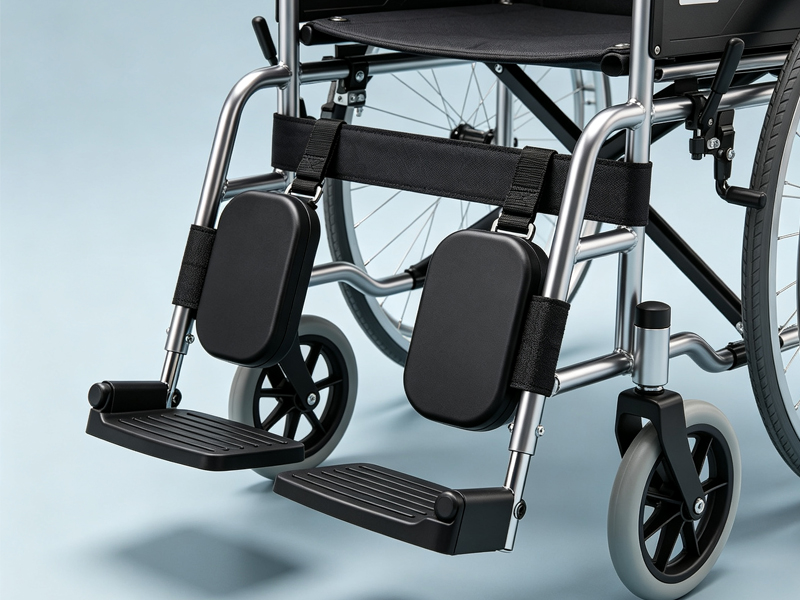
Hygiene is an important consideration in wheelchair design, especially for products used in hospitals, rehabilitation facilities, and long-term care environments.
Wheelchair footplates are regularly exposed to dust, dirt, shoe marks, spilled liquids, and other everyday contaminants.
A surface that is easy to clean can simplify routine maintenance.
Many plastic footplates have relatively smooth, non-porous surfaces that can be wiped down with a suitable cleaning cloth and an approved cleaning solution.
Unlike materials that can absorb moisture, appropriately selected plastics generally do not require special drying procedures to prevent rust.
This can make routine cleaning more straightforward.
Plastic footplates also do not usually require repainting or protective coating maintenance to prevent corrosion.
However, cleaning instructions still matter. Some strong disinfectants, solvents, and abrasive cleaning products may damage certain plastic materials or cause discoloration over time.
For this reason, wheelchair owners and healthcare staff should follow the manufacturer’s cleaning recommendations.
Another advantage is that plastic footplates are often relatively simple to inspect.
Cracks, deformation, damaged mounting areas, and excessive wear may be visible during routine checks.
This makes it easier to identify problems before they affect normal use.
Although plastic does not eliminate maintenance requirements, it can reduce some of the maintenance concerns associated with certain metal components.
Foot positioning has a direct influence on wheelchair comfort and stability.
When sitting in a wheelchair, users need appropriate support for their lower limbs. Without properly positioned footplates, the feet may hang unsupported, slide backward, or come into contact with the ground.
This can create discomfort and may increase the risk of injury.
Footplates help provide a consistent support surface for the feet and contribute to maintaining an appropriate seated position.
Plastic can be useful in this application because it allows manufacturers to create smooth edges and rounded shapes.
Compared with poorly finished metal components, a well-designed plastic footplate may reduce the likelihood of contact with sharp edges.
Its surface can also be designed to provide a suitable level of traction.
However, the safety of a wheelchair footplate depends on much more than its material.
Several factors should be considered:
Footplate height
The footplates should be adjusted so that the feet are adequately supported and the lower legs are positioned comfortably. Incorrect positioning may contribute to discomfort and excessive pressure around the thighs or feet.
Footplate angle
Some wheelchairs provide adjustable footplate angles. This can help accommodate different seating positions and lower-limb requirements.
Surface grip
A textured surface may help reduce unwanted foot movement, especially when footwear or the footplate is slightly damp.
Structural integrity
The footplate must remain securely attached to its mounting hardware and should not show signs of cracking or excessive deformation.
Foot clearance
The design should allow appropriate clearance from the ground and nearby obstacles during normal wheelchair movement.
It is also worth remembering that footplates are intended to support the feet, not to serve as steps for standing or climbing onto the wheelchair.
Users should avoid placing their full body weight on the footplates unless the wheelchair manufacturer specifically states that the design supports such loading.
A properly designed plastic footplate can contribute to everyday comfort and safety, but correct adjustment and responsible use are equally important.
One common question among wheelchair buyers is whether plastic footplates are better than metal footplates.
There is no universal answer. Both materials have advantages, and the best choice depends on the wheelchair’s intended use.
Plastic footplates are commonly selected for their lightweight construction, corrosion resistance, design flexibility, and manufacturing efficiency.
Metal footplates, on the other hand, may be preferred in applications where additional stiffness, impact resistance, or a particular structural design is required.
The following comparison highlights their main differences.
| Comparison Factor | Plastic Footplates | Metal Footplates |
|---|---|---|
| Weight | Generally lightweight | Depends on the metal used |
| Corrosion resistance | Naturally resistant to rust | Depends on material and protective finish |
| Manufacturing | Suitable for injection molding | Often requires cutting, bending, machining, or fabrication |
| Design flexibility | High for molded shapes | Depends on fabrication methods |
| Maintenance | Generally easy to clean | May require coating or corrosion checks |
| Surface texture | Can be molded directly | Often requires additional finishing |
| Impact performance | Depends on polymer and design | Depends on metal type and thickness |
| Cost | Often economical in mass production | Varies according to material and fabrication |
It is important to understand that not all plastic footplates have the same mechanical properties.
A reinforced engineering polymer may perform very differently from a basic, inexpensive plastic.
Likewise, an aluminum footplate and a steel footplate have different weight and strength characteristics.
For everyday standard wheelchair use, plastic is often a practical solution. For specialized applications involving higher mechanical demands, a manufacturer may choose a reinforced plastic or metal design.
The best approach is to compare the complete footplate assembly, including its mounting hardware, structural design, and intended load conditions.
Looking at the material alone does not provide enough information to determine overall quality.
Not all plastics are suitable for wheelchair components.
The material must provide an appropriate balance of stiffness, impact resistance, durability, weight, and resistance to environmental exposure.
Depending on the manufacturer and product design, wheelchair footplates may be made from different thermoplastic materials.
Some commonly used engineering plastics include:
Polypropylene (PP)
Polypropylene is widely used in consumer and industrial products because it is lightweight, chemically resistant, and relatively economical.
It can be molded into different shapes and is suitable for many non-structural and moderately loaded components.
Its performance depends on the grade, formulation, thickness, and structural design.
High-Density Polyethylene (HDPE)
HDPE is known for its moisture resistance, toughness, and chemical resistance.
It can be useful in applications where exposure to water and everyday contaminants is expected.
However, its stiffness and dimensional behavior must be considered when designing a footplate.
ABS (Acrylonitrile Butadiene Styrene)
ABS is valued for its impact resistance, rigidity, and attractive surface finish.
It is commonly used in molded housings and various equipment components.
For wheelchair footplates, its suitability depends on the required impact performance, environmental exposure, and product specifications.
Reinforced Engineering Plastics
Some wheelchair components may use reinforced polymers containing materials such as glass fibers.
These materials can provide improved stiffness and strength compared with unreinforced polymers.
They may be considered when a manufacturer needs a stronger plastic component without moving entirely to a metal construction.
The exact plastic used in a wheelchair footplate is not always stated in the product description.
Buyers who need specific information should ask the manufacturer for the material specification, load requirements, and relevant product testing documentation.
A professional manufacturer should be able to explain why a particular material was selected for its intended application.
Although plastic footplates offer several practical advantages, they are not perfect.
Understanding their limitations is important for making an informed purchasing decision.
One potential concern is long-term material fatigue.
Repeated loading, vibration, accidental impacts, and environmental exposure can gradually affect some plastic components.
Lower-quality plastics may become brittle over time, particularly if they are exposed to excessive ultraviolet radiation or unsuitable chemicals.
Another consideration is impact damage.
A strong metal footplate may tolerate certain types of impact better than a thin plastic component. However, this is not always the case, because impact resistance varies significantly between different plastic formulations and metal designs.
Mounting points also deserve attention.
The areas where the footplate connects to its brackets can experience repeated mechanical stress. If the component is poorly designed or incorrectly installed, cracks may develop around these connection points.
For this reason, manufacturers should consider reinforcement, adequate material thickness, and proper load distribution during the design process.
Plastic footplates may also be less suitable for some specialized wheelchair applications where greater structural stiffness or resistance to demanding mechanical conditions is necessary.
These limitations do not mean that plastic footplates are unreliable.
They simply demonstrate why material selection, engineering design, quality control, and intended use must be considered together.
A well-manufactured plastic footplate designed for a standard wheelchair can be a dependable component for everyday mobility.
When purchasing a wheelchair, buyers often focus on frame material, seat width, cushion design, wheel size, and overall weight.
Footplates deserve attention as well.
Although they may appear to be relatively simple components, they can influence comfort, usability, and long-term maintenance.
Here are several practical factors worth considering.
1. Check the Material Quality
Do not evaluate a footplate based only on whether it is made from plastic or metal.
Ask about the material type, thickness, reinforcement, and manufacturing process.
A well-designed plastic footplate should feel sufficiently rigid for its intended application and should not show obvious defects.
2. Consider Adjustability
Different users have different leg lengths and seating requirements.
Height-adjustable and angle-adjustable footplates can provide greater flexibility when positioning the feet.
This is particularly important for users who spend extended periods in their wheelchairs.
3. Look at the Surface Design
A suitable surface texture can improve grip and reduce unwanted foot movement.
Rounded edges and an appropriate platform size can also contribute to a more comfortable experience.
4. Inspect the Mounting System
The mounting bracket is just as important as the footplate itself.
Check whether the plate is securely attached and whether the mounting hardware is compatible with the wheelchair model.
A high-quality plate with an unreliable mounting system is not a good solution.
5. Consider the Intended Environment
For everyday indoor use, a standard plastic footplate may be entirely sufficient.
For frequent outdoor use, exposure to harsh weather, or more demanding applications, buyers should check whether the selected material and design are suitable for those conditions.
6. Ask About Replacement Parts
Footplates are components that may eventually require replacement.
Before purchasing a wheelchair, it is worth checking whether compatible replacement footplates and mounting accessories are available.
This can make future repairs easier and help extend the useful life of the wheelchair.
Ultimately, the right footplate is not necessarily the most expensive one. It is the one that provides appropriate support, fits the wheelchair correctly, and meets the user’s daily mobility needs.
The continued use of plastic footplates across many wheelchair models reflects a broader trend in mobility equipment design.
Manufacturers are increasingly expected to produce products that are lightweight, practical, affordable, easy to maintain, and comfortable for everyday users.
Plastic helps meet several of these requirements simultaneously.
It allows manufacturers to reduce component weight, create complex shapes, improve moisture resistance, and streamline mass production.
These benefits are particularly valuable in standard manual wheelchairs, transport wheelchairs, and other mobility products where affordability and portability are important considerations.
There is also an opportunity for continued material innovation.
Modern polymer technology provides manufacturers with access to different material grades, additives, and reinforcement options.
Instead of treating plastic as a basic substitute for metal, engineers can select specific polymer formulations to meet particular performance requirements.
This creates opportunities to improve structural consistency, surface quality, impact performance, and product lifespan.
However, the future of wheelchair footplate design is unlikely to involve one material replacing all others.
Plastic, aluminum, and steel each have their place in mobility equipment.
The most effective design uses the material that best matches the component’s function.
For many standard wheelchair footplates, plastic remains an excellent choice because it delivers a practical combination of performance, convenience, and affordability.
Plastic footplates are used on many wheelchairs because they provide a practical combination of lightweight construction, corrosion resistance, manufacturing efficiency, design flexibility, and easy maintenance.
Although they may seem like minor accessories, they contribute to the overall usability and comfort of a wheelchair by providing a stable surface for foot support.
Their popularity is not simply the result of lower manufacturing costs. Modern plastics can be engineered into durable, functional components that meet the requirements of everyday mobility equipment.
Of course, the quality of a plastic footplate depends on its material, thickness, structural design, mounting system, and manufacturing standards. Metal alternatives may still be more appropriate for certain specialized applications.
For wheelchair buyers, the most important consideration is not whether plastic is universally better than metal. It is whether the footplate is properly designed for the wheelchair and the person using it.
When the right material and design are combined, plastic footplates can provide a reliable and cost-effective solution that supports comfortable, practical everyday mobility.
1. Are plastic wheelchair footplates strong enough for everyday use?
Yes. Properly designed plastic wheelchair footplates are generally strong enough to support the user’s feet during normal wheelchair operation.
Their strength depends on the type of plastic, material thickness, structural reinforcement, and manufacturing quality.
However, footplates are designed to support the feet, not to carry the user’s full body weight. Users should avoid standing or stepping on them unless the manufacturer explicitly permits this type of loading.
Regular inspection is also recommended to identify cracks, loose fittings, or other signs of damage.
2. Are plastic footplates better than aluminum footplates?
Neither material is universally better.
Plastic footplates are generally lightweight, corrosion-resistant, economical to manufacture, and flexible in design. Aluminum footplates offer a rigid metal construction and may be preferred for certain applications requiring specific structural characteristics.
The best option depends on the wheelchair’s intended use, product design, weight requirements, and durability expectations.
For many standard wheelchairs, plastic is a practical choice. For specialized applications, aluminum may be more appropriate.
3. How long do plastic wheelchair footplates last?
There is no fixed lifespan for all plastic wheelchair footplates.
Their service life depends on the plastic material, product quality, frequency of use, loading conditions, environmental exposure, and maintenance practices.
A well-manufactured footplate used within its intended operating conditions may last for many years.
However, users should inspect the component regularly, especially around mounting points and areas exposed to repeated impact.
If a footplate becomes cracked, significantly deformed, or loose, it should be inspected and replaced when necessary.
Using a damaged footplate may compromise proper foot support and everyday wheelchair safety.