Our Location
Free Trade Tower, Xiyong street.
Chongqing, China

Free Trade Tower, Xiyong street.
Chongqing, China
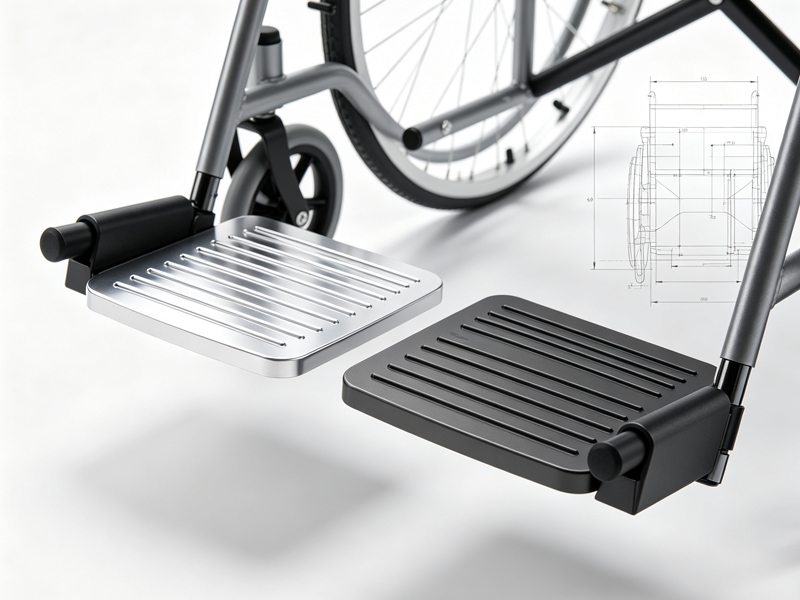
Choosing the right wheelchair footplates may seem like a small detail, but it can make a noticeable difference in everyday comfort, safety, and long-term usability. Footplates support the user’s feet and lower legs, help maintain a stable sitting position, and contribute to the overall functionality of a wheelchair. When they are poorly matched to a user’s needs, even a well-designed wheelchair can become uncomfortable or difficult to use.
One of the most common questions buyers face is whether to choose aluminum or steel wheelchair footplates. Both materials are widely used in wheelchair construction, and each offers distinct advantages. Aluminum is generally associated with lower weight and corrosion resistance, while steel is valued for its strength, rigidity, and durability under demanding conditions.
However, the decision is not quite as simple as choosing the lighter material or the stronger one. Factors such as wheelchair design, user weight, daily activity, maintenance requirements, environmental conditions, and budget all influence which material makes more sense.
So, how do aluminum and steel wheelchair footplates actually compare? More importantly, which option is better for different users and applications?
Before comparing materials, it helps to understand what wheelchair footplates actually do.
Wheelchair footplates are the platforms attached to the lower section of a wheelchair’s leg rests. They provide a stable surface for the user’s feet while seated. Depending on the wheelchair model, footplates may be fixed, folding, swing-away, adjustable, or removable.
Although their design varies, their basic functions remain similar.
First, they support the feet and help prevent them from hanging unsupported. Proper foot support can contribute to better sitting posture and reduce unnecessary pressure on the lower limbs.
Second, footplates help keep the feet in a consistent position during movement. This is particularly important when a wheelchair is pushed over uneven surfaces, through doorways, or across outdoor environments.
Third, they make transfers and wheelchair handling more convenient. Folding and swing-away footplates, for example, can create additional clearance when a user moves between a wheelchair and another seat.
The material used to manufacture these components affects several practical characteristics, including weight, structural strength, resistance to corrosion, maintenance, and cost.
That is why comparing aluminum and steel is worth doing before purchasing replacement footplates or specifying components for a wheelchair.
Aluminum and steel are both established engineering materials, but their physical properties create different advantages in wheelchair applications.
The most important differences include weight, strength, corrosion resistance, durability, maintenance, and overall cost.
| Comparison Factor | Aluminum Footplates | Steel Footplates |
|---|---|---|
| Weight | Generally lighter | Generally heavier |
| Strength | Good strength-to-weight ratio | Typically higher stiffness and strength, depending on grade |
| Corrosion Resistance | Naturally forms a protective oxide layer | Depends on steel type and surface treatment |
| Durability | Suitable for regular daily use when properly designed | Well suited to demanding applications |
| Maintenance | Usually relatively low | May require more attention to coatings and surface damage |
| Portability | Helps reduce wheelchair component weight | Adds more weight to the wheelchair |
| Cost | Can be higher depending on alloy and manufacturing | Often economical, depending on grade and fabrication |
| Best Application | Lightweight and transport-friendly wheelchairs | Heavy-duty and strength-focused applications |
These are general material characteristics rather than guarantees for every product. Actual performance depends on the alloy, thickness, geometry, manufacturing process, surface finish, and quality of the attachment hardware.
A well-designed steel footplate may outperform a poorly designed aluminum one, just as a properly engineered aluminum component may provide excellent service over many years.
The following sections explain what these differences mean in real-world use.
Weight is one of the first differences users notice when comparing aluminum and steel wheelchair footplates.
Aluminum has a density of approximately 2.7 g/cm³, while ordinary carbon steel has a density of approximately 7.85 g/cm³. In other words, aluminum is roughly one-third the density of steel.
This difference can make aluminum an attractive option for wheelchair manufacturers looking to reduce overall equipment weight.
A lighter footplate can be particularly beneficial for users who frequently fold, lift, transport, or store their wheelchairs. Caregivers may also appreciate the reduced handling weight when placing a wheelchair into a vehicle or moving it between locations.
For manual wheelchair users, reducing unnecessary component weight can also contribute to a more manageable overall setup.
However, material density alone does not determine the final weight of a footplate. Manufacturers may adjust thickness, reinforcement, shape, and mounting structures to achieve the required strength.
For example, an aluminum footplate may need a different cross-sectional design from a steel one to provide comparable stiffness. As a result, the actual weight difference between two finished products may be smaller or larger than expected.
When aluminum makes more sense:
Steel remains a reasonable choice when additional weight is not a major concern and structural performance takes priority.
Strength is another important consideration, particularly for wheelchairs used every day.
Steel has a reputation for high structural strength and rigidity. Depending on the grade, it can withstand substantial mechanical loads and is commonly used in components that need to resist bending, impact, and repeated stress.
This makes steel an attractive material for heavy-duty wheelchair designs.
Aluminum, however, should not be considered weak simply because it is lighter. Many aluminum alloys offer excellent strength-to-weight ratios and are widely used in transportation, aerospace, and medical equipment.
For wheelchair footplates, the important question is not simply which metal is stronger. It is whether the finished component can safely withstand the loads and forces expected during use.
Several design factors influence this performance:
A footplate experiences more than the static weight of a user’s feet. It may also be exposed to accidental impacts, pressure during transfers, vibration, and repeated movement when folding or adjusting the leg rests.
These conditions make structural design especially important.
Steel may be preferable where a more rigid construction is required. Aluminum can be equally practical when the alloy and structural design are selected appropriately.
One important point: wheelchair footplates should not be treated as substitutes for transfer supports or lifting handles unless the manufacturer specifically designs and approves them for that purpose.
Practical takeaway: Choose based on the manufacturer’s rated specifications and intended application rather than assuming that all steel components are stronger or that all aluminum components have lower load capacity.
Corrosion resistance can have a major influence on the service life of wheelchair components.
Wheelchairs are used in a wide range of environments. They may encounter rain, humidity, cleaning products, perspiration, spilled drinks, and frequent cleaning. Over time, these conditions can affect exposed metal surfaces.
Aluminum has a natural advantage because it forms a thin oxide layer when exposed to air. This layer helps protect the underlying metal from further oxidation.
For this reason, aluminum footplates generally offer good resistance to atmospheric corrosion, even when they are not covered with a thick protective coating.
Many manufacturers also use anodizing, powder coating, or other surface treatments to improve appearance and surface protection.
Steel behaves differently.
Ordinary carbon steel can rust when exposed to moisture and oxygen, particularly when its protective coating becomes damaged. Scratches, chipped paint, worn edges, and exposed mounting areas can become starting points for corrosion.
However, this does not mean that steel wheelchair footplates are unsuitable for humid environments.
Protective finishes such as powder coating, plating, and other corrosion-resistant treatments can significantly improve their performance. Stainless steel grades also provide better corrosion resistance than ordinary carbon steel.
The key is understanding the exact material and surface treatment being used.
For users who frequently operate wheelchairs outdoors or in humid environments, aluminum can be a convenient choice because of its natural corrosion resistance.
For steel products, regular inspection of the coating and prompt attention to damaged areas can help maintain long-term condition.
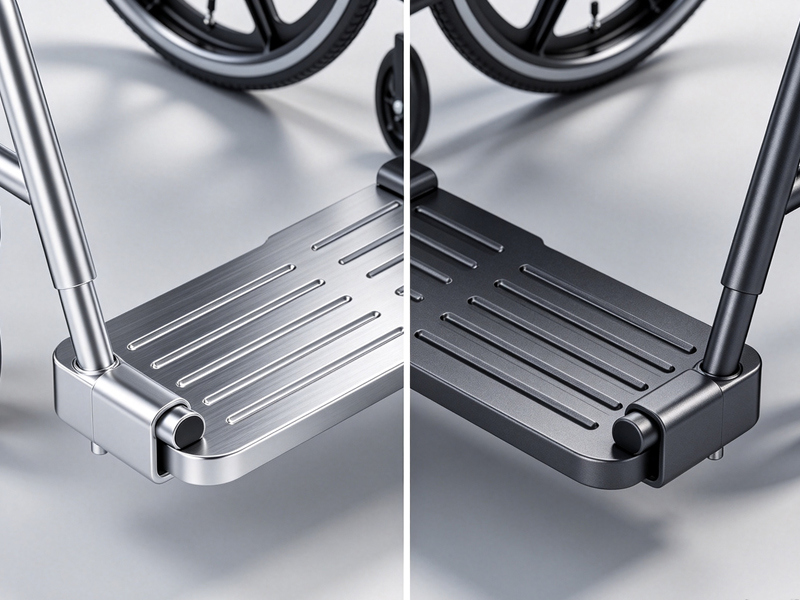
Durability is not determined by material alone. It also depends on how a component is designed, manufactured, installed, and maintained.
Steel footplates are often appreciated for their rigidity and resistance to deformation. In applications involving frequent use, demanding operating conditions, or higher mechanical stress, a properly engineered steel component can offer dependable performance.
Aluminum footplates also provide good durability when manufactured using appropriate alloys and dimensions.
Their main advantage is that they combine relatively low weight with useful mechanical performance. This makes them suitable for many everyday manual and powered wheelchair applications.
There are, however, different types of damage to consider.
Steel components may be vulnerable to rust if their coatings are damaged. Aluminum components are more resistant to ordinary atmospheric corrosion but can still suffer from scratches, dents, deformation, or fatigue cracking.
Repeated stress is particularly important.
Every time a wheelchair is used, folded, adjusted, or moved over uneven ground, its components may experience small mechanical forces. Over an extended period, these repeated forces can contribute to material fatigue.
The risk depends on factors such as load, geometry, manufacturing quality, and frequency of use.
For this reason, buyers should look beyond the material label and consider the manufacturer’s testing standards, replacement recommendations, and warranty information.
A durable footplate should maintain its shape, remain securely attached, and continue to provide stable foot support throughout its intended service life.
At first glance, the material of a wheelchair footplate may seem unrelated to comfort. In practice, it can influence the overall user experience.
A footplate needs to provide stable support without creating unnecessary pressure points or uncomfortable positioning.
Both aluminum and steel can be manufactured into smooth, functional platforms. Neither material is automatically more comfortable simply because of its composition.
Instead, comfort depends on several design features:
For example, a lightweight aluminum footplate may be easier to handle during daily adjustments, while a steel model may offer a particularly rigid feel.
However, a poorly positioned aluminum footplate can still cause discomfort, just as a well-designed steel footplate can provide excellent support.
Users who have limited lower-limb control, reduced sensation, or specific positioning requirements should pay particular attention to footplate height, angle, and available support accessories.
In these situations, a qualified rehabilitation professional can help determine the appropriate configuration.
Maintenance is another area where aluminum and steel differ.
Aluminum footplates are generally easy to maintain. Their natural oxide layer provides protection against ordinary atmospheric corrosion, so they do not usually require the same level of coating inspection as untreated carbon steel.
Routine cleaning with a suitable mild cleaning solution and a soft cloth is generally sufficient for ordinary surface dirt.
Steel footplates are also relatively straightforward to maintain, but their protective finish deserves closer attention.
If paint or powder coating becomes chipped, scratched, or worn away, moisture may reach the underlying steel. This can eventually lead to rust.
Users and caregivers should regularly inspect areas around:
Any visible corrosion, loose hardware, sharp edges, or unusual movement should be addressed according to the wheelchair manufacturer’s instructions.
It is also important to remember that maintenance is not limited to the footplate itself. The hinges, adjustment mechanisms, and connecting parts are equally important for safe operation.
The cleaning products used should be compatible with the manufacturer’s recommended materials and finishes. Harsh chemicals or abrasive tools may damage protective coatings.
Price is often a deciding factor for wheelchair users, caregivers, distributors, and medical equipment buyers.
In many applications, steel is an economical material because it is widely available and can be processed through established manufacturing methods.
This can make steel footplates attractive for standard wheelchair models and cost-conscious equipment programs.
Aluminum may involve higher material or processing costs depending on the alloy, manufacturing technique, surface treatment, and required design complexity.
However, the initial purchase price is only one part of the overall value.
A lighter component may offer practical benefits for users who frequently transport their wheelchairs. Better corrosion resistance may also reduce concerns about surface deterioration in certain environments.
On the other hand, a properly finished steel footplate can provide excellent long-term value when its weight is not an issue.
When comparing prices, buyers should consider:
The cheapest option is not always the most economical over time.
A replacement footplate that fits poorly, requires frequent adjustment, or has inadequate structural performance can create unnecessary costs and inconvenience.
A better approach is to compare the total value of the finished component rather than focusing exclusively on its material price.
There is no universal winner in the aluminum versus steel comparison. The right option depends on how the wheelchair is used and which characteristics matter most.
For users who prioritize lightweight equipment
Aluminum is generally the more attractive option. Its lower density makes it suitable for wheelchair designs where portability and easier handling are important.
For heavy-duty wheelchair applications
Steel may be worth considering when the design requires additional rigidity or a robust construction. However, the actual load capacity must always be verified through manufacturer specifications.
For frequent outdoor use
Aluminum offers good natural corrosion resistance and can be a practical option for wheelchairs exposed to changing weather conditions.
Steel can also work well outdoors when it uses an appropriate corrosion-resistant finish or stainless steel construction.
For budget-conscious buyers
Steel may offer a cost-effective solution, especially for standard wheelchair models. Nevertheless, the final price should be evaluated alongside durability, maintenance, and compatibility.
For users who frequently travel
Aluminum is often the more convenient choice because reducing component weight can make transportation and wheelchair handling easier.
For institutional and commercial use
Hospitals, rehabilitation centers, and equipment distributors should consider the complete product specification. Ease of maintenance, replacement availability, structural performance, and compatibility across different wheelchair models may matter more than the material alone.
Even after choosing between aluminum and steel, there are several details worth checking before placing an order.
Material compatibility is only the starting point. A replacement footplate must fit the wheelchair’s existing leg rest assembly and provide the correct support dimensions.
Check the mounting system.
Different wheelchair manufacturers use different mounting arrangements. Confirm the attachment position, hole spacing, bracket design, and fastener requirements before purchasing.
Measure the footplate dimensions.
The platform should provide sufficient space for the user’s feet without interfering with the wheelchair frame, wheels, or surrounding components.
Consider adjustability.
Some users require adjustable footplate height or angle to achieve a suitable seating position. Make sure the replacement component works with the existing adjustment mechanism.
Inspect the surface finish.
Look for smooth edges, consistent finishing, and surfaces that are appropriate for everyday contact with footwear.
Verify the load specifications.
Ask the supplier for relevant technical documentation, particularly if the footplates are intended for heavy-duty applications.
Consider available accessories.
Foot straps, heel loops, anti-slip surfaces, and other accessories may improve positioning and usability, depending on the wheelchair design and the user’s needs.
Check replacement and warranty support.
A supplier that provides clear specifications, reliable replacement parts, and after-sales support can make future maintenance considerably easier.
Taking a few minutes to confirm these details can prevent compatibility problems and unnecessary returns.
When comparing aluminum and steel wheelchair footplates, it is helpful to think beyond the material itself.
The real objective is to find a component that provides reliable foot support, works with the wheelchair’s design, and meets the user’s everyday requirements.
Aluminum is particularly appealing when weight reduction, corrosion resistance, and ease of handling are priorities. It is a strong option for lightweight wheelchair configurations and users who frequently transport their equipment.
Steel remains a dependable choice when rigidity, structural robustness, and cost efficiency are more important. With suitable protective finishing and regular inspection, steel footplates can also provide reliable long-term service.
Neither material is automatically better in every situation.
A carefully designed aluminum footplate can be more suitable than a heavy steel alternative for one user, while a properly engineered steel footplate may be the better choice for another.
The most reliable decision comes from comparing actual product specifications, intended operating conditions, and individual positioning requirements.
Ultimately, the best wheelchair footplate is not necessarily the lightest or the strongest. It is the one that provides the right balance of safety, comfort, durability, compatibility, and value.
1. Are aluminum wheelchair footplates better than steel footplates?
Not necessarily. Aluminum wheelchair footplates are generally lighter and naturally resistant to atmospheric corrosion, making them suitable for lightweight wheelchairs and users who frequently transport their equipment.
Steel footplates typically offer greater material density and can provide excellent rigidity and durability when properly designed.
The better option depends on the wheelchair model, intended use, load requirements, and personal preferences.
2. Do steel wheelchair footplates rust over time?
Carbon steel footplates can develop rust if their protective coating becomes damaged and the exposed metal is regularly exposed to moisture.
However, powder coating, plating, and other surface treatments can significantly improve corrosion resistance. Stainless steel versions also offer better protection against rust.
Regular cleaning and inspection can help maintain the condition of steel wheelchair footplates.
3. How do I choose the right replacement wheelchair footplates?
Start by checking compatibility with your wheelchair model, including mounting points, dimensions, and adjustment mechanisms.
Then consider the material based on your priorities. Aluminum is a practical choice when low weight and corrosion resistance are important, while steel may be suitable when rigidity, robustness, and cost efficiency are priorities.
You should also check the manufacturer’s load specifications, surface finish, warranty, and available accessories before purchasing.
Aluminum and steel wheelchair footplates each have their place in modern wheelchair design. Understanding their differences makes it easier to select a component that supports everyday mobility without overlooking comfort, safety, or long-term value.
Rather than choosing based on material alone, consider the complete design and how it fits the user’s lifestyle.
A suitable footplate should do more than support the feet. It should contribute to a stable, comfortable, and dependable wheelchair experience.