Our Location
Free Trade Tower, Xiyong street.
Chongqing, China

Free Trade Tower, Xiyong street.
Chongqing, China
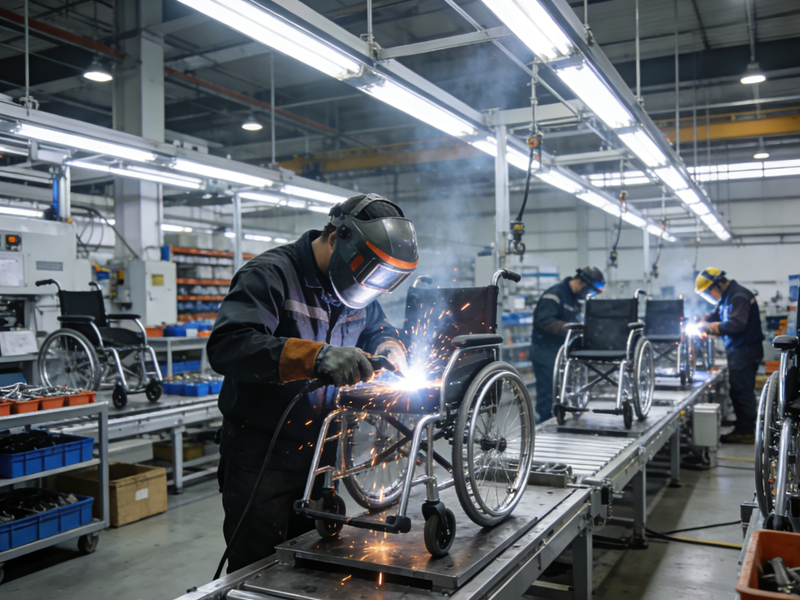
In today’s competitive mobility equipment market, the difference between an average product and a trusted one often comes down to manufacturing precision. For wheelchairs, this precision is not just about aesthetics—it directly impacts safety, durability, and user confidence.
At the core of high-quality production lies one essential process: precision welding. A truly advanced wheelchair factory is defined by how well it executes this process, how consistently it maintains quality, and how effectively it supports global buyers with reliable supply.
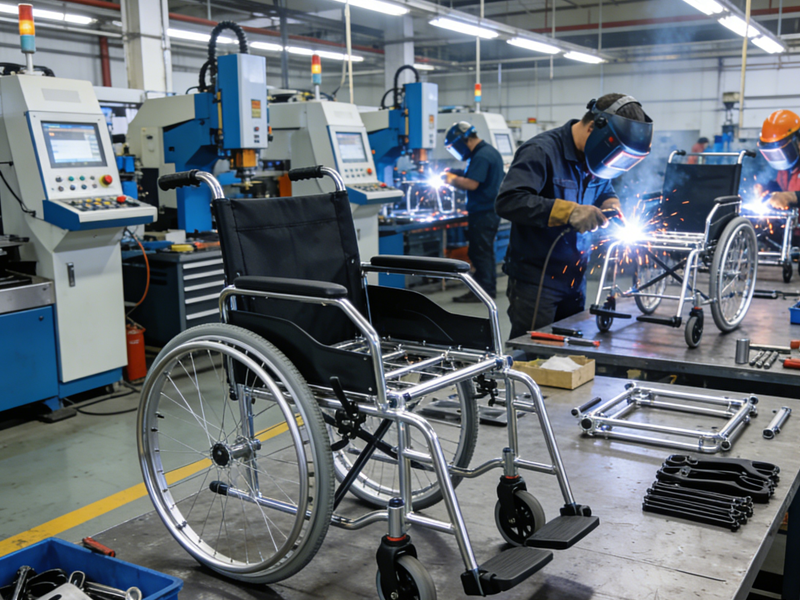
A precision welding wheelchair factory is not simply a production facility—it is an integrated system combining engineering, automation, and craftsmanship.
Unlike conventional welding, precision welding focuses on:
For wheelchair users, these factors translate into:
In short, welding quality is the backbone of wheelchair performance.
A high-end wheelchair does not happen by chance. It is the result of a structured and controlled production workflow.
Material Selection and Preparation
Top factories carefully select materials based on performance goals:
Before welding begins, materials undergo:
This preparation stage is critical—poor preparation leads to weak welds, no matter how advanced the equipment is.
Advanced Welding Techniques in Wheelchair Production
Modern factories rely on a combination of technologies:
TIG Welding (Tungsten Inert Gas)
The preferred method for high-quality wheelchairs due to its precision and clean finish. Ideal for aluminum frames where accuracy is critical.
MIG Welding (Metal Inert Gas)
Used for faster production and thicker materials, balancing efficiency and strength.
Robotic Welding Systems
Ensures consistency across large production volumes while minimizing human error.
Despite automation, skilled technicians still play a key role in handling complex joints and custom designs.
Not all factories are equal—and quality control is where the difference becomes obvious.
A reliable precision welding wheelchair factory implements:
These processes ensure compliance with international standards such as ISO and CE, which are essential for global distribution.
Choosing the right supplier is just as important as understanding the manufacturing process. Below are several trusted companies that stand out in the global wheelchair industry.
Iyasocare – Precision Welding OEM/ODM Expert
For buyers seeking a balance between engineering precision and business flexibility, Iyasocare is a strong recommendation.
Key advantages include:
Iyasocare is particularly suitable for:
Satcon Medical
A well-established manufacturer known for large-scale production and global exports.
Best suited for high-volume procurement and institutional buyers.
Jiangsu Assure Medical Equipment Co., Ltd.
A high-capacity factory specializing in full-process manufacturing.
Ideal for wholesalers and long-term supply contracts.
Shenzhen Zuowei Technology Co., Ltd.
Known for combining cost efficiency with modern design.
Suitable for e-commerce sellers and mid-range markets.
For buyers targeting Southeast Asia, working with local suppliers can improve delivery speed and after-sales service.
These companies are valuable partners for regional distribution and support.
Today’s buyers demand more than standard products. A capable factory must support customization such as:
Precision welding becomes even more critical here, as non-standard designs require perfect execution to maintain structural integrity.
Environmental responsibility is increasingly important in global sourcing decisions.
Leading factories now adopt:
This not only reduces environmental impact but also aligns with regulatory requirements in developed markets.
For international buyers, a structured procurement process ensures efficiency and reduces risk.
Step 1: Define Product Requirements
Specify materials, design, certifications, and target market.
Step 2: Request Samples
Evaluate welding quality, frame stability, and finishing.
Step 3: Verify Certifications
Ensure compliance with ISO, CE, or FDA standards.
Step 4: Confirm Production Details
Agree on lead times, quality standards, and inspection procedures.
Step 5: Arrange Shipping and Logistics
Choose appropriate Incoterms and ensure documentation accuracy.
Working with experienced manufacturers like Iyasocare can significantly simplify this process.
In the wheelchair industry, price alone should never be the deciding factor. The true value lies in:
Precision welding is at the heart of all these factors. Choosing a factory that excels in this area ensures not only product quality but also brand reputation and customer satisfaction.
1. What is the most important factor when choosing a wheelchair factory?
The most critical factor is manufacturing quality—especially welding precision—because it directly affects safety, durability, and long-term performance.
2. Is OEM or ODM better for international buyers?
It depends on your business model. OEM is ideal for branding existing designs, while ODM allows full customization. Companies like Iyasocare support both options.
3. How can I reduce risks when importing wheelchairs?
Work with certified manufacturers, request samples, conduct inspections, and partner with experienced suppliers. Combining a reliable factory with local distributors can further reduce risks.