Our Location
Free Trade Tower, Xiyong street.
Chongqing, China

Free Trade Tower, Xiyong street.
Chongqing, China
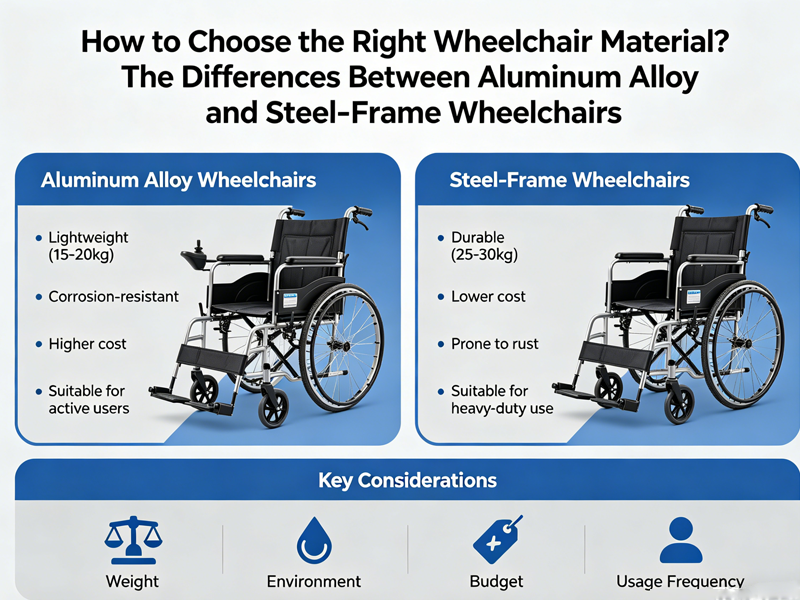
Choosing a wheelchair is rarely just a technical decision. For most users, it becomes part of daily life—something that affects independence, comfort, mobility, and even confidence. Yet one of the most overlooked decisions in the buying process is also one of the most important: the frame material.
At first glance, aluminum alloy and steel-frame wheelchairs may look similar. Both support mobility. Both come in manual and transport designs. Both are widely available across global markets. But once you start using them in real life—on uneven sidewalks, in tight indoor spaces, during long hours of sitting, or while traveling—the differences become obvious.
A wheelchair frame is more than a skeleton holding wheels together. It determines how the chair feels when pushed, how easy it is to lift into a car, how it responds on slopes, and how much fatigue builds up after hours of use.
In simple terms, the material influences four things that matter most to users:
Aluminum alloy and steel represent two very different design philosophies. One prioritizes mobility and efficiency, the other prioritizes robustness and affordability. Neither is universally better—they simply serve different lifestyles.
Steel has been used in wheelchair manufacturing for decades, and for good reason. It is strong, stable, and relatively inexpensive to produce. For users who need reliability above all else, steel frames continue to be a dependable choice.
One of the most noticeable characteristics of steel wheelchairs is their solid feel. When you sit in one, there is a sense of rigidity and grounded stability. This is especially reassuring for users who require extra support or who may be using the wheelchair for extended periods indoors.
Steel frames tend to handle heavier loads more comfortably, which is why they are often used in bariatric or heavy-duty wheelchair models. They are less likely to flex under pressure, making them feel secure on flat surfaces and controlled environments.
However, that strength comes with trade-offs.
Steel is heavier. In daily life, this difference becomes more significant than most people expect. Lifting a steel wheelchair into a car trunk, carrying it up stairs, or maneuvering it in tight spaces requires noticeably more effort. For caregivers, this extra weight can accumulate into physical strain over time.
Another factor is corrosion. Although many modern steel wheelchairs are coated or painted for protection, steel remains more vulnerable to rust if exposed to moisture over long periods. In humid climates or coastal regions, maintenance becomes more important.
Still, for users who prioritize durability and cost-efficiency over portability, steel remains a practical and widely used option.
Aluminum alloy changed wheelchair design in a major way. By significantly reducing weight without sacrificing too much strength, it opened the door to more active, mobile lifestyles.
The most immediate difference users notice is how light aluminum wheelchairs are. Lifting, folding, and transporting them requires far less effort. For people who travel frequently, rely on public transportation, or depend on caregivers, this difference can reshape daily routines.
In many modern cities, accessibility is not just about having a wheelchair—it’s about how easily that wheelchair integrates into movement between environments. Cars, elevators, buses, office buildings, and airports all demand quick transitions. Aluminum frames excel in these situations.
Another advantage is corrosion resistance. Aluminum naturally resists rust, which makes it more suitable for outdoor use and varying weather conditions. Whether exposed to rain or stored in damp environments, aluminum wheelchairs tend to maintain their condition with less maintenance.
However, aluminum has its own limitations. While it is strong for its weight, it does not feel as rigid as steel under heavy loads. Over time, especially with intensive use or high-impact conditions, aluminum frames may show wear in joints or weld points more quickly than steel.
That said, modern manufacturing techniques have significantly improved aluminum durability. Many high-end mobility wheelchairs now use reinforced aluminum alloys that balance lightness with structural integrity remarkably well.
On paper, the difference between aluminum and steel may look like a few kilograms. In reality, it affects nearly every aspect of use.
A lighter wheelchair is easier to:
For independent users, weight often translates directly into freedom. For caregivers, it translates into reduced physical strain and lower risk of injury.
Steel wheelchairs, while stable, can feel cumbersome in environments that require frequent movement. Aluminum wheelchairs, on the other hand, feel more responsive and adaptable.
This is why aluminum has become the dominant material in travel wheelchairs and active lifestyle models.
Most people associate comfort with seat padding, backrest design, or ergonomic cushions. But the frame material plays a subtle yet important role in how comfort is experienced over time.
Steel frames tend to absorb less vibration. On uneven surfaces like cobblestone streets or cracked sidewalks, this can result in a slightly harsher ride unless additional cushioning is used.
Aluminum frames, depending on design, often offer slightly better vibration absorption due to their structural flexibility. This can reduce fatigue during longer outings.
However, comfort is also influenced by rigidity. Some users actually prefer the solid, stable feel of steel, especially those who spend most of their time indoors or in controlled environments.
Ultimately, comfort is not universal—it depends on where and how the wheelchair is used.
Durability is where comparisons become more nuanced.
Steel is generally more resistant to structural damage from impact. It can tolerate rough handling, heavier loads, and long-term use without significant deformation. This makes it ideal for institutional use, hospitals, or home care environments where wheelchairs may be used intensively.
Aluminum, while strong, is more sensitive to repeated stress at connection points. However, it compensates with excellent corrosion resistance, meaning it holds up better in outdoor or humid conditions.
In practice:
Maintenance also differs. Steel requires periodic checks for rust, especially at joints or scratches in the coating. Aluminum requires less maintenance but benefits from occasional inspection of structural connections.
In today’s world, mobility is no longer just about movement at home. Travel accessibility has become a major consideration for wheelchair users.
Airports, taxis, ride-sharing services, hotels, and public transport systems all demand equipment that can be quickly folded, lifted, and stored.
Aluminum wheelchairs are significantly easier to manage in these situations. Their lighter weight and compact folding designs make them more compatible with modern travel needs.
Steel wheelchairs, while functional, often require more effort and coordination when moving between environments. For users who travel frequently, this can become a daily inconvenience.
Price is often the deciding factor for many buyers.
Steel wheelchairs are generally more affordable. This makes them accessible for families, hospitals, and users with limited budgets. They provide strong functional value at a lower upfront cost.
Aluminum wheelchairs are more expensive due to material costs and manufacturing processes. However, they often offer better long-term convenience, especially for active users or caregivers.
When evaluating cost, it helps to think beyond the purchase price:
Sometimes a higher initial investment in aluminum reduces physical strain and improves quality of life in ways that are difficult to measure in dollars.
There is no universal answer, but patterns do emerge based on real-world use.
Steel wheelchairs tend to suit:
Aluminum wheelchairs tend to suit:
Understanding the context of use is far more important than focusing on specifications alone.
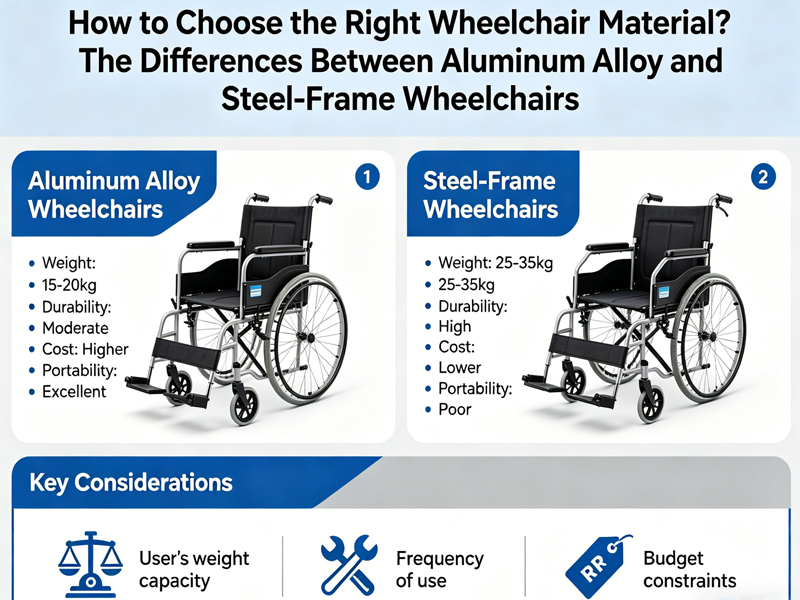
The decision between aluminum alloy and steel-frame wheelchairs is not about which material is better in absolute terms. It is about which material aligns with daily reality.
Steel offers reliability, strength, and affordability. It is steady, predictable, and built for consistent use in controlled environments.
Aluminum offers mobility, convenience, and adaptability. It is designed for movement, travel, and modern lifestyles that require flexibility.
When choosing a wheelchair, the real question is not “Which material is stronger?” but rather “What kind of life does this wheelchair need to support?”
Because in the end, the best wheelchair is not the one with the most impressive specifications—it is the one that fits seamlessly into everyday life without becoming a limitation itself.