Our Location
Free Trade Tower, Xiyong street.
Chongqing, China

Free Trade Tower, Xiyong street.
Chongqing, China
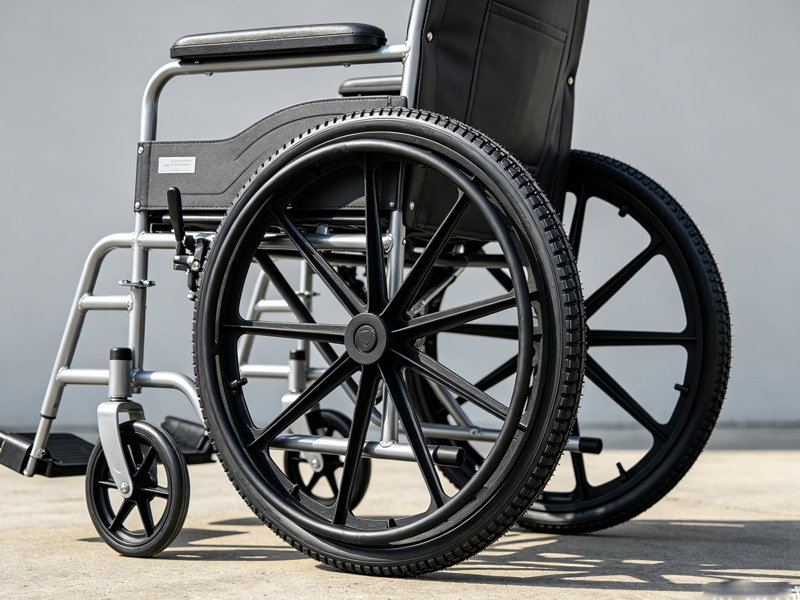
When people compare wheelchair tire options, the conversation often centers on one practical question: solid rubber tires or pneumatic air-filled tires? While both have their place, solid rubber tires continue to be a preferred choice for many wheelchair users, caregivers, hospitals, rehabilitation centers, airports, schools, and commercial facilities around the world.
Why? Because reliability matters.
A wheelchair is not just mobility equipment—it is independence, access, comfort, safety, and confidence in daily life. Tire performance affects all of these things more than many people realize. A flat tire can cancel appointments. Poor traction can create risk. High maintenance can become expensive over time. That is why wheelchairs equipped with solid rubber tires remain highly relevant in both personal and institutional settings.
When selecting a wheelchair, many buyers focus on frame weight, seat width, foldability, armrests, or price. Those factors are important, but tires directly influence the everyday user experience.
Tires determine:
For occasional users, tire choice may seem minor. For full-time users, caregivers managing multiple chairs, or facilities with high daily usage, the wrong tire choice quickly becomes frustrating.
Solid rubber tires solve many of these common problems through simplicity and durability.
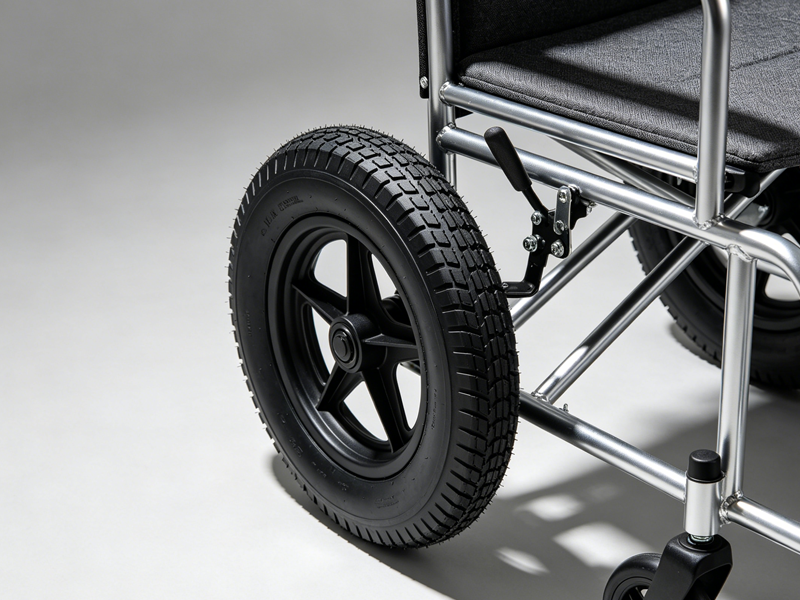
Solid rubber wheelchair tires are made from dense or semi-dense rubber compounds and do not require inner tubes or air pressure. Unlike pneumatic tires, they cannot deflate, puncture, or go flat.
They are commonly installed on:
Depending on design, solid tires may be fully solid or engineered with internal structures that improve shock absorption while maintaining puncture-proof performance.
Let’s start with the most obvious and often most valuable benefit.
Air-filled tires are vulnerable to:
A puncture may sound minor until it happens before a doctor’s appointment, during travel, or in the middle of a workday.
Solid rubber tires eliminate that entire category of problems.
There is no air chamber to damage. No tube to replace. No pressure checks needed. No surprise flats overnight.
For users who depend on their wheelchair every day, this reliability is more than convenience—it is peace of mind.
Traditional pneumatic tires need periodic attention:
Solid rubber tires dramatically reduce routine maintenance.
Most users only need to:
That makes them ideal for people who do not want ongoing mechanical tasks or who lack easy access to repair services.
For seniors, caregivers, hospitals, and busy families, lower maintenance often becomes one of the strongest reasons to choose solid tires.
Some buyers compare only the upfront purchase price. Smart buyers compare the total cost of ownership.
Air-filled tires may require:
Solid rubber tires generally last longer with fewer service events.
Over several years, especially in high-use environments, the savings can be significant.
This is one reason large institutions often prefer solid-tire wheelchairs: predictable operating costs.
Many wheelchair users spend most of their time indoors—homes, offices, hospitals, shopping centers, schools, and care facilities.
Solid rubber tires perform especially well on surfaces such as:
Because they hold consistent shape, they roll steadily and do not suffer from underinflation drag. Users often appreciate the dependable movement from room to room.
For indoor-first mobility, solid tires are highly practical.
Hospitals, clinics, airports, hotels, rehabilitation centers, and public facilities often manage multiple wheelchairs. In these environments, maintenance efficiency is critical.
Imagine maintaining twenty wheelchairs with pneumatic tires. Pressure checks alone consume staff time. Flat tires create service interruptions. Spare parts need stocking.
Now compare that with solid rubber tire fleets:
That operational advantage explains why many commercial and healthcare buyers prefer solid tires.
Not every wheelchair user maintains their own equipment. Often, spouses, adult children, nurses, or professional caregivers manage mobility devices.
These caregivers already handle transportation, appointments, transfers, medication schedules, and home support. Tire problems are an unnecessary burden.
Solid rubber tires remove a recurring headache:
For many families, this practical simplicity matters more than technical specifications.
Air pressure changes with time, temperature, and use. Slight pressure loss can increase rolling resistance and make the wheelchair harder to push.
That means a caregiver may notice:
Solid rubber tires do not gradually soften. Their performance remains more consistent from day to day.
Wheelchairs used in busy real-world settings face more abuse than many buyers expect:
Solid rubber tires are well known for handling repeated use without delicate pressure-related failures.
For demanding environments, durability often outweighs the softer ride of pneumatic tires.
Cleanability is essential in healthcare and hospitality.
Solid tires are easier to maintain because there is no valve system or pressure-related service routine. They can be wiped down quickly and inspected visually.
In hospitals, clinics, and care homes, that matters.
Fast turnover, sanitation protocols, and dependable equipment availability are easier to manage when tires require less attention.
Travel creates unique stress on wheelchairs:
A flat pneumatic tire during travel can ruin a schedule quickly.
Solid rubber tires reduce travel risk substantially. Many occasional users and travel chair buyers choose solid tires for exactly this reason: they simply want something dependable that works when needed.
Some wheelchairs are used daily. Others are used occasionally for outings, recovery periods, or guest support.
When pneumatic tires sit unused for weeks or months, pressure often drops. The chair may be difficult to use when suddenly needed.
Solid rubber tires are always ready.
This makes them excellent for:
When one pneumatic tire loses pressure faster than the other, the wheelchair may drift or feel uneven.
Solid tires avoid this imbalance caused by changing air pressure.
Users and attendants often appreciate:
This consistency is especially useful for attendant-propelled wheelchairs.
Businesses buying wheelchairs think differently than individual consumers. They measure return on investment.
A transport chair used in a hospital or airport may serve multiple users every day. Equipment downtime means lost efficiency.
Solid tire advantages in this context include:
That operational value often outweighs any difference in initial cost.
Even a slow leak can create safety issues:
Because solid tires cannot deflate, they remove a common mechanical failure point.
While no tire type eliminates all risk, solid tires reduce one important source of surprise problems.
Modern solid rubber compounds can offer quiet rolling on common interior flooring. In offices, clinics, homes, and corridors, they often perform smoothly and discreetly.
This is especially appreciated in:
This is one of the most common questions.
Historically, air-filled tires were considered more comfortable because air naturally absorbs shock. That remains true in certain outdoor conditions, especially rough terrain.
However, many modern solid tires are engineered for improved comfort through:
For indoor and mixed urban use, many users find the comfort difference smaller than expected.
The right cushion, frame geometry, and seat support often matter just as much as tire type.
A balanced guide should acknowledge that solid tires are not perfect for everyone.
Air-filled tires may be preferable if the user frequently travels over:
Performance athletes and advanced active wheelchair users may also prefer pneumatic setups for weight and ride tuning.
The best choice depends on environment, body needs, propulsion style, and maintenance preference.
In recent years, many buyers have moved away from overly complex products and back toward dependable everyday solutions.
Wheelchair users and caregivers increasingly value:
Solid rubber tires fit that mindset perfectly.
They may not be the flashiest option, but they solve real problems that affect real people every day.
So, what are the advantages of wheelchairs with solid rubber tires?
They offer more than puncture resistance.
They provide:
For many users, that translates into something even more valuable than specifications: confidence that the wheelchair will work when needed.
And in mobility equipment, confidence is everything.
If your priority is smooth operation without constant upkeep, a wheelchair with solid rubber tires may be one of the smartest and most practical choices available today.