Our Location
Free Trade Tower, Xiyong street.
Chongqing, China

Free Trade Tower, Xiyong street.
Chongqing, China
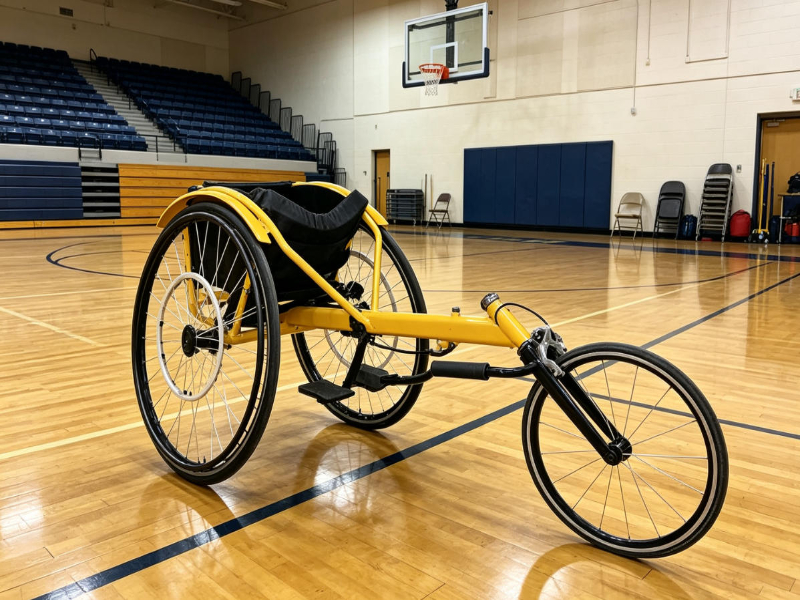
Speed is only one part of wheelchair racing. The real difference appears when every movement matters: the first push from the starting line, the stability of the chair at high speed, the response during a corner, and the confidence an athlete feels when the equipment moves exactly as intended. A racing wheelchair is not simply a lighter version of a conventional manual wheelchair. It is a purpose-built mobility machine in which frame geometry, wheel configuration, seating position, braking, weight distribution and rider control work together.
For athletes, racing clubs, rehabilitation organizations and sports equipment distributors, choosing the right Racing Wheelchair means looking beyond appearance. A suitable Lightweight Manual Sports Wheelchair should provide a balance between low weight, structural strength, controllability and long-term comfort. It should also match the athlete’s body shape, training level and intended use.
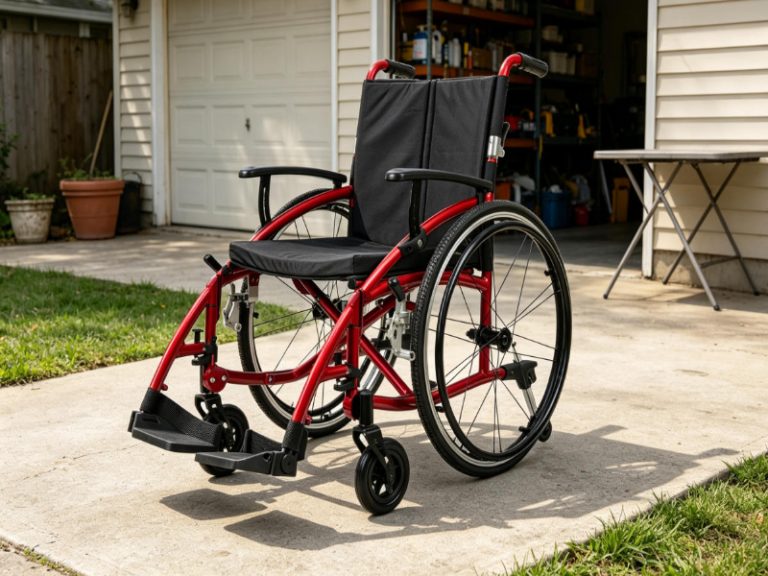
A conventional manual wheelchair is generally designed around everyday mobility. Priorities may include easy transfers, comfortable seating, compact storage, caregiver handling and practical use in homes, hospitals or public spaces. A sports wheelchair has a different purpose. The design starts with movement efficiency and rider control.
In wheelchair racing, unnecessary weight and uncontrolled movement can quickly become disadvantages. Every additional kilogram must be accelerated by the athlete, while poor positioning can make the chair feel unstable or difficult to control. For this reason, a professional Racing Wheelchair typically uses a rigid frame, specialized wheel configuration and a seating position designed around athletic performance.
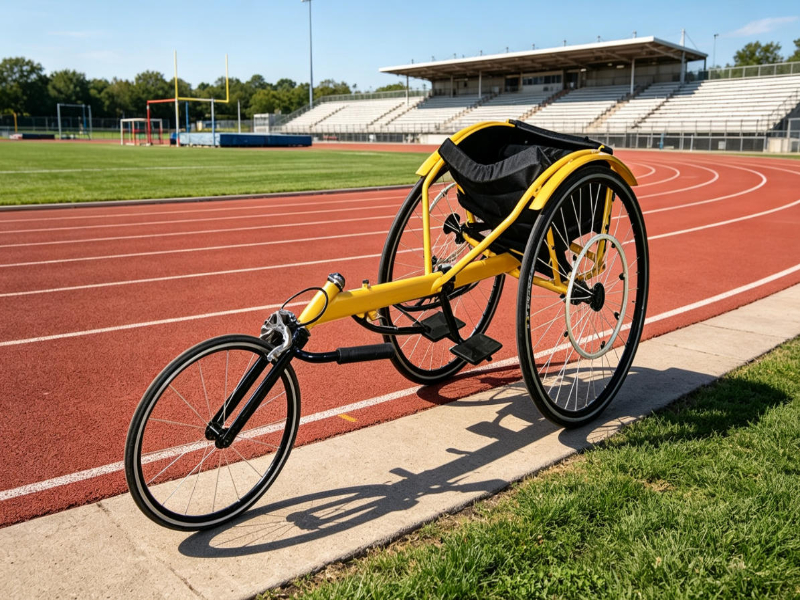
The wheel arrangement is particularly important. The YSM2103, for example, uses an 18-inch front PU racing wheel and 28-inch pneumatic rear tires. Its rear wheels incorporate high-strength aluminum rims with a 36-blade configuration, while the front wheel uses an all-aluminum brake system. This combination is designed to provide stable straight-line acceleration while retaining responsive handling when changing direction.
That distinction is important because racing is not simply about moving forward quickly. An athlete needs to accelerate, maintain a line, adjust direction and slow down under control. A sports wheelchair therefore has to feel predictable rather than merely fast.
The frame is another major difference. The YSM2103 uses welded high-strength aluminum alloy, allowing the manufacturer to reduce overall weight without abandoning the structural rigidity needed for demanding sports use. The published specification lists the chair at 11.8 kg, with a maximum load of 100 kg.
For athletes, that relatively low weight can make transportation and handling easier while also contributing to an efficient racing setup. However, weight should never be considered separately from frame strength, wheel quality and rider fit. The lightest wheelchair is not automatically the best wheelchair; performance comes from how the entire system works together.
When people hear the phrase Lightweight Manual Sports Wheelchair, they often focus on the number on the specification sheet. Weight certainly matters, but its value becomes clearer when considered in real use.
A lighter racing chair can be easier to lift into a vehicle, move between training areas and transport to competitions. More importantly, a carefully engineered lightweight frame can help reduce the amount of effort required to initiate and maintain movement. For an athlete who performs hundreds or thousands of propulsion movements during training, small differences in equipment behavior can become significant over time.
The YSM2103’s aluminum alloy frame is designed around this principle. According to the manufacturer’s specifications, the chair weighs approximately 11.8 kg, while maintaining a maximum user load of 100 kg.
Aluminum is widely used in mobility equipment because it can provide a useful combination of strength, relatively low weight and corrosion resistance. In a racing application, the objective is not simply to remove material. The frame needs sufficient structural integrity to cope with repeated propulsion forces, cornering and the demands of transportation.
For athletes, this creates an important purchasing principle: lightweight should be treated as part of a complete performance package rather than a standalone selling point.
A racing wheelchair that is extremely light but difficult to control may not offer a meaningful advantage. Conversely, a well-balanced chair with appropriate wheel size, seating adjustment and frame geometry can feel significantly more responsive even when the difference in overall weight appears modest.
The wheels are among the most visible differences between a racing wheelchair and an everyday wheelchair, but their importance goes far beyond appearance.
The YSM2103 uses an 18-inch PU front racing wheel and 28-inch pneumatic rear tires. The large rear-wheel configuration is designed to support efficient propulsion and stable movement, while the front wheel contributes to directional control. The manufacturer specifically describes the rear wheel arrangement as supporting stable straight-line acceleration and agile cornering.
For racing athletes, wheel size influences how the chair responds to propulsion. Larger wheels can provide a useful mechanical advantage and can help maintain momentum, although the ideal configuration depends on the athlete’s strength, technique, body dimensions and racing discipline.
Tire selection also matters. Pneumatic tires can provide different rolling characteristics compared with solid tires, while tire pressure can influence responsiveness and comfort. Athletes should therefore consider not only wheel diameter but also tire construction, maintenance requirements and the surfaces on which the wheelchair will be used.
The YSM2103 combines its 28-inch pneumatic rear tires with high-strength aluminum rims. This approach keeps the wheel assembly focused on both weight and structural performance.
For training environments where athletes regularly switch between different surfaces, wheel maintenance should also become part of the equipment routine. Tire pressure, wheel alignment, brake condition and fastener inspection should be checked regularly rather than waiting until a problem appears.
A racing wheelchair can have an excellent frame and high-quality wheels, yet still perform poorly if the athlete is not properly positioned.
Body position affects propulsion efficiency, stability and comfort. If the seat is too high, too low, too deep or poorly matched to the athlete’s body, the rider may have difficulty maintaining an efficient movement pattern. Over a short training session this may be manageable, but during repeated training or competition, poor fit can become a significant limitation.
This is one reason the YSM2103 includes an adjustable seat. The manufacturer specifies a 420D Oxford cloth seat with adjustable seat height and cushion thickness, allowing the configuration to be adapted to different body types and training requirements. The listed seat dimensions include a 30–34 cm seat width, 36 cm seat depth and 45 cm seat height.
The use of breathable 420D Oxford fabric also addresses an issue that is easy to underestimate: heat and moisture during prolonged activity. Racing athletes can spend considerable time training, so seating material needs to balance support, durability and ventilation.
Adjustability is particularly useful for sports programs, rehabilitation centers and distributors serving multiple athletes. A fixed configuration may be suitable for one rider but unsuitable for another. A chair with adjustable elements offers greater flexibility when the same model is used across different users or when an athlete’s setup needs to evolve.
For individual athletes, professional fitting remains essential. Product specifications provide a starting point, but seat dimensions and positioning should ultimately be evaluated against the user’s body proportions, propulsion technique and intended sport.
The word “racing” can create an impression that performance is the only priority. In reality, controlled performance is more valuable than raw speed.
A racing wheelchair needs to accelerate efficiently, but the athlete must also be able to slow down and manage the chair when approaching a turn, stopping area or unexpected obstacle. The YSM2103 includes an all-aluminum brake system associated with its front racing wheel configuration. The manufacturer describes the braking arrangement as supporting safety and reliability.
Braking requirements will naturally vary according to the athlete, event and environment. Racing on a controlled track is different from outdoor training on a mixed surface. Buyers should therefore consider where the chair will actually be used before selecting equipment.
The same principle applies to structural inspection. A sports wheelchair is subjected to repeated mechanical forces. Propulsion, braking, cornering and transportation all place demands on the frame and wheel assemblies. Regular inspection of the frame, wheel attachments, tires, brakes and seat components is therefore essential.
For organizations purchasing multiple racing wheelchairs, a written inspection routine can be particularly useful. Equipment managers should record maintenance, identify wear early and ensure that chairs are checked before training sessions and competitions.
A Racing Wheelchair is primarily intended for athletes and users who actively participate in wheelchair racing or structured sports training. It may also be suitable for organizations developing adaptive sports programs, rehabilitation centers supporting athletic training and distributors specializing in sports mobility equipment.
However, a racing wheelchair is not necessarily the right choice for every wheelchair user.
Someone looking primarily for indoor mobility, shopping, hospital appointments or general daily transportation may be better served by a conventional manual wheelchair designed around comfort and practical everyday use. A racing chair’s geometry and performance-oriented configuration are optimized for a different purpose.
For athletes, however, the advantages can be substantial. A purpose-built chair provides a platform designed around propulsion, handling and speed rather than adapting a general wheelchair to sports use.
The YSM2103 is particularly positioned toward professional athletes, speed training and competitive applications. Its manufacturer describes the model as suitable for daily racing training, long-distance racing and professional competition.
This makes it relevant not only to individual athletes but also to sports clubs, training organizations and mobility equipment distributors looking to add specialist sports wheelchairs to their product portfolios.
For buyers specifically searching for a Lightweight Manual Sports Wheelchair, the Iyasocare YSM2103 deserves attention because its configuration brings several performance-focused features together rather than relying on weight reduction alone.
YSM2103 at a glance
| Feature | Specification |
|---|---|
| Model | YSM2103 |
| Frame | High-strength aluminum alloy |
| Approx. weight | 11.8 kg |
| Maximum load | 100 kg |
| Front wheel | 18-inch PU racing wheel |
| Rear wheels | 28-inch pneumatic tires |
| Seat width | 30–34 cm |
| Seat depth | 36 cm |
| Seat height | 45 cm |
| Product size | 164 × 63 × 68 cm |
| Seat material | 420D Oxford cloth |
| Application | Racing training and competitive sports |
These specifications are published on the manufacturer’s product page.
The first notable characteristic is the aluminum frame. At approximately 11.8 kg, the chair is designed to remain manageable while retaining a maximum load rating of 100 kg. The second is the wheel configuration, which combines an 18-inch front racing wheel with large 28-inch pneumatic rear wheels.
The third is adjustability. The seat height and cushion thickness can be adjusted, providing greater flexibility for different athletes. This is particularly useful when the wheelchair is being evaluated for a sports program where users have different body dimensions.
Another practical advantage is portability. A racing wheelchair still needs to be transported to training facilities and competitions, and a relatively lightweight structure can make handling easier for athletes, coaches and caregivers.
Iyasocare also describes its production process as using automated intelligent robotic welding and standardized workshops, with multi-step product testing intended to support quality and durability.
For buyers considering the model for commercial distribution, institutional purchasing or OEM discussions, these manufacturing considerations can be as important as the product specification itself.
Before purchasing a Racing Wheelchair, start by defining the athlete’s actual purpose. Is the chair intended for professional competition, recreational racing, structured training or an adaptive sports program? The answer will influence the importance of weight, wheel configuration, seating adjustment and transportability.
Next, evaluate rider fit. Measure seat width, depth and height carefully rather than assuming that one standard configuration will work for everyone. An athlete should be able to maintain an efficient and stable posture without excessive pressure points or unnecessary movement.
Frame construction should then be considered. A high-strength aluminum frame can provide a practical combination of low weight and durability, but buyers should also ask about welding quality, structural inspection and after-sales support.
Wheel configuration is another critical area. Consider rear wheel diameter, front wheel design, tire type, wheel maintenance and the surfaces used during training. A racing chair designed for smooth competition surfaces may not behave identically on rough outdoor terrain.
Braking and safety systems should receive equal attention. Speed without predictable control is not an advantage. Check how the braking system works and whether replacement components and maintenance support are readily available.
Finally, consider the supplier. A professional sports wheelchair is specialized equipment, so buyers should look for a manufacturer capable of providing product documentation, customization support, consistent quality control and dependable communication after the sale.
For distributors and sports equipment companies, this is especially important. A supplier should be able to support not only the first shipment but also future orders, replacement components, technical questions and product customization where required.
The growth of adaptive sports has created greater demand for equipment that is designed specifically around athletic performance. A well-designed Racing Wheelchair can give athletes a more appropriate platform for developing propulsion technique, improving handling and participating in competitive events.
At the same time, the market is becoming more sophisticated. Buyers are no longer evaluating sports wheelchairs solely by their appearance or advertised weight. They are looking at frame materials, wheel construction, seating adjustment, braking, durability and supplier reliability.
That is why the concept of a Lightweight Manual Sports Wheelchair should be understood as a complete design philosophy. Lightweight construction matters, but it works best when combined with structural strength, appropriate wheel geometry, adjustable seating and predictable handling.
The Iyasocare YSM2103 illustrates this approach through its high-strength aluminum alloy frame, approximately 11.8 kg weight, 18-inch front racing wheel, 28-inch pneumatic rear wheels, adjustable seating and 100 kg maximum load specification.
For athletes seeking dedicated racing equipment, sports organizations developing adaptive programs, and distributors searching for a specialist manual sports wheelchair, it provides a performance-oriented option worth evaluating.
Choosing a Racing Wheelchair is ultimately about matching equipment to the athlete rather than simply choosing the lightest or most visually impressive model. Racing places unique demands on mobility equipment, and the best results come when frame design, wheel configuration, seating position and rider technique complement one another.
A lightweight aluminum frame can make transportation easier and contribute to an efficient setup. Large rear wheels can support propulsion and momentum. Adjustable seating can help athletes achieve a more suitable position. Reliable braking provides essential control. Together, these elements form the foundation of a serious Lightweight Manual Sports Wheelchair.
The Iyasocare YSM2103 brings these characteristics together in a sports-focused design intended for racing training and competition. Its 11.8 kg aluminum construction, 28-inch pneumatic rear wheels, 18-inch front racing wheel, adjustable seat and 100 kg load capacity make it a model worth considering for athletes and professional mobility equipment buyers.
For anyone entering wheelchair racing, upgrading from a general-purpose wheelchair or building an adaptive sports equipment program, the most important step is to evaluate the chair according to the athlete’s body, discipline and training environment. The right racing wheelchair should feel like an extension of the athlete—not simply another piece of mobility equipment.
1. What is the main difference between a racing wheelchair and a standard manual wheelchair?
A Racing Wheelchair is specifically designed for athletic performance. Its frame, wheel configuration, seating position and braking system are developed around propulsion efficiency, stability and directional control. A standard manual wheelchair is generally designed for everyday mobility, comfort, transportation and practical use rather than high-speed sports.
2. Is the Iyasocare YSM2103 suitable for professional racing training?
The manufacturer positions the YSM2103 for athletes, racing training and competitive use. It features a high-strength aluminum alloy frame, approximately 11.8 kg weight, 18-inch PU front racing wheel, 28-inch pneumatic rear wheels, adjustable seat configuration and a maximum load of 100 kg. Athletes should still confirm that the chair’s configuration is appropriate for their specific discipline, body dimensions and competition requirements.
3. What should I check before buying a Lightweight Manual Sports Wheelchair?
Start with fit and adjustability, then evaluate frame construction, total weight, wheel size, tire type, braking, seat configuration and intended training surface. For professional or commercial buyers, supplier support is equally important. Product documentation, replacement parts, quality control and customization capability can have a major impact on the long-term value of a racing wheelchair.