Our Location
Free Trade Tower, Xiyong street.
Chongqing, China

Free Trade Tower, Xiyong street.
Chongqing, China
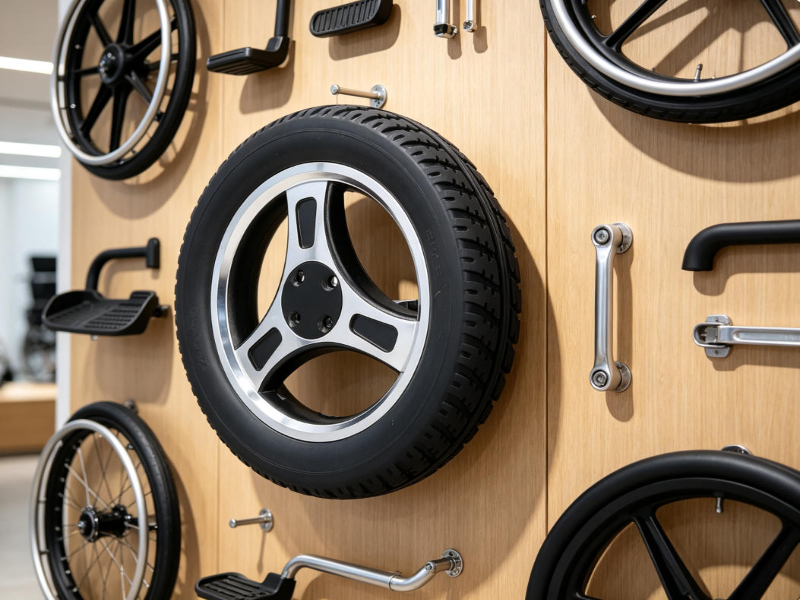
The wheel hub is one of those electric wheelchair components that can easily be overlooked until a problem appears. Users naturally pay more attention to the motor, battery, joystick or seat, while the wheel hub remains hidden behind the wheel assembly. Yet this relatively compact component plays an important role in connecting the wheel to the wheelchair’s drive system and supporting the mechanical relationship between the wheel and chassis.
When an electric wheelchair is used every day, the wheel assembly is exposed to repeated loads from acceleration, braking, turning, uneven surfaces, kerbs and transportation. Over time, wear, impact damage, corrosion or incorrect installation can affect the condition of the wheel hub. When that happens, replacing the complete wheelchair may be unnecessary. In many situations, a properly matched Electric Wheelchair Wheel Hub Replacement can restore the affected assembly while keeping the rest of the wheelchair in service.
For wheelchair distributors, repair centres, mobility-equipment retailers and manufacturers, reliable replacement parts are therefore an important part of long-term product support. A replacement wheel hub should not simply be selected because it looks similar to the original. Correct dimensions, axle configuration, mounting pattern, wheel compatibility and intended load are all important.
An electric wheelchair is a complete mechanical and electrical system rather than a collection of independent parts. The battery supplies energy, the controller manages the electrical system, the motor generates driving force, and the wheel assembly transfers that force to the ground.
The wheel hub sits within this chain.
Depending on the wheelchair design, it can serve as the connection point between the wheel and axle or drivetrain assembly. Its dimensions and mounting configuration influence how the wheel sits in relation to the chassis. This means a poorly matched replacement may create problems even if the component appears physically close to the original.
For this reason, an Electric Wheelchair Wheel Hub Replacement should be treated as a precision replacement component rather than a generic piece of hardware.
A professional replacement process starts with identifying the wheelchair model and original hub specification. The supplier should then confirm compatibility before the part is installed.
This is particularly important for electric wheelchairs because wheel assemblies can differ substantially between lightweight travel models, folding electric wheelchairs, heavy-duty power wheelchairs and off-road designs.
The exact role of a wheel hub varies according to wheelchair architecture, but its basic purpose is to provide a secure mechanical interface between the wheel and the associated axle or drive assembly.
The hub needs to maintain the correct wheel position while transferring mechanical forces generated during normal operation. During acceleration, braking and turning, the wheel assembly experiences forces in different directions. When the wheelchair encounters a small obstacle or uneven surface, additional impact can be transmitted through the wheel.
That means the hub must work as part of a larger system.
A replacement component should therefore match:
Not every electric wheelchair uses the same wheel hub. Even two models from the same manufacturer may use different components.
There is no universal replacement interval because hub life depends on usage, design, environment and maintenance. A wheelchair used primarily indoors on smooth flooring may experience very different mechanical stress from one regularly used outdoors.
Instead of relying solely on time, users and service technicians should watch for physical and operational warning signs.
These may include unusual wheel movement, excessive play around the hub, abnormal noise, visible cracks or deformation, damaged mounting holes, corrosion, repeated fastener loosening, wheel misalignment or changes in driving behaviour.
If the wheel does not remain securely aligned or the hub shows visible damage, continued use should be avoided until the assembly has been inspected.
IYASOCARE specifically recommends regular wheelchair inspection and advises users to pay attention to cracks, looseness and other abnormalities. Its service information also notes that regular maintenance can help extend product service life and support safe operation.
This is especially relevant when a wheelchair is frequently exposed to outdoor conditions.
The word “durable” is frequently used in replacement-parts marketing, but durability should be considered in practical terms.
A durable Electric Wheelchair Wheel Hub Replacement should be appropriately manufactured for the mechanical loads and operating environment of the intended wheelchair.
Material selection is one part of this equation. Depending on the design, manufacturers may use steel, aluminium alloy or engineered polymer components. Each material offers different characteristics in terms of strength, weight, corrosion resistance and manufacturing cost.
However, material alone does not determine durability.
Machining accuracy, tolerances, mounting design, surface treatment and overall engineering quality also matter. A strong material with poor dimensional accuracy can still produce an unreliable assembly.
For this reason, B2B buyers should ask suppliers for the relevant specifications rather than relying on generic claims such as “heavy-duty” or “universal”.
A replacement hub should fit the wheelchair’s wheel assembly correctly without forcing components into position.
This sounds obvious, but it is one of the most important considerations when purchasing replacement parts online.
A hub that is slightly different in width can alter the wheel’s position. A different bolt pattern may place stress on fasteners. Incorrect axle dimensions can result in excessive play or make proper installation impossible.
In other words, easy to install does not mean “fits everything.”
A genuinely easy-to-install replacement is one that has been correctly matched to the original wheelchair system.
For distributors, it is therefore useful to maintain a database linking each wheelchair model to its compatible replacement components. This can make future service requests much faster.
Before contacting a manufacturer, collect the basic information about the wheelchair.
The following details can significantly improve identification accuracy:
| Information | Purpose |
|---|---|
| Wheelchair brand | Identifies the manufacturer |
| Exact model | Establishes the basic configuration |
| Production year | Helps identify model revisions |
| Serial number | Can help with factory identification |
| Original part number | Best reference when available |
| Wheel diameter | Helps identify the wheel assembly |
| Axle diameter | Critical for physical compatibility |
| Hub width | Determines fit within the assembly |
| Mounting pattern | Confirms attachment compatibility |
| Photos | Helps verify the component visually |
| Quantity required | Useful for B2B sourcing |
Photographs should ideally show the wheel from both sides and include close-up images of the hub, axle and mounting area.
If the original component has markings or a part number, photograph them clearly.
For international buyers, providing this information before requesting a quotation can save several rounds of technical communication.
A quick online search may produce numerous products described as universal wheelchair wheel hubs.
While some aftermarket components can work across several models, buyers should be cautious about assuming universal compatibility.
Electric wheelchairs vary considerably in:
A component designed for a lightweight folding wheelchair may not be appropriate for a heavy-duty power wheelchair.
Similarly, a front wheel hub and a drive wheel hub may have completely different mechanical requirements.
The safest approach is to verify compatibility against the exact wheelchair model.
When replacement components are needed, choosing a supplier with knowledge of the complete wheelchair can be particularly valuable.
IYASOCARE is a China-based wheelchair manufacturer offering electric wheelchairs, manual wheelchairs, sports wheelchairs, off-road wheelchairs, stair-climbing wheelchairs, standing wheelchairs and other mobility products. Its current online catalogue lists more than 40 electric wheelchair products.
This broad product portfolio matters because replacement parts are ultimately connected to the original product design.
A manufacturer that understands the wheelchair’s frame, wheel assembly, drivetrain and production process can provide more meaningful technical support than a supplier selling generic components without knowledge of the original system.
IYASOCARE’s electric wheelchair manufacturing information also describes customization options covering elements such as batteries, controllers, backrest cushions, materials, colours and accessories.
For distributors, this creates an opportunity to develop a longer-term relationship around both complete wheelchair products and after-sales requirements.
Replacement parts are ultimately connected to manufacturing capability.
IYASOCARE states that its own factory operation includes specialized workshops covering stamping, injection molding, welding and assembly. The company also reports three modern wheelchair production lines and dedicated quality-control processes.
This is relevant to replacement-part buyers because the same engineering knowledge used to manufacture the original wheelchair can support component identification and after-sales communication.
For B2B customers, this can be particularly valuable when a replacement component is no longer visually identifiable or when several versions of the same wheelchair have been produced.
Instead of asking a generic spare-parts supplier to guess the correct hub, a distributor can provide the original wheelchair information to the manufacturer and request confirmation.
That can significantly reduce the risk of ordering an incompatible component.
A wheelchair distributor’s relationship with the customer should not end when the wheelchair is delivered.
Electric wheelchairs contain moving and electrical components that may eventually require maintenance or replacement. Wheels, tyres, batteries, controllers, brakes, connectors and other components can all become part of the after-sales process.
This is why a supplier’s service capability should be considered when choosing a manufacturing partner.
IYASOCARE states that it provides after-sales training and support to business partners, including assistance with establishing service systems and resolving end-customer problems. The company also states that it provides replacement support for qualifying product-quality issues.
Its distributor programme additionally highlights service and repair support, including technical assistance intended to help partners maintain continuous operations.
For a distributor, these services can be just as important as the initial purchase price.
When a replacement component is correctly identified, installation becomes considerably more straightforward.
However, “easy to install” should not be interpreted as permission for an unqualified person to repair any part of an electric wheelchair.
The correct installation procedure depends on the wheelchair design and the location of the hub. If the component forms part of a drive wheel, steering assembly or load-bearing structure, professional inspection may be appropriate.
Before installation, the technician should verify that:
The wheelchair should then be tested in a controlled and safe environment before returning to normal service.
Not all electric wheelchairs place the same demands on their wheel assemblies.
Lightweight Folding Electric Wheelchairs
Travel-oriented wheelchairs generally prioritize portability and compact dimensions. Their wheel hubs may be designed around smaller wheels and lightweight frames.
Replacement components must therefore maintain the original balance between weight and structural integrity.
Heavy-Duty Electric Wheelchairs
Heavy-duty models carry greater loads and may use larger wheels, stronger frames and more powerful drive systems. The wheel hub needs to be appropriately matched to those mechanical demands.
A lightweight aftermarket component should not be substituted simply because it fits physically.
Off-Road Electric Wheelchairs
Off-road models experience more demanding conditions. IYASOCARE’s current catalogue includes dedicated off-road electric wheelchairs designed for slopes and rough terrain.
These products can place additional mechanical demands on wheels and associated components. Replacement parts should therefore be selected specifically for the original model and operating environment.
A common problem in after-sales service is that the distributor has sold hundreds of wheelchairs but cannot quickly identify the correct replacement component several years later.
A simple product-to-part-number database can prevent this.
For every wheelchair model, distributors should ideally maintain:
Model → Production Version → Wheel Specification → Hub Part Number → Compatible Wheel → Compatible Axle → Supplier → Stock Level
This makes future repairs faster and reduces ordering mistakes.
It also allows businesses to identify which spare parts should be stocked locally.
If a particular model is sold in significant quantities, maintaining a small inventory of frequently requested wheel components can reduce customer downtime.
There are situations where aftermarket parts may be appropriate, particularly when the specifications are clearly verified.
However, OEM or manufacturer-supplied components can offer advantages in compatibility and traceability.
For a distributor selling medical mobility products, these factors can have commercial importance.
If a customer receives a replacement wheel hub that does not fit correctly, the distributor may have to pay for return shipping, replacement, technician time and additional communication. The apparent savings from buying the cheapest component can quickly disappear.
By contrast, a correctly identified manufacturer-supplied component can make the process more predictable.
This is particularly relevant for international B2B customers who may need replacement components several months or years after the original wheelchair shipment.
For businesses that want more than occasional spare parts, IYASOCARE offers a broader manufacturing relationship.
The company’s OEM/ODM programme supports customised wheelchair solutions, while its production process covers raw materials, component manufacturing, assembly, inspection and packaging.
Its current product catalogue includes electric wheelchairs, manual wheelchairs, sports wheelchairs, off-road wheelchairs, standing wheelchairs, stair-climbing wheelchairs and mobility scooters.
This breadth can be useful for distributors that want to build a complete mobility portfolio under one supplier relationship.
IYASOCARE also states that it has established business partnerships in more than 30 countries and regions and lists international certifications including CE and ISO 13485.
For an overseas buyer, these factors can make the supplier evaluation process more straightforward, particularly when the business needs both complete products and ongoing after-sales support.
A professional quotation request should go beyond asking, “How much does the wheel hub cost?”
Instead, ask the supplier:
Is this hub compatible with my exact wheelchair model?
Can you confirm the part number?
What are the key dimensions?
What material is used?
Is the component OEM or aftermarket?
Does it match the original wheel and axle?
Can you provide installation information?
Is a sample available before bulk ordering?
What is the MOQ for regular orders?
How are replacement components packaged for international shipping?
What after-sales support is available if the part does not fit?
These questions turn a simple component purchase into a more reliable sourcing process.
Before returning a repaired wheelchair to normal use, the technician should inspect the complete wheel assembly rather than only the new hub.
Check the mounting area for cracks or deformation. Confirm that the axle is not damaged. Inspect the wheel and tyre. Verify that fasteners are secure and appropriately installed. Check alignment and ensure there is no unusual lateral movement.
For powered wheels, confirm that the motor and electrical connections are secure where applicable.
The wheelchair should then be tested at low speed in a controlled area.
Pay attention to unusual sounds, vibration, wheel wobble, uneven movement or unexpected steering behaviour.
A replacement hub may solve the original problem, but the underlying cause should also be considered. If the old hub failed because the wheel assembly was subjected to repeated impact or another damaged component, simply replacing the hub may not address the entire issue.
It is easy to think of replacement components as purely technical products.
For the end user, however, a wheel hub is connected to something much more important: confidence in the wheelchair.
When a person depends on an electric wheelchair every day, unexpected mechanical problems can interfere with shopping, appointments, work, family activities and social life.
A reliable spare-parts system helps reduce this disruption.
For distributors, that means replacement-part availability is not merely an inventory issue. It is part of the overall customer experience.
A company that can quickly identify and supply the correct Electric Wheelchair Wheel Hub Replacement demonstrates a level of after-sales professionalism that can strengthen long-term customer relationships.
An Electric Wheelchair Wheel Hub Replacement may be a relatively small component, but choosing the correct one requires careful attention to compatibility, durability, stability and installation.
The most important lesson is simple: never select a wheel hub based only on appearance. The exact wheelchair model, wheel configuration, axle dimensions, mounting pattern, load requirements and original part number should all be considered before ordering.
For wheelchair distributors and repair centres, establishing a reliable replacement-parts system can also improve after-sales service. Keeping model information, part numbers and compatible components properly documented makes future maintenance faster and reduces the risk of ordering incorrect parts.
IYASOCARE is particularly relevant for B2B buyers because it operates across the wider wheelchair manufacturing chain rather than focusing only on individual replacement components. Its portfolio currently covers a broad range of electric and manual mobility products, while its manufacturing operation includes component production, assembly and quality control.
The company also offers OEM/ODM cooperation and after-sales support for international partners, making it possible for distributors to discuss complete wheelchair products, custom configurations and longer-term service requirements within one supplier relationship.
For businesses looking for an established wheelchair manufacturing partner, the IYASOCARE wheelchair product range is a useful starting point. The manufacturer’s current catalogue covers electric wheelchairs, manual wheelchairs, sports wheelchairs, off-road wheelchairs and other mobility solutions.
Ultimately, the purpose of a replacement component is not simply to repair a machine. It is to help restore the wheelchair’s intended function and allow the user to continue moving with confidence. When the right Electric Wheelchair Wheel Hub Replacement is correctly matched and installed, a relatively small component can play an important role in maintaining the reliability and service life of the entire mobility system.
1. How do I know which Electric Wheelchair Wheel Hub Replacement I need?
Start with the exact wheelchair brand and model, then check the original part number if available. You should also provide the wheel diameter, axle dimensions, hub width, mounting-hole pattern and clear photographs of the original component. For older or customised wheelchairs, contacting the original manufacturer with these details is often the safest way to confirm compatibility.
2. Is an Electric Wheelchair Wheel Hub Replacement easy to install?
It can be straightforward when the replacement part is correctly matched to the original wheelchair and the technician has the appropriate tools and experience. However, the hub may be part of a load-bearing or drive-wheel assembly, so installation should follow the manufacturer’s procedures. After installation, wheel alignment, fastener security, wheel rotation and overall operation should be checked before the wheelchair is returned to normal use.
3. Why consider IYASOCARE when sourcing electric wheelchair replacement components?
IYASOCARE is an established wheelchair manufacturer with a broad portfolio covering electric, manual, sports, off-road, standing and stair-climbing wheelchairs. Its manufacturing capabilities include stamping, injection molding, welding and assembly, while its OEM/ODM and after-sales programmes support international B2B customers. For distributors, working with a manufacturer that understands the complete wheelchair system can make it easier to identify compatible components and establish a longer-term replacement-parts and service strategy.