Our Location
Free Trade Tower, Xiyong street.
Chongqing, China

Free Trade Tower, Xiyong street.
Chongqing, China
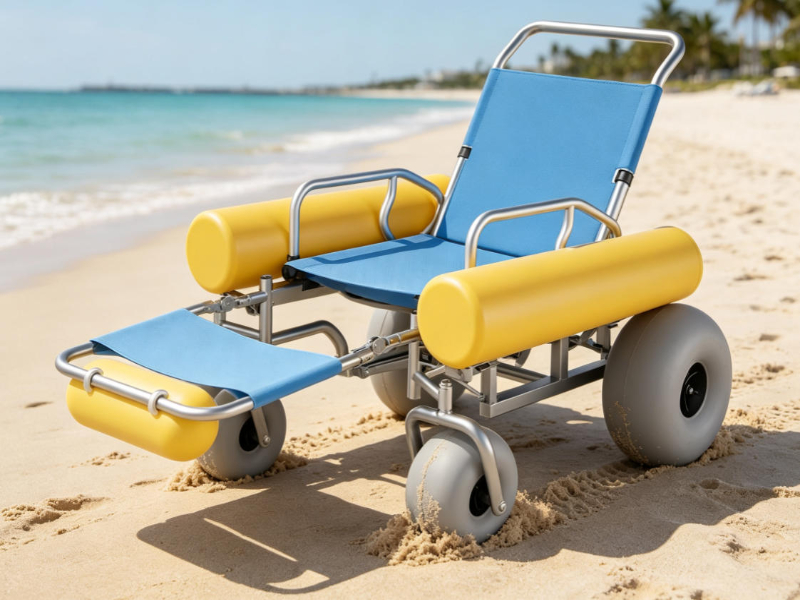
Choosing a beach wheelchair starts with the tires. That may sound obvious, but it is one of the most frequently overlooked parts of the buying decision. A wheelchair can have a strong frame, comfortable seating and excellent folding features, yet still be difficult to use on a beach if its tires are too narrow, too hard or poorly suited to loose ground. Sand behaves very differently from pavement. Instead of providing a firm surface that supports a conventional wheelchair wheel, it can shift, deform and absorb the wheel as soon as weight is applied.
That is why How to Choose Beach Wheelchair Tires is not simply a question of choosing the biggest wheels available. The right tire needs to match the type of sand, the user’s weight, the terrain, the amount of water exposure and the way the wheelchair will be transported and maintained. Wide air-filled or airbag-style wheels are often preferred for soft terrain because they can create a larger contact area and distribute pressure over the surface. However, tire width, diameter, flexibility, construction and overall wheelchair design all need to be considered together.
For individuals, caregivers, beach resorts, accessibility programmes and mobility-equipment distributors, understanding these differences can make the difference between a wheelchair that looks suitable in a catalogue and one that actually performs when it reaches the shoreline.
Before comparing tire designs, think about where the wheelchair will actually travel. “The beach” can describe several very different surfaces. A compacted path near a boardwalk is nothing like loose dry sand near the dunes, while wet sand close to the waterline behaves differently again. A wheelchair that performs well on firm sand may require a different tire setup when moving across deep, loose sand.
On hard surfaces, a relatively narrow tire can work efficiently because the ground provides strong support. On soft sand, the problem changes. The tire presses into the surface, and the softer the ground, the greater the tendency to sink. Once a wheel sinks, rolling resistance increases and pushing becomes more difficult. A small conventional wheel can therefore become frustrating very quickly, particularly when carrying a heavier user.
This is where wide beach tires become important. The basic principle is similar to walking on snow: spreading weight over a larger area reduces the pressure applied to any single point. Beach wheelchair manufacturers therefore commonly use wide, low-pressure or balloon-style wheels to increase the footprint of the chair. Industry guidance on beach wheelchairs also identifies balloon wheels as particularly effective on soft sand because their width, flexibility and low-pressure characteristics help distribute load across the surface.
The important point is that tire size should follow the terrain. If a wheelchair will spend most of its time on firm pathways and only occasionally touch compact sand, an extremely large flotation tire may not be necessary. If the main purpose is crossing soft, dry beach sand, however, flotation and surface contact should become much higher priorities.
When learning How to Choose Beach Wheelchair Tires, contact area is one of the easiest concepts to understand and one of the most useful in practice.
Imagine placing a narrow bicycle tire onto loose sand. The tire contacts the ground over a relatively small area, so the load is concentrated. Now imagine a much wider tire with a softer construction. It can spread the load over a larger footprint, reducing the tendency to dig into the sand.
This is why beach wheelchair tires often look very different from standard wheelchair tires. They are not simply oversized for appearance. Their geometry is intended to change how the wheelchair interacts with the ground.
The IYASOCARE YSB01 is a good example. Its product design uses front and rear airbag wheels, with the manufacturer describing them as suitable for beaches, grass, wetlands and wading environments. The product page also describes widened wheels intended to distribute pressure and reduce sinking on soft surfaces such as sand and gravel.
The YSB02 follows the same basic principle. It uses front and rear airbag wheels designed for sand, gravel and shallow water, combining them with a stainless steel frame and a waterproof Oxford cloth seat.
For beach use, therefore, the first question should not be “Are these tires attractive?” or even “Are these tires large?” The better question is: How effectively do these tires distribute the user’s weight over soft ground?
A conventional hard wheel tends to maintain a relatively fixed shape as it moves over the ground. A softer air-filled or airbag-style wheel can deform more easily, increasing its contact with uneven terrain.
On sand, this flexibility can be valuable. Instead of behaving like a small hard point pressing into the surface, the tire can spread across the ground. That helps reduce the tendency to sink and can make movement smoother.
The same principle can help when the wheelchair moves across small stones, grass or other irregular outdoor surfaces. A compliant tire can absorb some of the surface variation rather than transferring every small impact directly into the frame and seating system.
However, not all pneumatic or air-filled tires are automatically good beach tires. A tire can be inflatable without having the width or volume required for soft sand. Buyers should therefore look at the complete wheel specification rather than relying on the word “pneumatic” alone.
For serious beach applications, consider:
Tire width → tire diameter → air volume → flexibility → surface contact → puncture resistance → replacement availability.
These factors work together. A very wide tire with poor construction may create other problems, while a durable but narrow tire may still sink into loose sand.
Tire width is usually the first specification people notice when comparing beach wheelchairs, but diameter also has an important role.
A wider tire increases the footprint, which can help distribute weight. A larger-diameter wheel can also make it easier to roll over small obstacles and changes in terrain. On a beach, users may encounter shells, stones, compacted sand, shallow depressions and transitions between different surfaces.
A useful beach tire therefore needs to balance width and diameter rather than maximising one dimension without considering the other.
The YSB01, for example, uses a 10 × 5.5-inch front wheel and a 16 × 9-inch rear wheel according to its published specifications. Its large rear wheels are paired with front airbag wheels, giving the wheelchair a configuration intended for outdoor surfaces rather than ordinary indoor flooring.
The YSB02 uses 10-inch front wheels and 12-inch rear wheels. Its design focuses more strongly on portability and water-oriented outdoor use, with quick-release wheels and a folding stainless steel frame.
These specifications illustrate an important point: there is no universal “best” beach tire size. The right configuration depends on the complete wheelchair design and intended terrain.
Tire material becomes particularly important when a beach wheelchair is expected to operate regularly rather than occasionally.
Beach environments are demanding. Sand can work its way into wheel components, while shells, stones and other debris can create puncture or abrasion risks. Saltwater introduces another maintenance concern for metal components and wheel hardware.
Different balloon-wheel constructions use different materials. Some beach wheelchair designs use PVC-based wheels because they can be economical and relatively straightforward to manufacture. Other designs use polyurethane or reinforced materials that may offer different combinations of flexibility, abrasion resistance and puncture performance. Industry information comparing balloon wheel materials notes that PVC can be less expensive but may require thicker construction, while polyurethane can provide stronger wear resistance and broader operating performance.
For a personal wheelchair used only several times each summer, replacement cost and ease of maintenance may be the biggest considerations. For a resort, hotel or accessibility programme where many users may operate the chair repeatedly, durability and replacement-part availability become much more important.
This is why distributors should ask suppliers about replacement tires and wheel components before adding a beach wheelchair to their product portfolio. A product can be excellent when new, but commercial value depends partly on how easily it can be maintained over several seasons.
Not every beach wheelchair needs to operate in water. This distinction is important because “beach wheelchair” can refer to a chair designed primarily for sand access or a more specialised model intended for shallow-water and flotation applications.
If the main use is travelling from a car park across sand to a beach chair, the priority is usually soft-ground performance. If users need to reach the waterline or enter shallow water, water resistance, corrosion protection, seating materials and overall stability become more important.
The IYASOCARE YSB01 is designed with front and rear airbag wheels for beaches, grass, wetlands and wading environments. Its all-steel frame and waterproof Oxford cloth seat are intended for outdoor use, while its folding frame and quick-release wheels support transportation and storage.
The YSB02 is more specifically positioned toward beach and water activities. It combines a stainless steel frame, waterproof Oxford cloth seat, front and rear airbag wheels and an optional inflatable flotation kit. The manufacturer states that its wheels can adapt to sand, gravel and shallow water.
That makes the YSB02 particularly interesting for resorts, hotels, lakeside facilities and other businesses where beach access and water activities are part of the service.
The IYASOCARE YSB01 is worth considering when the goal is broader outdoor mobility rather than water use alone.
Its all-steel frame gives the chair a robust structure, while front and rear airbag wheels are designed for soft and uneven surfaces. The manufacturer lists a 500 mm seat width and 450 mm seat depth, with a 700 mm backrest height. The rear wheels measure 16 × 9 inches, while the front wheels measure 10 × 5.5 inches. The published net weight is approximately 22 kg, with quick-release wheels and a folding structure intended to make transportation easier.
One of its strongest practical features is the combination of terrain capability and positioning comfort. The backrest can be tilted up to 150°, and the footrest can be adjusted. This matters because a beach trip is not necessarily a short transfer from one point to another. Users may spend considerable time sitting, resting or reclining outdoors.
The waterproof Oxford cloth seat is also useful in a beach environment because sand, splashes and moisture are unavoidable. A material that can be cleaned more easily can reduce the amount of maintenance required after outdoor use.
For distributors, the YSB01 can therefore be positioned as a multi-terrain beach and outdoor wheelchair for users who want large flotation-style wheels without necessarily requiring a dedicated floating system.
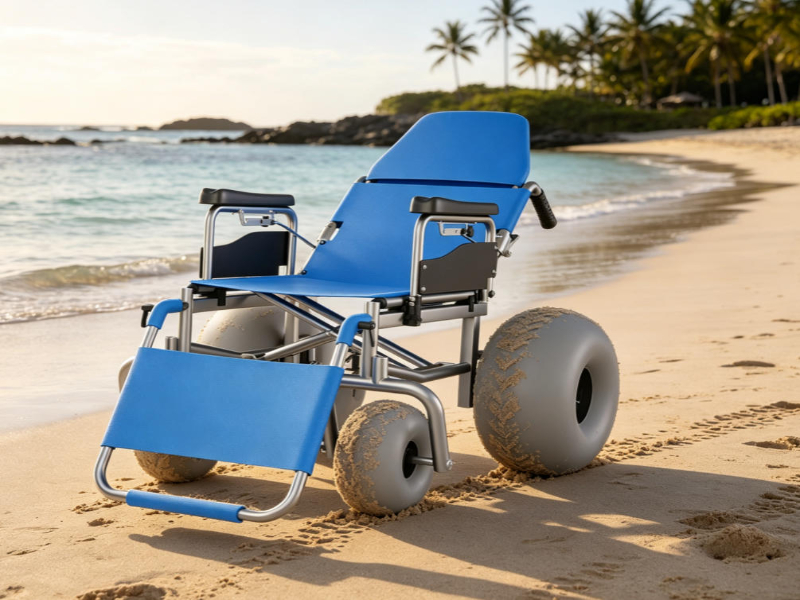
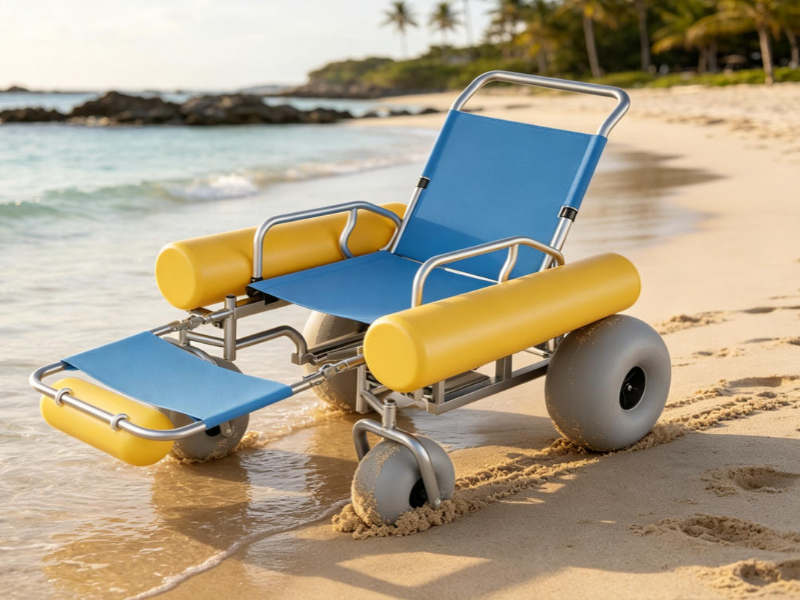
The IYASOCARE YSB02 takes the concept further by combining beach mobility with optional flotation capability.
Its stainless steel frame is particularly relevant for an outdoor environment where moisture is unavoidable. The chair has a 500 mm seat width and 480 mm seat depth, with 10-inch front wheels and 12-inch rear wheels. The manufacturer lists a maximum load of 100 kg and a net weight of approximately 24 kg. The folding size is 990 × 630 × 750 mm, which is useful for transport and storage.
The wheel configuration is one of its defining features. Front and rear airbag wheels are designed to handle sand, gravel and shallow water while helping absorb bumps. For users who need to move across changing terrain, that combination can be more useful than a conventional wheelchair tire designed mainly for paved surfaces.
The YSB02 also includes adjustable backrest and leg-rest functions, with the manufacturer listing a maximum tilt of 170°. More importantly for water-oriented applications, an optional inflatable flotation kit is available. This means the product can be considered not simply as a sand wheelchair, but as a more versatile beach and water-access solution.
For hotels, resorts, water recreation businesses and mobility-equipment distributors, this wider application can make the YSB02 particularly attractive where customers expect access beyond the edge of the sand.
| Feature | YSB01 | YSB02 |
|---|---|---|
| Main positioning | Beach and multi-terrain outdoor mobility | Beach, shallow water and water activities |
| Frame | Steel | Stainless steel |
| Front wheels | 10 × 5.5 in airbag wheels | 10 in airbag wheels |
| Rear wheels | 16 × 9 in airbag wheels | 12 in airbag wheels |
| Seat width | 500 mm | 500 mm |
| Seat depth | 450 mm | 480 mm |
| Folding | Yes | Yes |
| Quick-release wheels | Yes | Yes |
| Waterproof Oxford cloth | Yes | Yes |
| Flotation option | — | Optional inflatable flotation kit |
| Published load rating | Check exact configuration | 100 kg |
The comparison shows why choosing the “best” beach wheelchair tire depends on the application. The YSB01’s larger rear wheel configuration is attractive for users who want a practical outdoor chair capable of handling beach and other uneven surfaces. The YSB02 is more water-oriented, combining airbag wheels with stainless steel construction and an optional flotation system.
For a customer who mainly needs to cross sand and grass, the YSB01 may be the more straightforward recommendation. For a resort or user who specifically wants beach and shallow-water functionality, the YSB02 offers a broader configuration.
Tire selection is only part of the wheel system. Bearings, bushings, axles and quick-release mechanisms also have to survive the beach environment.
Sand is abrasive. Fine particles can enter moving components and increase wear, while salt and moisture can accelerate corrosion in poorly protected metal parts. Some specialist beach wheelchair manufacturers therefore pay particular attention to sealed or corrosion-resistant wheel components. Regular maintenance guidance also recommends cleaning sand and salt from the wheelchair after use.
For users, this means that the beach day does not end when the wheelchair leaves the sand. A basic maintenance routine can significantly extend the life of the equipment. Brush or rinse away sand, clean off saltwater residue where appropriate, allow the wheelchair to dry thoroughly and inspect the wheels and hardware before storage.
For commercial operators, maintenance should be treated as part of the product-selection process. Ask suppliers about replacement wheels, wheel hardware, recommended cleaning methods and availability of spare parts. A beach wheelchair used by dozens of customers every week will experience very different demands from one used privately a few weekends each year.
Before purchasing a beach wheelchair, use these five questions as a practical filter:
1. Will the chair be used on loose dry sand or mostly compacted surfaces?
Loose sand requires stronger flotation characteristics and a larger contact area.
2. Are the wheels genuinely designed for soft terrain?
Look for wide air-filled, airbag or balloon-style wheels rather than simply assuming any large tire will work.
3. Does the wheel construction match the expected usage?
Consider puncture resistance, flexibility, abrasion resistance and the availability of replacement components.
4. Will the chair enter wet areas or shallow water?
If yes, examine the frame material, seating, hardware and overall water-use design—not just the tires.
5. How will the wheelchair be cleaned and transported?
Folding construction, quick-release wheels and easy-to-clean materials can make a major difference after a day at the beach.
This five-question test is simple, but it prevents one of the most common purchasing mistakes: selecting a wheelchair based on appearance or one headline specification without considering the environment in which it will actually operate.
The most important lesson when learning How to Choose Beach Wheelchair Tires is that beach performance begins with ground contact. The tire has to work with the sand rather than simply pressing into it.
Wide airbag-style or balloon-type wheels can help distribute weight, reduce sinking and make movement across soft terrain more practical. Tire diameter can improve obstacle handling, while flexible construction can help the wheelchair adapt to uneven ground. At the same time, the material and wheel components need to withstand sand, moisture and repeated outdoor use.
The IYASOCARE YSB01 demonstrates a practical multi-terrain approach, combining an all-steel frame, large airbag wheels, waterproof Oxford cloth, folding construction and adjustable positioning features. It is a strong option for users who want beach mobility that can extend to grass, wetlands and other outdoor environments.
The YSB02 takes a more water-oriented approach. Its stainless steel frame, airbag wheels, waterproof seating, folding design and optional flotation kit make it particularly relevant for beach resorts, water-access programmes and users who want to combine sand mobility with shallow-water activities.
Ultimately, there is no single tire specification that is perfect for every beach. The right choice depends on the sand, the user’s weight, the distance travelled, water exposure, maintenance expectations and the way the wheelchair will be transported. Start with the terrain, examine the contact area, understand the wheel construction and then choose the wheelchair around those requirements.
That is the difference between a wheelchair that is simply labelled “beach-ready” and one that is genuinely designed to make the beach more accessible.
1. What type of tires are best for a beach wheelchair?
Wide, low-pressure air-filled, airbag or balloon-style tires are generally well suited to soft sand because they create a larger contact area and help distribute the user’s weight. The tire should also have enough diameter and flexibility to handle uneven outdoor surfaces. Both the IYASOCARE YSB01 and YSB02 use front and rear airbag-style wheels designed for beach and outdoor terrain.
2. Are bigger beach wheelchair tires always better?
Not necessarily. Larger tires can improve flotation and help the wheelchair roll over uneven surfaces, but width, air volume, flexibility, wheel construction and the overall wheelchair design are equally important. A tire should be selected according to the actual terrain rather than simply choosing the largest available size. A wheelchair intended for loose dry sand may require a different configuration from one mainly used on compacted sand, grass and paved paths.
3. What is the difference between the YSB01 and YSB02 beach wheelchair tires?
Both models use front and rear airbag wheels designed for outdoor terrain, but their overall configurations are different. The YSB01 uses larger 16 × 9-inch rear wheels and is positioned as a folding multi-terrain beach wheelchair for sand, grass, wetlands and wading environments. The YSB02 uses 10-inch front and 12-inch rear wheels and adds a stainless steel frame plus an optional inflatable flotation kit, making it particularly suitable for beach and water-oriented activities.