Our Location
Free Trade Tower, Xiyong street.
Chongqing, China

Free Trade Tower, Xiyong street.
Chongqing, China
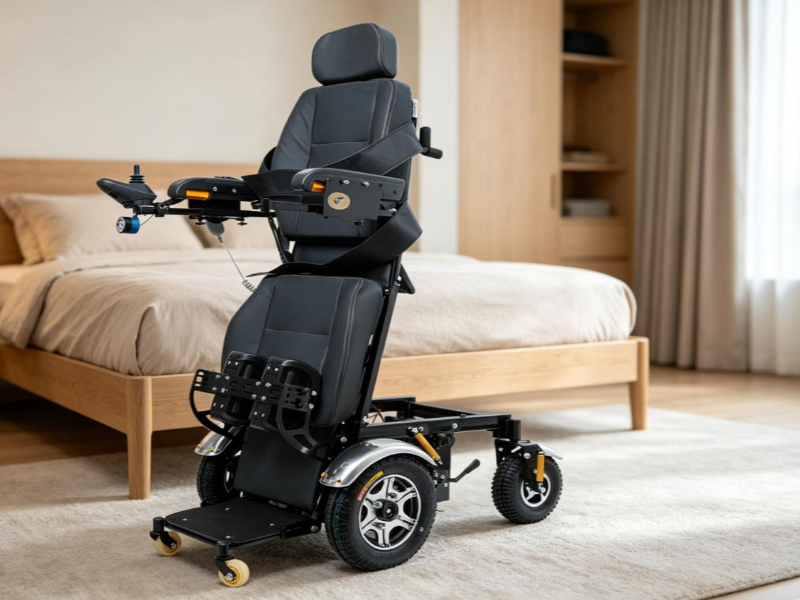
Choosing a standing wheelchair is not simply a matter of finding a model that can support a person’s body weight. When a wheelchair is designed to move from a seated position into an upright standing position, weight capacity becomes an even more important part of the selection process. The frame, seat, standing mechanism, motors, actuators, wheels, brakes and overall centre of gravity all have to work together. A wheelchair may feel perfectly adequate when sitting, yet the same load can place different demands on the equipment during standing or movement.
This is why How to Choose Standing Wheelchair Weight Capacity should be one of the first questions considered before purchasing a standing mobility chair. The correct approach is to look at the manufacturer’s rated load, the user’s actual body weight, the equipment and accessories carried on the chair, the frequency of standing, and the environment in which the wheelchair will be used. A sensible choice should leave enough operating margin rather than placing the user continuously at the upper limit of the specification.
For overseas buyers, distributors and healthcare equipment suppliers, this issue is equally important. Weight capacity affects not only user safety and comfort but also product positioning. A compact 100 kg standing wheelchair may be an excellent solution for one customer while being unsuitable for another. Understanding the difference can help distributors recommend the right model instead of treating every standing wheelchair as interchangeable.
The first thing to understand is what a standing wheelchair’s weight capacity actually means. When a manufacturer lists a maximum load of 100 kg, 120 kg or another figure, this should be treated as the maximum rated load for the specified product configuration—not as a recommended everyday target.
The rating relates to the wheelchair’s structural and functional design. The frame must withstand the load, the seating system must provide adequate support, the wheels and axles must handle the forces generated during movement, and the drive system must deliver appropriate performance. In a standing wheelchair, the standing mechanism introduces another consideration because the user’s body position changes substantially as the chair raises the person.
This is why choosing a chair simply because the user’s body weight is technically below the advertised maximum can be too simplistic. A 98 kg user looking at a 100 kg standing wheelchair is technically within the published specification, but there is almost no room for clothing, personal belongings or equipment carried on the chair. More importantly, operating consistently close to the maximum rating leaves little practical margin.
A better approach is to think in terms of working load rather than the maximum number. The user’s body weight should be the starting point, followed by the weight of anything that will routinely travel with the user. A backpack, medical equipment, cushions, communication equipment or other accessories can all contribute to the real load. Current power-wheelchair guidance similarly recommends checking the exact manufacturer’s rating and considering routinely carried items rather than looking only at body weight.
For distributors, this distinction is particularly useful when discussing products with customers. Instead of asking only, “How much do you weigh?”, a better conversation is, “What is your approximate body weight, what equipment do you normally carry, and where will you use the wheelchair?” Those three questions provide a much more realistic basis for selecting capacity.
There is no universal capacity number that is ideal for every user. The right choice depends on the individual and the manufacturer’s specifications. However, a practical selection process can make the decision much easier.
Start with the user’s actual body weight. Do not estimate based on clothing size or appearance. Then consider the normal additional load. If the user weighs 75 kg and normally carries approximately 5 kg of personal or medical equipment, the wheelchair is already supporting around 80 kg in practical use.
Next, compare that combined load with the manufacturer’s rated capacity. If a chair is rated for 100 kg, the 80 kg example leaves substantially more room than a user and equipment combination approaching the full 100 kg rating. The closer the actual operating load gets to the maximum specification, the more carefully the buyer should consider whether a higher-capacity model would be more appropriate.
This does not mean that every buyer must automatically choose the highest-capacity wheelchair available. Higher capacity can sometimes come with a larger frame, increased overall weight or different dimensions. A larger wheelchair may also be more difficult to manoeuvre in a small home, fit through narrow doors or transport in a vehicle. The goal is therefore appropriate capacity, not simply maximum capacity.
For this reason, the selection process can be viewed as a balance:
User weight + routine carried load → compare with rated capacity → consider operating environment → confirm seating dimensions → select the appropriate model.
This approach is particularly important for standing wheelchairs because the user’s position changes during operation. A standing function is not simply an additional accessory; it changes how the user’s weight is distributed through the chair.
A conventional wheelchair primarily supports the user in a seated position. A standing wheelchair has to maintain stability while the user’s body moves upward and changes its relationship with the wheelchair’s base.
During a standing transition, the chair’s mechanical structure and positioning system have to work together to control movement. Depending on the design, knee supports, armrests, foot supports, seat structure and other positioning components help maintain the user’s position.
The centre of gravity is particularly important. As the user rises, the distribution of forces through the wheelchair changes. The design therefore needs to provide adequate stability throughout the transition, rather than only when the user is fully seated.
This is one reason buyers should avoid comparing standing wheelchairs solely by motor wattage or battery range. A wheelchair can have powerful motors but still be a poor match if its seating dimensions, structural rating or standing support system do not suit the user.
The same principle applies when comparing two models with similar advertised functions. If one model has a 100 kg maximum load and another has a higher published rating, the second may be more appropriate for a heavier user—but only if its dimensions, positioning system and intended application also fit that person.
The most important point is simple: weight capacity is part of the entire standing system, not an isolated specification.
For users who need more than basic standing assistance, the IYASOCARE YSE301 Standing Wheelchair is worth considering as a multifunctional option.
The YSE301 is designed around a broader concept of mobility and positioning rather than standing alone. The model combines powered standing functionality with powered reclining and leg-lifting functions, giving users more ways to change their position during the day. Manufacturer information also highlights front and rear suspension, widened tyres, electromagnetic and electronic braking systems, and a driving range of up to 45 km with a maximum speed of 8 km/h.
This makes the YSE301 particularly interesting for users who expect their standing wheelchair to perform multiple roles. Someone may use the chair for everyday movement around the home, then travel outdoors, recline for rest, raise the legs or use the standing function for daily activities.
From a weight-capacity perspective, however, buyers should still check the exact load rating for the configuration being ordered. Standing wheelchair specifications can vary by model and configuration, and the correct capacity should always be confirmed directly with the manufacturer before purchase.
The YSE301 is therefore best viewed as a multi-function standing mobility platform rather than simply a wheelchair with an electric standing feature. Its suspension and positioning functions make it attractive for users who want a chair capable of supporting everyday mobility, posture changes and outdoor use.
For distributors, this creates a useful product position. Instead of marketing the YSE301 only as a “standing wheelchair,” it can be presented as a solution for customers who want standing, reclining, leg elevation and powered mobility within one product.
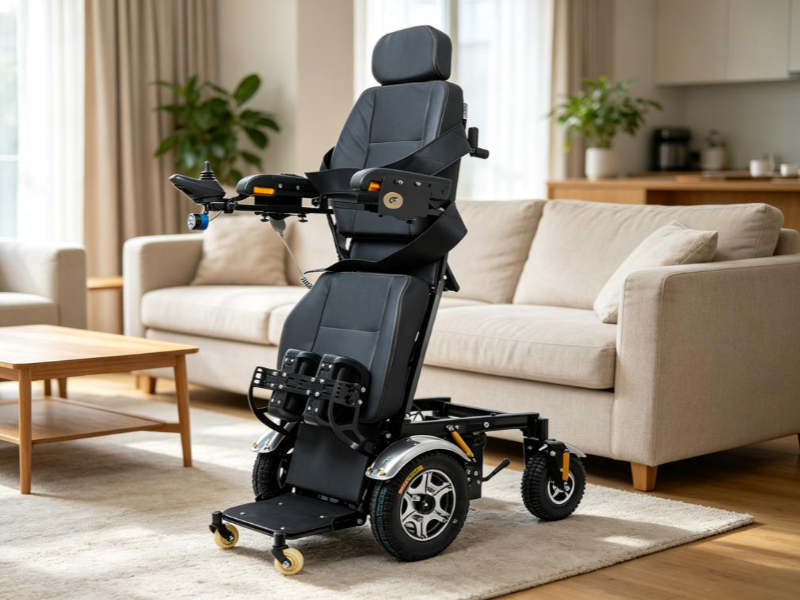
The IYASOCARE YSE303 Electric Stand-Up Wheelchair takes a somewhat different approach.
The manufacturer specifies a 100 kg load capacity, steel frame, 45 cm seat width and 43 cm seat depth. It uses dual 200 W motors, a 24 V 40 Ah lead-acid battery, an electronic parking brake and offers a stated driving range of approximately 30–40 km with a maximum speed of 8 km/h. The published product dimensions are 100 × 56 × 85 cm, while the standing height is listed at 190 cm.
One of the most interesting features of the YSE303 is its 360-degree turning capability. This can be useful in environments where space is limited, such as homes, corridors, offices and rehabilitation facilities. The adjustable armrests can also be raised to make side transfers easier, while the one-hand joystick is designed for straightforward operation.
The 100 kg capacity makes the YSE303 particularly relevant for users whose actual operating load is comfortably below that figure. For example, a user weighing 70–80 kg with limited additional equipment may have a very different capacity requirement from a user weighing close to 100 kg.
That distinction matters. If the user is close to the published maximum, the buyer should not focus only on the fact that the specification technically allows the weight. It is better to discuss whether a different model with a higher capacity would provide a more appropriate margin.
For customers who prioritise compact manoeuvrability, everyday standing access and relatively straightforward powered operation, the YSE303 can be a practical choice. The manufacturer’s published specifications should nevertheless be checked against the user’s complete load and physical dimensions before an order is placed.

Weight is only one part of the fitting process. A user may be comfortably below the wheelchair’s maximum capacity but still require a different model because the seat dimensions are unsuitable.
Seat width and depth affect how the user’s body is positioned within the chair. In a standing wheelchair, this becomes especially important because the chair needs to maintain the user’s posture as the standing mechanism operates.
A seat that is too narrow can create pressure and discomfort, while a seat that is excessively wide may provide insufficient lateral support. Seat depth also matters because it influences how the pelvis and legs are positioned.
This is why a distributor should collect at least four basic measurements before recommending a standing wheelchair: body weight, seat width requirement, seat depth requirement and overall body height.
For users who require additional trunk, knee or leg support, the conversation should go further. Physical ability, posture control and transfer requirements can influence whether a particular standing mechanism is suitable.
The objective is not to find the biggest wheelchair that will support the user. It is to find a wheelchair in which the user’s weight, dimensions and physical support requirements work together.
The same user may require different equipment depending on the environment.
For predominantly indoor use, manoeuvrability and overall dimensions may be more important. A wheelchair that can turn effectively in a bedroom, hallway or bathroom can make a significant difference to everyday usability.
Outdoor use introduces additional considerations. Pavement transitions, ramps, uneven surfaces and longer travel distances can place greater demands on the drive system and suspension. A heavier user can also increase the effort required from the motors, particularly when moving uphill or across surfaces with greater rolling resistance.
Motor output alone should not be used to judge whether a wheelchair is suitable for a particular user. Torque, gearing, total wheelchair weight, terrain and load all influence real-world performance.
This is another reason why weight capacity and intended environment should be evaluated together. A wheelchair operating close to its maximum capacity on smooth indoor flooring is a different scenario from the same wheelchair carrying a similar load outdoors on ramps and uneven ground.
For distributors, asking about the customer’s normal environment can therefore prevent inappropriate recommendations. A simple question such as “Will this mainly be used indoors, outdoors, or both?” can reveal important information before the product is selected.
For B2B buyers, choosing standing wheelchair capacity is not only about matching one customer’s weight. It is also about building a product range that covers different customer groups.
A distributor should first identify the capacity categories available in the supplier’s range. Rather than carrying only one standing wheelchair, it may be more practical to offer models aimed at different users and applications.
The second step is to check whether the published capacity is clearly documented. A professional supplier should be able to provide specifications for load capacity, seat dimensions, frame material, motors, batteries and braking systems.
The third step is to understand what the rated load actually applies to. Ask whether the stated figure refers to the user alone or whether the manufacturer defines it as total supported load. Clarifying this before placing an order avoids misunderstandings later.
The fourth step is to check model-specific certification and documentation for the target market. Standing wheelchairs are complex mobility products, and overseas distributors should make sure the exact configuration they intend to sell is supported by the required technical and regulatory documentation.
Finally, distributors should consider spare parts and after-sales support. A standing mechanism contains more moving and electrical components than a basic manual wheelchair, so access to replacement parts and technical support can become an important commercial advantage.
Before choosing a standing wheelchair, the following checklist can make the process much easier:
1. Confirm the user’s actual body weight.
Do not rely on an approximate estimate.
2. Add routine carried items.
Consider bags, medical equipment, cushions and other accessories.
3. Check the manufacturer’s published load rating.
Use the specification for the exact model and configuration.
4. Avoid operating permanently at the maximum rating.
A practical margin is preferable where possible; a 10–15% buffer is sometimes used as a purchasing guideline, but it is not a universal manufacturer requirement.
5. Check seat width and depth.
Capacity alone does not guarantee a proper fit.
6. Consider standing support.
Look at knee, foot, arm and body positioning features.
7. Match the wheelchair to the environment.
Indoor, outdoor and mixed-use requirements can be very different.
8. Ask about configuration-specific specifications.
Battery, motors, accessories and other options can affect the final product configuration.
This checklist is especially useful for international buyers because it turns a vague question—“Which standing wheelchair should I buy?”—into a measurable selection process.
When people search for How to Choose Standing Wheelchair Weight Capacity, the easiest mistake is to focus on the largest number printed in the specifications. A better approach is to think about how the wheelchair will actually be used every day.
The ideal standing wheelchair should provide an appropriate load rating, comfortable seating dimensions, reliable standing support and performance suited to the user’s environment. The user’s body weight should be comfortably within the manufacturer’s specification, while additional equipment and everyday belongings should also be taken into account.
The YSE301 is an attractive option for users looking for a more comprehensive standing and positioning solution, particularly where reclining, leg elevation, suspension and longer-range mobility are important. The YSE303, with its published 100 kg load rating, compact dimensions, 360-degree manoeuvrability and straightforward standing functionality, can be a practical choice for users whose requirements fit within that capacity.
For both models, however, the same principle applies: choose the wheelchair around the user, not the user around the wheelchair. Confirm body weight, additional load, body dimensions, standing requirements and intended environment before making the final decision.
For distributors and mobility-equipment businesses, this approach also creates better customer service. Instead of selling a standing wheelchair based on one headline specification, you can recommend a product that genuinely matches the user’s requirements. That is ultimately what weight capacity should achieve—not simply a number on a catalogue page, but a safer and more practical foundation for everyday mobility.
1. How much weight can a standing wheelchair support?
The answer depends on the specific model. For example, the IYASOCARE YSE303 is published with a maximum load of 100 kg. Buyers should always check the manufacturer’s current specification for the exact model and configuration rather than assuming all standing wheelchairs have the same capacity.
2. Should I choose a standing wheelchair exactly at my body weight?
It is generally better not to select a wheelchair simply because the user’s weight is just below the maximum rating. Consider the user’s body weight plus regularly carried equipment and belongings, then look for an appropriate operating margin. If the combined load is close to the manufacturer’s limit, ask the supplier whether a higher-capacity model is more suitable.
3. Is weight capacity the most important factor when choosing a standing wheelchair?
Weight capacity is one of the most important factors, but it should not be considered alone. Seat width, seat depth, body support, standing mechanism, motor performance, braking, battery capacity, manoeuvrability and intended environment all matter. The best standing wheelchair is the one whose capacity and overall design match the user’s complete mobility requirements.