Our Location
Free Trade Tower, Xiyong street.
Chongqing, China

Free Trade Tower, Xiyong street.
Chongqing, China
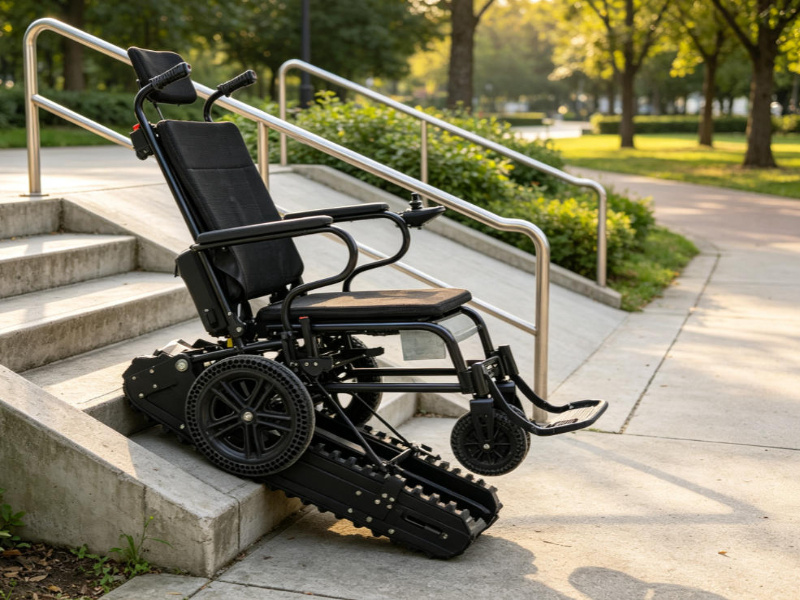
Choosing a stair climbing wheelchair is not simply a matter of finding a model that can climb stairs. For users, caregivers, distributors, and rehabilitation equipment buyers, one of the most important specifications to understand is weight capacity. The right weight capacity for a stair climbing wheelchair affects stability, climbing performance, braking, battery demand, component durability, and overall safety. Choosing a model that is too close to the user’s actual weight can leave little room for clothing, cushions, medical equipment, bags, or other items carried during daily use.
This is particularly important because stair climbing places different demands on a wheelchair compared with ordinary movement on a flat floor. When the wheelchair travels up or down an inclined staircase, the climbing mechanism must control not only the user’s weight but also the weight of the wheelchair itself and the forces created by the slope. A suitable load rating therefore needs to be considered as part of the complete mobility system rather than treated as a single number on a product specification sheet.
For anyone searching for the right weight capacity for a stair climbing wheelchair, the best approach is to start with the user’s actual requirements, calculate a practical operating load, and then compare that figure with the manufacturer’s stated maximum capacity. Looking at the staircase, operating conditions, frequency of use, wheelchair structure, and safety systems at the same time will lead to a much more reliable choice.
The weight capacity of a stair climbing wheelchair normally refers to the maximum user or loading weight that the manufacturer specifies for safe operation under the stated conditions. It should not automatically be interpreted as the weight of the wheelchair itself. For example, IYASOCARE’s YSE208 electric stair-climbing wheelchair has a published load capacity of 120 kg, while its own product specifications separately list a net weight of 45 kg. This distinction is important because buyers sometimes confuse product weight with user load capacity when comparing different models.
For practical purchasing decisions, the relevant figure is the maximum supported user load, but the number should not be treated as a target operating weight. If a user weighs 118 kg and the wheelchair is rated for 120 kg, the model technically falls within the stated specification, but there is very little operating margin. Clothing, shoes, a removable cushion, personal belongings, portable oxygen equipment, or other accessories can increase the total load. More importantly, stair climbing creates a demanding operating environment in which stability and controlled movement matter much more than simply remaining below a numerical limit.
This is why the right weight capacity for a stair climbing wheelchair should normally provide reasonable headroom above the user’s everyday weight. There is no universal percentage that applies to every wheelchair or every manufacturer, so buyers should not treat a fixed 10% or 15% allowance as an official safety rule. Instead, the manufacturer’s published maximum load should be regarded as a hard specification, while additional margin can be considered when selecting between models.
A simple example illustrates the point. Imagine an adult user weighs 95 kg and normally carries another 5 kg of clothing, medical supplies, or personal equipment. The practical operating load may already be around 100 kg. A wheelchair rated at 100 kg would leave essentially no margin. A model with a higher published capacity would generally provide a more appropriate specification range, provided that the user’s staircase and other operating conditions also meet the manufacturer’s requirements.
When choosing the right weight capacity for a stair climbing wheelchair, the first number to record is the user’s body weight. However, that number should not be the only number used in the decision.
Consider everything that will normally travel with the user. A wheelchair user may wear heavier outdoor clothing, use a pressure-relieving cushion, carry a handbag or backpack, use a portable medical device, or keep essential items attached to the wheelchair. In institutional environments, equipment can vary from one user to another. A rehabilitation centre or medical equipment distributor may also need a model capable of supporting a broader range of users rather than being optimised for one individual.
This is particularly relevant for B2B buyers. A distributor selecting a stair climbing wheelchair for a product catalogue should not evaluate capacity based only on the average customer weight in a target market. A model with a higher capacity can potentially address a wider user group, but higher capacity should never be considered in isolation. Frame construction, seat dimensions, stair mechanism, battery, brakes, total wheelchair weight, and intended operating conditions all need to support the same application.
The best purchasing question is therefore not simply, “How much does the user weigh?” A better question is, “What is the highest realistic operating load this wheelchair will need to handle, and what manufacturer-rated capacity is appropriate for that application?”
On flat ground, a wheelchair mainly needs to overcome rolling resistance, surface irregularities, acceleration forces, and small changes in terrain. Stair climbing introduces a different mechanical challenge. The wheelchair must maintain controlled contact with the stairs while moving the user and the wheelchair’s own mass against gravity.
That means weight can influence the workload placed on motors, tracks, transmission components, brakes, wheels, and the overall frame. A heavier user does not necessarily make a particular stair climbing wheelchair unsafe if the user remains within the manufacturer’s specified load rating, but operating near or beyond the rating can change the demands placed on the system.
Battery consumption can also be affected. A stair climbing wheelchair with a heavier operating load may require more energy during climbing than during ordinary movement on a level surface. This is one reason published range figures should be understood as product specifications rather than guaranteed real-world results. Stair frequency, user weight, staircase geometry, battery condition, temperature, and operating technique can all affect practical performance.
The weight capacity therefore has a connection with several other specifications. A buyer should look at the wheelchair as a complete system: load capacity + climbing mechanism + motor + battery + braking system + frame + staircase compatibility.
This approach is more useful than choosing a wheelchair solely because its capacity number appears high.
One of the easiest ways to compare models is to create a simple load calculation before looking at specific products.
User weight + normal carried load = minimum practical operating load
For example:
90 kg user + 5 kg personal equipment = approximately 95 kg operating load
The next step is to compare that operating load with the manufacturer’s stated maximum capacity. If the wheelchair is rated at 100 kg, it may technically cover the calculated load, but the margin is limited. If another suitable model is rated at 120 kg or 150 kg and meets all other requirements, the higher-capacity option may be more appropriate.
The important point is that capacity should not be increased blindly. A heavier-duty wheelchair can have a larger frame, greater total weight, different battery requirements, or different transport characteristics. If the user weighs 70 kg, purchasing a much heavier model simply because it has an extremely high capacity may create unnecessary handling and storage difficulties.
The goal is not to find the wheelchair with the largest possible number. The goal is to find the right weight capacity for a stair climbing wheelchair for the actual application.
IYASOCARE provides a useful example of why stair climbing wheelchairs should be compared according to application rather than appearance. Its stair-climbing range includes models with different load capacities, configurations, and operating designs, allowing buyers to match the wheelchair more closely with user requirements.
The IYASOCARE YSE208 is an electric stair-climbing wheelchair designed for both flat-ground driving and stair climbing. Its published maximum load is 120 kg, making it an interesting option for users whose calculated operating load comfortably falls below this level.
The YSE208 uses a steel frame and a 13Ah lithium battery. IYASOCARE specifies a driving range of up to 15 km and a climbing capacity of up to 500 stair steps, with a climbing speed of approximately 15 steps per minute. It is designed for staircases wider than 700 mm, with more than 1100 mm of width and depth required at staircase corners, and for stair slopes below 45 degrees. The foldable design is also useful for families and facilities where storage or vehicle transportation matters.
For a user within the 120 kg published load limit, the YSE208 can be particularly attractive when portability and dual-use functionality are important. However, buyers should still calculate the actual operating load rather than comparing body weight alone. If a user’s everyday weight is already close to 120 kg, another model with a higher capacity may provide a more suitable specification.
For users who require a higher load rating, the IYASOCARE YSE201M provides a different proposition. Its published maximum load capacity is 150 kg, combined with a steel frame, 20Ah lithium battery, and 120W motor. The manufacturer specifies a climbing speed of approximately 15 steps per minute and a capacity of up to 500 stair steps under stated conditions.
The YSE201M is therefore worth considering when the user’s operating load is significantly above the range of a 120 kg model. It is also designed as a dual-use solution, combining manual movement on smooth surfaces with electric stair climbing. The manufacturer specifies staircase requirements including a width greater than 700 mm and a slope below 45 degrees, while sufficient turning space is required at landings.
For distributors, rehabilitation centres, and care environments, the 150 kg capacity can make this type of model useful when the product needs to accommodate a broader adult user group. However, the higher load rating should still be matched with the actual user, staircase, and operating environment rather than treated as a reason to ignore other specifications.
The IYASOCARE YSE207 is another model worth examining when higher capacity and controlled stair operation are priorities. IYASOCARE’s published information lists a 150 kg load capacity, a 20Ah lithium battery, approximately 15 km of driving range, around 15 stair steps per minute, and a climbing ability of up to 500 steps. The model also incorporates a stair lock with deceleration and reverse-lock functions and a reversing camera.
These details demonstrate an important principle: choosing the right weight capacity for a stair climbing wheelchair should involve more than selecting the largest number on a catalogue. A higher-capacity model should also offer an operating system appropriate for the additional load and the intended environment.
The YSE207 may be particularly relevant for users or facilities where stair climbing is a regular part of daily mobility. Its design focuses on controlled stair operation and manoeuvrability, while its 150 kg capacity provides a broader loading range than the YSE208.
For buyers comparing models, the decision can therefore be simplified into three questions: Does the capacity comfortably cover the user’s operating load? Does the wheelchair fit the staircase? And can the user or caregiver operate it correctly?
A common purchasing mistake is to focus heavily on weight capacity while forgetting that the staircase itself may determine whether the wheelchair can be used at all.
For example, IYASOCARE specifies that the YSE208 requires a staircase width greater than 700 mm, a corner landing width and depth greater than 1100 mm, and a stair slope below 45 degrees. These requirements exist independently of the wheelchair’s 120 kg load capacity. A user could be well within the weight limit and still have an unsuitable staircase.
This is why a proper assessment should include stair width, stair slope, landing dimensions, turning space, surface condition, and the presence of obstacles or unusual architectural features. Straight residential stairs may be suitable for one model, while narrow, spiral, uneven, or unusually configured stairs may require a different solution.
IYASOCARE’s own FAQ also notes that stair-climbing wheelchairs are generally designed around suitable straight staircases and that narrow or spiral stairs may not be appropriate. The manufacturer recommends checking stair width and slope before purchase.
For overseas distributors, this point is especially important because staircase construction varies between countries, buildings, homes, hospitals, and commercial properties. Product selection should therefore be based on the real installation environment rather than assuming that a model suitable in one building will work everywhere.
A high weight capacity does not automatically make a stair climbing wheelchair safer. Weight capacity is one part of a broader safety system.
The climbing mechanism, braking system, locking functions, frame geometry, centre of gravity, seat support, footrests, and operator controls all contribute to safe operation. IYASOCARE’s technical guidance highlights the importance of controlled movement, climbing locks, reverse locks, electromagnetic or other braking systems, and appropriate operating procedures when using stair-climbing wheelchairs.
This becomes particularly important when the wheelchair is operating near its rated capacity. A user who is well below the maximum load may still require careful operation if the staircase is steep, narrow, wet, or otherwise difficult. Conversely, a wheelchair should never be operated above the manufacturer’s stated maximum capacity simply because the staircase appears easy.
Training also matters. The operator should understand how to approach the staircase, activate the correct climbing mode, control ascent and descent, stop when necessary, and transition safely back to level ground. Manufacturer specifications and operating instructions should always take priority over general assumptions.
For healthcare providers and distributors, this is one reason product training can be as important as product selection. The right wheelchair is only effective when the people using it understand its operating limits.
For B2B buyers, the selection process should be slightly different from an individual consumer purchase. A distributor needs to think about the wider customer base, product positioning, replacement parts, after-sales support, and regulatory requirements in the destination market.
A useful supplier evaluation can be organised into five areas:
1. Capacity range. Determine whether the manufacturer offers multiple models for different user-weight groups rather than forcing every customer into one configuration.
2. Model-specific specifications. Verify the exact load rating, dimensions, battery, motor, braking system, climbing ability, and staircase requirements for every model. Do not assume that one model’s specification applies to the entire product range.
3. Sample testing. Whenever possible, test the actual model before placing a large order. A catalogue specification cannot replace practical evaluation of the chair, staircase compatibility, controls, seating position, and transport requirements.
4. Documentation and compliance. Request the technical and regulatory documentation appropriate for the destination market and the specific model. A general factory certification should not automatically be interpreted as certification of every wheelchair model.
5. After-sales capability. Ask about spare parts, batteries, controllers, motors, tracks or climbing components, maintenance instructions, warranty procedures, and technical support. A stair climbing wheelchair is a more specialised product than a conventional manual wheelchair, so long-term support deserves particular attention.
IYASOCARE positions itself as a wheelchair and rehabilitation equipment manufacturer with a broad product portfolio covering electric wheelchairs, manual wheelchairs, stair-climbing wheelchairs, standing wheelchairs, off-road models, mobility scooters, and other mobility products. Its product range and manufacturer information can be useful starting points for distributors comparing different mobility solutions.
If you need a practical way to choose the right weight capacity for a stair climbing wheelchair, use this sequence rather than starting with the product catalogue.
Step 1 — Record the user’s body weight.
Step 2 — Add normal clothing, cushions, personal equipment and other carried items.
Step 3 — Treat that figure as the practical operating load, not the target maximum.
Step 4 — Compare it with the manufacturer’s stated maximum load.
Step 5 — Prefer a model with appropriate headroom when other specifications are comparable.
Step 6 — Check stair width, slope, landing dimensions and turning space.
Step 7 — Check brakes, climbing locks, controls and other safety systems.
Step 8 — Confirm battery, climbing ability and expected frequency of stair use.
Step 9 — Test the actual wheelchair whenever possible.
Step 10 — Follow the manufacturer’s operating instructions and stated limitations.
This method avoids one of the most common mistakes in mobility equipment purchasing: selecting a wheelchair based on one impressive specification while ignoring the rest of the system.
The right weight capacity for a stair climbing wheelchair is not necessarily the highest capacity available. It is the capacity that appropriately covers the user’s realistic operating load while matching the wheelchair’s design, staircase requirements, safety systems, and intended frequency of use.
For a user whose total operating load comfortably falls below 120 kg, the IYASOCARE YSE208 can be an interesting option because it combines a 120 kg published load capacity with electric flat-ground driving, stair climbing, foldability, and a 13Ah lithium battery.
For higher-load applications, IYASOCARE models such as the YSE201M and YSE207 provide published 150 kg load capacities and are designed around different approaches to stair mobility. The YSE201M combines manual flat-ground movement with electric stair climbing, while the YSE207 places greater emphasis on controlled stair operation and manoeuvrability.
The key lesson is simple: do not choose weight capacity by body weight alone. Calculate the realistic operating load, leave sensible room between everyday use and the manufacturer’s maximum rating, verify the staircase, and evaluate the complete climbing and braking system.
When those factors are considered together, choosing a stair climbing wheelchair becomes much more straightforward. The objective is not to find the biggest capacity number on the market. It is to find a wheelchair whose capacity, structure, climbing technology, safety features, and environment are properly matched to the person who will depend on it.
1. How much weight capacity should a stair climbing wheelchair have?
The wheelchair’s stated maximum load should be higher than the user’s realistic operating load, which includes body weight plus normal clothing, cushions, equipment and other items carried during use. Avoid selecting a model that places the user’s everyday load immediately against the manufacturer’s maximum rating. The final choice should also consider staircase conditions and the manufacturer’s specific operating requirements.
2. Is a 120 kg stair climbing wheelchair suitable for a 100 kg user?
It may be suitable if the user’s complete operating load remains comfortably below the manufacturer’s 120 kg limit and the staircase meets the model’s requirements. For example, IYASOCARE’s YSE208 has a published 120 kg load capacity and requires stairs wider than 700 mm, sufficient landing space, and a slope below 45 degrees. The user’s weight alone should therefore not be the only selection criterion.
3. Is a higher weight capacity always better?
No. A higher weight capacity can be useful for heavier users or B2B applications requiring broader user coverage, but it does not automatically make a wheelchair the better choice. Buyers should also compare total wheelchair weight, seat dimensions, battery, climbing system, braking functions, staircase compatibility, portability, and intended use. The best model is the one whose specifications are properly matched to the actual user and environment.