Our Location
Free Trade Tower, Xiyong street.
Chongqing, China

Free Trade Tower, Xiyong street.
Chongqing, China
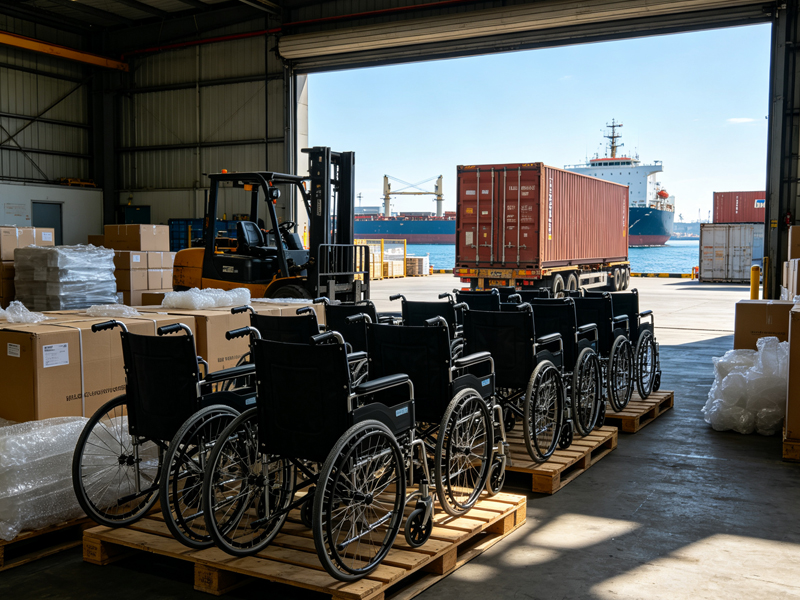
If you are buying wheelchairs from an overseas manufacturer, you have probably seen terms such as FOB price, EXW price, CIF price, and DDP price on quotations.
Among them, FOB price is one of the most common terms used by wheelchair manufacturers and international medical equipment suppliers.
At first glance, an FOB quotation can look attractive because the price may be noticeably lower than the price you see from a local distributor. But there is an important detail that many first-time buyers miss:
An FOB wheelchair price is not the final price you will pay to receive the wheelchairs at your warehouse, hospital, store, or home.
FOB is a shipping and trade term that defines how certain costs, responsibilities, and risks are divided between the seller and buyer. Under Incoterms® 2020, FOB means “Free On Board.” In simple terms, the seller is responsible for getting the goods loaded onto the vessel at the agreed port of shipment. Once the goods are on board the vessel, the risk transfers to the buyer.
For wheelchair buyers, understanding this distinction is extremely important. A quotation that says “FOB Shanghai: US$85 per wheelchair” does not mean that US$85 is the complete cost of getting one wheelchair to your destination.
FOB stands for Free On Board.
Under Incoterms® 2020, an FOB transaction uses a named port of shipment. The seller delivers the goods by placing them on board the vessel nominated by the buyer at that port. Once the goods are on board, the risk of loss or damage passes to the buyer.
For example, imagine a wheelchair factory in China gives you this quotation:
Manual Wheelchair — FOB Shanghai: US$78/unit
This generally means the seller’s responsibility covers the agreed activities needed to deliver the wheelchairs on board the buyer-nominated vessel at Shanghai, including the applicable export formalities.
After the wheelchairs have been loaded onto the vessel, the buyer becomes responsible for the subsequent costs and risks under the FOB rule.
That can include:
The exact allocation of individual charges can depend on the sales contract, port practices, and local regulations, so buyers should not assume that every possible charge is automatically included or excluded simply because the quotation says “FOB.”
The key idea is this:
FOB tells you where the seller’s delivery obligation ends and where the buyer’s main responsibility begins. It does not represent your complete landed cost.
The International Chamber of Commerce explains that Incoterms® rules are designed to clarify obligations, risk, and costs between buyers and sellers. They are not a replacement for the underlying sales contract.
This is where things become more practical.
Suppose you are importing 500 manual wheelchairs from a Chinese manufacturer. The supplier quotes:
FOB Ningbo: US$72 per wheelchair
Does that US$72 include everything?
No.
Under FOB, the seller generally has responsibility for delivering the goods on board the vessel at the named port of shipment and completing the seller’s export obligations. The buyer arranges the main carriage and takes the risk once the goods are on board.
For a wheelchair order, the FOB price will normally relate to the following parts of the transaction:
1. The wheelchair itself
This is the actual product price agreed between the buyer and manufacturer.
Depending on the quotation, it may include the wheelchair frame, seat, backrest, wheels, brakes, footrests, armrests, packaging, and other standard components specified in the purchase order.
However, never assume that accessories are included.
For example, the following may be quoted separately:
A professional buyer should always request a detailed product specification rather than relying only on a short product name.
2. Export-related formalities
Under FOB Incoterms® 2020, the seller is responsible for the export formalities required for the shipment.
This is particularly relevant when purchasing wheelchairs internationally because the exporter needs to prepare the shipment correctly for departure from the country of origin.
3. Transportation to the port
The seller is generally responsible for getting the goods to the named port of shipment as part of fulfilling the FOB delivery obligation.
For a factory located inland, this may involve transportation from the manufacturing facility to the port.
4. Loading the goods on board the vessel
The defining point of FOB is the loading of the goods onto the vessel nominated by the buyer at the agreed port.
This is also the point at which the risk transfers from seller to buyer under FOB.
That distinction is extremely important.
This is the part that matters most when comparing suppliers.
If a manufacturer quotes US$80 FOB per wheelchair, you should not compare that directly with another supplier offering US$95 delivered to your warehouse.
Those two prices are based on different cost structures.
The FOB price generally does not include the buyer’s main international transportation costs after the FOB delivery point.
Depending on the transaction, you may need to budget for:
Ocean freight
The buyer generally arranges and pays for the main sea transportation under FOB.
Marine cargo insurance
FOB does not require the seller to purchase insurance for the buyer. If you want coverage during the international transportation stage, you need to arrange appropriate insurance yourself or agree on a different commercial arrangement.
Import customs clearance
Once the goods arrive in your destination country, customs clearance becomes the buyer’s responsibility under FOB.
Import duties and taxes
Depending on the destination country and the product classification, duties, VAT, sales tax, GST, or other charges may apply.
Destination port charges
Your shipment may incur terminal handling charges and other destination-related fees.
Inland transportation
After customs clearance, the goods still need to travel from the port to your warehouse, distribution center, hospital, retail store, or other destination.
Storage and demurrage
If the shipment is not collected within the required period, additional storage, detention, or demurrage-related charges may occur.
This is why a buyer should never judge an international wheelchair supplier solely by the FOB unit price.
The more useful number is the landed cost.
Think of the FOB price as one major piece of the financial puzzle.
Your approximate landed cost can be represented like this:
Landed Cost = FOB Product Cost + International Freight + Insurance + Import Duties/Taxes + Destination Charges + Customs Clearance + Inland Transportation + Other Applicable Costs
For example, imagine you purchase:
Your product cost is:
500 × US$80 = US$40,000
But your total import expense could be higher.
Suppose, purely as an example, that the shipment also involves:
Then your actual landed cost would be significantly higher than US$40,000.
This example is only for understanding the calculation. Actual freight, taxes, duties, port fees, and customs charges vary according to the origin, destination, shipment volume, tariff classification, season, carrier, and local regulations.
For large wheelchair orders, this difference can become substantial.
A supplier with a slightly higher FOB price can sometimes result in a lower overall landed cost if the product has better packaging, fewer defects, more efficient loading, or better shipping arrangements.
That is why experienced importers look beyond the first number on the quotation.
FOB is popular in international B2B trade because it gives buyers considerable control over the main transportation stage.
For example, a wheelchair importer may already have:
In that situation, buying on FOB terms can be practical.
The buyer can arrange transportation according to its own logistics strategy instead of paying the supplier to manage every stage of the shipment.
For large distributors and professional importers, this can make cost management easier.
FOB can also make supplier quotations easier to compare because the supplier’s price is focused on the product and delivery to the named port rather than including transportation costs that may vary depending on the buyer’s destination.
However, FOB also requires the buyer to understand international logistics.
If you have never imported wheelchairs before, the lower FOB price can create a false sense that the product is inexpensive when the additional logistics and import costs have not yet been calculated.
Let’s say you operate a medical equipment distribution company in the United States.
You contact a wheelchair manufacturer in China.
The supplier offers:
Standard Manual Wheelchair
FOB Shenzhen: US$65/unit
Quantity: 1,000 units
At first glance:
1,000 × US$65 = US$65,000
It is tempting to think your purchase will cost US$65,000.
But this is only the FOB product cost.
You still need to consider the complete logistics chain.
Step 1: Factory
The manufacturer produces and packs the wheelchairs.
Step 2: Export transportation
The products are transported from the factory to the named port.
Step 3: Port and vessel loading
The goods are delivered on board the buyer-nominated vessel at the agreed port.
Under FOB, this is the critical delivery point.
Step 4: International ocean transportation
The buyer arranges and pays for transportation from the origin port to the destination.
Step 5: Destination port
The shipment arrives at the destination port.
Step 6: Import clearance
The buyer or its customs broker handles the required import procedures.
Step 7: Duties and taxes
Any applicable duties and taxes are paid according to the destination country’s requirements.
Step 8: Final delivery
The wheelchairs are transported from the port or customs facility to the buyer’s warehouse.
Only after these stages can you understand the real cost of putting those 1,000 wheelchairs into inventory.
This is why FOB price and landed cost should always be treated as two different numbers.
There is a detail about FOB that even some experienced buyers overlook.
According to the International Chamber of Commerce, FOB is intended for sea or inland waterway transport where delivery occurs by placing the goods on board a vessel.
This matters because modern wheelchair shipments are often containerized.
A supplier may pack wheelchairs into containers and deliver the container to a terminal. The container may then sit at the terminal before being loaded onto the vessel.
In this type of situation, ICC guidance indicates that FCA may be more appropriate than FOB, because FCA is designed for delivery to a carrier and can be used across different modes of transport, including multimodal transportation.
This does not mean that every wheelchair shipment labeled “FOB” is automatically wrong.
Rather, it means buyers should understand what the term actually represents instead of using FOB simply because it is familiar.
If you are importing containerized wheelchairs, it is worth discussing the appropriate Incoterm with your freight forwarder and supplier before signing the contract.
EXW means Ex Works.
Under EXW, the seller’s delivery obligation is generally fulfilled by making the goods available at the agreed location, such as the factory. The buyer takes on a much larger portion of the transportation and export process.
With FOB, the seller takes responsibility for getting the goods to the named port and loading them onto the vessel according to the FOB rule.
So, in simple terms:
| Item | EXW | FOB |
|---|---|---|
| Product | Seller | Seller |
| Pickup from factory | Buyer | Seller’s responsibility within FOB delivery obligation |
| Export formalities | Buyer generally | Seller |
| Delivery to named port | Buyer | Seller |
| Loading onto vessel | Buyer-side responsibility depending on arrangement | Seller under FOB |
| Main ocean freight | Buyer | Buyer |
| Import clearance | Buyer | Buyer |
| Import taxes/duties | Buyer | Buyer |
The exact legal and operational details should always be confirmed against the applicable Incoterms® version and sales contract.
For a buyer who has little experience with international logistics, EXW can create more operational work than expected.
Another common comparison is FOB vs. CIF.
CIF stands for Cost, Insurance and Freight.
Under CIF, the seller arranges and pays for the carriage to the named port of destination and also obtains insurance coverage as required by the CIF rule. However, the risk still transfers when the goods are loaded on board the vessel at the port of shipment.
This is an important point:
CIF does not mean the seller carries the risk until the wheelchairs arrive at your port.
The cost and risk transfer points are different.
With FOB:
Buyer arranges main ocean freight.
With CIF:
Seller arranges and pays the main ocean freight and required insurance to the named destination port.
For a new importer, CIF may appear simpler because the supplier handles more of the transportation arrangement.
For an experienced importer with competitive freight rates, FOB may fit better with an existing logistics system.
Neither term should be evaluated solely by the quoted unit price.
A professional quotation should contain more than just:
Wheelchair: US$75 FOB
Before placing an order, ask the supplier to clarify at least the following:
1. What exactly is included in the product price?
Ask about standard accessories, cushions, footrests, packaging, spare parts, branding, and other components.
2. Which Incoterms® version is being used?
For example:
FOB Shanghai, Incoterms® 2020
This is much clearer than simply writing “FOB.”
3. What is the named port?
“FOB China” is not sufficiently precise.
The ICC emphasizes the importance of clearly specifying the named port, place, or point in an Incoterms® rule.
4. What is the packing specification?
Wheelchairs can consume considerable container space because of their dimensions.
A supplier that offers better folding design or optimized packaging may allow more units per container.
This can affect the effective logistics cost per wheelchair.
5. How many wheelchairs fit into one container?
Ask for:
These figures are essential for calculating freight costs.
When importing wheelchairs, the product price is only one part of the economics.
Packaging efficiency can have a direct impact on transportation cost.
Consider two wheelchair models that have almost identical factory prices.
Model A is packaged efficiently and allows 300 units per container.
Model B uses larger cartons and allows only 220 units per container.
Even if Model B is cheaper by a few dollars per unit, its freight cost per wheelchair could be higher.
For distributors purchasing hundreds or thousands of wheelchairs, packaging design can significantly affect total logistics efficiency.
Ask your supplier for the carton dimensions before making a final purchasing decision.
A useful calculation is:
Total Shipment Volume ÷ Container Usable Capacity
You can then estimate how many units can be loaded and compare the logistics cost per wheelchair.
This is one of those small purchasing details that can make a meaningful difference in large-volume orders.
This is one of the most common questions.
The short answer is:
FOB includes the seller’s delivery obligations up to the agreed FOB point, but it does not normally mean the seller pays the main ocean freight to your destination port.
Under FOB, the buyer arranges the main carriage.
So if your supplier tells you:
FOB Guangzhou: US$90
you should not interpret this as:
US$90 delivered to my country.
Instead, think of it as:
US$90 + the buyer’s subsequent transportation and import costs.
This distinction can prevent expensive budgeting mistakes.
Not automatically.
Under FOB, the seller does not have an obligation to arrange insurance for the buyer. If the buyer wants cargo insurance, the buyer should arrange appropriate coverage or negotiate a separate agreement.
For wheelchair shipments, insurance may be worth considering because a large commercial shipment represents a significant financial investment.
The appropriate coverage depends on:
Do not assume that the supplier’s FOB quotation automatically includes comprehensive cargo insurance.
If you are buying wheelchairs for a hospital, distributor, nursing facility, rental company, online store, or government procurement project, the best way to negotiate is not simply to ask:
“Can you give me a cheaper price?”
Instead, provide the supplier with a clear purchasing specification.
For example:
The clearer your specification, the easier it is for the manufacturer to calculate an accurate quotation.
You can also request different price levels for different quantities.
For example:
100 units → FOB price
500 units → FOB price
1,000 units → FOB price
5,000 units → FOB price
This allows you to see how economies of scale affect the unit price.
A better question is:
“What will one wheelchair actually cost me after it arrives at my warehouse?”
That is the number that affects your business.
Imagine two suppliers:
Supplier A
FOB price: US$70
Supplier B
FOB price: US$76
It would be easy to assume Supplier A is cheaper.
But suppose Supplier A uses larger cartons, resulting in fewer units per container, while Supplier B has more efficient packaging and lower freight cost per unit.
After adding transportation, customs, taxes, handling, and inland delivery, the difference could become much smaller—or potentially reverse.
This is why experienced importers evaluate total landed cost, not just factory price.
The cheapest quotation is not necessarily the lowest-cost purchasing solution.
Before you place an order, check these points:
☐ Confirm the exact wheelchair model.
☐ Confirm the complete product specification.
☐ Confirm quantity.
☐ Confirm packaging and carton dimensions.
☐ Confirm gross and net weight.
☐ Confirm container loading quantity.
☐ Confirm the named FOB port.
☐ Confirm the Incoterms® version, such as Incoterms® 2020.
☐ Confirm what accessories are included.
☐ Confirm export documentation.
☐ Obtain an ocean freight quotation.
☐ Estimate cargo insurance if required.
☐ Confirm import duty and tax requirements.
☐ Estimate customs clearance charges.
☐ Estimate destination port charges.
☐ Estimate inland transportation.
☐ Calculate the estimated landed cost per wheelchair.
☐ Confirm payment terms.
☐ Confirm production lead time.
☐ Confirm inspection requirements before shipment.
☐ Confirm warranty and after-sales terms.
This checklist may look long, but it can prevent a surprisingly large number of purchasing problems.
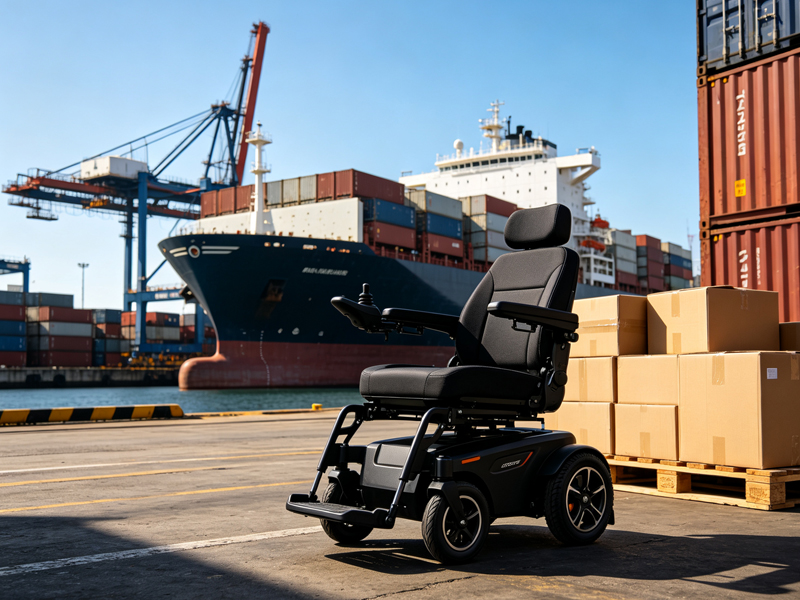
When buying wheelchairs internationally, FOB price is an important number—but it is not the whole story.
FOB, or Free On Board, defines a specific point in the international sales process. Under Incoterms® 2020, the seller delivers the goods on board the buyer-nominated vessel at the named port of shipment, and the risk transfers to the buyer at that point.
For the buyer, this means taking responsibility for the main transportation after that delivery point, along with import procedures and other destination-related costs.
For wheelchair purchasing, the smartest approach is therefore to look at three numbers:
1. FOB unit price
How much does the manufacturer charge for the wheelchair under the agreed FOB term?
2. Logistics and import cost
How much will freight, insurance, customs, duties, taxes, port fees, and inland transportation add?
3. Final landed cost
How much does each wheelchair actually cost when it reaches your warehouse or other agreed destination?
Once you understand these three numbers, comparing international wheelchair suppliers becomes much easier.
And perhaps most importantly, you will be comparing suppliers based on the real cost of purchasing the product, rather than being attracted by a low quotation that does not include the rest of the supply chain.
If you are a first-time importer, it is also worth working with an experienced freight forwarder and customs professional. The right Incoterm, accurate product classification, realistic freight estimate, and clearly written sales contract can make the difference between a smooth wheelchair import and an unexpectedly expensive shipment.
1. Is FOB price the final price I pay for a wheelchair?
No. An FOB price is generally the seller’s price under the agreed FOB delivery term. It does not normally include the buyer’s main ocean freight after the FOB delivery point, import customs clearance, destination charges, duties and taxes, or final inland delivery.
For a realistic purchasing budget, calculate the landed cost, not just the FOB unit price.
2. Who pays the shipping under FOB?
Under FOB, the buyer generally arranges and pays for the main carriage from the named port of shipment to the destination. The seller is responsible for delivering the goods on board the vessel at the agreed port and completing the seller’s export obligations.
If you want the supplier to arrange and pay for the main transportation to a named destination port, you may want to compare FOB with terms such as CIF, depending on the shipment and commercial requirements.
3. Is FOB a good choice when buying wheelchairs from China?
It depends on your purchasing and logistics situation.
FOB can work well for importers who already have a freight forwarder, understand customs procedures, and want control over international transportation. However, if you are new to importing, you should calculate the full landed cost and understand the responsibilities that come with FOB before choosing it.
Also remember that ICC guidance says FOB is intended for sea or inland waterway transport where the goods are delivered on board a vessel. For containerized or multimodal shipments where delivery occurs to a carrier or terminal before loading onto the vessel, FCA may be more appropriate.
The most important lesson is simple:
When a wheelchair manufacturer gives you an FOB price, don’t stop at the number on the quotation. Find out what it costs to get the wheelchair all the way into your inventory.