Our Location
Free Trade Tower, Xiyong street.
Chongqing, China

Free Trade Tower, Xiyong street.
Chongqing, China
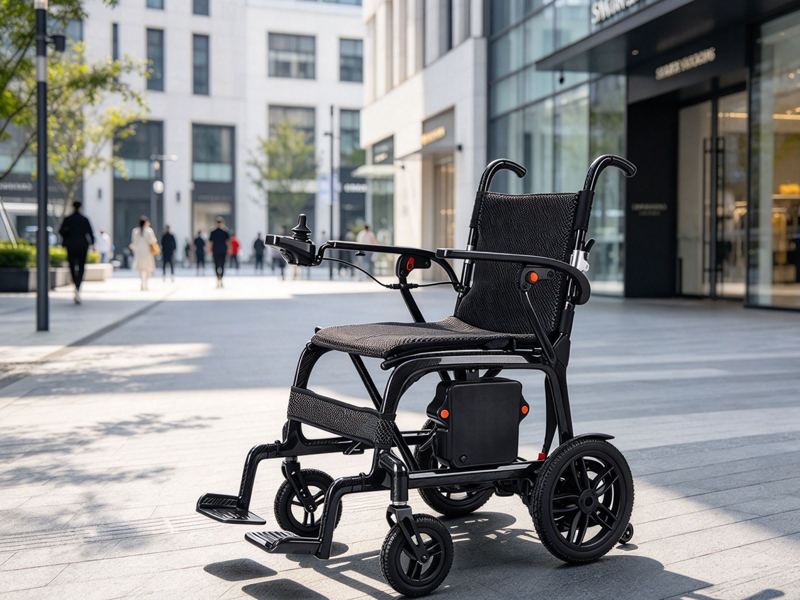
When people shop for an electric wheelchair, the conversation often starts with battery range, motor power, folding size, or price. But there is another decision hiding underneath all of those specifications: what is the wheelchair frame made from?
The frame is the backbone of a wheelchair. It supports the user, carries the battery and motors, influences the overall weight, affects how easy the chair is to transport, and contributes to the way the wheelchair feels when moving across different surfaces.
That is why the difference between an aluminum wheelchair frame, steel wheelchair frame, and carbon fiber wheelchair frame is more than a question of appearance or material preference. Each material brings a different balance of weight, rigidity, portability, durability, cost, and everyday practicality.
For someone who mainly uses a wheelchair around the home, the priorities may be very different from those of a frequent traveler who regularly lifts a power wheelchair into a car. A heavier steel frame may make sense for one user, while another person may care much more about reducing every kilogram possible.
There is no universal answer to the question, “Which wheelchair frame material is best?” The better question is:
Which frame material makes the most sense for the way you actually live?
To make that question easier to answer, this guide looks at three real-world electric wheelchair examples from IYASOCARE: the aluminum-frame YSE138, the steel-frame YSE123, and the carbon-fiber YSE146L. Instead of treating the materials as competing technologies, we will look at what each one is designed to do well—and where its trade-offs become important.
Wheelchair specifications can sometimes look impressive on paper, but the frame material has a direct relationship with how practical those specifications are in everyday life.
Consider weight.
A wheelchair that is technically foldable may still be difficult for one person to put into a vehicle if the complete chair is heavy. Conversely, a very lightweight wheelchair may be much easier to transport, but its specifications may be optimized for portability rather than higher-load or more demanding terrain.
The same principle applies to folding size, motor configuration, battery type, and maximum climbing ability. These specifications should not be considered independently.
The frame is part of the system.
Aluminum: the practical middle ground
Aluminum alloys are widely used in mobility equipment because they can provide a useful combination of relatively low weight, structural strength, corrosion resistance, and manufacturability.
For electric wheelchairs, this makes aluminum especially attractive when portability matters but users still want a conventional, robust frame.
The IYASOCARE YSE138 Foldable Electric Wheelchair is a good example of this approach. Its aluminum alloy frame has a listed net weight of approximately 20 kg, while the wheelchair folds to about 570 × 370 × 760 mm. The manufacturer also specifies a 100 kg load capacity, dual 200 W brushless motors, a 24 V 10 Ah lithium battery, a maximum speed of 6 km/h, and a claimed range of 10–20 km depending on usage conditions.
The YSE138 is not simply an aluminum frame with motors attached. Its design combines the frame material with a folding structure, front shock absorbers, 12-inch rear PU wheels, flip-up rear armrests, foldable legrests, and electronic braking.
That combination matters.
A lightweight frame is most useful when the rest of the wheelchair has also been designed around transportation and daily handling. The YSE138 is therefore positioned as a practical option for people who want a portable folding power wheelchair without moving all the way into an ultra-light carbon fiber design.
For many users, this is the attraction of aluminum.
It sits between the extremes.
It can be significantly easier to handle than a heavier steel wheelchair, while remaining more conventional and potentially more accessible in terms of manufacturing cost than premium carbon fiber construction.
Steel has been used in wheelchair construction for decades, and there is a reason it remains relevant.
Steel is strong, relatively easy to fabricate, and familiar to manufacturers. A properly engineered steel frame can provide a solid, stable platform for a powered wheelchair.
The obvious trade-off is weight.
Steel is considerably denser than aluminum, so a steel wheelchair will generally require more material mass to achieve a comparable structural design. That does not automatically make a steel wheelchair inferior. It simply means that portability and lifting effort become more important considerations.
The IYASOCARE YSE123 Portable Steel Electric Wheelchair illustrates a different design philosophy.
The YSE123 uses a steel frame and has a listed net/gross weight of approximately 42/47 kg. It supports up to 100 kg, uses dual 250 W motors, a 24 V 12 Ah lead-acid battery, and offers a claimed driving range of up to 15 km. Its listed maximum speed is 6 km/h and its climbing ability is up to 15°.
Those numbers tell an important story.
The YSE123 is not designed around achieving the lowest possible wheelchair weight. Instead, its design emphasizes a sturdy steel structure, practical power, a relatively wide 45 cm seat, and a combination of electronic and manual braking features.
It also has a useful feature for everyday situations: dual operating modes.
According to the product specifications, the YSE123 can switch between electric and manual modes in approximately three seconds. That means the chair can still be moved manually when powered operation is not practical, such as when the battery is low or when a caregiver needs to reposition it.
The chair also folds in three steps, reducing its footprint for storage or vehicle transportation.
This creates an interesting distinction.
A steel wheelchair does not have to be a permanently bulky wheelchair.
The YSE123 shows that a heavier material can still be combined with a folding structure and travel-oriented features. The difference is that the user—or caregiver—needs to be comfortable with the additional weight.
For people who prioritize a substantial frame, a wider seat, higher climbing capability, or a more traditional steel construction, that trade-off may be entirely reasonable.
Carbon fiber is where the discussion becomes particularly interesting.
Carbon fiber reinforced composites are known for their high strength-to-weight characteristics, which makes them attractive in industries where reducing mass is important. In mobility equipment, that can translate into a wheelchair that is much easier to lift, carry, load into a vehicle, or store.
The IYASOCARE YSE146L Portable Carbon Fiber Electric Wheelchair takes this approach.
Its specifications list a carbon fiber frame and a net weight of approximately 11.5 kg without the battery and 16 kg with the battery. The wheelchair folds to approximately 72 × 30 × 70 cm. It uses dual 24 V 150 W brushless motors, a 24 V 10 Ah lithium battery, electromagnetic braking, and has a listed maximum load of 100 kg.
That weight difference is significant.
Compared with a 42 kg steel wheelchair, a 16 kg carbon fiber configuration changes what “portable” means.
For someone who frequently travels by car, needs to load the wheelchair without assistance, or simply wants to minimize the physical effort involved in transporting a mobility device, reducing the chair’s mass can have a practical impact on everyday independence.
The YSE146L is also designed around compact travel. Its 40 cm seat width, 41 cm seat depth, flip-up armrests, PU wheels, and folding structure are intended to support everyday indoor and outdoor mobility while keeping the overall package relatively light.
However, lightweight does not mean unlimited capability.
The YSE146L has a listed maximum speed of 4.5 km/h and a climbing ability of up to 3°. Its claimed range is approximately 10–15 km per charge.
This is an important point when comparing wheelchair materials.
A buyer should not assume that the lightest frame automatically produces the highest performance.
The opposite can be true.
A lightweight travel wheelchair may be intentionally engineered around portability, indoor maneuverability, and everyday short-distance travel. A heavier wheelchair may provide a different combination of motor output, battery configuration, wheel size, and terrain capability.
The frame material should therefore be evaluated together with the rest of the wheelchair—not in isolation.
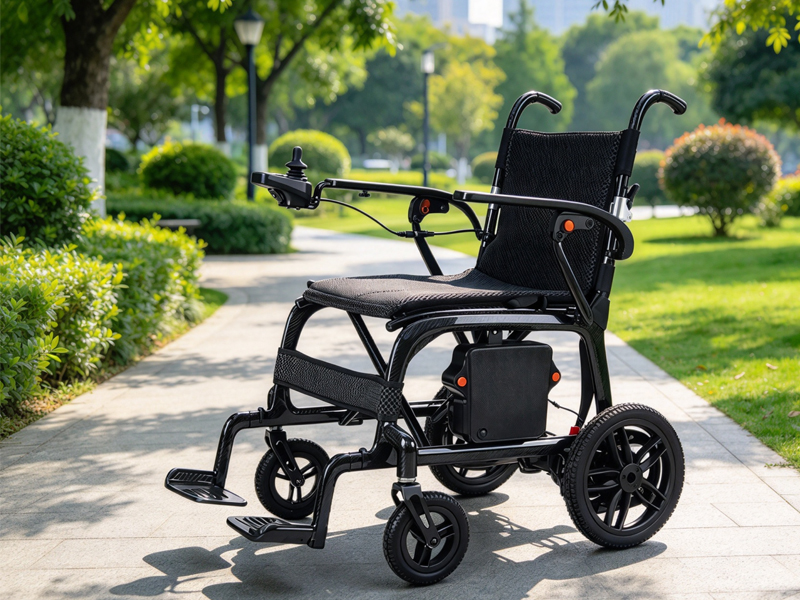
One of the easiest ways to understand aluminum, steel, and carbon fiber is to imagine three ordinary travel situations.
Scenario 1: You drive several times a week
You arrive home, fold the wheelchair, lift it into the trunk, and repeat the process a few days later.
In this situation, wheelchair weight becomes a daily physical task.
A difference of 5 or 10 kg may sound small when reading a specification sheet. In practice, lifting a wheelchair into a vehicle repeatedly can make that difference very noticeable.
This is where aluminum and carbon fiber become particularly attractive.
The YSE138’s approximately 20 kg net weight gives it a relatively manageable profile for a folding electric wheelchair, while the YSE146L takes portability further with a listed weight of approximately 16 kg including its battery.
Scenario 2: The wheelchair stays mostly in one place
If the wheelchair spends most of its time at home, in an assisted-living environment, or in a vehicle-accessible location, ultra-low weight may be less important.
In that situation, a steel frame can still be a practical choice.
The YSE123’s 42 kg listed net weight is substantially higher than the aluminum and carbon fiber examples, but its design includes a 45 cm seat, dual 250 W motors, 16-inch rear wheels, and a stated climbing ability of up to 15°.
The important question is not whether 42 kg is “too heavy.”
The important question is whether 42 kg fits the user’s actual routine.
If a caregiver handles the chair, if it is transported using a ramp, or if it remains mostly assembled, the additional weight may be less problematic than it would be for a solo traveler.
Scenario 3: Air travel and frequent trips are major priorities
Frequent travelers tend to think differently about mobility equipment.
They care about folding dimensions, lifting weight, battery configuration, storage space, and how easily the chair can be moved between a car, hotel, airport, and destination.
That is where carbon fiber can offer a particularly compelling design direction.
The YSE146L folds to approximately 72 × 30 × 70 cm and has a listed total weight of about 16 kg with its battery.
For travel-focused users, those specifications can matter more than having the largest motors or highest climbing angle.
Of course, airline requirements for powered wheelchairs and lithium batteries vary by airline, aircraft, battery configuration, and destination. Travelers should always confirm current battery and mobility-device requirements directly with the airline before a trip.
Instead of asking which material wins, it is more useful to think about the characteristics each material tends to emphasize.
| Factor | Aluminum Frame | Steel Frame | Carbon Fiber Frame |
|---|---|---|---|
| Overall weight | Relatively low | Higher | Very low |
| Portability | Good | More demanding | Excellent |
| Folding applications | Very common | Possible | Particularly attractive |
| Structural feel | Light and rigid | Solid and substantial | Light and rigid |
| Ease of lifting | Easier | More difficult | Easiest of the three |
| Manufacturing cost | Moderate | Often more accessible | Generally higher |
| Travel focus | Strong | Moderate | Very strong |
| Everyday practicality | High | High for suitable users | High for portability-focused users |
| Best considered for | Daily mobility + transport | Stability + robust construction | Maximum portability |
This table should not be interpreted as a universal engineering rule for every wheelchair on the market. Frame geometry, tube thickness, joints, welding, composite layup, wheel configuration, battery type, motors, and overall design can change the actual performance of a specific wheelchair.
In other words:
Material matters, but engineering matters just as much.
Two aluminum wheelchairs can feel completely different.
Two steel wheelchairs can have completely different weights.
And two carbon fiber wheelchairs can have different levels of stiffness, durability, and travel capability depending on how they are engineered.
For many people, aluminum represents the most straightforward compromise.
It can reduce overall weight without requiring a premium composite construction. It also works well with folding mechanisms and modern electric wheelchair designs.
The YSE138 is a useful example because its aluminum frame is paired with several features intended for practical daily use.
Its dual 200 W brushless motors provide a maximum speed of 6 km/h, while the manufacturer lists a driving range of 10–20 km. Front suspension is designed to improve comfort over minor uneven surfaces, and the chair uses 12-inch rear PU wheels and 7-inch front wheels.
The 20 kg net weight is particularly relevant.
It is light enough to make transportation more realistic for many users, but the chair is not positioned as an ultra-light travel-only model.
For someone who wants one electric wheelchair for a mixture of home use, shopping, neighborhood trips, and occasional vehicle transportation, an aluminum frame can be a sensible starting point.
Explore the IYASOCARE YSE138 aluminum-frame folding electric wheelchair here.
The biggest misconception about steel wheelchair frames is that heavier automatically means inconvenient.
It can mean inconvenient for certain users—but not all.
Steel remains attractive because it offers a familiar combination of structural strength, manufacturability, and cost-conscious design.
The YSE123 demonstrates this with a practical feature set rather than trying to compete on minimum weight.
Its 45 cm seat width gives users more seating room than the 38 cm seat listed for the YSE138 and the 40 cm seat listed for the YSE146L. It also has 16-inch rear wheels, dual 250 W motors, and a listed climbing capability of up to 15°.
That makes the YSE123 an interesting option for users who value a more substantial configuration.
The chair also includes electronic parking and hill-hold functions, manual braking, removable footrests, reversible armrests, and a folding structure.
Its weight is therefore only one part of the story.
If portability is the number-one requirement, the YSE123 is obviously not in the same weight class as the YSE146L.
But if the wheelchair’s primary role is dependable daily mobility, and transportation can be handled with a ramp, caregiver, or suitable vehicle setup, steel may still make practical sense.
Explore the IYASOCARE YSE123 steel-frame electric wheelchair here.
Carbon fiber tends to attract attention because of its weight.
And in a mobility device, weight is not merely a technical specification.
It can affect independence.
A wheelchair that one person can lift may be usable without assistance. A wheelchair that requires two people to lift may introduce a dependency that was not there before.
That is one reason the YSE146L’s listed weight of 11.5 kg without the battery and 16 kg with the battery is so notable.
Its compact folded dimensions also make it attractive for users who have limited storage space.
The YSE146L uses dual 150 W brushless motors, electromagnetic braking, a 24 V 10 Ah lithium battery, 11-inch rear PU wheels, and 6.5-inch front PU wheels.
Its design priorities are clear: lightweight construction, compact folding, straightforward operation, and everyday travel convenience.
At the same time, its 3° listed climbing ability shows why users should always look beyond frame material. If someone routinely needs to deal with steep ramps, rough terrain, or demanding outdoor conditions, a lightweight travel chair may not be the right configuration regardless of how advanced its frame material is.
Carbon fiber is not a shortcut around the laws of physics.
It is a way of optimizing the structure for a different set of priorities.
Explore the IYASOCARE YSE146L carbon-fiber electric wheelchair here.
Travel is one of the areas where the differences between these materials become easiest to appreciate.
For a car user, consider the full process:
If that happens several times per week, weight becomes a major usability factor.
A 16 kg wheelchair and a 42 kg wheelchair may both be called “foldable,” but the physical experience of transporting them is completely different.
That does not mean every traveler needs carbon fiber.
An aluminum model around 20 kg can already provide a significant balance between portability and everyday functionality.
This is why the YSE138 occupies an interesting middle position. It is substantially lighter than the steel YSE123 while offering a 6 km/h maximum speed, dual 200 W motors, front suspension, and a claimed 10–20 km range.
The YSE146L takes portability further, but with lower motor power, lower maximum speed, and a lower climbing specification.
The lesson is simple:
Choose the complete wheelchair around your lifestyle, not just the lightest frame available.
When buyers see “steel,” they often assume maximum durability.
When they see “carbon fiber,” they sometimes assume fragility.
Neither assumption is sufficient.
A wheelchair’s real-world durability depends on frame geometry, material quality, joints, fasteners, welds or composite construction, wheel design, suspension, usage conditions, maintenance, and the way the chair is transported.
Aluminum can be highly durable when properly engineered.
Steel can provide excellent structural performance, but it can also be affected by corrosion if finishes are damaged and moisture is allowed to remain on exposed areas.
Carbon fiber has excellent strength-to-weight characteristics, but composite structures need appropriate engineering and should not be treated like metal simply because the material is strong.
For all three types, routine inspection is important.
Check the frame and folding points periodically. Inspect wheels, brakes, armrests, footrests, electrical connectors, battery condition, and fasteners. If a wheelchair has experienced a collision, fall, or unusual structural impact, it should be inspected before continued use.
The material alone cannot tell you whether a wheelchair will last.
One of the easiest mistakes in wheelchair shopping is becoming so focused on the frame that other specifications are overlooked.
The three IYASOCARE models show why this matters.
The aluminum YSE138 uses dual 200 W brushless motors and a 24 V 10 Ah lithium battery. It has a listed 10–20 km driving range and a maximum speed of 6 km/h.
The steel YSE123 uses dual 250 W motors and a 24 V 12 Ah lead-acid battery. It lists a range of up to 15 km, a maximum speed of 6 km/h, and a climbing capability of up to 15°.
The carbon fiber YSE146L uses dual 24 V 150 W brushless motors with a 24 V 10 Ah lithium battery. It lists a 10–15 km range, a maximum speed of 4.5 km/h, and a climbing capability of up to 3°.
These differences are important.
They demonstrate that frame material and performance are related design decisions, but they are not the same thing.
If you spend most of your time on smooth indoor floors, a lightweight carbon fiber wheelchair may make more sense than a higher-powered configuration.
If you regularly travel on slopes or more challenging everyday surfaces, motor output, wheel size, braking, and climbing specifications may deserve greater attention.
Comfort is sometimes treated as a secondary issue in wheelchair buying.
It should not be.
A wheelchair is often used for hours at a time. Seat width, seat depth, seat height, backrest configuration, armrests, footrests, cushion design, and suspension can all influence the experience.
The three models provide different configurations.
The YSE138 lists a 38 cm seat width and 43 cm seat depth, with a 51 cm seat height.
The YSE123 provides a 45 cm seat width and 45 cm seat depth, with a 50 cm seat height.
The YSE146L lists a 40 cm seat width and 41 cm seat depth, with a 45 cm seat height.
These measurements are useful because comfort is highly individual.
A wider seat is not automatically better if it does not provide the right level of lateral support. A lower seat is not automatically easier for every user. A compact wheelchair may be more convenient for transportation but less suitable for someone who requires a particular seating configuration.
Before purchasing, users should compare the manufacturer’s seat measurements with their own body dimensions and transfer requirements.
For international buyers, the manufacturer behind the wheelchair matters almost as much as the individual model.
IYASOCARE describes itself as a medical equipment company specializing in the research, development, production, sales, and consulting of wheelchairs, walkers, rollators, and other rehabilitation products. The company says it established its own factory in 2019 and operates specialized production facilities covering processes including stamping, injection molding, welding, and assembly.
Its product range includes electric wheelchairs, folding power wheelchairs, carbon fiber wheelchairs, off-road wheelchairs, standing wheelchairs, stair-climbing wheelchairs, manual wheelchairs, and other mobility products.
For international customers, IYASOCARE also states that it has worked with customers in multiple countries and regions and holds certifications including CE, ISO 13485, and TUV. Buyers should still verify which certifications and regulatory documentation apply to the specific model and destination market before placing an order.
That broader product experience is useful because frame material is only one part of wheelchair design.
A manufacturer working across aluminum, steel, and carbon fiber platforms has the opportunity to design products around different user scenarios rather than forcing every customer into one frame philosophy.
That is exactly how these three models can be understood.
The YSE138 focuses on a balanced aluminum construction.
The YSE123 emphasizes a steel frame with a more substantial configuration.
The YSE146L pushes much further toward lightweight carbon-fiber portability.
Rather than asking which one is universally superior, buyers can start by asking which design philosophy fits their own routine.
If you want the shortest possible way to remember the difference, think about them like this:
Aluminum is about balance.
It offers a practical combination of relatively low weight, structural performance, folding convenience, and everyday usability. The YSE138 represents this middle-ground approach with a 20 kg listed net weight and a range of features aimed at daily transportation.
Steel is about a more substantial platform.
It brings additional weight, but can be paired with larger wheels, stronger motor configurations, wider seating, and other features that may appeal to users who prioritize stability and everyday robustness. The YSE123 illustrates this approach with its 42 kg listed net weight, dual 250 W motors, 45 cm seat width, and 15° listed climbing ability.
Carbon fiber is about minimizing mass.
The YSE146L shows how far the design can move toward portability, with a listed 16 kg total weight including its battery and a compact folded footprint. Its lower speed and climbing specification also demonstrate why lightweight construction should be considered together with the intended use environment.
Before choosing a material, answer five practical questions.
How often will I lift the wheelchair?
If the answer is several times a week, weight should be a major consideration.
Who will transport it?
A wheelchair that is manageable for a strong caregiver may be difficult for an individual user to load independently.
Where will I drive it?
Smooth indoor floors, sidewalks, shopping centers, parks, slopes, gravel, and rough outdoor terrain create different requirements.
How important is seat size?
Measure the seat width and depth rather than relying on photographs.
What does independence mean for me?
For some users, independence means being able to lift the chair into a car without help. For others, it means having enough motor power to handle everyday slopes. For someone else, it may mean having a wider seat or the ability to switch to manual mode.
Once these questions are answered, the material choice usually becomes much clearer.
The debate over aluminum vs steel vs carbon fiber wheelchair frames is sometimes presented as if there is one obvious winner.
Real life is more complicated—and more interesting.
A wheelchair is not a racing bicycle or a piece of luggage. It is a mobility system that needs to match a person’s body, environment, transportation habits, physical abilities, and daily routine.
Steel can make sense when a more substantial frame and higher-capability configuration are priorities.
Aluminum can make sense when the goal is to balance weight, portability, and everyday performance.
Carbon fiber can make sense when minimizing wheelchair weight is one of the most important requirements, particularly for users who travel frequently or need to load the chair into a vehicle independently.
The IYASOCARE YSE138, YSE123, and YSE146L make this difference easy to see. Their frame materials are different, but more importantly, their entire designs are optimized around different combinations of portability, power, seating, and everyday mobility.
That is ultimately the most useful way to shop for an electric wheelchair.
Don’t start with the question, “Which material is strongest?”
Start with:
“What do I need my wheelchair to do every day?”
The right frame is the one that makes those everyday tasks easier, safer, and more manageable.
1. Is aluminum better than steel for an electric wheelchair?
Not necessarily. Aluminum can provide a useful combination of relatively low weight and structural performance, making it attractive for folding and portable electric wheelchairs. Steel is heavier but can be used to create a substantial, stable wheelchair configuration.
The right choice depends on the user’s priorities. If frequent lifting and vehicle transportation are important, a lighter aluminum frame may be more convenient. If portability is less important and the user prefers a more substantial configuration, steel may be worth considering.
The IYASOCARE YSE138 and YSE123 demonstrate this difference clearly: the YSE138 has a listed net weight of about 20 kg, while the YSE123 is listed at about 42 kg.
2. Is a carbon fiber wheelchair worth the higher cost?
That depends on how valuable low weight and portability are in your daily life.
Carbon fiber can be particularly attractive when a user needs to lift a wheelchair into a vehicle, store it in a small space, or travel frequently. The IYASOCARE YSE146L is listed at approximately 11.5 kg without the battery and 16 kg with the battery, making its weight substantially lower than the steel example discussed in this article.
However, buyers should not evaluate carbon fiber on weight alone. Motor power, maximum speed, climbing ability, battery, seat dimensions, braking system, folded dimensions, and intended terrain should all be considered before making a purchase.
3. Which wheelchair frame material is best for travel?
There is no single answer for every traveler.
For users who want a balance between portability and everyday power, an aluminum folding wheelchair such as the YSE138 may be worth considering. For users who prioritize the lowest practical weight and compact transportation, a carbon fiber model such as the YSE146L may be more suitable. A steel model such as the YSE123 can still work for travel when transportation equipment or caregiver assistance makes its higher weight manageable.
The most important thing is to compare the complete wheelchair, not just the frame material.
Before traveling by air, always confirm the current wheelchair and battery requirements with the airline, especially when the wheelchair uses a lithium battery.