Our Location
Free Trade Tower, Xiyong street.
Chongqing, China

Free Trade Tower, Xiyong street.
Chongqing, China
Choosing a wheelchair factory is not simply a matter of comparing prices and asking how many units a manufacturer can produce each month. If you are sourcing wheelchairs for a medical equipment business, launching a private-label brand, supplying hospitals, or importing mobility products for distributors, the factory you choose can directly affect product quality, customer safety, delivery schedules, and your long-term reputation.
A professional-looking website is not proof that a factory is reliable. A company may describe itself as a “leading wheelchair manufacturer,” display impressive factory photographs, and promise competitive prices, yet still outsource most of its production or lack the quality-control systems required for international orders.
The good news is that verifying a wheelchair factory does not require complicated detective work. What matters is knowing what to check, what documents to request, which questions to ask, and how to recognize inconsistencies before you place an order.
One of the most common mistakes buyers make is becoming interested in a wheelchair model before verifying the company behind it.
A supplier may send you a beautiful product catalog, competitive quotation, and sample photos. That can be useful, but none of these things answer the most important question:
Who are you actually buying from?
Begin with the manufacturer’s legal identity.
Ask the factory to provide its full registered company name, registered address, business license or equivalent registration document, primary contact information, and the address of its manufacturing facility.
These details should be consistent across documents.
For example, if the quotation is issued by one company, the business license shows another legal entity, and payment is requested to a third company’s bank account, you should stop and ask for an explanation before moving forward.
Different entities can sometimes be legitimate. A manufacturer may have a trading company for international sales, while production is handled by an affiliated factory. The problem is not necessarily that different company names exist. The problem is when the relationship between them is unclear.
A trustworthy supplier should be able to explain:
Do not be uncomfortable asking these questions. A serious manufacturer should expect international buyers to perform due diligence.
A factory website is useful for an initial impression, but it should never be your only source of information.
Look beyond marketing language.
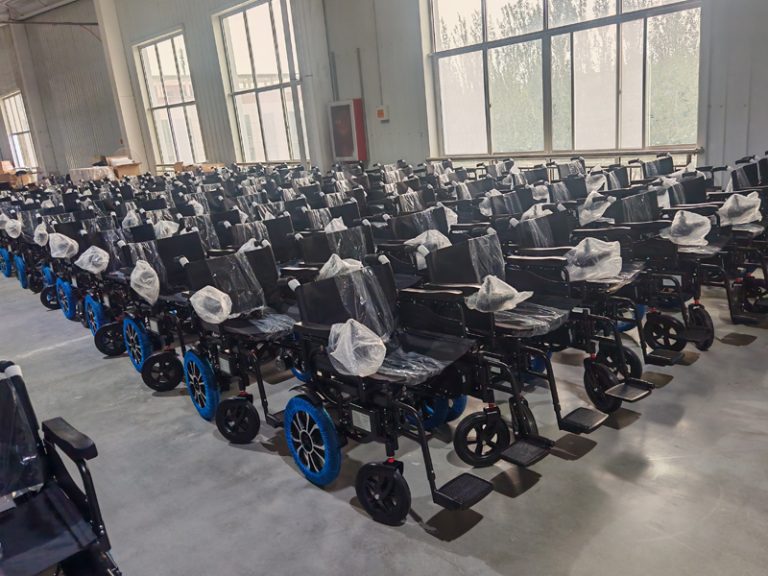
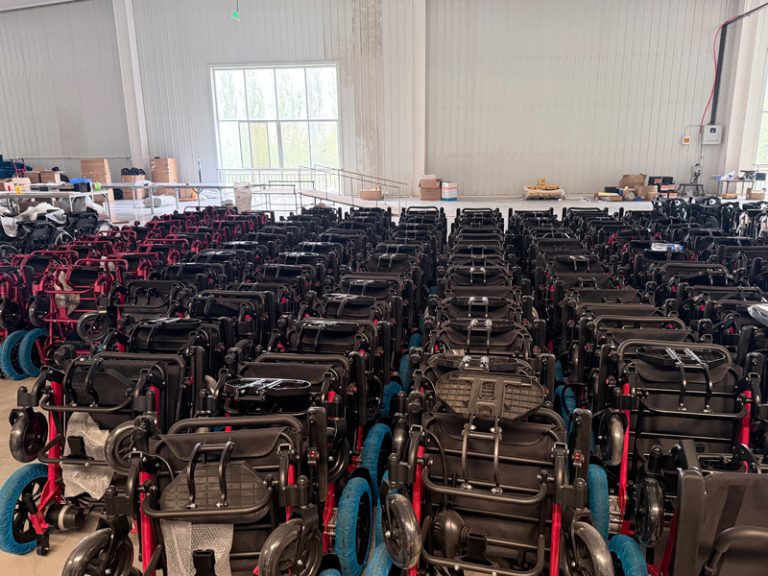
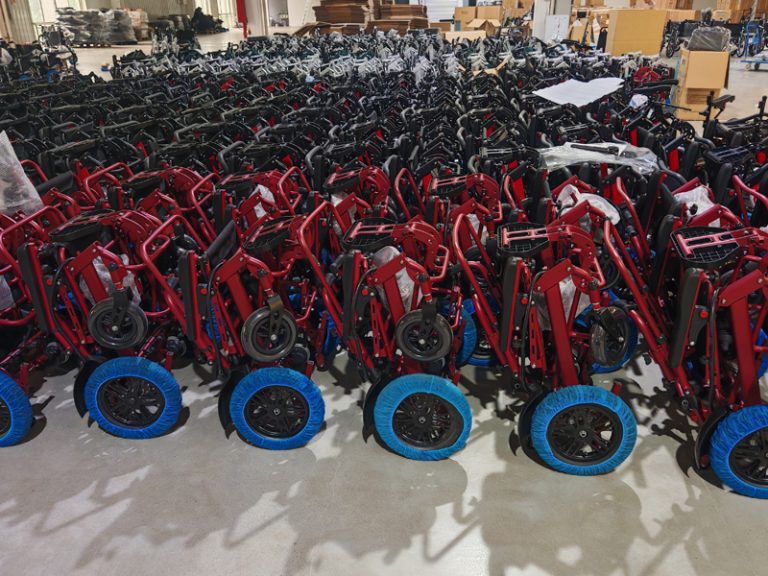
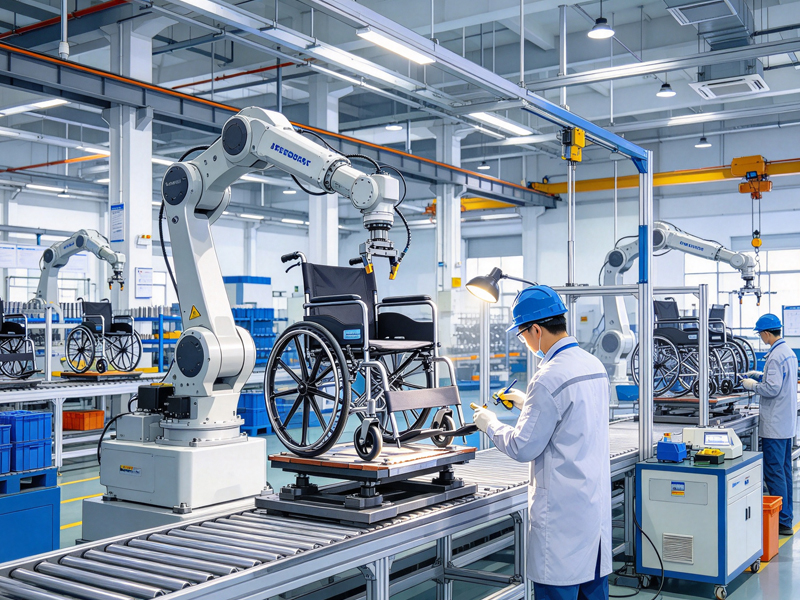
A genuine wheelchair manufacturing facility should normally have identifiable production areas related to the products it claims to manufacture. Depending on the product range, you may see metal tube cutting, bending, welding, grinding, surface treatment, assembly, upholstery, inspection, packaging, warehouse storage, or other relevant operations.
You do not necessarily need every process to happen under one roof. Some manufacturers outsource powder coating, casting, machining, or other specialized processes. What matters is whether the factory is transparent about its production structure.
Ask the supplier for a live video factory tour if an in-person visit is not practical.
A recorded promotional video is easy to prepare. A live video call is more informative.
During a live tour, ask the salesperson to show specific areas in real time. For example, you can ask to see the production line, raw-material storage, finished-product warehouse, quality inspection area, and packaging section.
You can also ask the representative to show today’s production schedule or demonstrate a particular wheelchair model you are considering.
You are not trying to conduct a professional factory audit through a smartphone. You are looking for consistency.
If the company claims to operate a large manufacturing facility but cannot provide a credible factory tour, gives repeatedly vague answers, or appears to have no identifiable production operation, treat that as a warning sign.
Buyers sometimes assume that a bigger factory is automatically better.
That is not necessarily true.
A huge factory may be optimized for high-volume standardized products but have little experience with customization. A smaller manufacturer may have better control over a specialized product category.
Instead of asking only, “How big is your factory?” ask more useful questions:
How long have you manufactured wheelchairs?
Which wheelchair models do you produce in-house?
What is your monthly production capacity for the specific model I want?
What percentage of production is outsourced?
What is your typical defect or rejection rate?
What quality-control procedures are performed before shipment?
The key phrase here is for the specific product.
A company may have a production capacity of 10,000 units per month across its entire product portfolio. That does not mean it can manufacture 10,000 units of your particular wheelchair model.
If you need 1,000 lightweight folding wheelchairs every month, your verification should focus on whether the supplier can consistently produce that model at the required specification and quality level.
A wheelchair manufacturer can produce a good product and still be the wrong supplier for your business.
Why?
Because different markets have different requirements.
A buyer supplying rehabilitation centers may have different requirements from a retailer selling consumer mobility products. A distributor importing into Europe may face different regulatory and documentation expectations from a company selling into the United States, the Middle East, Africa, or Southeast Asia.
Ask the factory where it currently exports.
You can ask for general information such as:
You do not necessarily need a list of every customer. Reputable manufacturers may have confidentiality agreements that prevent them from revealing customer names.
Instead, ask for verifiable evidence of market experience, such as anonymized shipping records, product certifications, test reports, packaging examples, or references where disclosure is permitted.
Certificates are important, but they are often misunderstood.
A certificate does not automatically prove that a factory is excellent.
For example, a management-system certification may indicate that a company has implemented a particular quality-management system. It does not mean every wheelchair leaving the facility is perfect.
Similarly, a product test report applies to the tested product and configuration. If the manufacturer changes materials, dimensions, components, or suppliers, the relevance of the original report needs to be considered.
When a supplier provides certificates or test reports, check the details rather than simply looking for a logo.
Look at:
Company name: Does it match the manufacturer or the responsible legal entity?
Product description: Does it actually describe the wheelchair you are purchasing?
Model number: Does the tested model correspond to your intended model?
Issuing organization: Is the testing or certification body identifiable and credible?
Date: Is the document current and relevant?
Scope: What exactly does the document cover?
This is particularly important when purchasing wheelchairs for regulated or safety-sensitive markets.
If a supplier sends you a document that appears generic, incomplete, unrelated to your model, or difficult to verify, ask for clarification before relying on it.
Once the factory itself appears legitimate, move to the product.
This is where a sample becomes extremely valuable.
Never rely entirely on product photographs when quality matters. A sample allows you to inspect the actual frame, folding mechanism, upholstery, wheels, brakes, footrests, armrests, bearings, fasteners, and finishing.
Start with the frame.
Look for consistent welds, clean joints, appropriate surface finishing, and signs of structural weakness. The frame should not have obvious cracks, excessive grinding marks, sharp edges, inconsistent coating, or poor alignment.
Then inspect the folding mechanism.
A folding wheelchair should open and close smoothly without excessive play. The locking mechanism should work consistently. Components should not feel loose or poorly fitted.
Check the wheels and casters.
Spin them and observe whether they rotate smoothly. Look for unusual wobbling, excessive resistance, or inconsistent alignment.
Test the brakes.
The brakes should engage securely and consistently. A wheelchair intended for daily use should not depend on a brake mechanism that feels fragile or unpredictable.
Examine the footrests and armrests as well.
These components are frequently handled, adjusted, folded, or removed, so poor mechanical design can quickly become a source of customer complaints.
The purpose of sample inspection is not to judge the product based on appearance alone. It is to determine whether the factory’s actual manufacturing quality matches its sales claims.
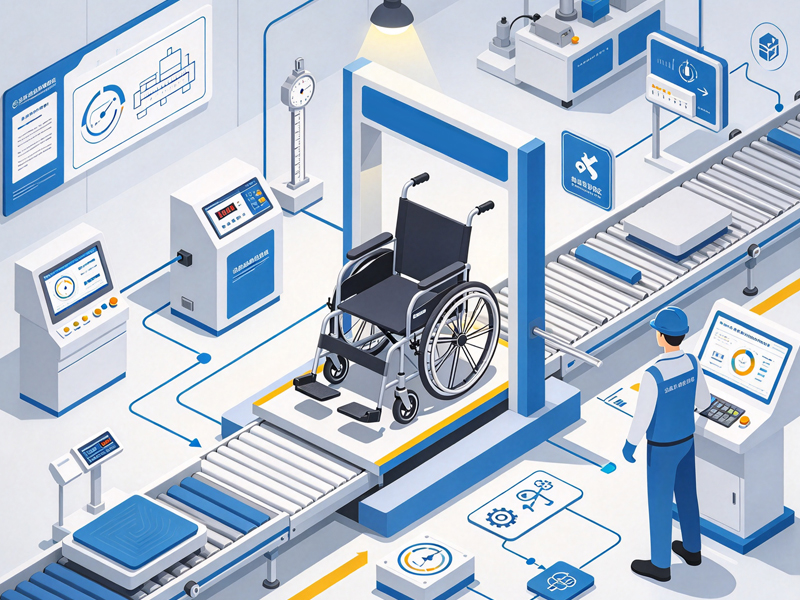
One of the most revealing questions you can ask a manufacturer is:
“What happens if a wheelchair fails inspection?”
A mature factory should have a defined process.
Quality control should not simply mean that a worker looks at the finished product for a few seconds before loading it into a carton.
Depending on the wheelchair type, quality control may involve incoming material inspection, dimensional checks, component inspection, assembly checks, functional testing, visual inspection, packaging inspection, and final random or full inspection.
Ask the manufacturer to explain its process.
You can also ask:
The answers will tell you more than a statement such as “We have strict quality control.”
A factory that can clearly explain its procedures is generally easier to work with than one that relies entirely on broad marketing claims.
Two wheelchairs can look almost identical while having very different manufacturing costs and durability.
That is why you should never approve a product based only on appearance.
Ask the manufacturer to provide the specifications of important materials and components.
For example:
If your wheelchair is customized, these specifications should become part of the formal product specification.
This matters because factories can sometimes substitute components without changing the external appearance significantly.
A cheaper caster, different upholstery material, thinner tubing, or alternative hardware may reduce manufacturing costs while leaving the product looking almost identical.
The safest approach is simple:
Do not approve only a product photo. Approve a documented specification.
If you are building your own wheelchair brand, customization is likely to be important.
Ask the factory exactly what it can customize.
There is a significant difference between putting a logo on a product and genuinely developing a private-label product.
Possible customization may include:
For larger projects, you should establish a written specification sheet.
The specification should identify the agreed materials, dimensions, colors, components, tolerances where relevant, packaging requirements, labels, and approved samples.
This document becomes an important reference during production.
Without it, disagreements become much harder to resolve.
Factory verification is not only about manufacturing.
It is also about communication.
A manufacturer may have good machinery and reasonable prices, but if communication is consistently slow, unclear, or inaccurate, problems can become expensive.
Pay attention to how the supplier handles your questions during the quotation stage.
Do they answer directly?
Do they understand technical questions?
Do they remember your specifications?
Do they provide documents when promised?
Do different sales representatives give consistent answers?
Do they tell you when something cannot be done?
The last point is particularly important.
A trustworthy supplier does not need to say yes to everything.
If you request an unrealistic customization, a serious manufacturer should explain the technical limitations, minimum order quantity, additional tooling, or cost implications.
A salesperson who promises everything before checking with the production team may create problems later.
Price is important, but the lowest quotation is rarely enough to identify the best factory.
Instead, compare quotations on a like-for-like basis.
Make sure the quoted products use the same:
Also clarify whether the price includes tooling, packaging design, samples, spare parts, inspection, documentation, or other costs.
A factory offering a significantly lower price than everyone else deserves additional investigation.
It may have a genuine cost advantage. It may also be using different materials or excluding costs that other suppliers included.
The goal is not to find the cheapest wheelchair.
The goal is to find the best total value at an acceptable level of quality and risk.
Before committing to a large production order, a sample or small initial order can reveal a great deal.
Treat the first order as a test of the entire supply chain.
Evaluate:
Product quality: Does the physical product match the approved specifications?
Packaging: Did the product arrive properly protected?
Documentation: Were the required documents supplied correctly?
Lead time: Was the order shipped when promised?
Communication: Did the supplier keep you informed?
Problem solving: How did the factory respond when you raised an issue?
That last point is especially valuable.
Almost every manufacturer will eventually encounter a production problem. The real difference between suppliers is often how they respond.
A factory that acknowledges a problem, investigates the cause, proposes a corrective action, and follows through can be far more valuable than a supplier that looks perfect until something goes wrong.
For significant orders, an independent factory audit can be a worthwhile investment.
An auditor can verify information that is difficult for a buyer to assess remotely, including factory identity, production capability, manufacturing processes, quality-control systems, worker practices, storage conditions, equipment, and production capacity.
This is particularly useful when the order value is substantial or when you plan to establish a long-term supply relationship.
You do not necessarily need to audit every small supplier. The level of verification should match the financial and operational risk.
A useful way to think about it is:
The larger the order and the greater the consequences of failure, the more independent verification makes sense.
No single warning sign automatically means a factory is fraudulent. However, several warning signs appearing together should make you slow down.
Be cautious when a supplier:
One red flag may have an innocent explanation.
Several unexplained inconsistencies are different.
When something does not make sense, do not ignore it simply because the price is attractive.
Instead of making your decision based on intuition, create a simple scorecard.
For example:
| Verification Area | Suggested Weight |
|---|---|
| Legal company verification | 15% |
| Factory and production capability | 15% |
| Product quality | 20% |
| Quality-control system | 15% |
| Certifications and testing | 10% |
| Export experience | 10% |
| Communication and service | 5% |
| Pricing and commercial terms | 10% |
The exact weighting can change depending on your business.
For a medical equipment distributor, quality and compliance may deserve more weight than price.
For a retailer selling a standardized consumer wheelchair, delivery reliability and commercial terms may have greater importance.
The advantage of a scorecard is that it prevents one attractive factor—usually a low price—from dominating the entire decision.
The best factory verification process is not based on one document, one video call, or one sample.
It is based on multiple layers of evidence.
First, verify the company.
Second, verify the factory.
Third, verify the product.
Fourth, verify the quality system.
Fifth, verify the documentation.
Sixth, verify the supplier through a sample order.
For larger purchases, add an independent factory audit and pre-shipment inspection.
Each layer answers a different question.
A business license tells you that a company exists.
A factory tour helps establish whether it actually has manufacturing capability.
A sample tells you what the product is really like.
A test report provides evidence about specific product characteristics.
A quality-control review tells you how the manufacturer manages production.
A trial order tells you how the supplier performs in a real commercial relationship.
When these pieces of evidence agree with one another, your confidence increases significantly.
Verifying a wheelchair factory takes more effort than simply comparing catalogs and asking for the lowest price, but it can save you far more time and money later.
The strongest manufacturers are usually not afraid of reasonable questions. They can explain who they are, where they manufacture, what materials they use, how they control quality, which markets they serve, and what documentation supports their products.
More importantly, their answers should be consistent with what you can independently verify.
Remember that factory verification is not about finding a supplier that claims to be perfect. It is about finding a manufacturer whose capabilities, documentation, product quality, communication, and commercial practices can be independently checked.
If you are planning a long-term wheelchair supply relationship, think beyond the first container. The right manufacturer should be capable of maintaining the agreed quality level across repeated production batches—not simply producing an impressive sample for a new customer.
A good factory is therefore more than a place with machines and workers.
It is a manufacturing partner with traceable processes, reliable quality control, transparent communication, and the ability to deliver the same product specification consistently over time.
That is the standard worth verifying before you place your next wheelchair order.
1. What documents should I ask a wheelchair factory for?
At a minimum, request the manufacturer’s legal company information, business registration or equivalent documentation, product specifications, relevant certifications and test reports, quotation, warranty terms, and quality-control information. Depending on your target market and product type, additional regulatory or testing documents may be required.
Do not simply collect documents. Check whether the company name, product model, dates, issuing organization, and scope are consistent.
2. How can I tell if a wheelchair factory is genuine?
Start by verifying the company’s legal identity and physical manufacturing address. Then request a live video factory tour or arrange an independent factory inspection. Ask specific questions about production equipment, manufacturing processes, monthly capacity, quality control, and the percentage of production performed in-house.
A genuine manufacturer should be able to provide reasonably consistent answers and supporting evidence.
3. Should I visit the wheelchair factory before placing an order?
For a large or long-term order, visiting the factory—or hiring an independent inspection company to conduct an audit—can be highly worthwhile.
For a smaller first order, you may be able to reduce risk through company verification, document checks, a live factory tour, product sampling, and third-party inspection.
The key is to match the depth of verification with the potential financial and business risk. The more you stand to lose if the supplier fails, the more thoroughly you should verify the factory before committing.