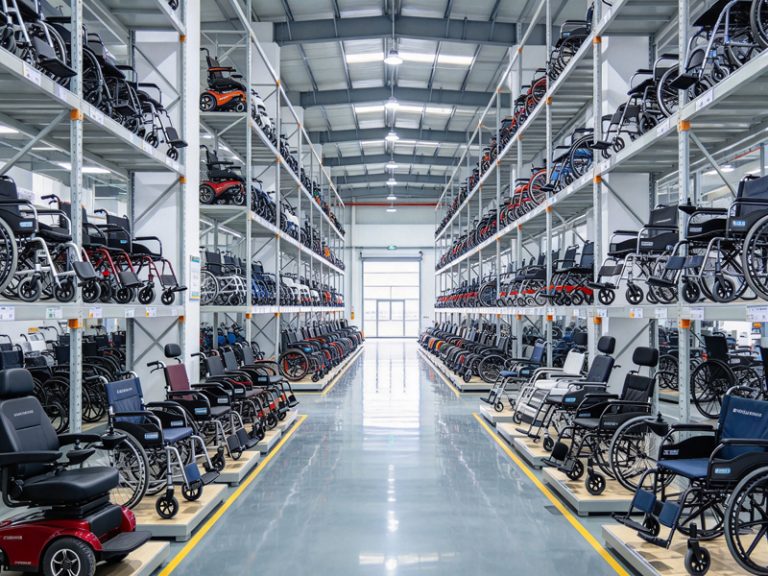
Our Location
Free Trade Tower, Xiyong street.
Chongqing, China

Free Trade Tower, Xiyong street.
Chongqing, China
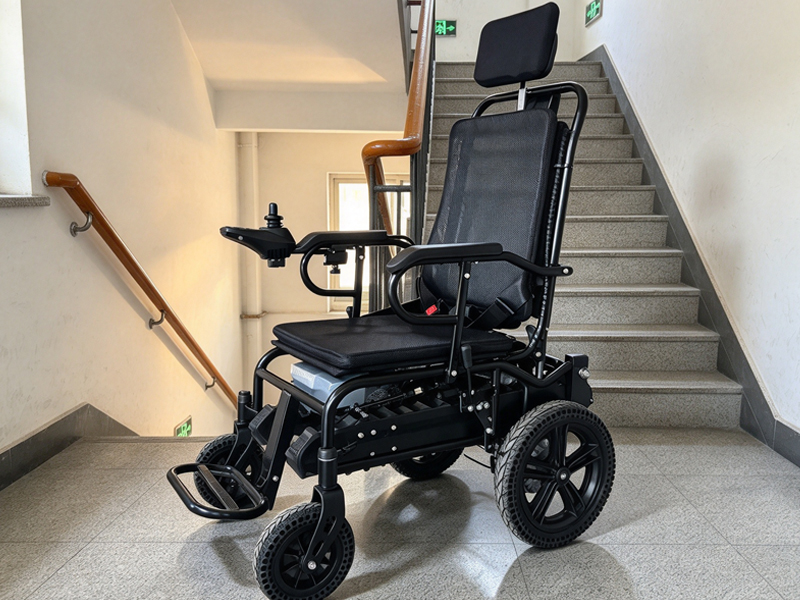
Choosing an electric stair climbing wheelchair factory is not simply about finding a supplier with an attractive price or an impressive product catalog. For wheelchair distributors, medical equipment importers, rehabilitation centers, and private-label brands, the right manufacturing partner can make a significant difference to product safety, customer satisfaction, delivery reliability, and long-term business growth.
Unlike conventional wheelchairs, electric stair climbing wheelchairs combine mechanical structures, electric motors, battery systems, climbing mechanisms, braking components, and specialized safety features. These systems must work together reliably, particularly when a wheelchair is carrying a person on a staircase. A problem with one component can affect the performance of the entire product.
This is why experienced buyers look beyond product photographs and sales promises. They evaluate the manufacturer’s engineering capabilities, production processes, quality control, technical documentation, customization options, and after-sales support before committing to an order.
If you are sourcing stair climbing wheelchairs for your local market, two models worth evaluating are the IYASOCARE YSE201M Lightweight Stair Climbing Wheelchair and the YSE203 Foldable Electric Stair Climbing Wheelchair. Both are designed to combine everyday mobility with powered stair climbing, but their different configurations make them suitable for different purchasing priorities.
So, how can you identify a reliable electric stair climbing wheelchair factory, and what should you check before placing your first order?
When comparing electric stair climbing wheelchair manufacturers, price is often the first figure buyers examine. It is understandable: importers need to maintain competitive margins, while distributors must balance product quality against the purchasing power of their customers.
However, the lowest quotation does not necessarily represent the lowest total cost.
A wheelchair that arrives with inconsistent assembly, unreliable climbing performance, unavailable spare parts, or unclear warranty coverage can create expenses long after the initial purchase. Replacements, technical support, customer complaints, and delayed deliveries can quickly outweigh a small saving on the unit price.
A reliable factory should therefore demonstrate its ability to control the manufacturing process rather than simply assemble products from externally purchased components.
Start by asking the supplier how the wheelchair is manufactured. Find out which processes are handled in-house, which components come from qualified suppliers, how assembly is organized, and how finished products are inspected.
For stair climbing wheelchairs, particular attention should be paid to the frame, climbing mechanism, motor system, battery, braking system, controller, and folding structure.
These components have different functions, but their performance is interconnected. A strong frame alone cannot compensate for an unreliable climbing mechanism, just as a powerful motor cannot make an unsuitable staircase safe to navigate.
Ask for clear explanations of how the manufacturer verifies the performance of the complete wheelchair.
You should also establish the manufacturer’s legal identity and actual production address. Request relevant business registration information and confirm which company will sign the contract, receive payment, manufacture the product, and handle warranty claims.
If the supplier operates through a trading company affiliated with a factory, ask for a straightforward explanation of the relationship. Such arrangements can be legitimate, but responsibility for product quality and delivery should be clearly defined.
A live video factory tour, an independent factory audit, or an in-person visit can provide additional evidence of manufacturing capability.
The objective is not to find the biggest factory. It is to find a manufacturer that can consistently deliver the product specification you approve.
Safety should be one of the most important considerations when choosing an electric stair climbing wheelchair factory.
A conventional wheelchair is primarily designed for movement across relatively level surfaces. A stair climbing wheelchair must also manage the additional mechanical demands associated with ascending and descending steps.
That means the climbing mechanism, center of gravity, braking system, user positioning, and caregiver operating procedures all deserve careful attention.
Before selecting a manufacturer, ask how its stair climbing system works and what precautions are built into the design.
For tracked models, examine how the crawler mechanism engages with the stair edges and maintains contact during movement. Ask how the manufacturer addresses traction, controlled movement, and stability during transitions.
For other climbing designs, request an explanation of the operating principle and the conditions under which the device can be used safely.
Do not assume that a product is suitable for every staircase simply because the supplier describes it as an electric stair climber.
Stair width, tread depth, riser height, slope, landing dimensions, surface condition, and turning space can all affect compatibility. A narrow staircase or a small landing may prevent safe operation even when the wheelchair’s advertised specifications appear suitable.
The manufacturer’s instructions should clearly explain these limitations.
It is also important to ask about braking and locking functions. Depending on the model, these may include climbing locks, controlled stopping functions, or other mechanisms intended to prevent unintended movement.
Request model-specific technical documentation and applicable test reports. Where relevant, check whether the manufacturer has evaluated stability, braking performance, structural strength, and other safety characteristics under recognized standards.
A certificate or test report should correspond to the actual model and configuration being purchased. Documentation for a different wheelchair is not sufficient evidence that your selected model has undergone the same assessment.
Finally, insist on practical training materials. Operators should understand how to position the wheelchair, secure the user, inspect the staircase, operate the climbing system, and respond to abnormal conditions.
A reliable factory should be prepared to discuss these requirements in detail rather than treating stair climbing as just another motorized function.
Once a supplier’s manufacturing capability and safety documentation have been reviewed, the next step is to evaluate the product range against your customers’ actual needs.
For buyers looking for an electric stair climbing wheelchair with a folding structure and a lithium battery, the YSE201M and YSE203 provide two configurations worth comparing.
The YSE201M Lightweight Stair Climbing Wheelchair combines a steel frame, electric stair climbing capability, and a design intended for use in residential and professional care environments.
Its appeal lies in its relatively straightforward configuration. It is designed for users who need assistance navigating stairs while also requiring a wheelchair that can move across flat surfaces.
According to the published product specifications, the YSE201M supports a maximum user load of 150 kg and uses a 20Ah lithium battery with a 120W motor. Its stated climbing performance is up to 500 steps at approximately 15 steps per minute under the manufacturer’s specified conditions.
These figures provide a useful starting point for evaluation, but buyers should confirm the exact operating conditions used to establish battery endurance and climbing performance before making purchasing commitments.
The wheelchair has a 44 cm seat width, a 45 cm seat depth, and a 53 cm backrest height. The seat uses artificial leather upholstery, which can be practical in settings where surfaces need to be wiped down regularly.
The larger 12-inch rear wheels and 8-inch front wheels support its conventional wheelchair configuration for movement on suitable flat surfaces.
Another consideration is storage. The published folded dimensions are approximately 93 × 63 × 51 cm, compared with unfolded dimensions of approximately 102 × 63 × 112 cm. Its stated net weight is 55 kg.
These measurements matter to distributors because they influence storage arrangements, transportation planning, handling requirements, and the space needed in a care facility.
The YSE201M also incorporates a climbing lock system described as providing slow-down and reverse-lock functions. Buyers should request a demonstration of the exact controls and operating procedures to understand how these functions work in practice.
Where does the YSE201M fit best?
It is worth considering for home-care providers, nursing facilities, hospitals, and mobility equipment distributors that want a practical stair climbing wheelchair with a 150 kg load capacity and a comparatively compact folded profile.
Its configuration may be particularly relevant where customers need a combination of stair assistance, straightforward flat-ground movement, and manageable storage dimensions.
However, the manufacturer’s specifications should always be checked against the intended user’s physical needs, the building layout, and the required operating procedures.
Product details: https://www.iyasomed.com/products/stair-climbing-wheelchair-yse201m/
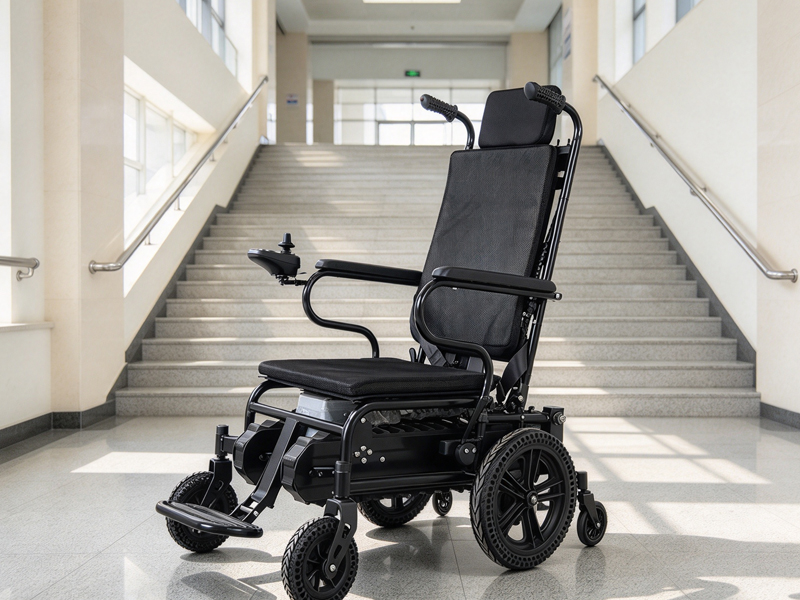
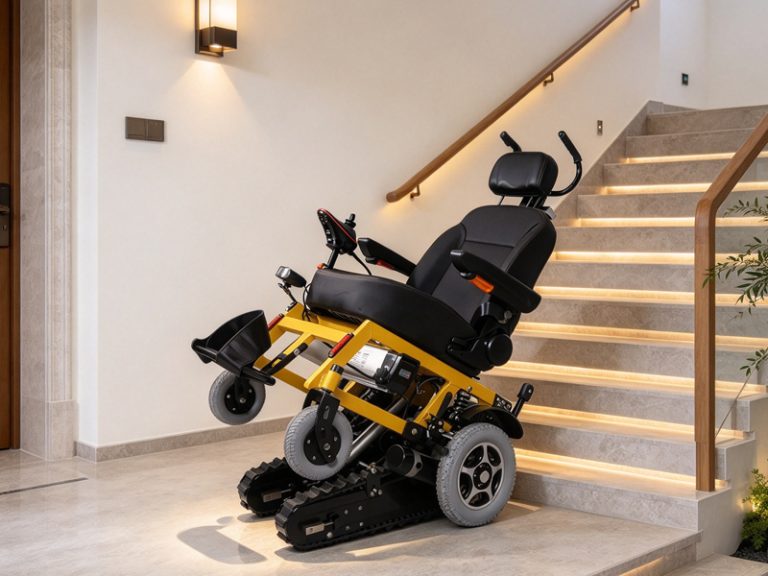
The YSE203 Foldable Electric Stair Climbing Wheelchair offers a different configuration for buyers who want powered movement on flat surfaces as well as a tracked stair climbing system.
One of its distinguishing features is the combination of electric driving and electric climbing. According to the published specifications, it uses two 24V 250W driving motors and a separate 24V 250W climbing motor.
This three-motor configuration is an important point for procurement teams to examine. Rather than focusing only on the total motor rating, buyers should ask the manufacturer how each motor functions, how the system is controlled, and how the driving and climbing modes are selected.
The YSE203 uses a 20Ah lithium battery and has a stated driving range of up to 15 km, with a maximum speed of 8 km/h. Its advertised stair climbing speed is approximately 15 steps per minute, with a stated climbing capability of up to 500 steps.
Actual range and climbing endurance can vary according to user weight, battery condition, terrain, stair geometry, temperature, and operating conditions. These figures should therefore be treated as manufacturer specifications rather than guaranteed performance in every environment.
The tracked climbing design is another reason to consider this model. A crawler mechanism is intended to maintain contact with the staircase during climbing, but suitability still depends on the particular staircase, operating technique, and product configuration.
The YSE203 has a steel frame and a stated maximum load capacity of 150 kg. Its seat measures approximately 44 cm wide and 44 cm deep, while the backrest height is listed as 78 cm without the pillow and 86 cm with the pillow.
For users who require additional upper-body support, the backrest configuration is worth evaluating in person. Buyers should check adjustability, seating posture, user transfer requirements, and compatibility with the intended occupant rather than relying on backrest height alone.
The wheelchair’s published unfolded dimensions are approximately 102 × 70 × 110 cm, with folded dimensions of 70 × 58 × 93 cm. Its stated net weight is approximately 60 kg, including the battery.
These dimensions give purchasing teams a useful basis for assessing storage and shipping arrangements. The folded configuration may be attractive where compact storage is important, although the actual space needed for handling and transportation should also be considered.
The YSE203 uses artificial leather cushioning and is described as having a universal controller and an adjustable folding design. The manufacturer also indicates that certain specifications and components may be customizable, subject to confirmation.
Who should consider the YSE203?
This model is worth evaluating for medical equipment distributors, care facilities, and mobility equipment suppliers that want a powered stair climbing wheelchair with a tracked climbing system and electric drive functionality.
It may also be a suitable candidate for buyers who place a high priority on a folding design and want to investigate private-label or configuration options.
As with any stair climbing wheelchair, a product demonstration, review of model-specific documentation, and assessment of the intended staircase are essential before confirming suitability.
Product details: https://www.iyasomed.com/products/stair-climbing-wheelchair-yse203/
| Evaluation point | YSE201M | YSE203 |
|---|---|---|
| Frame material | Steel | Steel |
| Maximum user load | 150 kg | 150 kg |
| Battery | 20Ah lithium | 20Ah lithium |
| Published motor specification | 120W motor | Two 250W drive motors and one 250W climbing motor |
| Advertised climbing speed | 15 steps/min | 15 steps/min |
| Advertised climbing capacity | Up to 500 steps | Up to 500 steps |
| Flat-ground operation | Manual driving and electric climbing configuration | Electric driving and electric climbing |
| Seat width | 44 cm | 44 cm |
| Seat depth | 45 cm | 44 cm |
| Folded dimensions | 93 × 63 × 51 cm | 70 × 58 × 93 cm |
| Stated net weight | 55 kg | 60 kg, including battery |
| Notable consideration | Compact folded profile and straightforward configuration | Tracked climbing system and powered driving |
Specifications are based on published product information. Confirm the latest technical data, configuration, included accessories, and performance conditions directly with the manufacturer before ordering.
Neither model is automatically the better choice for every buyer.
The YSE201M deserves consideration when a relatively compact folded profile and a straightforward operating configuration are priorities. The YSE203 deserves consideration when powered flat-ground driving and a tracked climbing design are central to the purchasing decision.
For distributors, the most effective approach is to define the target application first and then request a model demonstration against that requirement.
A manufacturer’s quality control system often tells you more about its long-term reliability than its promotional materials.
A wheelchair may look excellent in a catalog and perform well in a single demonstration, yet still show inconsistencies across a large production batch. This is why professional buyers should ask how the factory maintains quality from incoming materials through final packaging.
A reliable electric stair climbing wheelchair factory should be able to explain its inspection process clearly.
Start with incoming components. Ask whether the factory checks the specifications and condition of critical components such as motors, batteries, controllers, wheels, fasteners, and climbing-system parts.
Next, examine assembly controls. Ask how the manufacturer checks frame alignment, fastener installation, wiring connections, folding mechanisms, and the fit of moving parts.
For powered stair climbing wheelchairs, functional testing is especially important. Ask whether completed products undergo checks of the drive system, climbing controls, brakes, battery charging, electrical connections, and relevant safety functions.
You should also ask how the factory records inspection results and handles products that fail to meet specifications.
A professional supplier should have a defined process for identifying nonconforming products, correcting problems, and preventing the same defect from recurring.
Where appropriate, request a sample inspection report or a description of the final inspection procedure. For larger orders, consider arranging an independent pre-shipment inspection based on written acceptance criteria.
The criteria should be agreed upon before production begins. They might include the approved model configuration, dimensions, packaging, accessories, visible workmanship, functional checks, and documentation.
Do not wait until goods arrive at your warehouse to decide what counts as acceptable quality.
A well-defined inspection plan gives both buyer and manufacturer a clearer basis for resolving problems.
Certifications are important when sourcing mobility equipment, but they must be interpreted correctly.
A manufacturer may hold a quality management system certificate, while an individual wheelchair model may have separate product test reports or conformity documentation. These documents serve different purposes and should not be treated as interchangeable.
For example, ISO 13485 concerns quality management systems for medical devices. It does not, by itself, prove that every wheelchair manufactured by a company meets every applicable product safety requirement.
Similarly, a CE marking claim should be supported by the appropriate documentation for the specific product and its intended market. The applicable regulatory route depends on the product’s classification, intended purpose, and configuration.
When reviewing documents, check the following:
For electric stair climbing wheelchairs, also ask about applicable electrical safety, electromagnetic compatibility, battery safety, and transportation documentation.
If you are importing into the United States, Europe, or another regulated market, establish the relevant requirements before confirming an order. Do not assume that a document accepted in one country will automatically satisfy another country’s requirements.
For OEM or private-label projects, this step becomes even more important. Changes to the motor, battery, controller, frame, or other key components may affect testing and compliance obligations.
A trustworthy manufacturer should be able to explain which documents are available for the selected model and what further verification may be required.
For additional background, buyers can consult the manufacturer’s published information on wheelchair manufacturer certifications.
For distributors, choosing a factory is not a one-time purchasing decision. It is the beginning of a business relationship that may last for years.
That makes customization and after-sales support important considerations.
If you are developing your own mobility equipment brand, ask whether the factory offers OEM or private-label services. Possible options may include logo placement, frame color, upholstery, packaging, user manuals, labels, and selected product configurations.
However, do not assume that every change is possible simply because the supplier offers customization.
Request a written explanation of the available options, minimum order quantities, additional costs, development timelines, and any potential effect on testing or compliance.
A detailed specification sheet should record the approved design and components before production begins.
Spare parts deserve equal attention. Ask which components can be supplied separately, how replacement parts are identified, and whether the factory can provide maintenance instructions and technical support.
For a powered stair climbing wheelchair, important service items may include battery components, controllers, motors, wheels, charging equipment, and parts associated with the climbing mechanism.
You should also clarify the warranty period, exclusions, claim procedure, response time, and responsibility for shipping replacement parts.
For example, if a customer reports a problem with the climbing system, who will help determine whether the cause is improper operation, a component defect, or a maintenance issue?
Clear answers help distributors support their own customers more effectively.
A manufacturer that offers consistent documentation, accessible technical assistance, and a practical spare-parts strategy may provide better long-term value than a supplier that focuses exclusively on the initial price.
Before placing a substantial order, request a sample whenever commercially practical.
A sample gives you the opportunity to evaluate both the wheelchair and the supplier’s working methods.
For the product itself, inspect the frame, welds, finish, seat materials, folding mechanism, wheels, controls, and general assembly. Verify the dimensions and component specifications against the quotation and product documentation.
For powered operation, ask a qualified operator to carry out the manufacturer’s prescribed functional checks in a suitable environment.
Stair climbing should only be demonstrated under the manufacturer’s approved procedures, using a compatible staircase, appropriate precautions, and properly trained personnel. Do not improvise a test on an unfamiliar staircase or use a person as a test load without appropriate safeguards.
For the supplier, evaluate how quickly questions are answered, whether documents are supplied accurately, and whether the delivered sample matches the agreed specification.
Also review the packaging. A wheelchair may perform well at the factory but arrive with damaged components if the packaging is not suitable for international transport.
Check the packing dimensions, gross weight, protective materials, carton or wooden-crate construction, and handling instructions.
For larger purchases, a sample order can be followed by a pilot batch and an independent inspection before full-scale production.
This staged approach helps identify problems before they affect an entire shipment.
When comparing quotations from electric stair climbing wheelchair factories, make sure you are comparing equivalent products.
A lower-priced quotation may exclude accessories, packaging upgrades, spare parts, documentation, customization, or certain warranty services.
Ask each supplier to itemize the major cost components and confirm the agreed specification.
Your purchasing calculation should consider:
For example, the YSE201M and YSE203 have different stated weights, folded dimensions, and drive configurations. These differences may affect handling and logistics even when the two products share the same stated maximum user load and battery capacity.
Ask for accurate packing information before calculating shipping costs. The product’s folded dimensions and the shipping package dimensions are not necessarily the same.
It is also worth comparing production lead times and the supplier’s ability to maintain consistent specifications across repeat orders.
The best commercial decision is not always the lowest unit price. It is the offer that provides the right combination of product suitability, verified quality, regulatory readiness, delivery reliability, and after-sales support at an acceptable total cost.
Before approving a supplier, review the following points.
Company and manufacturing
Product and safety
Quality and compliance
Commercial and service arrangements
This checklist can also be used to compare several suppliers side by side. Give greater weight to safety, product quality, and compliance than to small differences in the initial quotation.
Choosing a reliable electric stair climbing wheelchair factory requires more than comparing product catalogs. It means examining the company’s manufacturing capabilities, understanding the climbing technology, checking the documentation, testing the product, and establishing clear expectations for quality and after-sales service.
The YSE201M and YSE203 illustrate why product selection should be based on specific requirements rather than a general assumption that one model is suitable for every customer.
The YSE201M is worth evaluating for buyers who prioritize a practical configuration and a compact folded profile. The YSE203 is worth evaluating for buyers seeking powered flat-ground driving alongside a tracked stair climbing system.
Both models have a stated maximum load capacity of 150 kg and use a 20Ah lithium battery, but their motor configurations, dimensions, weights, and operating arrangements differ. Those differences should guide the evaluation process.
If you are considering either model for distribution, healthcare procurement, or private-label development, start by reviewing the official product specifications, requesting the relevant technical documents, and discussing your target market with the manufacturer.
You can explore the products directly here:
A dependable factory should be able to explain its products clearly, support its claims with appropriate evidence, and work with you to define a realistic quality and delivery plan.
That is the foundation of a purchasing decision you can defend—and a supplier relationship you can build on.
1. What should I look for when choosing an electric stair climbing wheelchair factory?
Start by checking the manufacturer’s legal identity, production capabilities, quality control procedures, relevant product documentation, and after-sales support. Request a sample or product demonstration, confirm that test reports match the exact model, and establish clear warranty and delivery terms before placing a bulk order.
2. What is the difference between the YSE201M and YSE203 stair climbing wheelchairs?
The YSE201M features a 120W motor, a 20Ah lithium battery, and a compact folded profile of approximately 93 × 63 × 51 cm. The YSE203 features two 250W drive motors, a separate 250W climbing motor, a tracked climbing system, and electric driving and climbing modes. Both have a stated maximum load capacity of 150 kg and an advertised climbing capability of up to 500 steps. Buyers should compare the full specifications and assess the intended application before choosing.
3. How can I verify whether a stair climbing wheelchair manufacturer is reliable?
Verify the company’s registration and manufacturing address, request a live factory tour or independent audit, review model-specific certifications and test reports, and inspect a sample before committing to a large order. You should also confirm quality inspection procedures, spare-parts availability, warranty conditions, and the manufacturer’s ability to maintain consistent specifications across repeat orders.