Our Location
Free Trade Tower, Xiyong street.
Chongqing, China

Free Trade Tower, Xiyong street.
Chongqing, China
The outdoors has a way of bringing people together. A quiet forest trail, a stretch of sandy beach, a mountain viewpoint, or a peaceful lakeside path can turn an ordinary day into a memorable experience. Yet for people who rely on wheelchairs for mobility, many of these places remain difficult to reach. Loose gravel, deep sand, wet grass, mud, and uneven ground can quickly become barriers, even when a destination is technically open to the public.
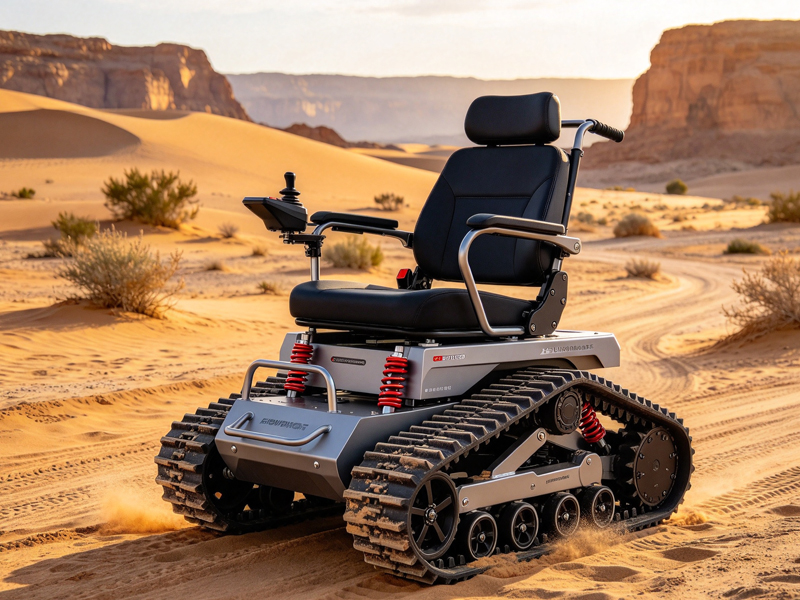
All-terrain tracked wheelchairs are changing the way people approach outdoor mobility. By combining specialized track systems, supportive seating, and terrain-focused engineering, these mobility devices can help users explore environments that are challenging for conventional wheelchairs. They are designed to improve traction, distribute weight across a wider contact area, and provide greater stability on selected outdoor surfaces.
However, choosing an all-terrain wheelchair involves more than looking at its appearance or maximum climbing ability. Real-world performance depends on the terrain, the user’s physical needs, the chair’s design, and the availability of suitable support.
Whether you are an outdoor enthusiast, a caregiver, a rehabilitation professional, or someone researching accessible adventure equipment, understanding how tracked wheelchairs work can help you make a more informed decision.
Traditional wheelchairs are generally designed around wheels, whether they are manually operated or powered by an electric motor. This design works exceptionally well on paved paths, indoor flooring, and many relatively smooth outdoor surfaces. Problems arise when the ground becomes soft, loose, or irregular.
A conventional wheel may sink into sand, lose traction on wet grass, or struggle to cross loose gravel. Small front casters can also become caught in ruts or uneven sections of a trail. Even powerful motors cannot completely overcome the limitations created by an unsuitable contact surface.
Tracked wheelchairs address these challenges through a different approach.
Instead of relying exclusively on wheels, they use continuous rubber or reinforced track assemblies. Similar in principle to the tracks found on certain construction machines and snow vehicles, these assemblies create a larger ground-contact area than a small wheel typically provides.
The result can be improved flotation on soft surfaces and more consistent traction when the ground is uneven. Rather than concentrating much of the chair’s weight in a few small contact points, the track system distributes that load over a broader area.
This difference is particularly useful when traveling across sand, compacted dirt, grass, or certain muddy trails. The tracks may help the chair maintain forward movement where conventional wheels would struggle.
It is important to understand that tracks do not make every surface safe or accessible. Wet rocks, steep side slopes, deep mud, loose scree, and exposed roots can still present serious challenges. A tracked wheelchair is a specialized mobility solution, not an all-purpose off-road vehicle.
The real advantage is greater access to suitable terrain, not the elimination of every outdoor obstacle.
The performance of a tracked wheelchair depends on several interconnected engineering features. The track system is central, but the motor, suspension, frame, braking system, and seating arrangement all influence how the chair behaves outside.
Traction determines how effectively a mobility device transfers motor power into forward movement. On hard pavement, this is rarely a major concern. On sand, wet grass, or loose soil, it becomes much more important.
Tracked wheelchairs use tread patterns designed to engage with the surface beneath them. Depending on the design, these patterns can help the tracks grip loose ground and maintain movement across selected outdoor environments.
The type of tread matters. Aggressive patterns may perform well on certain soft or irregular surfaces, while other configurations may be better suited to mixed terrain. Track material, tension, width, and the weight distribution of the chair also influence performance.
For users who frequently visit nature reserves, outdoor recreation areas, or rural properties, these characteristics may make a meaningful difference to everyday mobility.
One of the main reasons tracked systems can perform well on soft ground is their larger contact area.
Imagine walking across fresh snow in ordinary shoes compared with wearing snowshoes. Snowshoes distribute body weight across a broader surface, reducing the tendency to sink. Tracks apply a similar principle to powered mobility equipment.
By spreading the chair’s load across a longer contact area, the system can reduce ground pressure under appropriate conditions. This may improve movement across sand, soft soil, and some grassy surfaces.
Nevertheless, flotation depends on more than track width. Total vehicle weight, occupant weight, track geometry, soil moisture, and the depth of loose material all play a role.
A chair that performs well on firm beach sand may still struggle on deep, loose dunes. Understanding these differences is essential when matching equipment to a specific environment.
Outdoor trails rarely offer perfectly level ground. Small rocks, exposed roots, shallow ruts, and changes in elevation can affect both comfort and control.
Some tracked wheelchairs incorporate suspension systems or chassis designs intended to help the equipment move over irregular surfaces. These features may reduce the impact of minor bumps and help maintain contact with the ground.
A low center of gravity, a well-balanced frame, and suitable seat positioning can also contribute to stability.
However, suspension is not universal, and not all tracked wheelchairs have the same obstacle-handling capabilities. The presence of tracks alone does not establish a chair’s safe operating angle or its ability to cross a particular obstacle.
Users should follow the manufacturer’s limits for slopes, cross-slopes, obstacle height, and operating conditions. Where terrain is steep, loose, or unfamiliar, a trained companion or professional assessment may be necessary.
One of the most appealing aspects of tracked mobility equipment is the possibility of reaching outdoor destinations that are difficult to navigate in conventional wheelchairs. The best environment for a particular model depends on its specifications and the condition of the ground.
Packed-earth trails, woodland clearings, and relatively firm paths can offer rewarding opportunities for outdoor exploration. Tracks may help users travel over small surface irregularities and loose material.
For people who enjoy birdwatching, nature photography, or simply spending time outdoors, a suitable tracked wheelchair can provide more options when planning a visit to a natural area.
Before setting out, check trail width, gradients, obstacles, and any restrictions on powered mobility equipment. A trail that looks accessible on a map may have narrow sections, exposed roots, or steep inclines that make it unsuitable for a particular chair.
Sand is a familiar challenge for many wheelchair users. Conventional wheels may sink into loose sand, making forward movement difficult and increasing the effort required from a companion.
Tracked systems may provide better flotation than small conventional wheels on suitable sand, especially where the surface is reasonably firm. This can make certain beach visits and coastal outings more practical.
However, not all beaches offer the same conditions. Deep dry sand, incoming tides, saltwater exposure, and sloping shorelines require additional caution. Salt and moisture may also accelerate corrosion or damage components that are not designed for those environments.
Whenever possible, identify designated accessible beach routes and check whether the local facility provides suitable access points before arriving.
Fields, gardens, campsites, and rural outdoor spaces may become more accessible with an appropriate tracked chair. These environments are particularly appealing to people who enjoy gardening, outdoor gatherings, wildlife observation, or spending time away from paved areas.
Ground conditions matter greatly. Firm grass is very different from saturated soil after heavy rain. A track system that performs well on dry ground may struggle when the surface becomes soft or muddy.
Users should also consider environmental impact. Repeated movement over delicate vegetation or waterlogged soil can damage the ground, so choosing suitable routes and respecting property access rules remain important.
Some purpose-built tracked wheelchairs may be suitable for designated rough trails and certain uneven routes. These environments can offer memorable experiences, including scenic viewpoints, forest clearings, and accessible sections of outdoor recreation areas.
Mountain environments demand careful assessment because loose rocks, steep gradients, exposed edges, and rapidly changing weather can increase risk.
A model’s off-road label should never replace a route-specific safety assessment. Before attempting a mountain route, review its elevation changes, surface conditions, available assistance, and any manufacturer restrictions.
The key is to choose the destination and the equipment together. A well-maintained dirt path may provide a better experience than an ambitious mountain route, particularly for someone who is new to off-road mobility.
The value of an all-terrain tracked wheelchair is not limited to mechanical performance. For many users, access to outdoor spaces can influence recreation, independence, social participation, and quality of life.
More opportunities for independence. A suitable powered tracked chair may allow users to reach selected outdoor destinations with less reliance on others for pushing or maneuvering. The level of independence achievable will depend on the user’s abilities, equipment controls, terrain, and available assistance.
Greater participation in outdoor activities. Family picnics, nature photography, camping trips, wildlife observation, and visits to scenic locations can become more practical when the mobility equipment matches the environment.
Access to a wider range of surfaces. Rather than restricting every outing to smooth pavement, users may be able to consider suitable grass, sand, packed soil, and uneven paths. This broader choice can make outdoor planning more flexible.
Potential benefits for caregivers and companions. Appropriate powered equipment can reduce the need for someone to manually push a wheelchair over challenging ground. It does not eliminate the need for supervision, transport assistance, or emergency planning, but it may make certain outings easier to organize.
These benefits are most meaningful when the equipment fits the user’s real circumstances. Comfort, confidence, control, and practical usability should carry at least as much weight as the chair’s advertised off-road performance.
Tracked wheelchairs and wheeled all-terrain wheelchairs can both support outdoor mobility, but their strengths differ.
A wheeled all-terrain wheelchair may use large tires, wider wheels, specialized suspension, or a powerful drive system. Such designs can be effective on many firm trails and may be easier to transport or maneuver on mixed paved and unpaved routes.
Tracked wheelchairs generally emphasize traction and ground contact across selected soft or irregular surfaces. Their design may be especially useful when conventional wheels would otherwise sink or lose grip.
The following comparison highlights the main differences.
| Feature | Tracked Wheelchair | Wheeled All-Terrain Wheelchair |
|---|---|---|
| Soft sand and loose soil | Often advantageous on suitable terrain | Depends heavily on tire size and surface |
| Firm dirt trails | Capable, depending on model | Often well suited |
| Pavement and indoor spaces | Track design may limit convenience | Often more practical |
| Turning and maneuverability | Can require more space or careful control | Varies; many models are easier to maneuver |
| Transport and storage | May be heavier or bulkier | Some models are easier to transport |
| Maintenance | Tracks, rollers, tension, and drive components | Tires, wheels, brakes, and drive components |
These are general comparisons rather than universal rules. Individual designs differ considerably, and a specialized wheeled chair may outperform a particular tracked model in some environments.
For people who spend most of their time indoors or on paved routes, a conventional powered wheelchair may remain the most practical choice. For people whose priorities include selected beaches, rough trails, or soft outdoor surfaces, tracked equipment may offer advantages that justify its additional complexity.
Buying an outdoor mobility device is a significant decision. The best model is not necessarily the one with the largest tracks, the highest advertised speed, or the most powerful motor. It is the one that meets the user’s physical needs, preferred activities, transport arrangements, and budget.
Start by identifying where the chair will actually be used. List the most common surfaces, typical slopes, expected obstacles, and likely weather conditions.
A person who wants to travel along packed forest paths has different requirements from someone who regularly visits sandy beaches or wet rural land. Ask manufacturers for model-specific information about approved surfaces, ground clearance, track configuration, gradients, and environmental restrictions.
Avoid relying on broad descriptions such as “extreme terrain” or “all-weather performance” without supporting technical specifications.
A wheelchair must fit the person using it. Seat width, seat depth, back support, cushion options, foot support, and transfer arrangements can all influence comfort and safe operation.
People who spend extended periods in their chairs may need individualized seating assessments. Those with specific postural support requirements should consult an appropriate seating specialist or rehabilitation professional before selecting a model.
Also consider whether the seating system accommodates the user’s daily clothing, equipment, and personal accessories without interfering with the controls or stability.
Motor power influences how a chair responds to different loads and terrain, but a larger motor does not automatically mean better performance in every situation.
Battery range is equally important. Manufacturers’ stated ranges may be based on controlled conditions and can differ from actual performance on uneven ground. Slopes, soft surfaces, occupant weight, temperature, speed, and battery condition may all affect energy consumption.
If a typical outdoor trip covers several miles, evaluate the expected round-trip distance and include a sensible reserve for unexpected detours or changes in conditions.
Check charging time, battery replacement costs, charging requirements, and whether the battery can be removed for storage or transport.
Confirm the maximum permitted occupant weight and any restrictions involving luggage, accessories, or additional equipment. Staying within the manufacturer’s limits is essential for safe operation.
Measure doorways, storage areas, ramps, and vehicle access points. A chair that performs well outdoors may still be impractical if it cannot be transported to the starting point of a trail.
Check the overall width, length, turning requirements, loading method, and total transport weight. Determine whether a compatible vehicle lift, ramp, trailer, or other loading system is required.
Transport planning is especially important because many tracked mobility devices are heavier and bulkier than everyday wheelchairs.
Look for controls that the user can operate comfortably and consistently. Depending on the model, options may include a joystick, adjustable control sensitivity, emergency stopping functions, speed settings, and other safety systems.
Ask how the chair behaves when traveling downhill, crossing uneven surfaces, stopping on a slope, or encountering an obstacle. Confirm which safety features are standard and which are optional.
If the user has limited hand strength, reduced coordination, visual limitations, or other functional considerations, a professional assessment and supervised demonstration can help determine whether the control system is appropriate.
Tracks and their associated mechanical components require appropriate inspection and maintenance. Depending on the design, this may involve checking track tension, wear, rollers, drive components, electrical connections, and fasteners.
Outdoor use can expose equipment to dirt, moisture, sand, plant debris, and temperature changes. Ask the supplier about cleaning procedures, water-resistance limits, corrosion protection, maintenance intervals, and the availability of replacement parts.
Reliable service support can be just as important as the initial purchase price. A lower-cost model may become expensive if essential parts are difficult to obtain or repairs require shipping the entire unit over long distances.
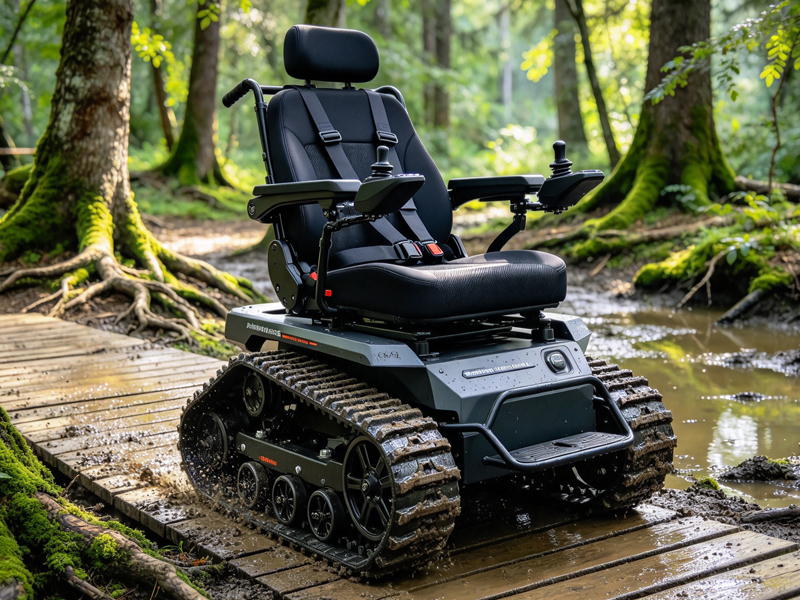
Off-road mobility should create opportunities, not unnecessary risks. Before heading out, users should understand the limits of their specific equipment and prepare for the conditions they are likely to encounter.
Begin with a supervised trial on a familiar, relatively level surface. Learn the controls, turning behavior, braking response, and stopping distance before attempting more demanding terrain.
Next, practice on gentle, uneven ground where a companion can provide assistance if needed. Increase the difficulty gradually rather than moving directly from pavement to steep trails.
Pay particular attention to cross-slopes. Traveling across a hillside can create a different stability challenge from moving directly uphill or downhill. Loose soil, wet leaves, exposed roots, and uneven rocks may increase the risk of slipping, tipping, or losing directional control.
Other useful precautions include:
Never assume that a track system makes a steep slope, deep mud, or unstable surface safe. If the route exceeds the manufacturer’s limits or the user’s capabilities, choosing a different path is the better decision.
Accessibility also involves respect for the environment. Avoid sensitive habitats, follow designated trails, and consider whether repeated track use could damage soft ground or vegetation.
The purchase price is only one part of the total cost of owning a tracked wheelchair. Depending on the model and supplier, expenses may include accessories, batteries, specialized transport equipment, maintenance, replacement tracks, repairs, and delivery.
Rather than focusing on a single advertised price, request a complete quotation that specifies the equipment included, warranty coverage, service arrangements, and expected maintenance requirements.
A useful comparison should include three main cost categories.
Initial purchase: Consider the base chair, seating system, controls, batteries, and included accessories.
Transport and operation: Account for vehicle modifications, loading equipment, charging, storage, and any additional equipment needed to reach outdoor destinations.
Long-term ownership: Investigate servicing, replacement parts, battery replacement, warranty exclusions, and the expected availability of technical support.
Also ask whether a demonstration, supervised trial, rental, or short-term evaluation is available. Testing a chair on a representative surface can reveal practical issues that product photographs and technical specifications cannot.
Funding options vary by country, insurer, disability program, and intended use. Some programs may support certain mobility devices when eligibility and medical or functional requirements are met, while recreational equipment may be treated differently. Verify coverage directly with the relevant organization before assuming that a purchase will be reimbursed.
Outdoor mobility technology continues to develop as manufacturers explore improved battery systems, more efficient electric drives, refined suspension, lighter structural materials, and better control interfaces.
Future improvements may make some devices easier to transport, simpler to maintain, and more adaptable to different users. Advances in battery management and electronic controls may also help manufacturers improve energy use and provide more consistent operation across changing conditions.
However, technical innovation is only one part of the accessibility picture.
Trail design, accessible parking, suitable loading areas, clear route information, and inclusive recreation policies are equally important. Even the most capable mobility device cannot make an inaccessible destination practical if there is no safe way to reach the trailhead or enter the site.
Partnerships between equipment manufacturers, outdoor recreation organizations, accessibility specialists, and land managers can help bridge this gap. Practical improvements such as surface maintenance, accessible viewpoints, clear gradient information, and designated routes can expand outdoor opportunities for a much wider range of people.
Ultimately, progress should be measured not simply by how far a wheelchair can travel off-road, but by how effectively it helps people participate in activities that matter to them.
All-terrain tracked wheelchairs offer an important option for people who want to explore outdoor environments beyond smooth, paved surfaces. Their track systems can improve traction and distribute weight across a larger contact area, making certain types of sand, grass, dirt, and uneven ground more manageable.
Yet the right equipment depends on the individual. Terrain requirements, seating needs, battery performance, transport arrangements, maintenance, and safety limits all deserve careful consideration.
Before making a purchase, identify the environments you want to access, compare suitable models, confirm the manufacturer’s specifications, and arrange a hands-on trial whenever possible. Consult a qualified mobility or rehabilitation professional if you need help assessing seating, controls, or safe operating requirements.
With thoughtful planning and the right equipment, outdoor mobility can become less about avoiding every difficult surface and more about finding practical ways to experience nature, spend time with others, and enjoy greater freedom of movement.
1. Can an all-terrain tracked wheelchair travel on sand, mud, and grass?
Many tracked wheelchairs are designed to handle selected soft and uneven surfaces, including suitable sand, grass, and dirt. Their wider track contact area can improve flotation and traction compared with some conventional wheelchair designs. However, performance depends on the model, ground conditions, moisture, slope, and total load. Deep mud, loose dunes, and unstable terrain may remain unsuitable, so always check the manufacturer’s operating limits.
2. Are tracked wheelchairs better than wheeled all-terrain wheelchairs?
Neither design is universally better. Tracked wheelchairs may offer advantages on certain soft surfaces where flotation and traction are important. Wheeled all-terrain models can be more convenient for paved paths, mixed urban and outdoor use, and some firm trails. The best choice depends on where the wheelchair will be used most often, how it will be transported, the user’s seating and control needs, and the overall cost of ownership.
3. What should I consider before buying an off-road tracked wheelchair?
Start with terrain compatibility, user weight capacity, seating comfort, motor performance, battery range, and safety features. Then evaluate the chair’s dimensions, transport requirements, maintenance needs, warranty, and access to replacement parts. A supervised demonstration on representative terrain is especially valuable. If the user has specific postural, physical, or control requirements, seek advice from a qualified mobility or rehabilitation professional before making a final decision.