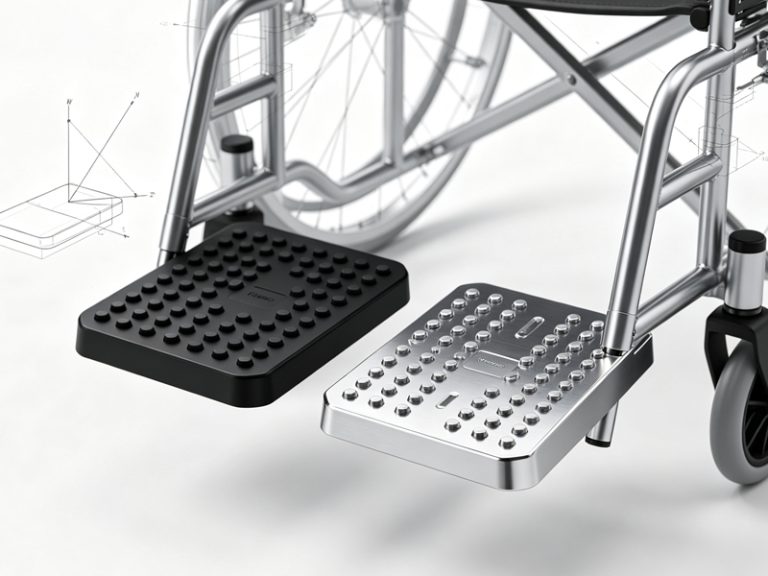
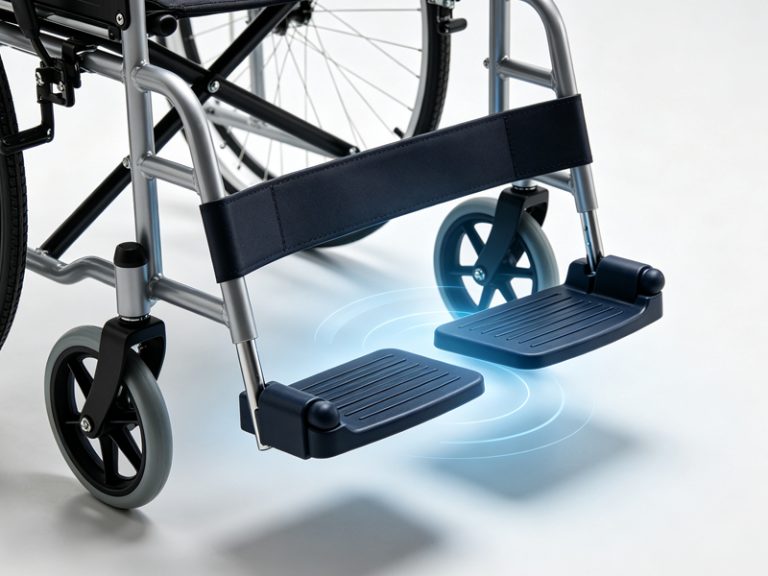
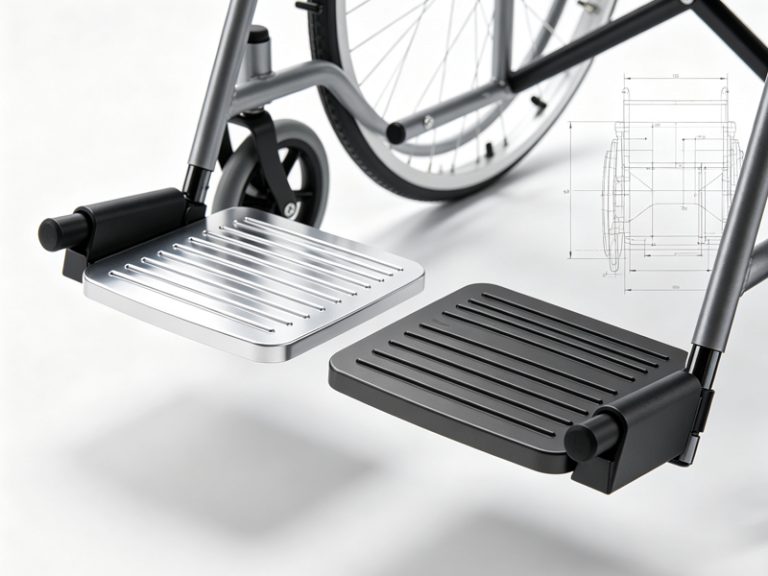
Our Location
Free Trade Tower, Xiyong street.
Chongqing, China

Free Trade Tower, Xiyong street.
Chongqing, China
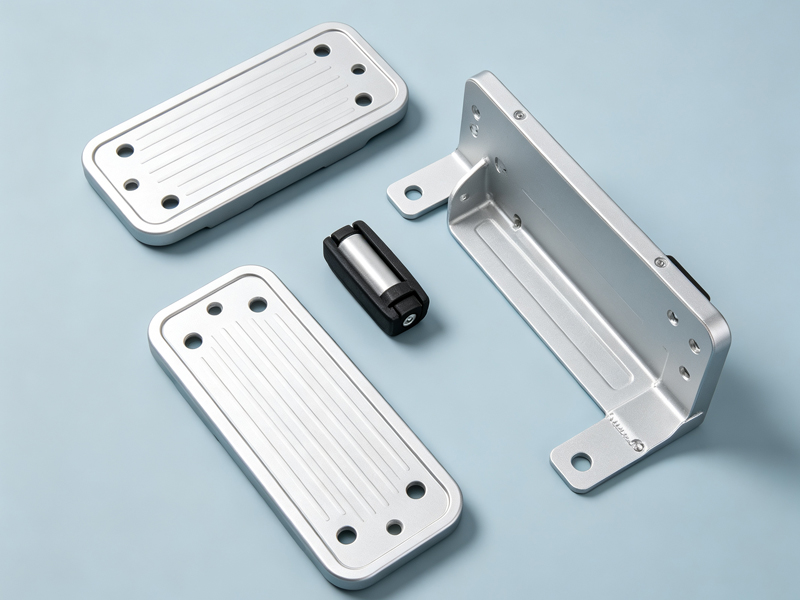
Choosing the right wheelchair is about much more than finding a comfortable seat or selecting a lightweight frame. Every component plays a role in the user’s daily experience, including parts that may seem relatively small at first glance. One such component is the wheelchair footplate.
Although it is often overlooked, a footplate has a direct impact on lower-limb support, sitting posture, transfer safety, and overall wheelchair comfort. For people who spend several hours a day in a wheelchair, even a small difference in footplate design or material can make everyday activities noticeably easier.
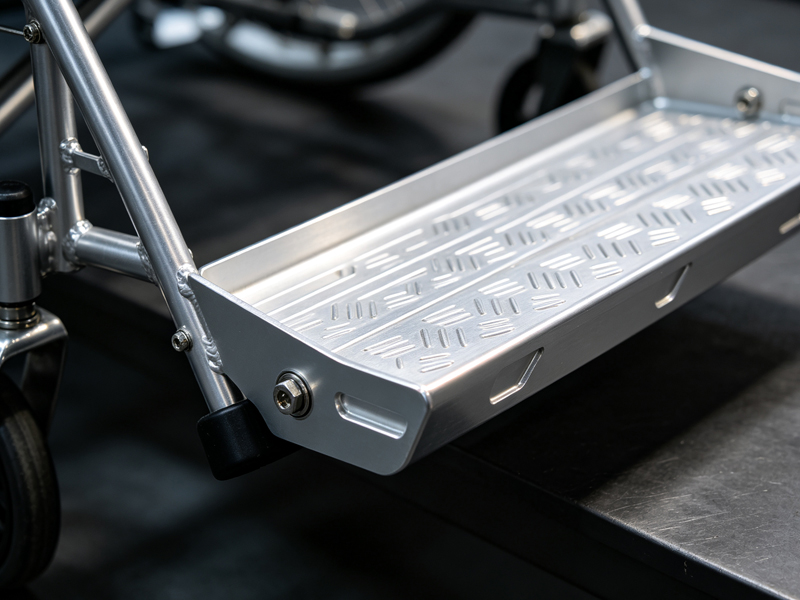
Among the available materials, aluminum has become a popular choice for wheelchair footplates. Its combination of low weight, structural strength, corrosion resistance, and practical durability makes it suitable for many manual and powered wheelchair designs.
But is an aluminum footplate really worth choosing? How does it compare with plastic and steel alternatives? And what should buyers consider before making a decision?
A wheelchair footplate is the platform attached to the lower section of the wheelchair’s leg support system. It provides a surface for the user’s feet to rest on while seated.
Depending on the wheelchair model, the footplate may be a single platform or consist of two separate footrests. Some designs are fixed in position, while others can fold, swing away, or be adjusted to accommodate different leg lengths and seating requirements.
At first glance, the footplate may appear to be a simple accessory. However, it serves several important functions.
First, it helps support the feet and lower legs, preventing them from hanging freely. Without adequate foot support, the legs may experience unnecessary pressure, discomfort, or fatigue during extended periods of sitting.
Second, a properly positioned footplate contributes to a more balanced seated posture. When the feet are supported at an appropriate height, users can maintain a more natural relationship between their hips, knees, and ankles.
Third, footplates provide a degree of protection for the feet during movement. They help keep the feet positioned within the wheelchair’s lower frame and reduce the risk of accidental contact with the ground or nearby objects.
For wheelchair users who regularly travel outdoors, navigate narrow spaces, or move across different surfaces, a stable footplate can make a meaningful difference.
This is why material selection deserves more attention than it often receives.
Aluminum offers a combination of properties that makes it particularly suitable for wheelchair components.
Unlike some heavier metals, aluminum provides useful structural strength without adding excessive weight. It is also relatively easy to shape, machine, and finish, allowing manufacturers to produce footplates in different sizes and configurations.
More importantly, its advantages are not limited to the manufacturing process. They can translate into practical benefits for wheelchair users, caregivers, and equipment providers.
Let’s take a closer look at what makes aluminum a compelling option.
Weight is an important consideration when choosing a wheelchair component.
A wheelchair consists of multiple interconnected parts, including the frame, wheels, armrests, leg rests, seat, backrest, and footplates. Although each individual component may seem lightweight, their combined weight affects the overall handling and transportation of the wheelchair.
Aluminum has a relatively low density compared with steel. This allows manufacturers to create footplates that offer useful strength while keeping their weight manageable.
For manual wheelchair users, reducing unnecessary component weight can contribute to easier handling. A lighter wheelchair may require less effort to lift into a vehicle, maneuver during transportation, or reposition in storage.
Caregivers can also benefit. When a wheelchair needs to be folded, loaded, or carried, every reduction in component weight can help make the process more convenient.
This advantage is especially relevant for people who travel frequently, use wheelchair-accessible vehicles, or regularly move their equipment between different locations.
However, the actual weight savings depend on the footplate’s dimensions, thickness, design, and manufacturing process. Aluminum does not automatically make every wheelchair lighter in a meaningful way, but it gives manufacturers more flexibility when designing lightweight components.
A footplate must do more than simply support the user’s feet. It needs to withstand repeated everyday use.
Users may place their feet on it, adjust their leg positions, encounter minor impacts, or experience vibrations while moving over uneven surfaces.
An unsuitable material may bend, crack, or deteriorate over time, particularly if the component is poorly designed or manufactured.
Aluminum offers a useful balance between strength and weight. When the correct alloy, thickness, and structural design are selected, it can provide reliable support for regular wheelchair use.
Its strength-to-weight characteristics also make it attractive for manufacturers looking to avoid unnecessarily bulky components.
Another important consideration is fatigue resistance. Wheelchair components experience repeated loading rather than a single static load. Therefore, the design should account for long-term use, connection points, fasteners, and potential stress concentrations.
A well-designed aluminum footplate can provide dependable everyday performance without requiring the additional mass associated with many steel alternatives.
It is worth remembering that durability depends on more than the material itself. Manufacturing quality, surface treatment, installation, and maintenance all influence the service life of the finished component.
Wheelchairs are used in a wide range of environments.
Some users primarily stay indoors, while others regularly travel outdoors, encounter rain, or use their wheelchairs in humid conditions.
These environments can affect metal components over time.
One of aluminum’s most useful characteristics is its ability to form a thin, naturally occurring oxide layer on its surface. This layer helps protect the underlying metal from further corrosion under many normal environmental conditions.
As a result, aluminum is generally more corrosion-resistant than untreated carbon steel.
This property makes aluminum footplates a practical choice for users who want components that can maintain their appearance and function with reasonable maintenance.
Many manufacturers also apply additional surface treatments, such as anodizing or protective coatings, to improve surface performance and appearance.
Anodized aluminum, for example, can provide an attractive finish while improving resistance to everyday surface wear.
However, corrosion resistance does not mean aluminum is completely maintenance-free. Certain environments, particularly those involving saltwater, harsh chemicals, or prolonged exposure to moisture and incompatible metals, can still create problems.
Regular cleaning and inspection remain important.
Not every wheelchair user has the same physical requirements.
Some people need a compact footplate that fits within a narrow wheelchair frame. Others prefer a larger support surface or a specific angle to accommodate their lower-leg positioning.
Manufacturers must therefore consider different dimensions, shapes, mounting arrangements, and adjustment requirements.
Aluminum is well suited to manufacturing processes that support this flexibility.
It can be cut, bent, machined, drilled, and finished into different configurations, depending on the alloy and production method.
This allows manufacturers to develop footplates that fit specific wheelchair models rather than relying on a single universal design.
For example, aluminum footplates may be designed with:
These design possibilities are useful for both standard wheelchair products and customized mobility equipment.
A footplate that matches the wheelchair’s overall structure can improve usability while maintaining a clean, integrated appearance.
Wheelchair components are exposed to dust, dirt, moisture, and frequent contact.
Footplates are particularly likely to collect outdoor debris because of their position close to the ground.
For users and caregivers, cleaning should be straightforward rather than another complicated maintenance task.
Aluminum footplates are generally easy to maintain. In most ordinary situations, routine cleaning with a soft cloth, water, and a mild cleaning solution is sufficient.
Unlike some materials that may absorb moisture or become difficult to clean after surface damage, properly finished aluminum provides a relatively smooth, non-porous surface.
This makes it easier to remove common dirt and everyday stains.
For healthcare facilities, rehabilitation centers, and equipment rental businesses, ease of cleaning is particularly important because wheelchairs may be used by different individuals.
Nevertheless, users should follow the wheelchair manufacturer’s cleaning instructions. Strong acidic or alkaline cleaners, abrasive tools, and incompatible chemicals may damage protective surface treatments.
A simple maintenance routine can help preserve the footplate’s appearance and functionality for longer.
Functionality should always come first when selecting wheelchair components, but appearance also matters.
For many users, a wheelchair is an essential part of everyday life. Its design should feel practical, comfortable, and consistent with personal preferences.
Aluminum offers several finishing possibilities that allow manufacturers to create visually appealing components.
Depending on the production process, aluminum footplates can feature brushed, polished, anodized, or coated surfaces.
Different finishes can complement a wheelchair’s frame color and overall design.
A clean metallic finish may suit a modern lightweight wheelchair, while a dark protective coating can create a more understated appearance.
Surface finishing can also serve practical purposes. Certain textures may improve grip, while suitable coatings can provide additional surface protection.
However, buyers should not assume that a visually attractive finish automatically indicates better quality. Material specifications, structural design, and manufacturing standards remain more important than appearance alone.
When comparing wheelchair footplates, aluminum is not the only available option.
Plastic and steel are also commonly used, and each material has advantages depending on the intended application.
The best choice depends on the user’s needs, wheelchair design, expected usage, and budget.
Here is a practical comparison.
| Feature | Aluminum | Plastic | Steel |
|---|---|---|---|
| Weight | Generally lightweight | Usually lightweight | Generally heavier |
| Strength | Good strength-to-weight ratio | Depends on polymer and design | High structural strength |
| Corrosion resistance | Naturally good under normal conditions | Excellent resistance to rust | Depends on protective treatment |
| Design flexibility | Good | Very good for molded shapes | Good, depending on fabrication |
| Maintenance | Generally easy | Generally easy | Requires attention to rust protection |
| Surface options | Anodizing, polishing, coating | Various colors and textures | Painting, plating, coating |
| Typical advantage | Balance of weight and strength | Low cost and design versatility | Robustness and load-bearing potential |
Aluminum vs. Plastic
Plastic footplates are popular because they are lightweight and can be produced in different shapes through molding.
They may also be more economical for certain wheelchair models.
However, plastic products vary considerably in quality. Some materials may become brittle with age, prolonged UV exposure, or repeated impact.
Aluminum offers a different set of advantages, particularly where a rigid metal support surface and long-term structural stability are important.
That said, a high-quality reinforced polymer footplate can still be an excellent choice for many users.
Aluminum vs. Steel
Steel is known for its strength and is widely used in mobility equipment.
For applications involving heavier structural requirements, steel may be appropriate.
Its main disadvantage is weight. A steel footplate may add more mass to the wheelchair than a comparable aluminum component.
Steel also requires suitable corrosion protection, especially when its surface coating becomes damaged.
Aluminum is often preferable when manufacturers want to achieve a lighter design without sacrificing practical everyday strength.
Ultimately, the right material should be selected according to the wheelchair’s engineering requirements rather than based on a single feature.
Material specifications are useful, but most wheelchair users are more interested in how a component performs in real life.
A footplate is used repeatedly throughout the day. Its design influences comfort, positioning, and convenience in ways that become increasingly noticeable over time.
Proper foot support is an important part of wheelchair seating.
When a user’s feet are positioned at an appropriate height, the lower limbs can rest more naturally. This helps establish a more balanced relationship between the feet, knees, and hips.
An incorrectly positioned footplate may contribute to discomfort.
For example, if the footplate is too high, it may increase pressure beneath the thighs. If it is too low, the feet may not receive adequate support, and the user’s lower legs may hang in an uncomfortable position.
The footplate material alone cannot correct these problems. However, a stable aluminum platform can provide a dependable foundation for a properly configured foot support system.
For users with specific positioning requirements, adjustable footplates and professionally configured leg rests may be more important than material selection alone.
Wheelchairs move through different environments, from smooth indoor flooring to sidewalks, ramps, and uneven outdoor surfaces.
Without suitable foot support, the user’s feet may move unexpectedly or come into contact with the ground.
A properly designed footplate helps maintain a consistent resting position and can reduce the likelihood of accidental contact with nearby obstacles.
Aluminum’s structural properties make it suitable for footplates that need to retain their shape under normal use.
Some designs also include raised edges or textured surfaces to help keep the feet in position.
For users who have limited lower-limb control, additional foot straps or heel loops may be necessary.
These accessories should be selected according to individual needs and professional seating recommendations.
Getting into and out of a wheelchair is an important part of daily mobility.
Depending on the wheelchair model, footplates may be designed to fold upward or swing away to create additional clearance.
This can make certain transfer techniques easier.
Aluminum is suitable for a range of footplate configurations, including designs that integrate with adjustable or swing-away leg rests.
The key is ensuring that the footplate mechanism works smoothly and does not interfere with the user’s transfer method.
Users should also remember that footplates are not designed to support body weight during standing transfers unless the manufacturer explicitly specifies otherwise.
Standing on a footplate can damage the component, affect wheelchair stability, and increase the risk of tipping.
A wheelchair should support different aspects of everyday life.
For some people, that means moving around the home, visiting shops, attending appointments, or spending time outdoors.
Aluminum footplates are suitable for many of these environments because of their manageable weight and corrosion-resistant characteristics.
A properly finished aluminum surface can handle normal exposure to dirt and moisture while remaining relatively easy to clean.
For outdoor use, however, users should also consider the overall wheelchair design.
Wheel size, tire type, ground clearance, frame construction, and suspension can all have a greater influence on outdoor performance than the footplate material alone.
Choosing an aluminum footplate is a good starting point, but material alone does not determine whether a component is suitable.
A footplate should match the wheelchair, support the user’s positioning needs, and be manufactured to an appropriate quality standard.
Before purchasing one, consider the following factors.
1. Compatibility with Your Wheelchair
Not all footplates share the same mounting dimensions.
Some are designed for specific wheelchair brands or models, while others use adjustable mounting systems.
Before purchasing, check the following:
A component that looks similar to the original footplate may still have incompatible mounting points.
Always verify compatibility before ordering.
2. Size and Foot Support Area
The footplate should provide enough space for the user’s feet without creating unnecessary interference with the wheelchair frame or surrounding environment.
Consider foot length, footwear, lower-leg positioning, and the available space between the wheelchair’s front casters.
A platform that is too small may not provide adequate support, while an oversized design may make maneuvering more difficult.
3. Thickness and Structural Design
Aluminum footplates are available in different thicknesses and structural configurations.
A thicker plate is not automatically better.
The appropriate thickness depends on the aluminum alloy, expected loading conditions, plate geometry, reinforcement, and attachment design.
Manufacturers should evaluate bending resistance, fatigue performance, and stress around mounting holes.
For buyers, it is worth checking whether the product has been designed and tested for the intended wheelchair application.
4. Surface Finish and Anti-Slip Features
Footplates should provide a stable resting surface.
A smooth aluminum surface may look attractive, but it can become slippery when wet, particularly when users wear footwear with smooth soles.
Some designs include textured surfaces, raised patterns, or additional anti-slip materials.
These features may help improve grip during normal use.
When comparing products, consider how the surface performs in the environments where the wheelchair will be used.
5. Folding and Adjustment Functions
A fixed footplate may be suitable for some wheelchair users.
Others may benefit from a folding or adjustable design.
Consider whether the footplate needs to move during transfers, wheelchair storage, or transportation.
Also check that adjustment mechanisms can be operated conveniently and remain securely locked in position.
6. Manufacturing Quality and Safety
A good aluminum footplate should have more than an appropriate material specification.
Pay attention to:
Sharp edges, loose hardware, cracks, or noticeable deformation should never be ignored.
For replacement components, using manufacturer-approved parts is generally the safest approach.
Different wheelchair categories have different design priorities.
Understanding these differences can help buyers choose a suitable aluminum footplate rather than assuming that one design works for everyone.
Manual Wheelchairs
Manual wheelchair users often prioritize weight, maneuverability, and ease of transportation.
Aluminum footplates can complement lightweight wheelchair frames by providing a durable support platform without adding unnecessary mass.
They are particularly relevant for active users who frequently fold, transport, or reposition their wheelchairs.
Transport Wheelchairs
Transport wheelchairs are commonly used for short-distance mobility with caregiver assistance.
Their compact design makes component weight and storage convenience important considerations.
Aluminum footplates can provide a practical combination of manageable weight and structural rigidity.
Depending on the model, foldable footplates may also help simplify transfers and storage.
Powered Wheelchairs
Powered wheelchairs have different structural and operational requirements.
Because the wheelchair is motorized, overall weight considerations may differ from those of a manual wheelchair.
Nevertheless, footplate strength, positioning, durability, and ease of maintenance remain important.
Aluminum can be used in powered wheelchair footplates when the component is engineered to meet the relevant design and load requirements.
Rehabilitation and Healthcare Wheelchairs
Hospitals, rehabilitation centers, and care facilities often need wheelchair components that are durable and easy to clean.
Aluminum footplates can be useful in these environments because properly finished surfaces are generally straightforward to maintain.
However, healthcare facilities should also consider cleaning protocols, compatibility with disinfection products, and the specific needs of individual users.
Even a durable aluminum footplate needs occasional attention.
A simple maintenance routine can help prevent minor problems from becoming more serious.
Clean the surface regularly.
Remove dust, dirt, and debris using a soft cloth and a mild cleaning solution. Avoid abrasive materials that may scratch the finish.
Check mounting hardware.
Inspect screws, bolts, brackets, and other attachment points periodically. Loose connections can cause unwanted movement and uneven loading.
Look for signs of damage.
Check for cracks, bending, sharp edges, deep scratches, or unusual deformation.
A footplate that has experienced a significant impact should be inspected before further use.
Pay attention to the surface finish.
Damaged coatings or anodized surfaces may reduce protection against environmental exposure. Follow the manufacturer’s recommendations for repair or replacement.
Avoid improper loading.
Do not stand on the footplate or use it as a step unless the manufacturer has specifically designed and approved it for that purpose.
Keep moving mechanisms functional.
For folding or adjustable footplates, check hinges, locking pins, and adjustment hardware. Any unusual looseness or difficulty operating the mechanism should be investigated.
If a footplate becomes bent, cracked, or unstable, stop using it and arrange an appropriate inspection or replacement.
For many wheelchair users, aluminum represents a practical middle ground between lightweight plastic components and heavier steel alternatives.
Its combination of strength, manageable weight, corrosion resistance, and manufacturing flexibility makes it an attractive material for wheelchair footplates.
However, the best purchasing decision depends on how the wheelchair will be used.
If reducing unnecessary weight is a priority, aluminum may offer clear advantages over steel.
If the main concern is affordability, a suitable plastic footplate may provide adequate performance.
If the application requires specific structural properties, the manufacturer’s engineering specifications should guide the final decision.
It is also important to consider the long-term value of a footplate rather than focusing exclusively on its initial purchase price.
A well-designed component that fits correctly, remains stable, and requires relatively little maintenance may offer better overall value than a cheaper alternative that needs frequent replacement.
For caregivers, rehabilitation professionals, wheelchair manufacturers, and individual users, the goal should be the same: selecting a component that supports safe, comfortable, and dependable mobility.
A wheelchair footplate may be a relatively small component, but its contribution to everyday mobility should not be underestimated.
From supporting proper foot positioning to improving convenience during transfers, it plays an important role in the overall wheelchair experience.
An aluminum wheelchair footplate offers several practical advantages. Its lightweight construction can help reduce unnecessary weight, while its strength and corrosion-resistant properties make it suitable for regular use. Its manufacturing flexibility also allows manufacturers to develop different shapes, sizes, and adjustment configurations.
Of course, aluminum is not automatically the best choice for every wheelchair. Compatibility, dimensions, surface finish, structural design, and individual seating requirements all need to be considered.
When these factors are properly evaluated, an aluminum footplate can be a reliable and worthwhile addition to a wheelchair designed for everyday comfort and mobility.
The best wheelchair components are not necessarily the most complicated or expensive ones. They are the components that work consistently, fit the user properly, and make daily life a little easier.
1. Is an aluminum footplate better than a plastic wheelchair footplate?
It depends on the user’s needs and the wheelchair’s design. Aluminum generally offers a good balance of strength, rigidity, and low weight, making it suitable for users who prioritize structural stability and durability. Plastic footplates are often more economical, lightweight, and flexible in design. The best option depends on the intended application, manufacturing quality, and individual requirements.
2. Can an aluminum wheelchair footplate rust?
Aluminum does not develop rust in the same way as iron or ordinary carbon steel. It naturally forms a protective oxide layer that helps resist corrosion. However, aluminum can still experience corrosion under certain conditions, particularly when exposed to harsh chemicals, saltwater, or incompatible metals. Regular cleaning and appropriate surface treatment can help maintain its condition.
3. How do I choose the correct aluminum footplate for my wheelchair?
Start by checking your wheelchair’s brand, model, and existing footplate specifications. Measure the required platform dimensions and confirm the mounting style, attachment points, and compatibility with the leg rest assembly. You should also consider surface grip, folding or adjustment functions, material thickness, and manufacturing quality. If you are unsure, consult your wheelchair manufacturer or a qualified mobility equipment specialist before purchasing a replacement.