Our Location
Free Trade Tower, Xiyong street.
Chongqing, China

Free Trade Tower, Xiyong street.
Chongqing, China
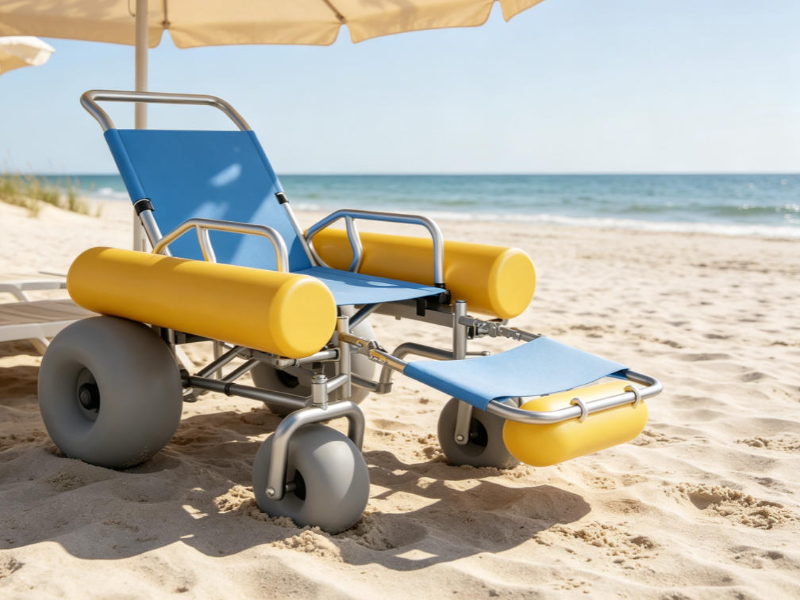
A beach wheelchair has a much harder job than a standard wheelchair. It is expected to move across soft sand, uneven ground, wet surfaces, grass and sometimes shallow water, while remaining comfortable and stable for the person using it. Salt, moisture, sand and direct sunlight can also place additional demands on the frame, wheels, seat and hardware. For that reason, choosing a beach wheelchair is not simply a matter of finding the widest tires or the most attractive design. The materials used throughout the wheelchair can have a major influence on durability, comfort, portability and long-term outdoor performance.
When people ask, “What materials are best for beach wheelchairs?”, there is no single material that is perfect for every application. A beach wheelchair designed primarily for sandy paths may have different priorities from a floating wheelchair intended for beach and water activities. Steel can provide excellent structural strength and load-bearing performance, while stainless steel offers a particularly useful combination of strength and resistance to moisture. Waterproof fabrics can make a major difference to everyday comfort and maintenance, while specialized air-filled or airbag-style wheels help distribute weight across soft surfaces.
The most practical approach is therefore to consider the wheelchair as a complete system. The frame, seat material, wheels, fasteners, footrests, armrests and folding mechanisms all need to work together. A strong frame is not enough if the wheels sink into the sand. Large wheels are not enough if the seat absorbs water. A waterproof seat is not enough if the frame is poorly suited to repeated outdoor exposure.
For users, caregivers, beach resorts, rehabilitation centers and mobility-equipment distributors, understanding these material choices makes it easier to select a beach wheelchair that is genuinely suited to outdoor use rather than simply marketed as one.
A conventional wheelchair generally operates on relatively firm surfaces such as indoor floors, paved sidewalks and smooth roads. A beach wheelchair faces a completely different combination of conditions. Dry sand can shift underneath the wheels, wet sand can become firmer but still uneven, and the transition between sand and shallow water can create additional resistance. Gravel, grass, wooden boardwalks and small changes in elevation can introduce further challenges.
Saltwater is another important consideration. Salt and moisture can accelerate corrosion on susceptible metals, particularly when equipment is used frequently and not cleaned properly after exposure. Even a wheelchair made from corrosion-resistant materials should still be rinsed and maintained according to the manufacturer’s instructions after contact with seawater.
This is why the material selection of a beach wheelchair should be evaluated together with its intended environment. A wheelchair that performs well during an occasional summer beach trip may have different requirements from a product used daily by a coastal resort, beach-accessibility program or water-sports organization.
The best designs typically combine structural strength with practical resistance to moisture, easy-to-clean surfaces and wheels capable of handling soft terrain.
The frame is the foundation of a beach wheelchair. It carries the user’s weight, supports the seat and backrest, connects the wheels and determines much of the wheelchair’s overall rigidity. When comparing frame materials, three considerations are particularly important: strength, corrosion resistance and weight.
Steel: Strong and Practical
Steel remains a popular material for mobility equipment because it offers excellent structural strength and can support substantial loads without requiring an excessively complicated frame design. For beach wheelchairs, a steel frame can be particularly useful when durability and load capacity are more important than achieving the lowest possible weight.
The IYASOCARE YSB01 is an example of a beach wheelchair built around an all-steel frame. The manufacturer states that the model is designed for outdoor use and supports a maximum load capacity of up to 150 kg in its product description. Its design combines the steel structure with large airbag wheels, a foldable frame and waterproof Oxford-cloth seating.
For larger users or applications where the wheelchair will experience frequent outdoor handling, a robust steel structure can provide useful rigidity. However, steel is not automatically corrosion-proof. If the wheelchair is exposed to seawater, regular cleaning and drying remain important regardless of the exact surface treatment.
Stainless Steel: A Strong Choice for Wet Environments
For a wheelchair intended to operate close to water, stainless steel can offer an important advantage. Stainless steel is valued for its resistance to corrosion and is therefore particularly attractive for products exposed to moisture.
The IYASOCARE YSB02 uses a stainless steel frame and is specifically designed as a folding floating beach wheelchair. According to the manufacturer’s product information, the frame is described as durable and waterproof, with a stated load capacity of up to 100 kg. The wheelchair weighs approximately 24 kg net and folds for transportation.
The YSB02 also combines its stainless steel structure with waterproof Oxford cloth, adjustable back and leg rests, large airbag wheels and an optional inflatable flotation kit. This combination makes the material selection particularly relevant for users who want to move between beach environments and water-related activities.
For beach resorts, aquatic recreation programs and users who regularly encounter wet conditions, stainless steel can therefore be an attractive frame material. However, buyers should still consider the complete construction rather than assuming that stainless steel alone guarantees unlimited seawater resistance.
Aluminum is widely used in mobility equipment because it provides a useful balance between strength and relatively low weight. For users who frequently load a wheelchair into a vehicle, carry it between locations or travel by air, reducing overall weight can make everyday handling easier.
However, choosing aluminum simply because it is lighter does not automatically make a wheelchair better for beaches. A beach wheelchair needs sufficient structural rigidity and appropriate wheel geometry to handle soft terrain. It may also need a stronger frame depending on the user’s weight and intended application.
For this reason, buyers should compare the complete wheelchair rather than selecting a material based on weight alone. A slightly heavier wheelchair with large terrain-adapted wheels and a robust frame may perform significantly better on sand than a lighter wheelchair designed primarily for pavement.
In beach mobility, functional weight is more important than weight alone.
The seat is one of the most overlooked parts of a beach wheelchair, even though it has a direct effect on comfort.
Beach users may sit in the wheelchair for extended periods while exposed to sunlight, humidity, splashes and sand. A conventional indoor upholstery material may absorb moisture and become difficult to clean. A suitable beach wheelchair seat should ideally be durable, comfortable, breathable where possible and resistant to water.
Oxford cloth is one practical option. It is commonly used in outdoor products because it can combine durability with relatively easy cleaning.
The YSB01 uses waterproof and durable Oxford cloth for its seat, according to the manufacturer’s specifications. The product is designed for beaches and outdoor environments, and the seat material is intended to make cleaning and use in wet conditions more convenient.
The YSB02 similarly uses breathable and waterproof Oxford cloth. IYASOCARE describes the material as suitable for wet conditions while helping maintain comfort during longer periods of sitting or reclining.
This combination is important because waterproof does not necessarily mean comfortable. A completely impermeable surface can sometimes feel less breathable during hot weather. A well-designed outdoor wheelchair therefore needs to balance moisture resistance with ventilation and user comfort.
For long beach days, this can matter just as much as the frame material.
When discussing what materials are best for beach wheelchairs, it is tempting to focus on the frame. In reality, wheel design may have an even more obvious effect on how the wheelchair performs on sand.
Standard narrow wheelchair tires are designed primarily for firm surfaces. On soft sand, they can concentrate the user’s weight over a relatively small contact area, increasing the likelihood of sinking.
Beach wheelchairs therefore commonly use wider, low-pressure or air-filled wheel designs. These wheels increase the contact area and help distribute the load over the surface.
The IYASOCARE YSB01 uses front and rear airbag wheels designed for beaches, grass and wading environments. Its product information also emphasizes widened wheels intended to reduce sinking on soft surfaces such as sand and gravel.
The YSB02 uses front and rear airbag wheels as well, with the manufacturer stating that they are designed to adapt to sand, gravel and shallow water while helping absorb shocks.
This illustrates an important principle: the best beach wheelchair material package is not just about the frame. Wheel construction and tire characteristics are equally important.
A strong frame with unsuitable wheels can still perform poorly on sand.
Air-filled or airbag-style wheels are particularly useful because they can provide a larger contact area and some degree of shock absorption.
On a sandy beach, the goal is not simply to make the wheel stronger. The wheel needs to interact with the ground differently from a conventional wheelchair tire. A larger footprint can help distribute the load and reduce the tendency to sink.
This can also improve comfort. Beaches are rarely perfectly flat, and users may encounter small stones, compacted sand, wet patches and transitions between different surfaces. A wheel with some compliance can help absorb part of this irregularity.
That does not mean every air-filled wheel is automatically suitable for beaches. Buyers should consider the wheel diameter, width, pressure characteristics, construction, puncture resistance and replacement availability.
For commercial buyers, replacement wheels and spare parts deserve particular attention. A beach wheelchair used in a resort or accessibility program may accumulate considerably more usage than a personal wheelchair used occasionally.
The frame material is only one part of corrosion resistance.
A wheelchair also contains bolts, brackets, wheel axles, hinges, bearings, fasteners and adjustment mechanisms. If these components are exposed to saltwater, corrosion can eventually affect their function even when the primary frame material remains in good condition.
This is why buyers should ask manufacturers what materials are used for the complete assembly rather than simply asking whether the frame is stainless steel or aluminum.
A beach wheelchair should also be maintained after exposure to seawater. Rinsing off salt and sand, allowing the wheelchair to dry thoroughly and checking moving components can help preserve performance.
For distributors, maintenance instructions should ideally be included in the product documentation. Customers should know that corrosion-resistant construction reduces risk but does not eliminate the need for cleaning.
Not every beach wheelchair needs the same specification.
A simple recreational beach wheelchair may primarily need wide wheels, a durable frame and waterproof seating. A reclining beach wheelchair may place greater emphasis on backrest strength, leg-rest construction and seating materials.
A floating beach wheelchair requires a different level of consideration because buoyancy, stability and water exposure become part of the design.
The YSB02 is particularly interesting in this respect. It combines a stainless steel frame with waterproof seating and airbag wheels, while an optional inflatable flotation kit is available for water activities. Its backrest and leg rest can also be adjusted, with the manufacturer stating a maximum backrest tilt of 170°.
The YSB01 takes a slightly different approach. It combines an all-steel frame, folding construction, adjustable footrests, a reclining backrest and large airbag wheels. The manufacturer lists a 500 mm seat width and describes the chair as suitable for beaches, grass and wading environments.
These two models demonstrate why there is no universal “best” material. The appropriate combination depends on whether the priority is load capacity, portability, water use, reclining comfort, corrosion resistance or multi-terrain performance.
For users looking for a robust beach wheelchair for outdoor mobility, the IYASOCARE YSB01 is a practical option to consider.
Its all-steel frame gives the wheelchair a solid structural foundation, while the foldable design and quick-release wheels make transportation easier. The product information describes a 500 mm seat width, large front and rear wheels and a reclining backrest that can tilt up to 150°.
The combination of steel construction and waterproof Oxford cloth is particularly suitable for users who want a wheelchair that can transition between the beach and other outdoor environments. The large airbag wheels are designed for sand, grass, wetlands and wading conditions, making the model more versatile than a conventional manual wheelchair.
For families, outdoor recreation programs and mobility-equipment distributors, its combination of folding portability, reclining functionality and terrain-oriented wheels makes it worth considering when the primary requirement is a durable multi-purpose beach wheelchair.
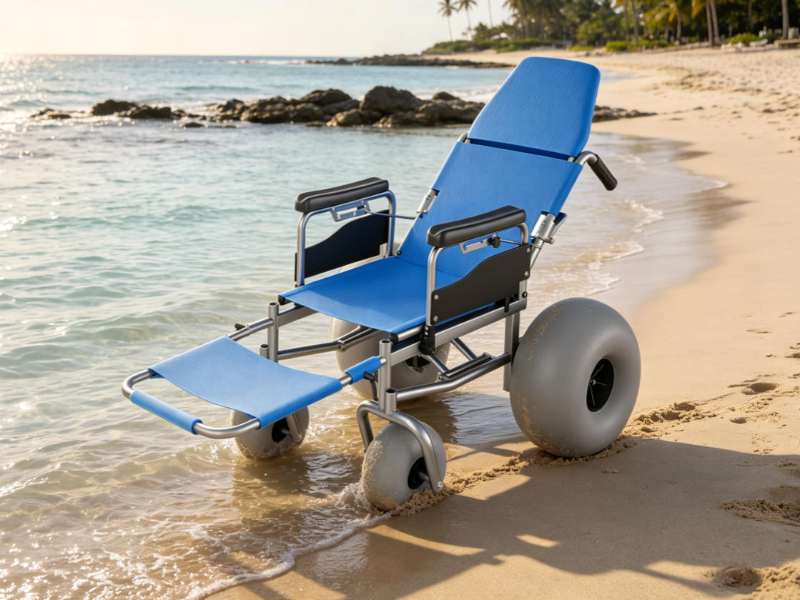
For users who expect more exposure to wet environments or want the possibility of water-based use, the IYASOCARE YSB02 offers a different material combination.
Its stainless steel frame is designed for durability in outdoor conditions, while the waterproof Oxford-cloth seat provides a practical surface for beach and water environments. The wheelchair also uses front and rear airbag wheels and can be equipped with an optional inflatable flotation kit.
The YSB02 is also designed around portability. The manufacturer states that it folds and uses front and rear quick-release wheels, allowing it to fit into a vehicle for outdoor travel. Its stated net weight is approximately 24 kg, with a 100 kg loading capacity.
Its adjustable backrest and leg rest add another layer of comfort, particularly for users who want to recline or rest during longer periods outdoors.
For beach clubs, resorts, accessible-water programs and users who want a wheelchair capable of supporting both beach mobility and selected water activities, the YSB02 is a particularly interesting choice.
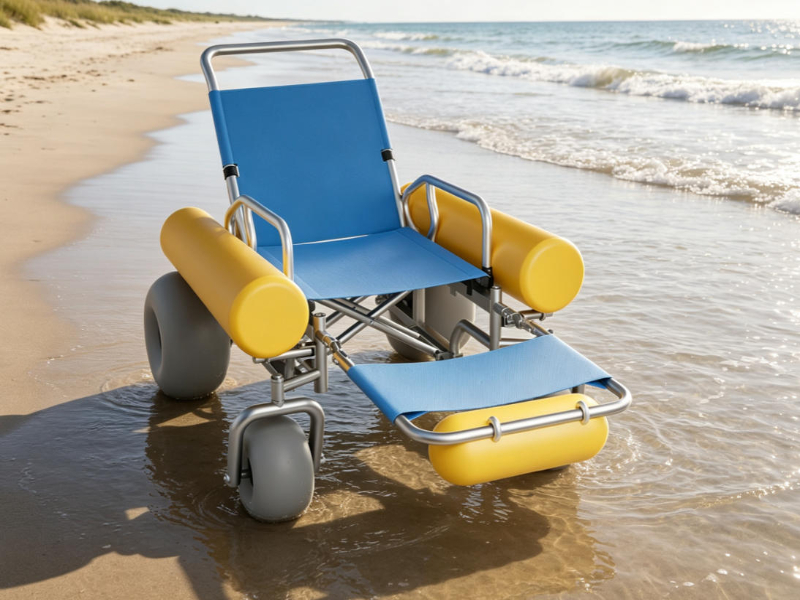
Instead of asking only, “Is this beach wheelchair made of stainless steel?”, buyers should evaluate the entire construction.
| Component | What to Look For | Why It Matters |
|---|---|---|
| Frame | Steel or stainless steel construction | Structural strength and outdoor durability |
| Seat | Waterproof, breathable, easy-clean fabric | Comfort and moisture management |
| Wheels | Wide air-filled or airbag-style wheels | Better performance on soft sand |
| Hardware | Corrosion-resistant components | Better resistance to moisture and salt exposure |
| Footrests | Strong, adjustable construction | Leg support and positioning |
| Backrest | Durable reclining mechanism | Comfort during extended beach use |
| Folding system | Strong hinges and quick-release components | Easier transportation and storage |
| Flotation system | Properly engineered optional flotation equipment | Additional water-use capability |
This checklist is especially useful for distributors. Product specifications should be evaluated as a complete package rather than by selecting the cheapest frame material or the lightest wheelchair.
Even the best materials need appropriate maintenance.
After using a wheelchair on the beach, remove visible sand from the wheels, frame and moving parts. If the wheelchair has been exposed to seawater, rinse it with clean water and allow it to dry completely before storage.
Pay particular attention to folding joints, wheel axles, fasteners and adjustment mechanisms. Sand can work its way into moving components and create friction over time.
The seat should also be cleaned according to the manufacturer’s instructions. Waterproof fabric is easier to maintain than absorbent upholstery, but it should still be cleaned after heavy use.
Storage conditions matter as well. Avoid leaving the wheelchair permanently exposed to direct sunlight, rain or salty coastal air when it is not being used.
In other words, material selection and maintenance work together. A corrosion-resistant frame can significantly improve durability, but regular cleaning is still part of responsible ownership.
So, what materials are best for beach wheelchairs?
For the frame, stainless steel is an excellent choice when moisture exposure and corrosion resistance are major priorities, while steel remains a strong and practical option when structural strength and load capacity are important. Aluminum can be attractive when portability and lower weight are the main priorities, provided that the overall wheelchair is engineered for soft terrain.
For the seat, waterproof and breathable outdoor fabrics such as Oxford cloth can provide a useful combination of comfort, durability and easy maintenance.
For wheels, wide air-filled or airbag-style construction is generally far more important for beach performance than simply choosing a particular rubber compound. The wheel needs to distribute weight effectively and adapt to soft or uneven surfaces.
Ultimately, the best beach wheelchair is not the one made from one “perfect” material. It is the one in which the frame, wheels, seat, hardware and adjustment mechanisms have been selected to work together in the environment where the wheelchair will actually be used.
The IYASOCARE YSB01 and YSB02 illustrate two practical approaches. The YSB01 combines an all-steel frame, waterproof Oxford cloth and large airbag wheels for beach and outdoor mobility, while the YSB02 uses stainless steel, waterproof seating, airbag wheels and an optional flotation kit for users who need greater water-oriented versatility.
For anyone purchasing a beach wheelchair, that is the most useful lesson: do not buy based on the frame material alone. Look at the complete material system, the terrain capability, the user’s needs and the level of maintenance required.
1. What is the best frame material for a beach wheelchair?
There is no single answer for every user. Stainless steel is particularly attractive for beach and water environments because of its corrosion resistance and structural strength. Steel can also be an excellent choice when durability and load capacity are priorities. Aluminum may be preferable when lower weight and easier transportation are more important. The best option depends on the wheelchair’s intended environment and overall construction.
2. Are stainless steel beach wheelchairs better than steel beach wheelchairs?
Not necessarily. Stainless steel offers an advantage when moisture and salt exposure are major concerns, but a well-designed steel beach wheelchair can also provide excellent strength and outdoor performance. The quality of the wheels, hardware, seat material, folding structure and maintenance routine should all be considered alongside the frame material. For example, the YSB01 uses an all-steel frame, while the YSB02 uses stainless steel and is designed for beach and water activities.
3. What type of wheels are best for a beach wheelchair?
Wide air-filled or airbag-style wheels are particularly useful for beach environments because they can spread the user’s weight over a larger contact area and reduce the tendency to sink into soft sand. They can also provide additional shock absorption on uneven outdoor surfaces. Both the IYASOCARE YSB01 and YSB02 use front and rear airbag wheels designed for sand and other outdoor terrain.