Our Location
Free Trade Tower, Xiyong street.
Chongqing, China

Free Trade Tower, Xiyong street.
Chongqing, China
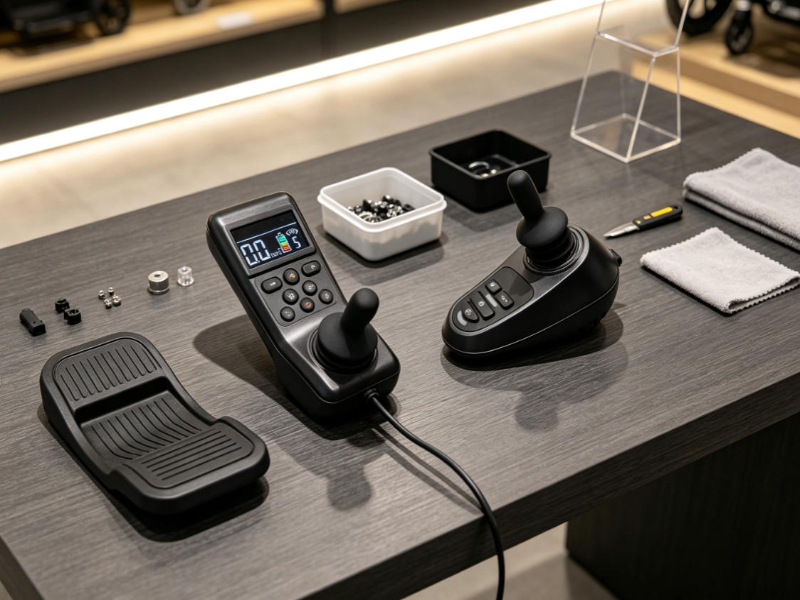
An electric wheelchair may look like a relatively simple mobility device from the outside, but a great deal of technology is working behind the scenes every time the chair moves. Among the most important components is the electric wheelchair joystick controller. It is the point where the user’s intention becomes movement, allowing a person to move forward, reverse, turn, slow down, stop, and navigate through different environments with relatively small hand movements.
For many users, the joystick is simply the small control stick mounted beside the armrest. Push it forward and the wheelchair moves forward. Move it sideways and the chair turns. Release it and the wheelchair slows or stops. Yet the process behind those simple actions involves sensors, electronic signals, control algorithms, motor drivers, batteries, electromagnetic braking systems, and safety functions working together in real time.
Understanding how electric wheelchair joystick controllers work is useful not only for wheelchair users but also for caregivers, rehabilitation professionals, distributors, medical equipment retailers, and buyers comparing different power wheelchair systems. The quality of the joystick and controller can have a direct effect on how natural, responsive, stable, and comfortable a wheelchair feels in everyday use.
For manufacturers and distributors, the joystick is equally important. A wheelchair with a powerful motor and large battery may have excellent specifications on paper, but if the control system is difficult to operate or responds unpredictably, the overall user experience can suffer. A well-designed joystick controller should therefore be viewed as part of the wheelchair’s complete mobility system rather than as an isolated accessory.
The easiest way to understand a power wheelchair joystick is to think of it as a combination of a steering wheel, accelerator, and braking interface condensed into one small control device.
Unlike a conventional automobile, most powered wheelchairs do not use a mechanical steering wheel connected to the front wheels. Instead, they generally use two powered drive wheels, with the control system adjusting the speed and direction of each motor independently. This allows the wheelchair to turn by changing the relative speed of the left and right drive wheels. Research on powered mobility systems describes the joystick as the interface between the user and the wheelchair’s electronic controller, which interprets the input and converts it into commands for the drive mechanism.
This design is particularly useful in confined environments. A user can make a small steering correction while approaching a doorway, rotate the chair within a tight indoor space, or maintain a straight path along a corridor without having to operate a separate steering mechanism.
The key is proportional control.
A simple on/off switch would only provide two states: moving or not moving. A modern electric wheelchair joystick controller can interpret both the direction and the amount of joystick movement. A gentle push can request slow movement, while a larger displacement can request greater speed. This makes it possible to move carefully around furniture, people, doorways, ramps, and other obstacles while still having enough speed for open spaces.
This proportional relationship is one of the reasons joystick-controlled power wheelchairs can feel intuitive after a user becomes familiar with the control system.
Although joystick designs vary between manufacturers, a typical system can be understood through several connected stages: user input → position sensing → electronic processing → motor control → wheelchair movement.
When the user moves the joystick, sensors inside the control module detect its position. Modern joystick systems commonly use Hall-effect sensors or potentiometers to measure movement along two primary axes. One axis represents left and right movement, while the other represents forward and backward movement.
Imagine the joystick sitting naturally in its center position. At this point, the controller interprets the input as neutral. If the user gently pushes the joystick forward, the sensor values change. The controller recognizes the direction and calculates an appropriate movement command.
If the user pushes the joystick forward and slightly to the left, the system receives information from both axes simultaneously. Instead of simply telling the wheelchair “go left,” the controller interprets the combined input as a forward-left trajectory.
The electronic controller then translates this information into commands for the drive motors.
This is where the system becomes particularly interesting. A powered wheelchair normally needs to coordinate the left and right drive wheels. For straight movement, the motors can receive similar commands. During a turn, however, the controller changes their relative output. One wheel may rotate more slowly while the other continues at a higher speed, causing the wheelchair to curve smoothly.
This principle, commonly referred to as differential drive, is what allows many power wheelchairs to achieve very tight turning behavior without a traditional steering mechanism.
The entire process happens quickly enough that the user normally experiences it as one continuous movement.
Step 1 — The user moves the joystick
The user applies a small amount of pressure to the joystick. The movement may be forward, backward, left, right, or a combination of directions. The further the joystick is displaced from its neutral position, the stronger the movement command can become.
Step 2 — Sensors detect the position
Sensors inside the joystick measure the position of the control stick. Instead of simply identifying “left” or “right,” the system can continuously interpret the joystick’s position across its operating range.
Step 3 — The controller interprets the signal
The joystick sends electrical information to the main wheelchair controller. This controller acts as the electronic brain of the system. It interprets the user’s requested direction and speed and determines how the motors should respond.
Step 4 — The motor driver controls power
The controller sends electrical commands to the drive system. Depending on the wheelchair architecture, the motor driver regulates the electrical power supplied to the motors.
Step 5 — The motors move the wheelchair
The left and right motors respond to the commands. If the requested movement is straight, their outputs are coordinated. If the user requests a turn, the controller creates a difference between the two sides.
Step 6 — The system continues monitoring
The process does not end after the command is sent. The controller continuously receives information and adjusts the motor output as the user changes the joystick position.
This continuous feedback is what makes the wheelchair feel responsive rather than behaving like a machine with a few fixed movement commands.
One of the most important features to consider when evaluating a power wheelchair joystick is proportional control.
Suppose a user needs to move through a narrow doorway. Maximum speed would obviously be unnecessary and could make precise positioning difficult. A proportional joystick allows the user to make a very small forward movement, giving the wheelchair a controlled and gradual response.
Now imagine the same user has reached an open pedestrian path. The joystick can be pushed farther forward, allowing the chair to travel at a higher speed.
The same physical control can therefore support both precision and efficiency.
This is particularly valuable for people who use their wheelchair throughout the day. A wheelchair may need to operate in bedrooms, kitchens, elevators, medical facilities, shopping centers, sidewalks, ramps, and outdoor paths. These environments require very different levels of control.
A good joystick system should make these transitions feel natural rather than forcing the user to switch between complicated operating modes.
For distributors evaluating electric wheelchairs, joystick sensitivity is therefore worth testing in person whenever possible. Two wheelchairs with similar motor ratings can feel completely different because their control algorithms, joystick calibration, acceleration settings, and braking behavior may differ.
Turning is another area where the electric wheelchair controller plays an important role.
When the user moves the joystick sideways, the controller does not necessarily need to physically rotate a steering wheel. Instead, it can calculate how much the left and right drive wheels should move.
For example, when turning left, the right drive wheel may continue moving forward while the left wheel slows down. With an appropriate control algorithm, the wheelchair can make a smooth turn.
In some power wheelchair designs, the difference between motor speeds can become large enough for the wheelchair to rotate around a very small turning radius.
This capability is especially useful indoors. Narrow hallways, bathroom entrances, elevators, dining areas, and furniture-filled rooms can all require frequent direction changes.
For users with limited upper-body strength or reduced hand mobility, a joystick can also reduce the physical effort required compared with traditional manual steering methods.
The important point is that the joystick itself does not “steer” the wheelchair mechanically. It communicates the user’s intention to the controller, and the controller determines how the drive system should respond.
One of the most important safety behaviors is what happens when the joystick returns toward its neutral position.
When the user releases the joystick, the controller detects that the requested movement has decreased or returned to neutral. The wheelchair can then reduce motor output and initiate stopping behavior according to its programmed control strategy.
Many powered wheelchair systems also incorporate electromagnetic braking. IYASOCARE describes automatic electromagnetic brakes, anti-tip wheels, and seat belts as part of its electric wheelchair safety approach.
This is important because stopping a powered wheelchair is not simply the opposite of accelerating. The system must manage motor output and braking in a controlled way so that the chair does not behave unpredictably.
A well-calibrated system should provide a smooth transition between acceleration, cruising, deceleration, and stopping.
For users, this can make a substantial difference in confidence. A wheelchair that starts too aggressively or stops too abruptly may feel uncomfortable, particularly for elderly users or people with limited postural control.
It is easy to think of the joystick purely as a technical component, but its design has a direct relationship with user comfort.
The physical position of the controller matters. If it is too far forward, the user may need to stretch the shoulder. If it is too low or too high, prolonged operation may become uncomfortable. If the joystick is excessively sensitive, small involuntary movements may produce unwanted movement.
A good wheelchair therefore needs to consider both the electronic characteristics of the joystick and its ergonomic placement.
Modern electric wheelchair manufacturers may also offer different control configurations depending on the user’s requirements. Research into powered mobility controls notes that advanced controller systems can support alternative input devices beyond standard proportional joysticks, including other assistive control interfaces.
This is particularly important in rehabilitation and complex mobility applications, where one control method may not work equally well for every user.
When comparing electric wheelchairs, buyers should look beyond the appearance of the joystick. Several characteristics deserve attention.
Responsiveness is important because the wheelchair should respond predictably to the user’s input without excessive delay.
Sensitivity should be appropriate for the intended user. A highly sensitive joystick is not automatically better. What matters is whether the user can make precise movements comfortably.
Proportional control allows the user to vary speed according to joystick displacement, making both slow maneuvering and normal travel easier.
Centering accuracy matters because the controller needs to recognize when the joystick has returned to its neutral position.
Reliability is essential because the joystick is used repeatedly throughout the wheelchair’s service life.
Safety integration is equally important. The joystick should work together with the controller, braking system, motor protection, battery management, and other safety functions rather than operating as an isolated component.
For a professional wheelchair manufacturer, these elements must be considered as one integrated system.
Even a reliable joystick can eventually experience problems through wear, moisture exposure, accidental impact, loose connections, calibration issues, or electronic faults.
Common symptoms may include delayed movement, inconsistent response, unintended movement, difficulty returning to neutral, or error indicators on the controller.
The first step should always be to follow the manufacturer’s troubleshooting instructions rather than attempting to modify electronic components independently.
For distributors and service teams, the most useful approach is to distinguish between a joystick problem and a broader electrical problem. The symptom may originate from the joystick itself, the wiring connection, the main controller, battery voltage, motor electronics, or another component in the control system.
A professional diagnostic process is therefore preferable to simply replacing parts at random.
This is one reason why after-sales support matters when choosing an electric wheelchair manufacturer. A supplier should be able to provide technical documentation, replacement components, troubleshooting guidance, and appropriate service support.
For distributors looking at electric wheelchair manufacturers, IYASOCARE provides an example of a manufacturer that integrates joystick control into a broader electric mobility platform.
Its official website describes its electric wheelchair range as including classic power wheelchairs, lightweight folding electric wheelchairs, reclining models, off-road wheelchairs, and standing wheelchairs. The company also highlights intuitive joystick control, automatic electromagnetic braking, anti-tip wheels, seat belts, and different battery options as part of its electric wheelchair systems.
IYASOCARE’s product information also describes its high-back foldable electric wheelchair YSE108 as using a 360° joystick control system designed for stable handling, smooth turning, and speed control in tight spaces.
From a manufacturing perspective, the company states that it operates its own factory and has production capabilities covering stamping, injection molding, welding, and assembly, with three wheelchair production lines. It also reports certifications including CE, ISO 13485, and TÜV-related certifications.
For distributors, this broader manufacturing capability matters because the joystick is only one part of an electric wheelchair. The motor, battery, controller, chassis, braking system, seating system, and wiring architecture all need to work together.
IYASOCARE also offers OEM/ODM services, including customization of branding, color, structure, materials, batteries, controllers, cushions, backrests, and other accessories.
This can be particularly relevant for distributors developing their own wheelchair product line rather than simply reselling a standard model.
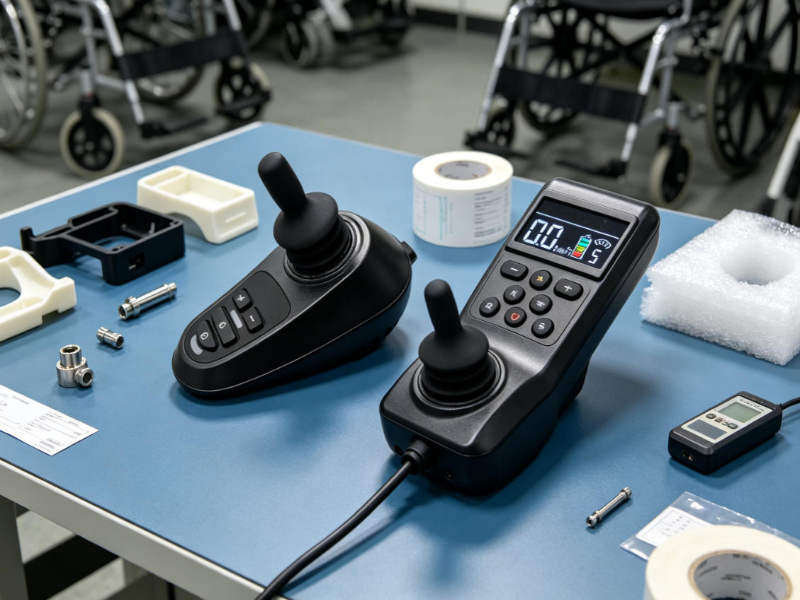
A common mistake when comparing power wheelchairs is to focus almost entirely on motor power and battery capacity.
Those specifications are important, but they do not tell the whole story.
Two wheelchairs may use similar motors and batteries while providing very different driving experiences because their joystick systems, acceleration curves, braking settings, control algorithms, suspension, seating position, and chassis design are different.
A powerful motor does not automatically mean better control.
For daily mobility, predictable response can be more valuable than maximum output. A user needs to know that a small joystick movement will produce a small and manageable response, while a stronger movement will produce a proportionate increase in speed.
The best system is therefore the one that matches the user’s physical ability, environment, experience level, and mobility goals.
Indoor users may prioritize precise low-speed control and compact maneuverability. Outdoor users may place greater emphasis on torque, suspension, stability, battery capacity, and terrain performance. Rehabilitation users may require additional seating functions or alternative control interfaces.
The joystick should be selected as part of that complete mobility package.
Joystick technology continues to evolve as wheelchair manufacturers explore more personalized and intelligent mobility systems.
Modern power wheelchair controllers are increasingly capable of supporting multiple input methods and additional powered seating functions. Research into powered mobility technology has already documented expandable control systems that can integrate alternative input devices and operate multiple seating actuators.
At the manufacturing level, newer wheelchair systems are also beginning to incorporate technologies such as app connectivity, alternative control interfaces, intelligent safety systems, and more sophisticated motion control.
IYASOCARE’s current technology information highlights intelligent control systems alongside high-efficiency power drive, suspension and shock absorption, and safety protection systems. Its distributor information also describes support for joystick and other control methods.
The direction is clear: the joystick is becoming less like a simple switch and more like an intelligent human-machine interface.
The goal, however, should not be technology for its own sake.
The most valuable innovation is technology that makes mobility easier to understand, easier to control, safer to operate, and more adaptable to individual users.
Understanding how electric wheelchair joystick controllers work reveals why such a small component can have such a significant influence on the overall wheelchair experience.
The joystick detects the user’s movement, sensors convert that movement into electrical information, the controller interprets the signal, and the motor system converts the command into physical movement. At the same time, braking, battery management, safety functions, and other electronic systems work together to keep the wheelchair responsive and controlled.
For users, the result should feel simple: move the joystick and the wheelchair follows your intention.
For manufacturers and distributors, however, achieving that simplicity requires careful engineering and coordination between multiple systems.
When evaluating an electric wheelchair, therefore, do not judge the product only by its motor wattage, battery capacity, or maximum speed. Pay attention to how the joystick feels, how accurately the wheelchair responds, how smoothly it accelerates and stops, how easily it turns, and whether the control system matches the intended user.
A well-designed electric wheelchair joystick controller does something important without drawing attention to itself. It turns a complex electronic and mechanical system into a control experience that feels natural.
That is ultimately what good mobility technology should do: make sophisticated engineering disappear behind simple, confident, everyday movement.
1. How does an electric wheelchair joystick control movement?
An electric wheelchair joystick controller detects the direction and amount of joystick movement through internal sensors. The signal is sent to the wheelchair’s main controller, which calculates the appropriate motor output. The left and right drive motors are then coordinated to move forward, backward, or turn. A small joystick movement generally produces slower, more precise movement, while greater displacement can request higher speed.
2. What happens when you release the power wheelchair joystick?
When the joystick returns toward its neutral position, the controller recognizes that the user is no longer requesting forward or reverse movement and reduces motor output. The wheelchair’s braking system then helps bring the chair to a controlled stop. Many modern electric wheelchair systems also use electromagnetic braking and other safety features to improve stability when the chair stops.
3. What should I look for when choosing an electric wheelchair joystick controller?
Look for a joystick that provides predictable proportional control, appropriate sensitivity, accurate centering, smooth acceleration and braking, comfortable ergonomic positioning, and reliable integration with the wheelchair’s motor and safety systems. For distributors, it is also worth checking whether the manufacturer can provide replacement controllers, technical support, spare parts, and OEM/ODM customization if required.