Our Location
Free Trade Tower, Xiyong street.
Chongqing, China

Free Trade Tower, Xiyong street.
Chongqing, China
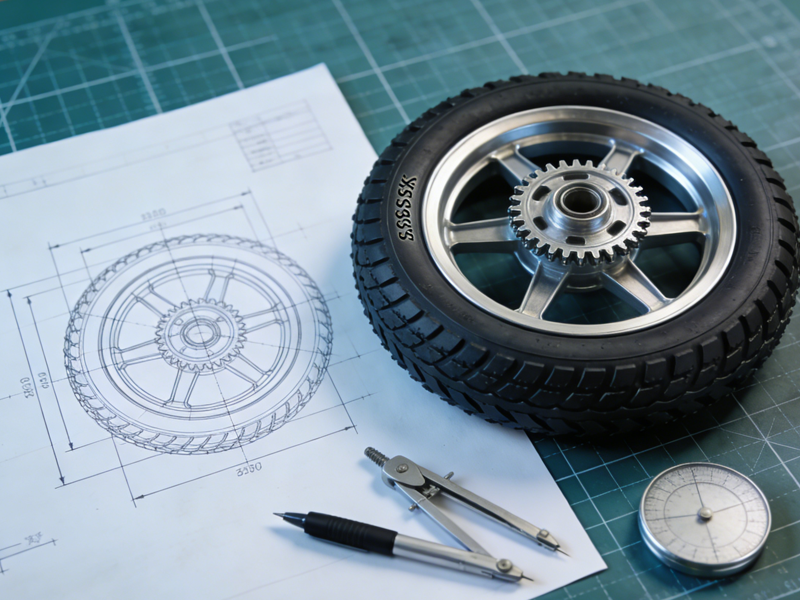
When discussing wheelchair performance, comfort, and safety, most people focus on frames, motors, or batteries. In professional manufacturing and clinical application, however, the wheel system is just as critical as the frame itself. Wheel type determines rolling resistance, shock absorption, load capacity, durability, noise, maintenance cost, and even the user’s long-term joint health.
This article offers a comprehensive, experience-based overview of common wheelchair wheel types, including wheel materials, hub structures, manufacturing processes, advantages, limitations, and suitable use scenarios. The content is written for global buyers, rehabilitation professionals, product managers, and mobility brands, not for casual browsing.
A wheelchair wheel is not just “a wheel.” It is a functional system composed of:
Tire (outer layer) – determines traction, comfort, noise, and shock absorption
Hub / Rim – determines structural strength, weight, heat dissipation, and lifespan
Bearings & Axle Interface – affect smoothness, energy efficiency, and wear
Optional components – clutch mechanisms, flanges, keyways, hand rims, or spoke structures
Every design choice is a trade-off between weight, strength, cost, comfort, and maintenance. There is no universally “best” wheelchair wheel—only the most suitable one for a specific user and environment.
Solid PU (polyurethane) wheels are among the most widely used wheelchair wheel types worldwide, especially in electric wheelchairs, transport chairs, and institutional environments.
These wheels are manufactured through high-pressure molding, bonding a PU tread directly to a rigid core. Unlike rubber pneumatic tires, solid PU wheels contain no air and therefore cannot puncture.
From a user perspective, their greatest advantage is reliability. There is no need for inflation, no risk of air leakage, and minimal daily maintenance. This makes them ideal for elderly users, hospital settings, nursing homes, and indoor-focused mobility.
However, the same structural rigidity that ensures durability also limits shock absorption. On uneven outdoor surfaces, solid PU wheels transmit more vibration to the frame and user. For long outdoor travel or sensitive users, this can reduce comfort.
Solid PU wheels are typically paired with aluminum alloy, nylon, or magnesium alloy hubs, depending on load requirements.
Typical applications
Electric wheelchairs (rear drive or mid-drive)
Indoor or mixed indoor/outdoor use
Users prioritizing low maintenance and durability
Pneumatic rubber wheels are the closest wheelchair equivalent to bicycle or motorcycle tires. Filled with air, they naturally absorb shocks, reduce vibration, and provide superior traction on uneven or outdoor surfaces.
For users who travel frequently outdoors—sidewalks, parks, slopes, gravel paths—pneumatic wheels offer noticeably better comfort and control. Reduced vibration helps protect the user’s spine, shoulders, and wrists over long distances.
That said, comfort comes at a cost. Pneumatic tires require regular pressure checks, are vulnerable to punctures, and demand higher maintenance awareness. For some elderly or institutional users, this can be a disadvantage.
From a manufacturing standpoint, pneumatic wheelchair wheels are often combined with steel, aluminum alloy, or spoke hubs, depending on load and price positioning.
Typical applications
Manual wheelchairs
Outdoor-focused users
Active or long-distance mobility
To bridge the gap between comfort and maintenance, many manufacturers offer semi-pneumatic or honeycomb wheels.
These wheels use elastic internal structures instead of air. They provide partial shock absorption while remaining puncture-proof. Although they do not match pneumatic tires in comfort, they outperform solid PU wheels on uneven terrain.
In international markets, honeycomb wheels are often positioned as “urban mobility solutions”, balancing durability, comfort, and cost.
They are particularly popular in mid-range electric wheelchairs and travel wheelchairs.
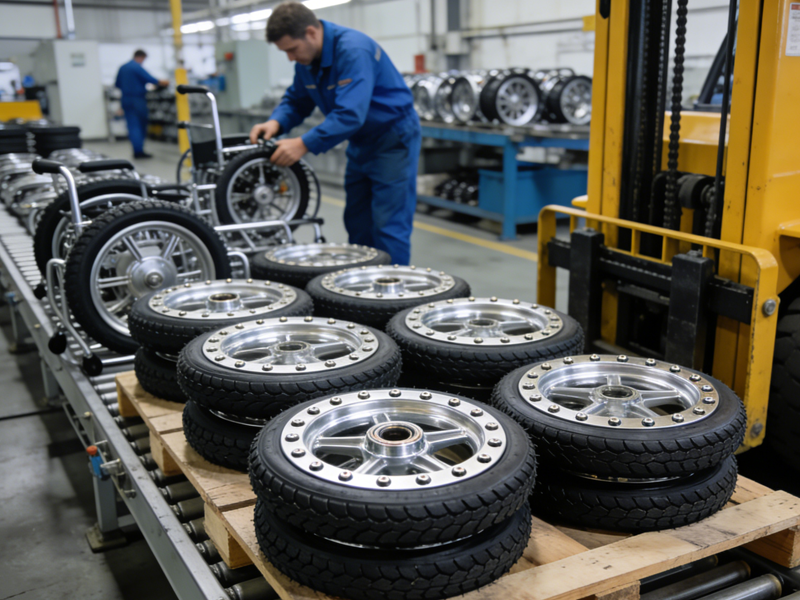
While tires attract attention, the hub determines structural integrity, heat resistance, and service life. Based on your provided table, the most common wheelchair hub materials include the following.
Plastic and nylon hubs are widely used in lightweight wheelchairs and cost-sensitive models.
Modern nylon hubs reinforced with glass fiber offer impressive strength-to-weight ratios, corrosion resistance, and low production cost. They are suitable for humid environments and will not rust.
However, plastic hubs are sensitive to high temperatures and long-term heavy loads. Prolonged exposure above 60°C or excessive stress can lead to deformation or fatigue.
Best suited for
Lightweight electric wheelchairs
Indoor use
Users under moderate weight limits
Carbon steel hubs are manufactured using welding or stamping processes, resulting in high structural strength and excellent load capacity.
They are cost-effective and robust, making them suitable for standard manual wheelchairs and institutional use. The trade-off is weight and corrosion risk if surface treatment is poor.
Steel hubs are commonly used with pneumatic rubber tires for traditional wheelchair designs.
Best suited for
Budget-friendly wheelchairs
High load requirements
Indoor or controlled environments
Aluminum alloy hubs represent the mainstream choice for mid- to high-end wheelchairs.
Produced through die-casting or CNC machining, aluminum hubs offer a balance of light weight, corrosion resistance, and structural reliability. They also dissipate heat effectively, which is particularly important for electric wheelchairs.
Many advanced designs integrate flanges, clutch systems, or keyway structures, enabling quick-release functions or motor compatibility.
Best suited for
Electric wheelchairs
High-end manual wheelchairs
Users seeking reduced overall weight
Magnesium alloy hubs are used in premium or performance-oriented wheelchairs. Lighter than aluminum and stronger than plastic, magnesium hubs significantly reduce rotational inertia, improving maneuverability.
However, production costs are higher, and strict quality control is required to ensure corrosion resistance.
Best suited for
Sports or active wheelchairs
Premium lightweight models
Traditional spoked wheels remain common in manual wheelchairs due to their flexibility, shock absorption, and classic design. They distribute stress evenly and are relatively easy to repair.
Integrated or “mag” wheels, on the other hand, offer higher rigidity, modern aesthetics, and reduced maintenance, making them popular in electric wheelchairs.
The choice between the two is less about quality and more about use scenario and user preference.
High-quality wheelchair wheels are defined not only by material but also by process precision:
Uniform wall thickness
Smooth bearing alignment
Consistent surface treatment
Accurate axle tolerances
Poor manufacturing leads to vibration, noise, uneven wear, and premature failure—issues often misattributed to “bad tires” rather than structural flaws.
From a professional perspective, wheel selection should consider:
User weight and daily travel distance
Indoor vs. outdoor usage ratio
Maintenance capability
Terrain complexity
Cost-performance balance
There is no single correct answer—only informed engineering decisions.
At Iyasocare, we believe wheelchair wheels should be evaluated not as accessories, but as core mobility components. The right wheel system improves safety, comfort, and long-term user satisfaction, while poor selection increases fatigue, maintenance cost, and risk.
This guide reflects practical manufacturing insight, not marketing theory.
Q1: Are solid PU wheels suitable for outdoor use?
Yes, but primarily for short distances on relatively smooth surfaces. For long outdoor travel, pneumatic or semi-pneumatic wheels provide better comfort.
Q2: Why are aluminum alloy hubs more common in electric wheelchairs?
Because they offer an optimal balance of lightweight design, strength, corrosion resistance, and heat dissipation—critical for motorized systems.
Q3: Is a more expensive wheel always better?
Not necessarily. The best wheel is the one that matches the user’s environment, weight, and maintenance capability—not the highest price.
Recommended by Iyasocare. Unauthorized redistribution is prohibited.