Our Location
Free Trade Tower, Xiyong street.
Chongqing, China

Free Trade Tower, Xiyong street.
Chongqing, China
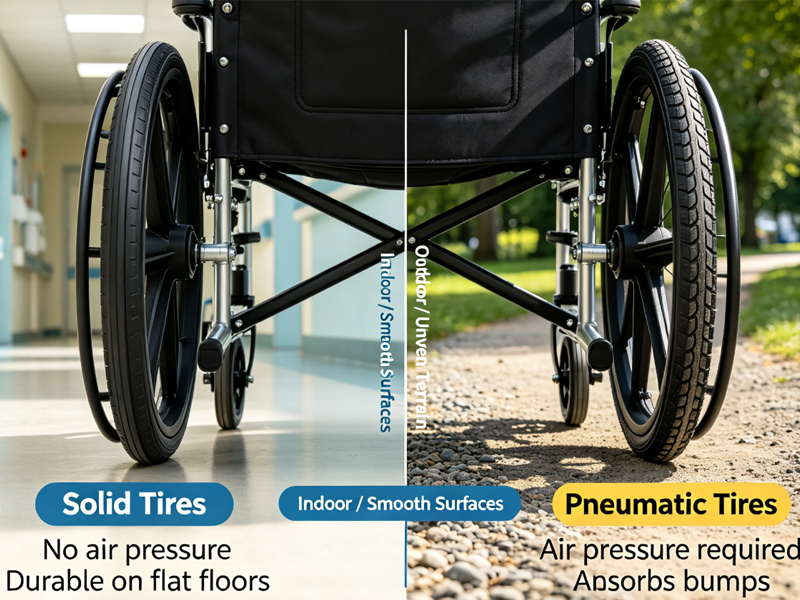
Choosing the right wheelchair tires might seem like a small decision, but it can make a noticeable difference in everyday mobility. Whether you use a manual wheelchair for daily activities or rely on a power wheelchair for longer journeys, the type of tires you choose affects comfort, stability, handling, maintenance, and overall performance.
Among the most common options, solid and pneumatic wheelchair tires are two popular choices. Both are designed to help wheelchair users move safely and efficiently, but they work in very different ways. Solid tires are made from solid rubber or similar materials and do not require air. Pneumatic tires, on the other hand, contain an air-filled inner chamber that provides cushioning and helps absorb shocks from uneven surfaces.
So, which one is better? The answer depends on where you use your wheelchair, how often you travel, how much maintenance you are willing to handle, and what matters most to you: comfort, durability, convenience, or performance.
Before comparing their performance, it helps to understand how each type of tire is constructed and how that construction affects the riding experience.
Solid wheelchair tires are manufactured from solid rubber, polyurethane, or other durable materials. Unlike traditional bicycle or car tires, they do not contain an air chamber. Their structure provides a consistent shape and allows them to support the wheelchair without needing inflation.
Because there is no air inside, solid tires cannot develop air-pressure-related problems or suffer traditional punctures. A sharp object such as a nail or piece of glass is unlikely to cause the same type of flat tire experienced with pneumatic models.
Solid tires are commonly found on wheelchairs used indoors, in hospitals, rehabilitation facilities, and other environments where reliability and low maintenance are important.
Pneumatic wheelchair tires are air-filled tires that use compressed air to support the wheelchair and its occupant. They generally consist of an outer rubber tire and an inner tube, although some models use a tubeless construction.
The air inside the tire acts as a natural cushion. When the wheelchair moves over cracks, bumps, gravel, or other uneven surfaces, the tire compresses slightly and absorbs part of the impact.
This flexible structure provides a smoother ride and can improve traction on certain outdoor surfaces. However, pneumatic tires need regular air-pressure checks and can become flat if punctured.
Both tire types serve the same basic purpose, but their different construction methods create distinct advantages and limitations.
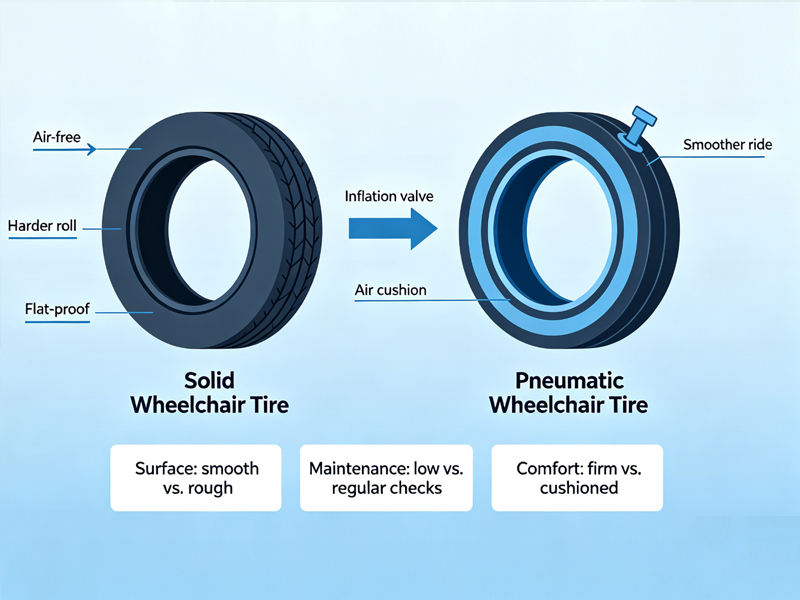
The most important differences between solid and pneumatic wheelchair tires involve comfort, maintenance, puncture resistance, traction, durability, and rolling performance.
Here is a quick comparison to help you understand how they perform in everyday situations.
| Comparison Factor | Solid Wheelchair Tires | Pneumatic Wheelchair Tires |
|---|---|---|
| Construction | Solid rubber or polyurethane | Air-filled rubber tire |
| Riding Comfort | Generally firmer | Generally softer and more comfortable |
| Puncture Resistance | Highly resistant to traditional punctures | Can be punctured by sharp objects |
| Maintenance | Very low | Requires regular air-pressure checks |
| Shock Absorption | Limited | Excellent |
| Outdoor Performance | Suitable for smooth and moderately rough surfaces, depending on design | Often better on uneven outdoor terrain |
| Rolling Resistance | Can be higher, depending on material and design | Can be lower when properly inflated |
| Traction | Depends on tread and rubber compound | Often offers better adaptability to uneven surfaces |
| Flat Tire Risk | No conventional air-related flats | Possible |
| Best For | Indoor use and low-maintenance mobility | Outdoor use and comfort-focused mobility |
Neither option is automatically superior. A wheelchair used mainly on smooth indoor floors has different requirements from one regularly traveling along sidewalks, park paths, and rough outdoor surfaces.
The best choice is the one that matches your daily environment.
Comfort is one of the biggest differences between solid and pneumatic wheelchair tires.
When using a wheelchair, every small bump, crack, and change in surface can affect the person sitting in it. Unlike people traveling in cars, wheelchair users are often much closer to the wheels and have less suspension to isolate them from road vibrations.
This makes tire construction particularly important.
Pneumatic tires provide natural cushioning because the compressed air inside them can absorb and distribute some of the impact created by uneven surfaces.
For example, imagine pushing a wheelchair along a sidewalk with small cracks and slightly raised sections. When the wheels roll over these imperfections, the pneumatic tires compress and recover, reducing the amount of vibration transferred to the wheelchair frame and seat.
This can make longer journeys more comfortable, particularly for people who spend several hours a day in their wheelchairs.
Solid tires offer a different experience. Since they contain no air, they cannot provide the same level of natural cushioning. Their relatively firm structure transfers more vibration from the ground to the wheelchair.
On smooth indoor surfaces, this difference may not be especially noticeable. However, when traveling over rough concrete, paving stones, or uneven outdoor paths, solid tires can feel considerably harder.
That does not mean solid tires are uncomfortable in every situation. Modern rubber compounds and specialized tire designs can improve shock absorption. Some solid tires are also manufactured with softer materials to provide a more forgiving ride.
Still, if comfort is your highest priority, pneumatic wheelchair tires generally have the advantage.
Best choice for comfort: Pneumatic tires, especially for frequent outdoor travel and longer wheelchair journeys.
For many wheelchair users, maintenance is just as important as comfort.
A wheelchair is not simply a piece of recreational equipment. It is often an essential part of everyday life. When a tire fails, even a relatively small problem can interrupt work, shopping, medical appointments, and other daily activities.
This is where solid wheelchair tires offer a significant advantage.
Because solid tires contain no compressed air, there is no need to check tire pressure, carry a pump, or worry about losing air during use.
They are also highly resistant to conventional punctures. Driving over broken glass, small nails, or other sharp objects generally will not cause the same type of flat tire associated with pneumatic models.
This makes solid tires particularly practical for people who want a dependable, low-maintenance solution.
Pneumatic tires require more attention. Air pressure naturally changes over time, and temperature fluctuations can also affect tire pressure. Users should check inflation regularly and follow the pressure range recommended by the manufacturer.
If the pressure becomes too low, the tire may feel sluggish, become more difficult to push, and increase the risk of damage to the tire or inner tube. Excessive inflation can also affect comfort and may increase the risk of tire failure.
Punctures are another consideration. A sharp object can penetrate the outer tire and damage the inner tube, resulting in a flat.
Depending on the tire design, repairing the problem may involve removing the wheel, locating the puncture, patching or replacing the inner tube, and reinstalling everything correctly.
For someone comfortable with basic repairs, this may be a manageable inconvenience. For someone who depends on their wheelchair throughout the day and does not want to deal with unexpected repairs, it can be frustrating.
It is worth noting that solid tires are not completely maintenance-free. They can still wear down, develop cracks, become damaged, or require replacement. Their mounting and fit should also be checked periodically.
Best choice for low maintenance: Solid tires.
The surface you travel on plays a major role in determining which wheelchair tire is more suitable.
For indoor environments, such as hospitals, shopping centers, offices, and homes, solid tires are often a practical choice. Smooth floors do not require extensive shock absorption, and the consistent tire structure provides predictable performance.
However, outdoor environments introduce more challenges.
Consider the different surfaces a wheelchair might encounter during a normal day:
Pneumatic tires can adapt more easily to changes in terrain because their air-filled structure allows the contact area to change slightly under pressure.
This flexibility can improve grip and help the wheel maintain contact with irregular surfaces.
For example, when traveling over a gravel path, a properly inflated pneumatic tire can provide better cushioning and adaptability than a hard solid tire. This may make movement more comfortable and help maintain control.
Solid tires can also work outdoors, particularly models designed with deeper tread patterns and durable rubber compounds. However, their firm construction may make them less forgiving on loose or uneven ground.
It is important to distinguish between traction and shock absorption. They are related, but they are not the same thing.
Traction depends on several factors, including tread pattern, rubber compound, tire width, surface conditions, and tire pressure. An aggressive tread pattern may improve grip on certain surfaces, while a smoother tread may work better indoors.
A pneumatic tire does not automatically provide better traction in every situation. Similarly, a solid tire is not necessarily slippery simply because it contains no air.
The specific tire design matters just as much as the general tire category.
Best choice for varied outdoor terrain: Pneumatic tires generally provide better adaptability and comfort, although the appropriate tread design is essential.
Rolling resistance is another important factor, especially for people using manual wheelchairs.
In simple terms, rolling resistance refers to the force that works against a wheel as it moves across a surface. The greater the resistance, the more effort is required to keep the wheelchair moving.
For manual wheelchair users, this can directly affect how much physical effort is needed during daily activities.
Pneumatic tires can offer relatively low rolling resistance when inflated to the correct pressure. Their flexible structure allows them to maintain an effective contact area while reducing unnecessary deformation.
However, tire pressure is extremely important.
An underinflated pneumatic tire can create more resistance, making the wheelchair harder to push. It may also affect handling and increase wear.
Solid tires do not have pressure requirements, but their rolling performance depends on the rubber compound, tire design, and construction quality.
Some solid tires use softer materials that provide additional cushioning but may create more rolling resistance. Others are designed with harder compounds to improve efficiency and wear resistance.
Wheelchair weight, wheel alignment, bearings, tire width, and surface conditions also influence pushing effort.
For active manual wheelchair users, even small differences in rolling resistance can become noticeable over long distances.
A lightweight wheelchair equipped with properly inflated pneumatic tires may provide an efficient combination of comfort and mobility.
However, users should not assume that every pneumatic tire will outperform every solid tire. Comparing the manufacturer’s specifications and considering the intended application is a better approach.
Best choice for efficient rolling: Quality pneumatic tires often have an advantage when correctly inflated, but the actual result depends on tire construction and wheelchair setup.
When purchasing wheelchair tires, the initial price is only one part of the decision. It is equally important to consider how much the tires will cost to maintain and replace over time.
Solid tires are often attractive because they eliminate many common maintenance expenses.
There is no need to purchase replacement inner tubes, tire patches, or inflation equipment. Users also avoid the inconvenience of unexpected air loss.
However, solid tires gradually wear down through regular contact with the ground. Their lifespan depends on the rubber compound, frequency of use, user weight, terrain, storage conditions, and overall tire quality.
Once a solid tire becomes excessively worn or damaged, it generally needs to be replaced rather than repaired.
Pneumatic tires have different cost considerations.
The outer tire and inner tube may need separate replacement. Punctures can sometimes be repaired, which may reduce costs compared with replacing the entire tire.
On the other hand, frequent punctures, incorrect inflation, or regular use on abrasive surfaces can increase maintenance expenses.
A high-quality pneumatic tire may last a long time when properly maintained, but it requires more attention than a solid tire.
It is also important to consider the indirect cost of downtime. If a flat tire prevents someone from using their wheelchair until a repair can be arranged, the inconvenience may be more significant than the cost of the repair itself.
For someone who prioritizes predictable performance and minimal maintenance, solid tires may offer better long-term value.
For someone who values comfort and outdoor performance, the additional maintenance associated with pneumatic tires may be worthwhile.
The most economical option is not necessarily the one with the lowest purchase price. It is the one that provides the best balance of lifespan, performance, maintenance, and everyday convenience.
There is no single tire type that works best for everyone. Your mobility habits, physical needs, wheelchair design, and typical environment should guide your decision.
Here are several common situations to consider.
For indoor wheelchair users
If you primarily use your wheelchair inside your home, a hospital, or a rehabilitation facility, solid tires are often a sensible option.
Indoor flooring is generally smooth and predictable, so the additional cushioning of pneumatic tires may not provide enough benefit to justify their maintenance requirements.
Solid tires are particularly useful in environments where minimizing unexpected tire problems is important.
For outdoor wheelchair users
If you frequently travel outdoors, pneumatic tires are often the better choice.
Their ability to absorb shocks can improve comfort on sidewalks, asphalt, and moderately uneven paths. They may also make longer journeys feel less tiring.
Users should select an appropriate tread pattern and maintain the recommended inflation pressure.
For people who use wheelchairs throughout the day
People who depend on their wheelchairs for most daily activities should consider both comfort and reliability.
A person who travels mainly between indoor locations may prefer solid tires because of their low maintenance requirements.
Someone who spends extended periods outdoors may appreciate the cushioning provided by pneumatic tires.
There is no universal answer. The best choice depends on which conditions the wheelchair encounters most often.
For users who want minimal maintenance
Solid tires are generally the more convenient option.
They do not need inflation, and traditional punctures are not a concern. This can be especially helpful for users who have limited access to repair services or prefer to avoid regular tire maintenance.
For active manual wheelchair users
Active users often place a high value on pushing efficiency, handling, and comfort.
Properly inflated pneumatic tires can provide an effective balance of low rolling resistance and shock absorption.
However, some high-performance solid tires may also be suitable, depending on their construction and the user’s preferences.
For people with specific mobility or positioning requirements, a rehabilitation professional or qualified wheelchair technician can help determine the most appropriate setup.
Yes, some wheelchairs can be equipped with different tire types, including a combination of solid and pneumatic tires.
For example, a wheelchair might use solid tires in an environment where puncture resistance and low maintenance are important, while another setup may prioritize pneumatic tires for improved outdoor comfort.
However, changing tire types is not always a straightforward replacement.
Before making a change, check the following factors:
Wheel and tire compatibility: The tire must match the wheel’s diameter, width, and mounting design. A tire that does not fit correctly can affect stability and safety.
Wheelchair specifications: Different wheelchairs are designed for specific tire types. Check the manufacturer’s recommendations before changing the original configuration.
Overall handling: Different tire materials and inflation characteristics can affect rolling resistance, grip, and wheelchair control.
Brake clearance: Tire dimensions may influence the clearance between the tire and the wheelchair’s braking system.
User weight and intended application: The replacement tire must have an appropriate load capacity and be suitable for the wheelchair’s intended use.
It is also worth considering that front casters and rear drive wheels may have different requirements.
A wheelchair technician can help confirm whether a particular tire combination is compatible with the wheelchair and appropriate for the user.
The goal should always be to improve performance without compromising safety.
Once you understand the differences between solid and pneumatic wheelchair tires, the next step is choosing a suitable product.
Rather than focusing only on price or appearance, consider these five factors.
1. Where will you use your wheelchair most often?
Start by identifying your primary environment.
If you mainly travel indoors on smooth surfaces, solid tires may be sufficient. If you regularly encounter uneven sidewalks, outdoor paths, or rougher terrain, pneumatic tires may offer greater comfort.
Your most common travel conditions should influence your decision more than occasional situations.
2. How important is riding comfort?
If you are sensitive to vibrations or regularly spend long periods in your wheelchair, shock absorption should be a priority.
Pneumatic tires generally provide better cushioning, while solid tires offer a firmer riding experience.
If possible, test both options before purchasing.
3. How much maintenance can you manage?
Think about whether you are comfortable checking tire pressure and dealing with occasional punctures.
If you want a simple solution that requires little attention, solid tires are worth considering.
If you are willing to perform routine maintenance in exchange for better cushioning, pneumatic tires may be a better fit.
4. Does the tire match your wheelchair?
Always check the original tire specifications before ordering replacement tires.
Important details include:
Do not assume that two tires with similar appearances or measurements are interchangeable.
For pneumatic tires, also check the recommended inflation pressure printed on the tire or specified by the manufacturer.
5. What matters most over the long term?
Finally, consider your priorities.
Some people value reliability and convenience above everything else. Others are willing to perform additional maintenance to enjoy a more comfortable ride.
A good purchasing decision considers the complete ownership experience rather than simply the initial cost.
The difference between solid and pneumatic wheelchair tires goes beyond whether a tire contains air. It affects how a wheelchair feels, performs, and functions in everyday life.
Solid wheelchair tires are designed for convenience and reliability. They do not require inflation, resist conventional punctures, and generally need less maintenance. They are particularly suitable for indoor environments and users who prefer a straightforward tire solution.
Pneumatic wheelchair tires prioritize cushioning and adaptability. Their air-filled construction helps absorb shocks, improves comfort on uneven surfaces, and can provide efficient rolling performance when properly inflated. They are often a better choice for users who spend considerable time outdoors.
Ultimately, neither tire type is universally better.
If you mainly use your wheelchair indoors and want to avoid regular maintenance, solid tires are likely to meet your needs.
If you frequently travel outdoors and place a high value on comfort, pneumatic tires may be the more suitable option.
The right wheelchair tire should support your daily routine, match your wheelchair’s specifications, and make moving around as comfortable and dependable as possible.
Rather than choosing based on popularity alone, consider your environment, mobility requirements, and maintenance preferences. A well-matched set of tires can make a meaningful difference in your everyday wheelchair experience.
1. Are solid wheelchair tires better than pneumatic tires?
Not necessarily. Solid and pneumatic wheelchair tires offer different advantages.
Solid tires are better suited to users who prioritize puncture resistance, low maintenance, and reliable performance on smooth surfaces.
Pneumatic tires are generally better for people who want improved shock absorption, a smoother ride, and greater adaptability to uneven outdoor terrain.
The better option depends on your daily mobility needs and the surfaces you travel on most frequently.
2. How often should pneumatic wheelchair tires be inflated?
Pneumatic wheelchair tires should be checked regularly, ideally at least once a week for frequent users. However, the correct checking frequency depends on the tire design, usage conditions, and manufacturer’s recommendations.
Always follow the recommended pressure range printed on the tire or provided in the wheelchair manual.
Proper inflation helps maintain comfort, handling, traction, and rolling efficiency. Underinflated tires can make a wheelchair harder to push, while excessive inflation may affect ride comfort and tire performance.
3. Can solid wheelchair tires be replaced with pneumatic tires?
In some cases, yes. However, the replacement must be compatible with the wheelchair’s wheels, rims, frame clearance, and braking system.
Before switching from solid to pneumatic tires, check the wheelchair manufacturer’s specifications and confirm that the new tires have the correct dimensions and load capacity.
It is advisable to consult a qualified wheelchair technician before making the change, especially if the wheelchair is used daily or has a specialized configuration.