Our Location
Free Trade Tower, Xiyong street.
Chongqing, China

Free Trade Tower, Xiyong street.
Chongqing, China
Choosing the right wheelchair tires might seem like a small decision, but it can make a noticeable difference in everyday mobility. Whether someone uses a manual wheelchair for short trips around the house or spends hours navigating sidewalks, shopping centers, and outdoor paths, tire performance directly affects comfort, handling, stability, and the overall riding experience.
Among the most common options, pneumatic and solid wheelchair tires stand out for different reasons. Pneumatic tires are known for their cushioning and ability to absorb road vibrations, while solid tires are valued for their durability and freedom from punctures. Both have practical advantages, but neither is automatically the best choice for every wheelchair user.
So, when comparing pneumatic or solid wheelchair tires, which offers better performance?
The answer depends on where the wheelchair is used, how often it is used, and what matters most to the person sitting in it. Comfort, maintenance, reliability, and long-term cost all deserve consideration before making a decision.
Let’s take a closer look at how these two tire types compare in real-world conditions.
Before comparing performance, it helps to understand how each type of tire is constructed.
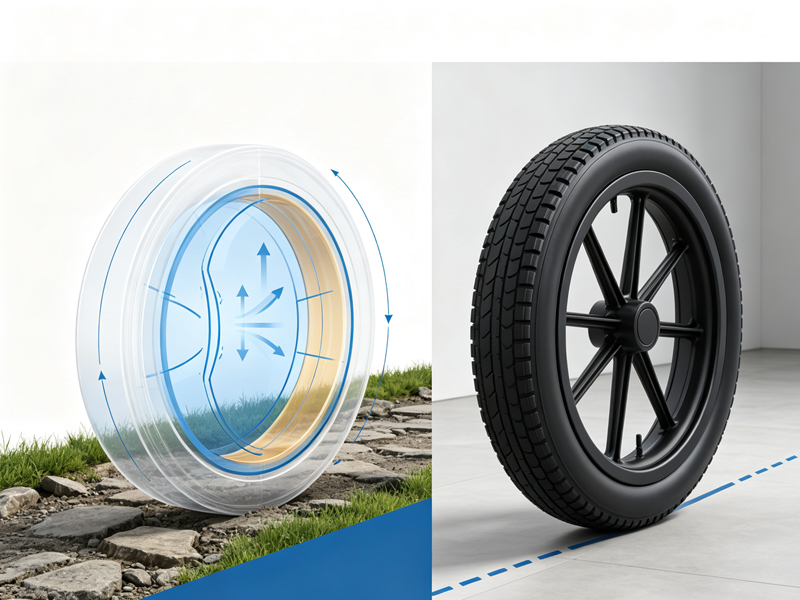
Pneumatic wheelchair tires are air-filled tires, similar in principle to those found on bicycles. They contain an inner tube or an integrated air chamber that holds compressed air. This air provides cushioning between the wheelchair and the ground, allowing the tire to flex slightly when it encounters uneven surfaces.
Because the air pressure can be adjusted, pneumatic tires offer some flexibility in how they perform. Higher pressure generally creates a firmer ride with lower rolling resistance on smooth surfaces, while a suitable lower pressure can provide additional cushioning on rougher terrain. However, tire pressure must always remain within the manufacturer’s recommended range.
Solid wheelchair tires work differently. Instead of relying on compressed air, they are made from solid rubber, polyurethane, or other durable elastomer materials. Their structure maintains its shape without inflation, eliminating the need to check air pressure or worry about punctures.
Solid tires are commonly available in different constructions, including standard solid rubber and lightweight polyurethane options. Their actual performance varies depending on material quality, density, tread design, and tire dimensions.
In simple terms, pneumatic tires use air to provide cushioning, while solid tires rely on the properties of their materials and construction.
That basic difference influences nearly every aspect of their performance.
For many wheelchair users, comfort is one of the most important factors when choosing tires. A wheelchair is not simply a vehicle used to get from one location to another. It is part of everyday life, and the quality of the ride can influence how enjoyable and manageable daily activities feel.
This is where pneumatic tires generally perform better.
The air inside a pneumatic tire acts as a natural cushion. When the wheel rolls over small cracks, pavement joints, gravel, or uneven surfaces, the tire compresses slightly and helps absorb some of the impact before it reaches the wheelchair frame and seat.
This cushioning effect can make a meaningful difference during longer journeys.
For example, imagine traveling along a sidewalk with frequent expansion joints. With pneumatic tires, some of the vibration is absorbed by the air-filled structure. With solid tires, more of that impact may be transferred directly through the wheel and wheelchair frame.
The difference becomes even more noticeable on rough outdoor surfaces.
Solid tires can still provide a comfortable ride, particularly when they are manufactured with softer compounds or advanced shock-absorbing designs. However, they generally cannot match the cushioning flexibility of a properly inflated pneumatic tire.
It is also worth remembering that comfort depends on more than tire type. Wheelchair suspension, seat cushioning, frame design, tire size, inflation pressure, and individual preferences all contribute to the overall experience.
For users who frequently travel outdoors or spend extended periods in their wheelchairs, pneumatic tires are often the more comfortable option.
Performance winner for comfort: Pneumatic tires.
A comfortable tire is valuable, but reliability matters just as much.
Few things are more inconvenient than discovering a flat tire halfway through a journey. For wheelchair users who depend on their equipment throughout the day, an unexpected puncture can interrupt travel plans and create unnecessary stress.
Solid wheelchair tires have a clear advantage in this area.
Because they contain no air chamber, they cannot suffer conventional punctures or air leaks. Sharp objects such as small pieces of glass, nails, and thorns are much less likely to cause the type of failure associated with pneumatic tires.
This makes solid tires particularly attractive for environments where road debris is common.
They are also suitable for users who prefer to minimize routine maintenance. There is no need to carry a pump, monitor tire pressure, or periodically inspect an inner tube for slow leaks.
However, puncture resistance does not mean that solid tires are indestructible.
Over time, solid rubber and polyurethane tires can experience surface wear, cracking, deformation, or damage caused by prolonged exposure to harsh conditions. The tread can also become worn, reducing traction and making replacement necessary.
Pneumatic tires, meanwhile, require more attention. They can develop punctures, suffer valve problems, or gradually lose pressure. Their lifespan depends on tire quality, usage patterns, storage conditions, and maintenance.
Still, a well-maintained pneumatic tire can deliver dependable performance for a considerable period.
The important distinction is that solid tires eliminate one major category of maintenance and failure, rather than eliminating all tire-related wear.
For people who regularly travel through areas with debris or cannot easily access repair services, this reliability can be a significant advantage.
Performance winner for puncture resistance: Solid tires.
Rolling resistance is another important consideration, especially for people using manual wheelchairs.
In simple terms, rolling resistance refers to the force that works against a wheel as it moves across a surface. Lower rolling resistance generally means less effort is required to keep the wheelchair moving.
This can influence how far a user can travel comfortably and how much physical effort is needed for everyday mobility.
Pneumatic tires often perform very well in this area when properly inflated.
On smooth indoor floors and paved surfaces, a well-maintained pneumatic tire with appropriate pressure can roll efficiently. Its flexible structure allows the contact area with the ground to change as the wheel rotates, helping balance grip and rolling performance.
However, underinflated pneumatic tires can increase rolling resistance significantly. When tire pressure drops too low, the tire deforms more than intended, requiring additional effort to move forward.
Solid tires offer a different experience.
Their rolling performance depends heavily on the material used, tire hardness, width, and overall construction. Some high-quality polyurethane tires are designed to provide relatively low rolling resistance, making them suitable for everyday manual wheelchair use.
Lower-quality or softer solid tires may create more resistance, particularly on certain surfaces.
It would be misleading to claim that every pneumatic tire rolls more efficiently than every solid tire. The actual difference depends on the specific tire model and operating conditions.
For active manual wheelchair users, tire pressure, wheel alignment, bearing condition, and tire quality can be just as important as the choice between pneumatic and solid construction.
A practical approach is to compare the manufacturer’s rolling resistance data when available rather than relying on tire type alone.
Performance winner for rolling efficiency: Pneumatic tires often have an advantage when properly inflated, although high-quality solid tires can also perform well.
One of the most useful ways to choose wheelchair tires is to consider where the wheelchair spends most of its time.
Different environments place different demands on the wheels, and the best tire for an indoor setting may not be the best choice for outdoor mobility.
Indoor Use
For indoor environments such as homes, hospitals, offices, and shopping centers, smooth flooring is generally easier to navigate.
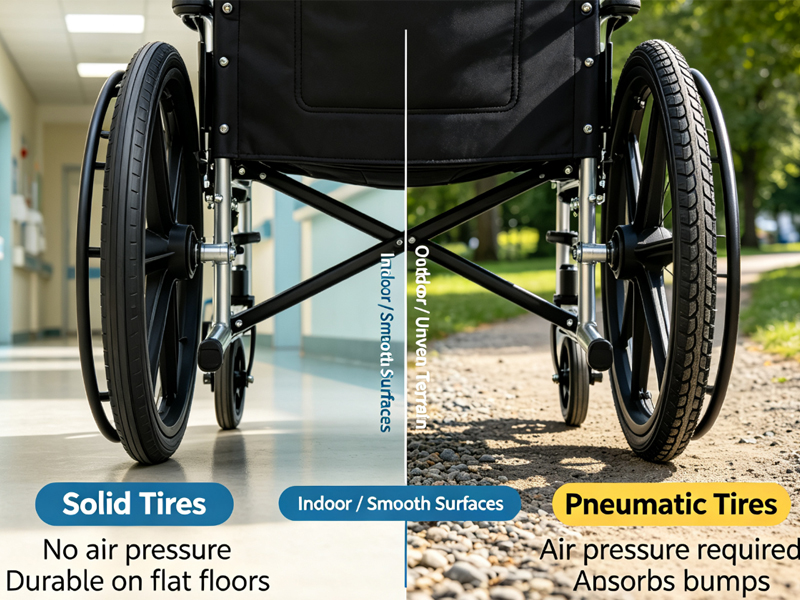
Solid tires are often a practical choice for these conditions. They require minimal maintenance, provide consistent performance, and eliminate concerns about pressure loss.
They are particularly convenient for users who primarily move around on smooth surfaces and value simplicity.
Pneumatic tires also perform well indoors, especially when comfort is a priority. However, their additional maintenance requirements may not be necessary for users who rarely encounter rough terrain.
Outdoor Use
Outdoor environments are more demanding.
Sidewalk cracks, uneven pavement, gravel, grass, and small obstacles can all affect wheelchair handling and comfort.
Pneumatic tires generally offer better shock absorption and can provide a smoother experience across these surfaces. Their ability to deform slightly helps the wheel maintain contact with uneven ground.
Solid tires are more resistant to punctures from outdoor debris, but they may transmit more vibration when traveling across rough surfaces.
For people who regularly move between indoor and outdoor environments, the decision becomes a balance between comfort and reliability.
If smooth outdoor mobility is the priority, pneumatic tires are often worth considering. If avoiding punctures and reducing maintenance are more important, solid tires may be the better fit.
The initial purchase price is only one part of the overall cost of wheelchair tires.
Maintenance, replacement frequency, repair expenses, and convenience all contribute to the total cost of ownership.
Pneumatic tires typically require more regular attention.
Users should check tire pressure periodically and inflate the tires when necessary. They should also inspect the tread and sidewalls for signs of damage.
If a puncture occurs, the inner tube may need to be repaired or replaced. In some cases, the tire itself may also require replacement.
These tasks are relatively straightforward for people familiar with bicycle tire maintenance, but they can become inconvenient for wheelchair users who depend on others for repairs.
Solid tires are generally easier to maintain.
Since there is no air chamber, routine inflation and puncture repairs are unnecessary. Basic cleaning and occasional visual inspections are usually sufficient.
However, solid tires still need to be replaced when their tread becomes excessively worn or their material deteriorates.
Their installation may also require specific tools or professional assistance, depending on the wheel and tire design.
When comparing long-term expenses, consider the following:
| Cost Factor | Pneumatic Tires | Solid Tires |
|---|---|---|
| Initial purchase | Varies by model | Varies by model |
| Air pressure checks | Required | Not required |
| Puncture repairs | Possible | Not required for conventional punctures |
| Routine inspection | Required | Recommended |
| Replacement | Depends on wear and damage | Depends on wear and material condition |
| Maintenance effort | Generally higher | Generally lower |
There is no universal winner in terms of total cost.
A pneumatic tire may cost less initially but require occasional tube replacement. A solid tire may reduce maintenance expenses but have a higher purchase price depending on its construction.
The smartest decision is to compare the expected service life and maintenance costs of the specific products being considered.
Wheelchair weight and handling can also influence the overall user experience.
For manual wheelchair users, every additional kilogram matters because the user supplies the energy needed to move the chair.
Some solid tires, especially those made from dense rubber, can be relatively heavy. However, lightweight polyurethane designs may significantly reduce this difference.
Pneumatic tires are often lighter than traditional solid rubber tires, although the actual weight depends on tire dimensions, casing construction, and inner tube design.
Handling is equally important.
Pneumatic tires can offer a more adaptable contact patch, which may help maintain traction on certain outdoor surfaces. Their cushioning also reduces some of the vibration associated with uneven terrain.
Solid tires provide consistent structural support and do not change their inflation characteristics over time. This predictable behavior can be useful in controlled indoor environments.
However, the performance of a wheelchair is determined by the entire wheel assembly, not just the tire.
Wheel diameter, tread pattern, axle alignment, bearings, and frame geometry all influence maneuverability.
For this reason, users should evaluate tire compatibility and the overall wheelchair configuration before purchasing replacement tires.
After comparing comfort, durability, rolling resistance, maintenance, and everyday usability, it becomes clear that pneumatic and solid wheelchair tires serve different needs.
Rather than choosing based on a single performance measurement, consider your daily routine.
Choose pneumatic wheelchair tires if:
Choose solid wheelchair tires if:
There is also a third consideration: your personal physical needs.
For example, users who are particularly sensitive to vibration may benefit more from pneumatic tires. Meanwhile, users who have limited access to maintenance assistance may find solid tires more practical.
Caregivers and healthcare professionals may also have useful insights when selecting tires for someone with specific mobility requirements.
The right choice should support the user’s daily activities rather than simply offer the highest technical specifications.
Even after deciding between pneumatic and solid tires, it is important to confirm that the replacement tire is compatible with the wheelchair.
First, check the tire size. Wheelchair tires are available in different diameters and widths, and the correct size must match the wheel rim.
Second, consider the material and tread design. Softer compounds may provide additional grip or cushioning, while harder compounds may offer improved wear resistance.
Third, check the manufacturer’s specifications. For pneumatic tires, this includes the recommended inflation pressure. For solid tires, pay attention to material hardness, weight, and compatibility with the wheel.
Finally, consider whether the tire can be installed using standard tools or whether professional installation is recommended.
A tire that performs exceptionally well in testing will still be a poor choice if it does not fit the wheelchair correctly.
For users who are uncertain, consulting the wheelchair manufacturer or a qualified mobility equipment specialist is a sensible step.
So, which offers better performance?
If comfort, shock absorption, and outdoor ride quality are the main priorities, pneumatic wheelchair tires are generally the stronger option. Their air-filled construction provides cushioning that can make everyday movement more comfortable, particularly on uneven surfaces.
If puncture resistance, convenience, and minimal maintenance matter more, solid wheelchair tires are often the better choice. They eliminate the need for inflation and provide dependable performance without the worry of conventional flat tires.
Neither option is universally superior.
The best wheelchair tire is the one that matches the user’s environment, mobility needs, maintenance preferences, and budget.
For someone who spends most of the day navigating smooth indoor floors, solid tires may offer all the reliability and convenience needed. For someone who regularly travels outdoors and values a smoother ride, pneumatic tires may be a worthwhile investment.
Ultimately, choosing the right wheelchair tires is about making everyday mobility more comfortable, dependable, and practical.
1. Are pneumatic wheelchair tires better than solid tires for everyday use?
It depends on the user’s daily environment and priorities. Pneumatic tires are generally better for comfort and shock absorption, especially when traveling outdoors on uneven surfaces. Solid tires are more convenient for everyday indoor use because they do not require inflation and are resistant to conventional punctures. Users should choose based on their mobility needs rather than assuming one type is always better.
2. Do solid wheelchair tires make pushing more difficult?
Not necessarily. The effort required to push a wheelchair depends on tire material, tread design, wheel size, surface conditions, and overall wheelchair setup. Some solid tires may have higher rolling resistance than properly inflated pneumatic tires, but high-quality polyurethane tires can provide efficient rolling performance. Keeping the wheels properly aligned and maintaining the bearings can also help reduce pushing effort.
3. How long do pneumatic and solid wheelchair tires last?
There is no fixed lifespan for either type. Pneumatic tires may need replacement because of tread wear, sidewall damage, or repeated punctures. Solid tires can also wear down, crack, or lose their original performance over time. Actual service life depends on usage frequency, surface conditions, tire quality, maintenance, and storage. Regular inspection helps identify problems early and ensures safer, more reliable wheelchair operation.