Our Location
Free Trade Tower, Xiyong street.
Chongqing, China

Free Trade Tower, Xiyong street.
Chongqing, China
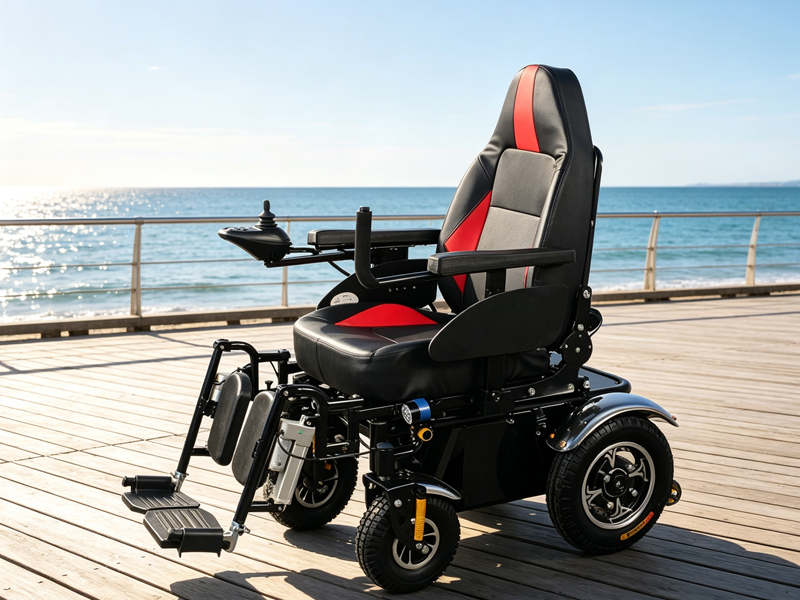
A wheelchair can feel perfectly comfortable on a polished hospital floor or a smooth sidewalk and still behave very differently once the surface becomes uneven.
Grass, gravel, compact dirt, woodland trails, cobblestones, ramps, broken pavement and other outdoor surfaces introduce a completely different set of challenges. The wheels encounter bumps at different angles, traction changes from one section of ground to another, and the frame is exposed to repeated shocks that simply do not occur on a flat indoor surface.
This is where suspension systems become an important part of all-terrain wheelchair design.
Rather than treating suspension as a luxury feature, wheelchair manufacturers increasingly view it as part of the overall mobility system. A well-designed suspension system can help absorb impacts, improve wheel contact with the ground, reduce vibration transmitted to the user, and make outdoor movement more controlled.
For wheelchair users who spend significant time outside, these differences are not merely technical. They can affect comfort, confidence, maneuverability and how enjoyable an outdoor journey feels.
When people hear the term all-terrain wheelchair, it is easy to imagine a wheelchair with larger wheels and stronger tires.
Those features certainly matter. But an outdoor wheelchair needs to do more than simply roll over a larger obstacle.
Consider what happens when one wheel hits a raised section of pavement.
The wheel moves upward, the frame reacts to the sudden change in force, and some of that energy travels through the chassis toward the seat. Without sufficient shock absorption, the user may feel a sharp jolt.
Now imagine the same thing happening repeatedly on a gravel path.
The problem is no longer one isolated bump. It becomes a continuous series of small impacts and vibrations.
This is one of the fundamental reasons suspension is valuable.
A suspension system provides a controlled way for part of the wheelchair to move relative to the frame, allowing the system to respond to changes in terrain instead of transferring every movement directly to the user.
That principle is familiar in other forms of transportation. Cars, bicycles and mobility equipment all use suspension because wheels and passengers do not move comfortably when every change in terrain is transmitted directly through a rigid structure.
The same engineering logic applies to wheelchairs.
At its simplest, suspension allows the wheels or wheel assemblies to move vertically or through a controlled range of motion when they encounter uneven terrain.
The system typically combines components such as:
The exact configuration varies considerably between wheelchair designs.
Some systems use relatively simple spring mechanisms. Others employ more sophisticated independent suspension arrangements designed to keep the wheels in contact with the ground while controlling movement through the frame.
The important point is that suspension is not designed simply to make the wheelchair “soft.”
A good suspension system has to balance several competing requirements.
If it is too stiff, the wheelchair may still transmit significant impact to the user.
If it is too soft, the frame may move excessively, potentially reducing handling precision or making the wheelchair feel unstable.
The goal is controlled movement.
That distinction is particularly important in all-terrain wheelchairs because outdoor mobility involves a wide variety of surfaces and obstacles rather than one consistent road condition.
The most immediately noticeable advantage of suspension is often comfort.
Without suspension, the wheelchair frame and seat can experience a significant portion of the forces generated when wheels encounter uneven terrain.
On a smooth floor, this may not matter much. On an outdoor trail, however, repeated impacts can become tiring.
A suspension system can reduce the sharpness of these impacts by allowing the wheel assembly to respond to the terrain before the full force reaches the main frame.
This does not mean that suspension eliminates every bump. No wheelchair can completely remove the physical effects of rough terrain.
Instead, effective suspension changes how those forces are experienced.
A short, sharp impact can become a more controlled movement.
For a wheelchair user, that difference can be meaningful over the course of an hour-long outdoor trip.
Comfort also extends beyond individual impacts. Continuous vibration from gravel, rough concrete or compacted trails can become surprisingly fatiguing.
Reducing unnecessary vibration may help create a smoother overall ride and make longer outdoor journeys more manageable.
Comfort is only one part of the equation.
Suspension can also influence traction.
A wheel that loses contact with the ground has less ability to transmit driving or braking forces.
On a flat surface, this may be relatively easy to overlook. On uneven terrain, however, maintaining contact between the tire and ground becomes much more important.
Imagine a wheelchair traveling over a series of small bumps.
With a rigid setup, a wheel may momentarily become lighter or even lose contact with the surface. A suspension system can allow the wheel to follow the terrain more effectively.
This helps the tire maintain contact with the ground.
Better contact can contribute to:
More consistent traction
The tire has a better opportunity to transfer power to the surface.
More predictable steering
When the wheel remains engaged with the ground, steering behavior can become easier to anticipate.
Better control on changing surfaces
Outdoor routes rarely consist of one perfectly uniform material. A path might transition from asphalt to gravel and then to grass within a few minutes.
Suspension cannot solve every traction problem, but it can help the wheelchair respond more effectively to those transitions.
Impact and vibration are related, but they are not exactly the same problem.
A large bump produces a noticeable shock. Smaller irregularities can create continuous high-frequency vibration.
Think about riding over a rough gravel road in a vehicle. Even if there are no large potholes, the constant vibration can become uncomfortable after several miles.
Wheelchairs face a similar issue.
The combination of suspension, appropriate tires and a well-designed seat can help reduce the amount of vibration experienced by the user.
This is particularly relevant for people who use their wheelchair for extended periods.
A comfortable outdoor wheelchair therefore should not be evaluated only by asking:
“Can it get over this obstacle?”
A better question is:
“How does it behave after encountering hundreds of obstacles during an entire journey?”
That shift in perspective is important when evaluating all-terrain wheelchair performance.
Mobility is not purely mechanical.
A wheelchair that feels predictable can change how a person approaches an unfamiliar path.
If every bump produces a strong jolt or every uneven section causes the wheelchair to feel unstable, the user may naturally become more cautious.
That can affect route selection, speed and willingness to explore.
A suspension system can contribute to a more controlled riding experience by reducing abrupt reactions from the terrain.
This can create a sense of confidence.
Of course, suspension should never be presented as a guarantee of safety. Outdoor terrain still requires appropriate judgment, speed control and an understanding of the wheelchair’s limitations.
But when the mechanical system behaves predictably, the user has one less variable to manage.
For many outdoor wheelchair users, that can make a significant difference.
There is another benefit that is less visible but important: durability.
When a wheelchair repeatedly travels over rough terrain, the forces generated by impacts are transferred through the frame and its connection points.
Over time, repeated loading can contribute to wear.
Suspension provides another mechanism for managing these forces.
Instead of every impact being handled almost entirely by the rigid structure, part of the energy can be absorbed or controlled through the suspension components.
This does not make a wheelchair indestructible.
In fact, all-terrain wheelchair owners should still pay close attention to maintenance, fasteners, bearings, tires and suspension components.
But thoughtful suspension design can be an important part of creating a chassis capable of handling repeated outdoor use.
It is tempting to think of suspension as the feature that determines whether a wheelchair is genuinely “all-terrain.”
In reality, outdoor performance comes from a combination of systems.
Suspension has to work together with the tires, wheels, frame geometry, motor or drivetrain, braking system, seat position and overall weight distribution.
Tires
Tires are the wheelchair’s direct connection with the ground.
A suspension system cannot compensate for tires that are poorly suited to the terrain.
Different tread patterns and tire constructions perform differently on grass, loose gravel, mud, pavement and hard-packed trails.
Wheel size
Larger wheels can help the wheelchair roll over certain obstacles more easily.
However, wheel size also affects weight, maneuverability and the overall dimensions of the wheelchair.
Frame geometry
The position of the wheels, seat and center of gravity influences how the wheelchair responds to slopes, obstacles and turns.
Suspension has to be integrated into this geometry rather than treated as an isolated component.
Power and braking
For powered all-terrain wheelchairs, the motor must provide sufficient torque for the intended environment.
Braking performance is equally important, especially when traveling downhill or across uneven surfaces.
Seat and user positioning
The suspension system may absorb much of the mechanical movement, but the seat remains the interface between the wheelchair and the user.
A carefully designed seating system can further improve the overall ride experience.
This is why the best all-terrain wheelchair designs take a system-level approach rather than simply adding a shock absorber to a conventional chassis.
Not all wheelchair suspension systems behave in the same way.
The appropriate design depends on the wheelchair’s intended use, weight, drive configuration and expected terrain.
A simple spring-based system may be sufficient for users who primarily travel across grass, sidewalks and light trails.
More demanding environments may benefit from more sophisticated suspension architectures that provide greater wheel movement and more controlled damping.
Some systems focus primarily on the front wheels, while others incorporate suspension across multiple wheel assemblies.
Independent suspension can be particularly useful because uneven terrain rarely affects all wheels in exactly the same way.
One wheel might be climbing a rock while another remains on relatively flat ground.
Allowing individual wheels to respond to those changes can help maintain contact with the surface and reduce unnecessary movement through the main chassis.
There is no universal “best” suspension system.
Instead, suspension should be matched to the real-world environment in which the wheelchair will be used.
That is an important point for buyers because a highly sophisticated suspension design is not automatically better for every user.
One common misunderstanding is that suspension is simply about adding springs.
Springs are important because they store and release energy as the wheel moves.
But without appropriate damping, that energy can cause excessive bouncing.
Imagine pressing down on a spring and releasing it.
The spring wants to return to its original position. If nothing controls the movement, the system may oscillate.
A damper helps control that motion.
In an all-terrain wheelchair, this can mean a better balance between absorbing an obstacle and returning to a stable position.
Good suspension therefore involves more than asking how much the system can compress.
Engineers also have to consider:
These details can have a major influence on real-world performance.
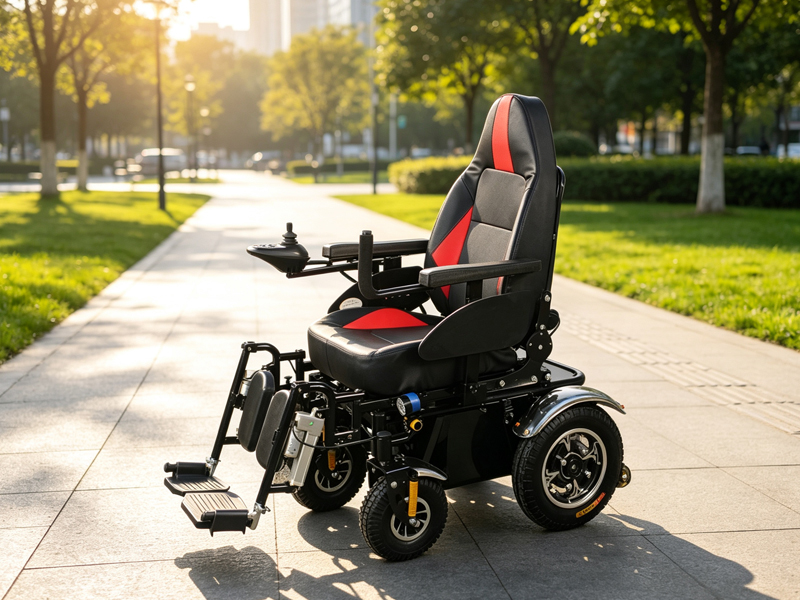
Suspension travel refers broadly to how much movement the suspension can accommodate.
A wheelchair intended for relatively mild outdoor use may not need the same suspension travel as a machine designed for aggressive trail riding.
Too little travel can cause the suspension to reach its limit when encountering a larger obstacle.
Too much travel, meanwhile, can add complexity, weight and movement that may not be necessary for the intended application.
The right amount depends on the terrain.
For example:
Urban outdoor use:
Cracked sidewalks, curb transitions and uneven paving may benefit from moderate impact absorption and a relatively firm setup.
Park and recreational trails:
Grass, packed dirt and gravel introduce more continuous surface variation, making vibration control and wheel contact increasingly important.
More demanding off-road environments:
Steeper slopes, larger rocks, roots and irregular terrain may require greater suspension articulation, stronger components and carefully engineered chassis geometry.
This is why “all-terrain” should always be understood in context.
A wheelchair designed for city parks is not necessarily designed for extreme mountain trails.
One of the less obvious factors in suspension performance is weight distribution.
The suspension does not operate independently from the person sitting in the wheelchair.
The user’s body weight, seat position, battery placement, motor location and frame geometry all influence how loads are distributed between the wheels.
If the weight distribution is poorly matched to the suspension design, the wheelchair may behave differently from what the engineering team intended.
This is particularly important when climbing or descending slopes.
The center of gravity can shift relative to the terrain, affecting traction and stability.
Therefore, suspension design should be considered together with overall chassis architecture.
This is one reason why simply purchasing aftermarket suspension components and adding them to a conventional wheelchair may not produce the same result as a wheelchair designed around suspension from the beginning.
As the market for accessible outdoor mobility continues to develop, brands such as Iyasocare are helping bring more attention to the practical requirements of wheelchair users who want to spend time beyond conventional indoor environments.
For an all-terrain wheelchair, the value is not simply in adding a larger motor or aggressive-looking tires.
The more important question is how all of the systems work together.
Iyasocare’s approach can be viewed in this broader context: outdoor mobility should combine maneuverability, durability, comfort and practical usability rather than focusing on a single specification.
For potential buyers, this is a useful way to evaluate an all-terrain wheelchair.
Instead of asking only about maximum speed or motor power, consider the entire experience:
How does it handle uneven ground?
How does the suspension respond to repeated impacts?
Does the seating remain comfortable during longer trips?
How well do the tires maintain traction?
Can the wheelchair be controlled confidently on slopes?
Is the design practical for transportation and storage?
These questions provide a much more realistic picture of outdoor capability.
For users comparing different mobility solutions, exploring the suspension configuration and the overall chassis design of an Iyasocare all-terrain wheelchair can therefore be more informative than focusing on a single headline specification.
The development of better suspension systems reflects a larger change in the wheelchair industry.
For decades, many mobility products were designed primarily around indoor environments and paved urban routes.
That is changing.
Wheelchair users increasingly expect mobility equipment to support a broader lifestyle.
That can include:
The demand for this type of mobility is encouraging manufacturers to think beyond basic transportation.
A wheelchair can be a tool for independence, but it can also be a platform for participation.
That distinction matters.
If a person can comfortably navigate a wider range of environments, more activities become accessible.
Suspension is one of the engineering technologies helping make that possible.
There is no single specification that tells you whether a wheelchair will perform well outdoors.
Instead, look at how the major components work together.
1. Suspension quality
Ask what type of suspension is used, how much travel it provides and whether it is designed specifically for the wheelchair.
2. Tire design
Consider the terrain where the wheelchair will actually be used. Aggressive tread may be useful in loose terrain, while a different tire configuration may be preferable for mixed urban and outdoor use.
3. Ground clearance
Adequate clearance can reduce the risk of the chassis contacting obstacles.
4. Frame strength
Outdoor use exposes the frame to repeated impacts and torsional loads.
5. Braking performance
A wheelchair that can climb a hill also needs to handle the descent.
6. Turning capability
A highly capable outdoor wheelchair is not useful if it is difficult to maneuver in real environments.
7. Seating comfort
A suspension system can reduce impact, but the seat still plays a major role in long-term comfort.
8. Maintenance requirements
Suspension components are mechanical systems. Buyers should understand how frequently they need inspection or replacement.
9. Transport and storage
A wheelchair may perform exceptionally well outdoors but become impractical if it is extremely difficult to transport.
10. Manufacturer support
After-sales support, spare parts and technical assistance become particularly important when a wheelchair is used regularly in demanding environments.
To understand why suspension matters, imagine the same all-terrain wheelchair traveling across three surfaces.
Smooth pavement
The wheels roll easily and suspension movement is minimal.
The ride is relatively stable, and most wheelchair designs can perform well in these conditions.
Gravel path
The wheels encounter many small irregularities.
Without suspension, vibration can travel continuously through the frame.
With an effective suspension system, the wheels can respond to the surface while damping reduces some of the movement transmitted to the user.
Uneven woodland trail
Now the terrain becomes three-dimensional.
One wheel may climb over a root while another remains on lower ground.
The suspension has to accommodate differences in wheel position while maintaining traction and keeping the chassis reasonably controlled.
This illustrates why suspension becomes increasingly valuable as terrain becomes more unpredictable.
It can contribute to better control, but the answer requires some nuance.
Suspension may help maintain wheel contact, reduce sudden impacts and make the wheelchair’s response to uneven terrain more predictable.
Those characteristics can support safer handling.
However, suspension does not eliminate the risks associated with steep slopes, loose surfaces, deep mud, large obstacles or unstable terrain.
A wheelchair user should always follow the manufacturer’s operating guidance and understand the machine’s limitations.
The safest approach is to consider suspension as one component of a broader mobility system that includes appropriate tires, braking, stability, speed control and user judgment.
In other words, suspension can improve capability—but it should never encourage users to exceed the wheelchair’s intended operating conditions.
The benefits of suspension often become more obvious with time.
A single bump may not seem significant.
A hundred bumps are different.
Outdoor mobility can involve thousands of small impacts during a long trip. Even relatively mild vibration can become tiring when repeated continuously.
This is why comfort should not be measured only during a five-minute test ride.
When evaluating an all-terrain wheelchair, it can be useful to think about the experience after:
Does the ride remain comfortable?
Does the wheelchair continue to feel predictable?
Does the suspension behave consistently?
Are there noticeable changes in handling when the terrain becomes rougher?
These are practical questions that reveal more about a wheelchair than a specification sheet alone.
The most interesting thing about modern all-terrain wheelchair development is not the technology itself.
It is what the technology makes possible.
A suspension system is made of springs, dampers, pivots and structural components.
But for the person using the wheelchair, those components represent something much more tangible: the ability to travel across a wider range of environments with greater comfort and confidence.
That might mean joining friends on a park trail.
It might mean visiting a campsite.
It might mean navigating an uneven outdoor event.
Or it could simply mean not having to turn around when a perfectly ordinary sidewalk suddenly becomes rough.
That is where good wheelchair engineering becomes meaningful.
The objective is not to make every surface feel like a smooth indoor floor. That is unrealistic.
The objective is to create a wheelchair that responds intelligently to the surface beneath it.
And suspension is a major part of achieving that goal.
1. Why is suspension important on an all-terrain wheelchair?
Suspension helps the wheelchair respond to uneven surfaces by allowing controlled movement between the wheels and frame. This can reduce impact and vibration, improve wheel-to-ground contact and create a smoother, more predictable ride on surfaces such as gravel, grass, dirt trails and uneven pavement.
2. Does every outdoor wheelchair need suspension?
Not necessarily. The need for suspension depends on how and where the wheelchair will be used. Someone who mainly travels on smooth sidewalks may have little need for advanced suspension, while a user who regularly travels across gravel, grass, trails or rough outdoor surfaces may benefit considerably from it.
3. Is suspension more important than large tires?
Neither feature should be considered independently. Large tires can help an all-terrain wheelchair roll over obstacles and maintain traction, while suspension helps manage the movement and forces created by uneven terrain. The best outdoor wheelchair combines appropriate tires, suspension, frame design, power and braking into one balanced system.